Kansas City BBQ Sauce — Molasses-Tomato

Equipment
- 1 Heavy-bottomed 3-quart saucepan Enameled cast iron or tri-ply stainless preferred; thin pans create scorching hot spots at high sugar concentrations
- 1 Silicone spatula For continuous bottom-scraping during the final 10 minutes of reduction
- 1 Digital refractometer (Brix scale) Optional but highly recommended; target 48–52 Brix at endpoint — costs under $20 and eliminates guesswork
- 2 Half-pint mason jars with lids Sterilize in boiling water before use; fill while sauce is still hot for best shelf life
- 1 set Measuring cups and spoons
Ingredients
Sauce Base
- 1 6-oz can tomato paste Standard domestic double-concentrated paste; avoid Italian-style if you want a less aggressively savory base
- 1 cup ketchup Standard full-sugar ketchup adds additional tomato solids, pectin, and initial Brix base
- ½ cup water Used to loosen the paste for even incorporation before reduction begins
Sweeteners
- ⅓ cup unsulfured blackstrap molasses Blackstrap carries the highest reducing-sugar load and most complex bitterness of any molasses grade; sulfured molasses introduces an off-note
- ⅓ cup dark brown sugar, packed Contributes reducing sugars and residual molasses melanoidins for additional Maillard depth
Acid and Umami
- 3 tablespoons apple cider vinegar (5% acidity) Split: 2 tbsp added at the start to activate pectin and drive pH to 3.2–3.6; 1 tbsp added off heat to preserve the bright aromatic top note
- 2 tablespoons Worcestershire sauce Contributes concentrated fermented amino acids and glutamate; contains anchovies — flag for fish-allergy guests
- 1 tablespoon yellow mustard Adds mild emulsification, subtle heat, and additional acidity
Spice Blend
- 1 ½ teaspoons smoked paprika Load-bearing ingredient — contributes Maillard-reactive carotenoid precursors that deepen color and smoke character during reduction; do not substitute sweet paprika
- 1 teaspoon chili powder Ancho-based preferred; contributes mild capsaicin warmth and complex earthiness
- ½ teaspoon garlic powder
- ½ teaspoon onion powder
- ¼ teaspoon freshly ground black pepper
- ¼ teaspoon ground cayenne pepper Optional — adds direct TRPV1 heat; omit for a purely sweet-and-smoky profile
- ½ teaspoon kosher salt Add conservatively at the start; the reduction concentrates all flavors — taste and correct only at the end

Instructions
Build the Base
- Combine the tomato paste, ketchup, and water in a heavy-bottomed 3-quart saucepan. Whisk until smooth and uniformly incorporated — no streaks of paste remaining.1 cup ketchup, 1/2 cup water
- Add the blackstrap molasses, dark brown sugar, 2 tablespoons of the apple cider vinegar (reserve 1 tablespoon for the finish), Worcestershire sauce, and yellow mustard. Whisk again to fully dissolve the sugar and integrate the molasses.1/3 cup unsulfured blackstrap molasses, 1/3 cup dark brown sugar, packed, 3 tablespoons apple cider vinegar (5% acidity), 2 tablespoons Worcestershire sauce, 1 tablespoon yellow mustard
- Add all the spices — smoked paprika, chili powder, garlic powder, onion powder, black pepper, cayenne (if using), and a conservative pinch of kosher salt. Stir to distribute evenly through the sauce base.1 1/2 teaspoons smoked paprika, 1 teaspoon chili powder, 1/2 teaspoon garlic powder, 1/2 teaspoon onion powder, 1/4 teaspoon freshly ground black pepper, 1/4 teaspoon ground cayenne pepper, 1/2 teaspoon kosher salt
Reduce to Target Brix
- Set the saucepan over medium heat. Bring the sauce to a steady, active simmer — large slow bubbles breaking across the surface, not a rapid rolling boil. Stir every 2–3 minutes during the first 10 minutes as the bulk water drives off.
- After 10–12 minutes the sauce will begin to thicken noticeably and the bubbles will grow larger and pop more slowly. At this point, drop the heat to medium-low. Begin stirring continuously with a silicone spatula, dragging it across the bottom of the pan to prevent the sugar-tomato matrix from scorching.
- Continue reducing for an additional 18–20 minutes, stirring continuously during the final 10 minutes. Total active cook time: approximately 30 minutes. The sauce is ready when it passes the spoon-coat test — drag a clean finger across the back of a sauce-coated spoon; the line should hold clean with no watery bleed. If you have a refractometer, target 48–52 Brix. The sauce will read slightly thin while hot; it thickens substantially as it cools.
Finish and Jar
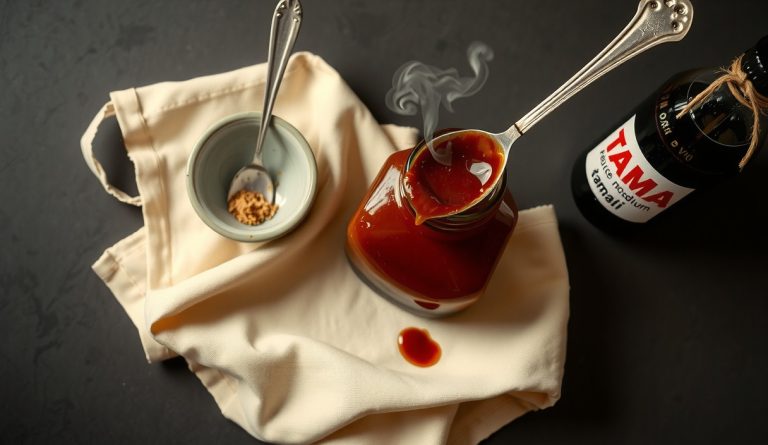
- Remove the saucepan from heat. Stir in the reserved 1 tablespoon of apple cider vinegar. This late addition preserves the volatile acetic acid top note that would otherwise cook off entirely during reduction — it is what gives the finished sauce its signature bright, fruity tang over the deep caramel base.3 tablespoons apple cider vinegar (5% acidity)
- Taste the sauce. Adjust salt carefully — the concentration has amplified every flavor. Add kosher salt in 1/8-teaspoon increments, tasting between each addition. Adjust acid with a few drops more ACV if you prefer a sharper profile.1/2 teaspoon kosher salt
- Transfer the hot sauce into pre-sterilized half-pint mason jars, leaving 1/4-inch headspace. Seal immediately. Allow to cool completely at room temperature — approximately 15 minutes — before refrigerating. The sauce will reach its final target body only after cooling fully. Refrigerate for up to 3–4 weeks, or water-bath can for up to 12 months.
Notes
Nutrition
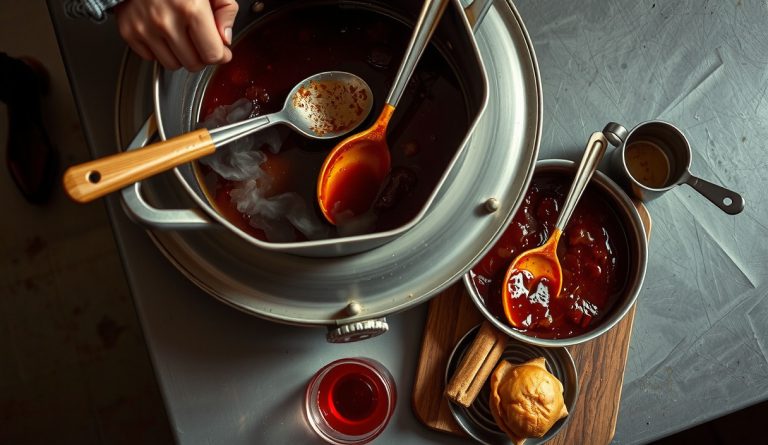
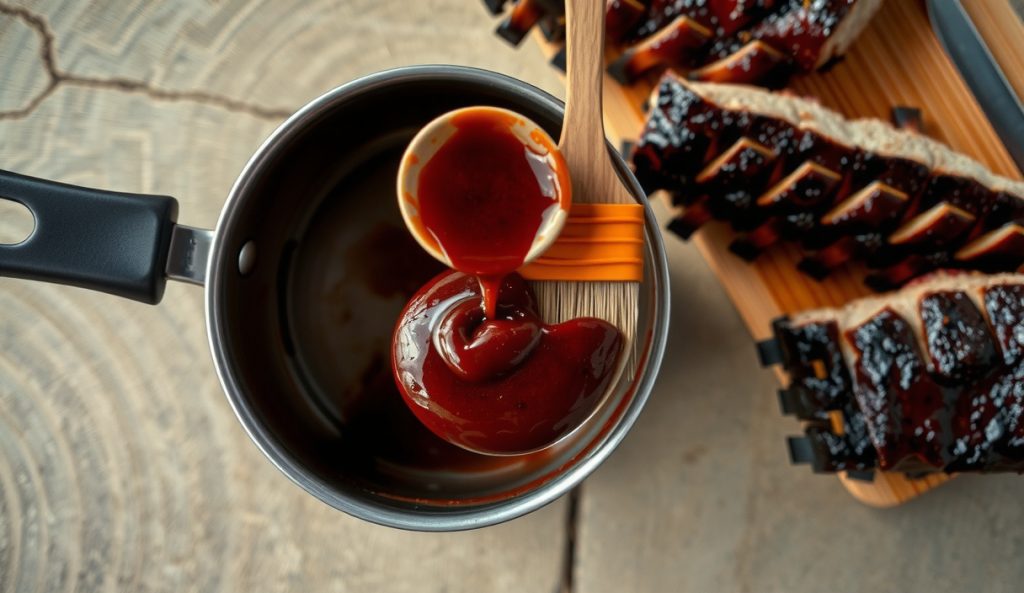
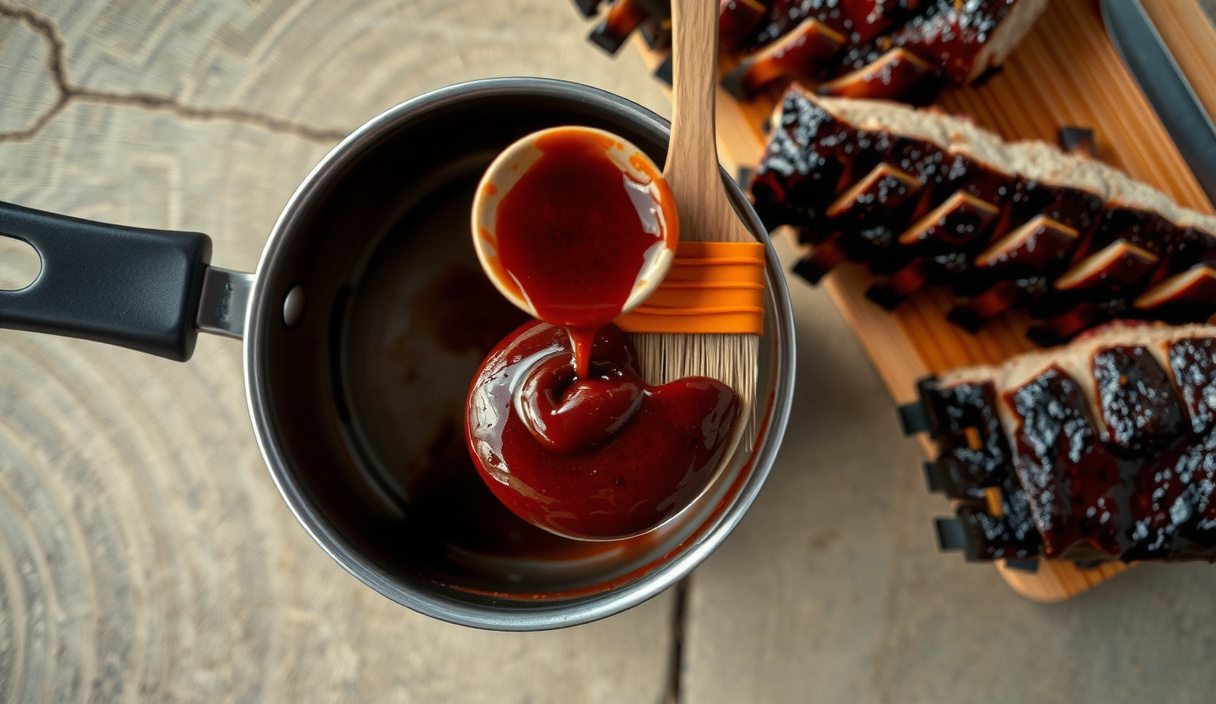
There is a moment in every KC pitmaster’s career when the sauce stops being an afterthought and starts being architecture. That moment arrives watching a pot of molasses-tomato sauce reduce under low heat, its surface thickening from a thin burgundy liquid into something that moves like warm caramel — slow, deliberate, coating the back of a spoon with a glossy sheen that catches the kitchen light like a lacquer finish. That sauce does not happen by feel alone. It happens because tomato pectin, dissolved sugars, and acetic acid are obeying the laws of thermodynamics in a very specific, very calculable sequence.
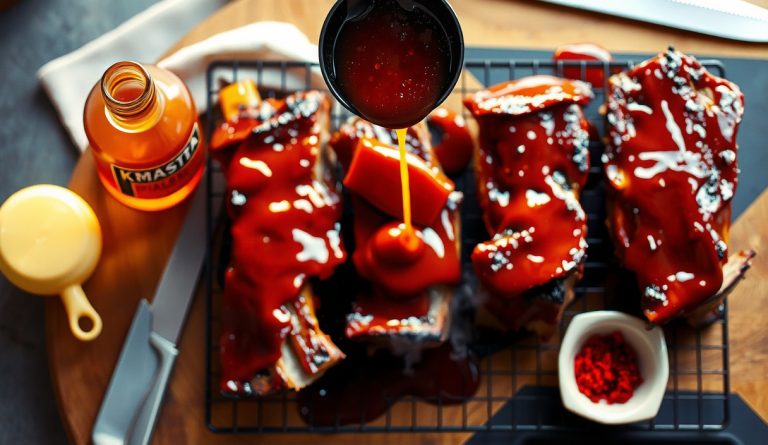
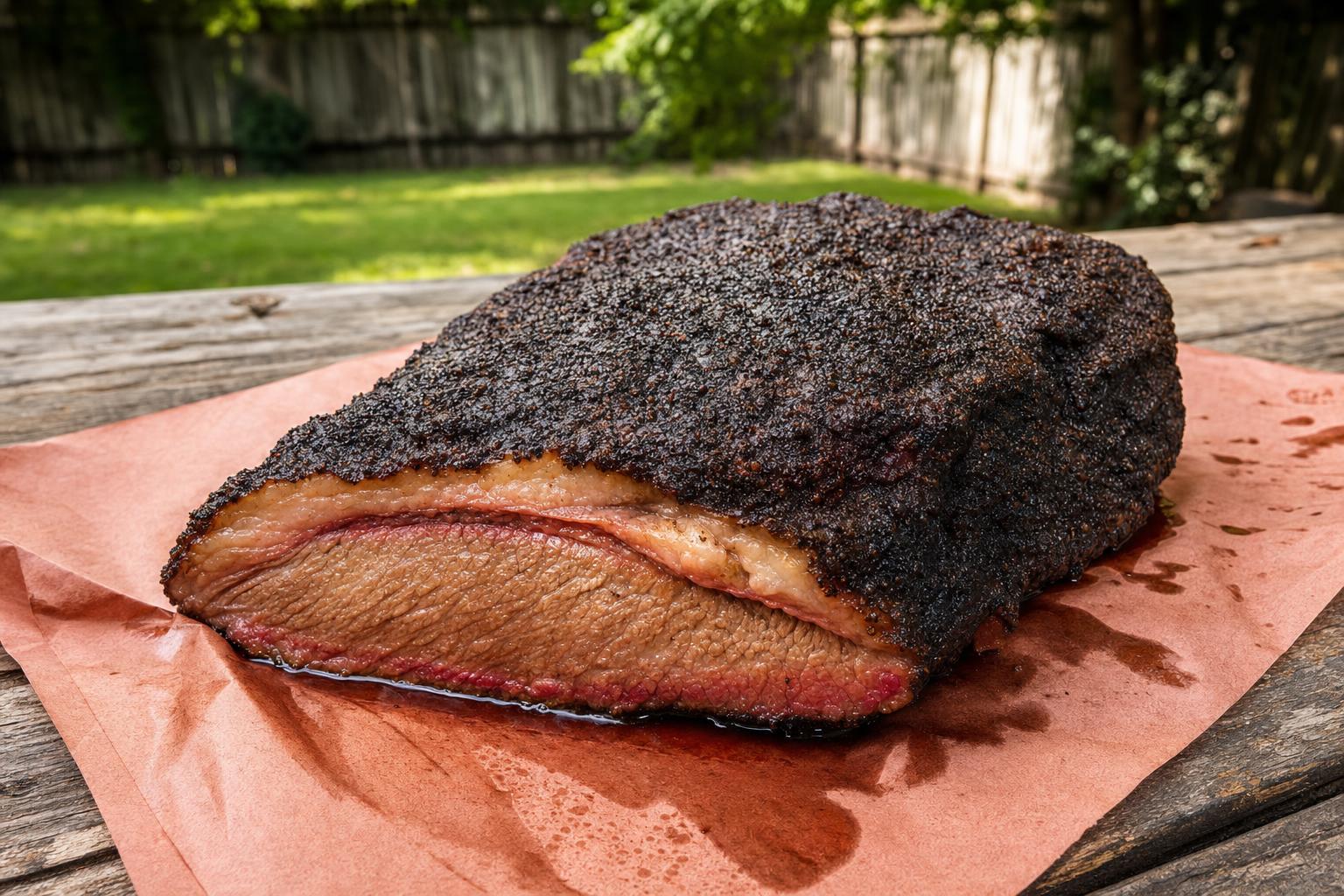
Kansas City sauce is the benchmark American BBQ condiment. Sweet-forward, smoke-backed, with just enough acid to cut through a fatty brisket flat or a rack of spare ribs that has been riding 225°F for six hours. This recipe builds that sauce from first principles — not just a list of pantry ingredients, but a formulation calibrated to hit a target soluble-solids concentration of roughly 50 degrees Brix, the threshold where tomato-pectin gelation and sugar crystallization mechanics converge into a body that clings to protein without running off the grate.
Why does Kansas City BBQ sauce work? The science
Kansas City BBQ sauce achieves its characteristic body through a dual gelling system: native tomato pectin and dissolved sugar concentration working in tandem. Tomato paste carries roughly 1.0–1.5% w/w methoxylated pectin within its cell-wall matrix. High-methoxyl (HM) pectin requires two conditions to form a continuous gel network: a soluble-solids concentration above approximately 55% and a pH between 2.8 and 3.5. This recipe targets approximately 50 Brix — slightly below the classical HM gel threshold — and that is intentional. At 50 Brix, the pectin contributes profound pseudoplastic (shear-thinning) viscosity and body without locking the sauce into a firm set. The result is a fluid gel: thick at rest, fluid under the shear of a brush stroke, which is exactly the behavior a pitmaster needs at the grate. Apple cider vinegar drives the pH down into the 3.2–3.6 range, simultaneously activating pectin’s weak gelling behavior and contributing the bright, volatile acetic acid top-note that Kansas City sauce demands.
The browning layers in this sauce come from two distinct Maillard pathways running in parallel. Molasses is a byproduct of sucrose refining and carries free reducing sugars (glucose, fructose) alongside amino-carbonyl precursors — exactly the combination that drives Schiff base formation and Amadori rearrangement at temperatures above 140°F (60°C). Brown sugar contributes additional reducing sugars plus residual molasses melanoidins. Worcestershire sauce adds a concentrated amino acid load from fermented anchovies and tamarind, inserting another stream of reactive nitrogen into the cascade. Together these sources produce the layered mahogany color and the deep, roasted caramel aromatic complexity that distinguishes a properly reduced KC sauce from a thin ketchup-based approximation. The chili powder and smoked paprika contribute Maillard-reactive peptides of their own plus capsaicin-driven trigeminal warmth — not heat, warmth — that lingers after the sweetness fades.
The reduction itself is a colligative-property engineering exercise. As free water is driven off by the latent heat of vaporization, the concentration of dissolved solids climbs. Every 10°F rise in the boiling point of the sauce corresponds to a roughly 10-Brix increase in dissolved solids — a standard refractometric relationship exploited in jam and candy making. Tracking viscosity visually (the spoon-coat test) or with a digital refractometer costing under $20 gives the cook direct feedback on when the sauce has reached its structural target. Overshoot past approximately 55 Brix and the HM pectin will begin to set hard on cooling; undershoot below approximately 45 Brix and the sauce will run off the meat rather than building the lacquered bark that defines competition-level KC ribs.
What equipment and ingredients do I need?
Heavy-bottomed 3-quart saucepan: Thin pans create hot spots that scorch the sugar-tomato matrix before the water has time to drive off evenly. A 3-quart pan provides enough surface area for efficient evaporation without constant stirring anxiety.
Tomato paste, not crushed tomatoes: This recipe starts from paste — already 28–30% solids — rather than whole or crushed tomatoes. Starting from paste compresses the reduction time dramatically and ensures the native pectin content is consistent batch to batch. Double-concentrated paste (Italian-style cans) shortens the cook further but can push the sauce into an aggressively savory register; standard domestic paste is preferable here.
Unsulfured blackstrap molasses: Blackstrap carries the highest concentration of reducing sugars and the most complex bitterness of the three grades of molasses. That bitterness is an asset — it counterbalances the brown sugar sweetness and gives the sauce backbone. Sulfured molasses introduces a detectable sulfur off-note that blunts the Maillard aroma cascade; avoid it.
Apple cider vinegar (5% acidity): Apple cider vinegar drives the sauce’s pH into the 3.2–3.6 range needed for pectin activation and contributes a fruity ester note that white distilled vinegar cannot replicate. The acetic acid also acts as a mild preservative, lowering water activity at the sauce surface during storage.
Worcestershire sauce: Standard Lea & Perrins or equivalent. Worcestershire contains anchovies — flag for guests with fish allergies. The fermented amino acid content is the functional driver; the 2-tablespoon quantity used is too small to register as a fishy note but contributes measurable glutamate synergy with the tomato’s natural free L-glutamic acid load.
Digital refractometer (optional but recommended): A Brix refractometer costs under $20 and removes the guesswork from the reduction endpoint. Place one drop of warm sauce on the prism and read the scale. Target: 48–52 Brix. Without a refractometer, use the spoon-coat test — the sauce should coat a metal spoon and hold a clean line when you draw your finger across the back, with no watery bleed.
Kansas City BBQ Sauce — Molasses-Tomato
Equipment
- 1 Heavy-bottomed 3-quart saucepan Enameled cast iron or tri-ply stainless preferred; thin pans create scorching hot spots at high sugar concentrations
- 1 Silicone spatula For continuous bottom-scraping during the final 10 minutes of reduction
- 1 Digital refractometer (Brix scale) Optional but highly recommended; target 48–52 Brix at endpoint — costs under $20 and eliminates guesswork
- 2 Half-pint mason jars with lids Sterilize in boiling water before use; fill while sauce is still hot for best shelf life
- 1 set Measuring cups and spoons
Ingredients
Sauce Base
- 1 6-oz can tomato paste Standard domestic double-concentrated paste; avoid Italian-style if you want a less aggressively savory base
- 1 cup ketchup Standard full-sugar ketchup adds additional tomato solids, pectin, and initial Brix base
- ½ cup water Used to loosen the paste for even incorporation before reduction begins
Sweeteners
- ⅓ cup unsulfured blackstrap molasses Blackstrap carries the highest reducing-sugar load and most complex bitterness of any molasses grade; sulfured molasses introduces an off-note
- ⅓ cup dark brown sugar, packed Contributes reducing sugars and residual molasses melanoidins for additional Maillard depth
Acid and Umami
- 3 tablespoons apple cider vinegar (5% acidity) Split: 2 tbsp added at the start to activate pectin and drive pH to 3.2–3.6; 1 tbsp added off heat to preserve the bright aromatic top note
- 2 tablespoons Worcestershire sauce Contributes concentrated fermented amino acids and glutamate; contains anchovies — flag for fish-allergy guests
- 1 tablespoon yellow mustard Adds mild emulsification, subtle heat, and additional acidity
Spice Blend
- 1 ½ teaspoons smoked paprika Load-bearing ingredient — contributes Maillard-reactive carotenoid precursors that deepen color and smoke character during reduction; do not substitute sweet paprika
- 1 teaspoon chili powder Ancho-based preferred; contributes mild capsaicin warmth and complex earthiness
- ½ teaspoon garlic powder
- ½ teaspoon onion powder
- ¼ teaspoon freshly ground black pepper
- ¼ teaspoon ground cayenne pepper Optional — adds direct TRPV1 heat; omit for a purely sweet-and-smoky profile
- ½ teaspoon kosher salt Add conservatively at the start; the reduction concentrates all flavors — taste and correct only at the end
Instructions
Build the Base
- Combine the tomato paste, ketchup, and water in a heavy-bottomed 3-quart saucepan. Whisk until smooth and uniformly incorporated — no streaks of paste remaining.1 cup ketchup, 1/2 cup water
- Add the blackstrap molasses, dark brown sugar, 2 tablespoons of the apple cider vinegar (reserve 1 tablespoon for the finish), Worcestershire sauce, and yellow mustard. Whisk again to fully dissolve the sugar and integrate the molasses.1/3 cup unsulfured blackstrap molasses, 1/3 cup dark brown sugar, packed, 3 tablespoons apple cider vinegar (5% acidity), 2 tablespoons Worcestershire sauce, 1 tablespoon yellow mustard
- Add all the spices — smoked paprika, chili powder, garlic powder, onion powder, black pepper, cayenne (if using), and a conservative pinch of kosher salt. Stir to distribute evenly through the sauce base.1 1/2 teaspoons smoked paprika, 1 teaspoon chili powder, 1/2 teaspoon garlic powder, 1/2 teaspoon onion powder, 1/4 teaspoon freshly ground black pepper, 1/4 teaspoon ground cayenne pepper, 1/2 teaspoon kosher salt
Reduce to Target Brix
- Set the saucepan over medium heat. Bring the sauce to a steady, active simmer — large slow bubbles breaking across the surface, not a rapid rolling boil. Stir every 2–3 minutes during the first 10 minutes as the bulk water drives off.
- After 10–12 minutes the sauce will begin to thicken noticeably and the bubbles will grow larger and pop more slowly. At this point, drop the heat to medium-low. Begin stirring continuously with a silicone spatula, dragging it across the bottom of the pan to prevent the sugar-tomato matrix from scorching.
- Continue reducing for an additional 18–20 minutes, stirring continuously during the final 10 minutes. Total active cook time: approximately 30 minutes. The sauce is ready when it passes the spoon-coat test — drag a clean finger across the back of a sauce-coated spoon; the line should hold clean with no watery bleed. If you have a refractometer, target 48–52 Brix. The sauce will read slightly thin while hot; it thickens substantially as it cools.
Finish and Jar
- Remove the saucepan from heat. Stir in the reserved 1 tablespoon of apple cider vinegar. This late addition preserves the volatile acetic acid top note that would otherwise cook off entirely during reduction — it is what gives the finished sauce its signature bright, fruity tang over the deep caramel base.3 tablespoons apple cider vinegar (5% acidity)
- Taste the sauce. Adjust salt carefully — the concentration has amplified every flavor. Add kosher salt in 1/8-teaspoon increments, tasting between each addition. Adjust acid with a few drops more ACV if you prefer a sharper profile.1/2 teaspoon kosher salt
- Transfer the hot sauce into pre-sterilized half-pint mason jars, leaving 1/4-inch headspace. Seal immediately. Allow to cool completely at room temperature — approximately 15 minutes — before refrigerating. The sauce will reach its final target body only after cooling fully. Refrigerate for up to 3–4 weeks, or water-bath can for up to 12 months.
Notes
Nutrition
How do I nail it every time? Tips for perfect KC sauce
- Start on medium, finish on medium-low. The first 10 minutes of reduction can run at medium heat to drive off bulk water quickly. Once the sauce thickens to the point where bubbles become large and pop slowly — around the 20-minute mark — drop to medium-low immediately. At high sugar concentrations, scorching happens in under 90 seconds of inattention.
- Stir continuously in the final 10 minutes. Once the sauce crosses roughly 45 Brix, the bottom of the pot is at risk. A silicone spatula dragged across the base every 20–30 seconds prevents localized scorching without mechanically shearing the pectin network.
- Add the apple cider vinegar in two stages. Half at the start of the cook establishes the pH environment for pectin activation and allows the sharp volatile acidity to partially cook off, softening to a rounded tang. The second half, added off heat in the last 2 minutes, preserves the bright, fruity top note that would otherwise volatilize completely during the reduction.
- Do not skip the resting step. The sauce thickens significantly as it drops from approximately 212°F to below 140°F. A sauce that looks slightly thin at the end of the cook will reach its target viscosity at room temperature. Jar it hot, cap it, and let it cool completely before judging body — then adjust with a brief additional reduction or a splash of water if needed.
- Taste for salt only after full reduction. The concentration process amplifies every flavor component. A sauce that tastes properly seasoned at 20 minutes will read aggressively salty at 50 Brix. Season conservatively at the start and correct at the end.
- Smoked paprika is load-bearing. Do not substitute sweet paprika and assume the smoker will carry the smoke note. Smoked paprika contributes not only smokiness but also Maillard-reactive pigment precursors (carotenoids) that darken and deepen the color during reduction. Sweet paprika is chemically different and will produce a noticeably lighter, thinner-tasting sauce.
What variations can I make to this Kansas City sauce?
Spicier Kansas City style: Add 1 teaspoon of cayenne pepper and 1 tablespoon of hot sauce (Crystal or Frank’s) alongside the chili powder. The cayenne increases the free capsaicin load, activating TRPV1 channels more aggressively, while the hot sauce contributes additional acetic acid — tighten the ACV quantity slightly to compensate and maintain the target pH range.
Bourbon-smoked variant: Deglaze the aromatics with 3 tablespoons of good-quality bourbon (Maker’s Mark or equivalent) before adding the tomato paste. The ethanol carries volatile esters from barrel aging into solution; most cook off during reduction, but enough remain to contribute a vanilla-oak aromatic register that pairs exceptionally well with pork ribs. The residual sugars in the whiskey add a small but perceptible colligative contribution to the final Brix reading — reduce by 2–3 additional minutes to compensate.
Scaling for competition batch production: This recipe scales linearly up to 10x with no reformulation required. The critical variable is surface-area-to-volume ratio — a wider, shallower pan at the same Btu output will reduce faster than a narrow stockpot. Monitor Brix every 5 minutes after the 25-minute mark regardless of pan geometry. At 5x scale in a wide brazier, reduction time drops to roughly 22–25 minutes; in a deep stockpot the same volume can stretch past 45 minutes.
Low-sodium adaptation: Replace the Worcestershire sauce with a reduced-sodium tamari-based substitute and omit added salt entirely. The tomato paste and molasses carry inherent sodium; the sauce will finish at roughly 280 mg sodium per 2-tablespoon serving — a meaningful reduction from the standard approximately 420 mg. Amplify umami depth by adding 1 teaspoon of mushroom powder alongside the spices, which introduces guanylate nucleotides that synergize with the tomato’s free glutamate without adding sodium load.
Frequently asked questions about Kansas City BBQ sauce
Why does my sauce turn out thin even after 30 minutes of reduction? Two causes are most likely: heat was too low to drive vigorous evaporation, or the tomato paste had a higher-than-average water content (common with store-brand pastes). Increase the simmer to maintain a steady, active bubble across the surface — not a rolling boil, but not a lazy simmer either — and extend the reduction by 5–10 minutes. A Brix refractometer removes all ambiguity.
Can I use this sauce directly on the smoker as a baste, or only as a finishing sauce? Kansas City BBQ sauce works in both roles, with one timing caveat. The high sugar concentration (targeting approximately 50 Brix) means the sauce will begin to char aggressively above 300°F grate temperature. For low-and-slow cooks below 250°F, apply the sauce in the last 45–60 minutes and it will caramelize beautifully without burning. For hotter direct-heat applications — charcoal grilling chicken thighs at 375°F, for example — apply the sauce only in the final 5–8 minutes of cooking and use indirect heat positioning to control char rate.
How long does this sauce keep, and does it need refrigeration? Jarred in sterile, sealed containers immediately after cooking, the sauce will keep refrigerated for 3–4 weeks. The combination of low pH from apple cider vinegar, high sugar concentration (approximately 50 Brix depresses water activity), and natural antimicrobial compounds in the molasses and spices creates a moderately hostile environment for spoilage organisms. For longer storage, process in a water-bath canner at 212°F for 15 minutes; properly sealed jars will hold at room temperature for up to 12 months with no significant quality loss.