Keto BBQ Sauce — Allulose Base

Equipment
- 1 Heavy-bottomed 2-quart saucepan Thick base prevents allulose scorching from hotspots
- 1 Instant-read thermometer Essential for holding the 200–205°F reduction window
- 1 Whisk For dispersing xanthan gum into cold liquid without clumping
- 1 Kitchen scale For weighing xanthan gum to the 0.3% w/w target — volume measures are imprecise at this level
- 1 Glass jar with lid (1 pint) For storage; refrigerate immediately after cooling
Ingredients
Sauce Base
- 1 cup tomato paste Double-concentrated preferred; provides Maillard precursors and natural pectin body
- ½ cup apple cider vinegar Drops pH to ~3.8; use raw unfiltered for malic acid complexity
- ½ cup water Adjust to preferred finished consistency
- ⅓ cup granular allulose ~67g; browns at ~230°F via Maillard cascade — do not substitute erythritol
- 1 tablespoon Worcestershire sauce Provides nucleotide-driven umami depth; verify keto-compliant brand with no added sugars
Spice Blend
- 2 teaspoons smoked paprika Spanish pimentón de la Vera preferred for complex smoke character
- 1 teaspoon garlic powder
- 1 teaspoon onion powder
- 1 teaspoon ground black pepper Freshly ground preferred
- ½ teaspoon dry mustard powder Adds low-level TRPA1 warmth and emulsifying mucilage
- ½ teaspoon cayenne pepper Adjust to heat preference; activates TRPV1 thermoreceptors
- 1 teaspoon fine kosher salt Or to taste; adds ionic strength that blunts perceived acidity
Thickener
- 1.2 g xanthan gum Approximately 0.3% w/w of finished sauce (~400g total); measure by weight — this is approximately 1/3 teaspoon but weigh it if possible

Instructions
Disperse Xanthan (Cold Phase)
- Combine the apple cider vinegar and water in the cold saucepan. Sprinkle the xanthan gum over the surface and whisk vigorously for 60 to 90 seconds until fully dispersed with no dry clumps visible. The mixture will thicken slightly and appear slightly gelled — this is correct. Do not skip this step or add the xanthan to a hot pan. Xanthan hydrates uniformly below 60°F and clumps irreversibly when added to hot liquid.1/2 cup water, 1.2 g xanthan gum
Build the Base
- Whisk the tomato paste, allulose, and Worcestershire sauce into the xanthan-liquid mixture until smooth and fully incorporated. The allulose should dissolve completely at this stage — granular allulose dissolves more slowly than sucrose; allow 60 seconds of active whisking.1/3 cup granular allulose, 1 tablespoon Worcestershire sauce
- Add all the spice blend ingredients — smoked paprika, garlic powder, onion powder, black pepper, dry mustard powder, cayenne, and kosher salt — and whisk to fully incorporate. The mixture will be thick and brick-red at this point.2 teaspoons smoked paprika, 1 teaspoon garlic powder, 1 teaspoon onion powder, 1 teaspoon ground black pepper, 1/2 teaspoon dry mustard powder, 1/2 teaspoon cayenne pepper, 1 teaspoon fine kosher salt
Reduction Phase
- Place the saucepan over medium heat. Bring to a gentle simmer, stirring frequently. Clip or hold your instant-read thermometer to confirm the sauce reaches and holds between 200°F and 205°F (93°C to 96°C). Do not allow a rolling boil — the high evaporation rate will concentrate the allulose rapidly and push the sauce toward scorching.
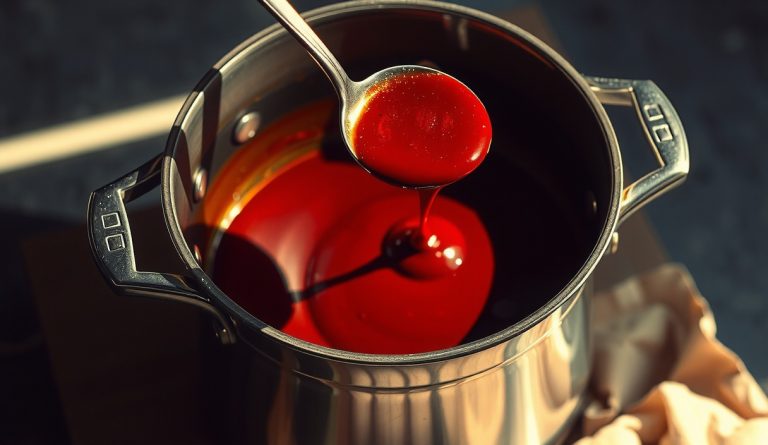
- Reduce uncovered for 20 to 25 minutes, stirring every 3 to 4 minutes and scraping the bottom of the pan with a silicone spatula to prevent sticking. The sauce will appear thin and bright red for the first 10 to 12 minutes. Watch for the color shift: as the allulose concentration increases with water loss, the sauce will rapidly deepen to a dark mahogany red — this is the Maillard cascade activating at concentrated temperatures. The sauce is ready when it coats the back of a spoon thickly and a line drawn through the coating holds cleanly.
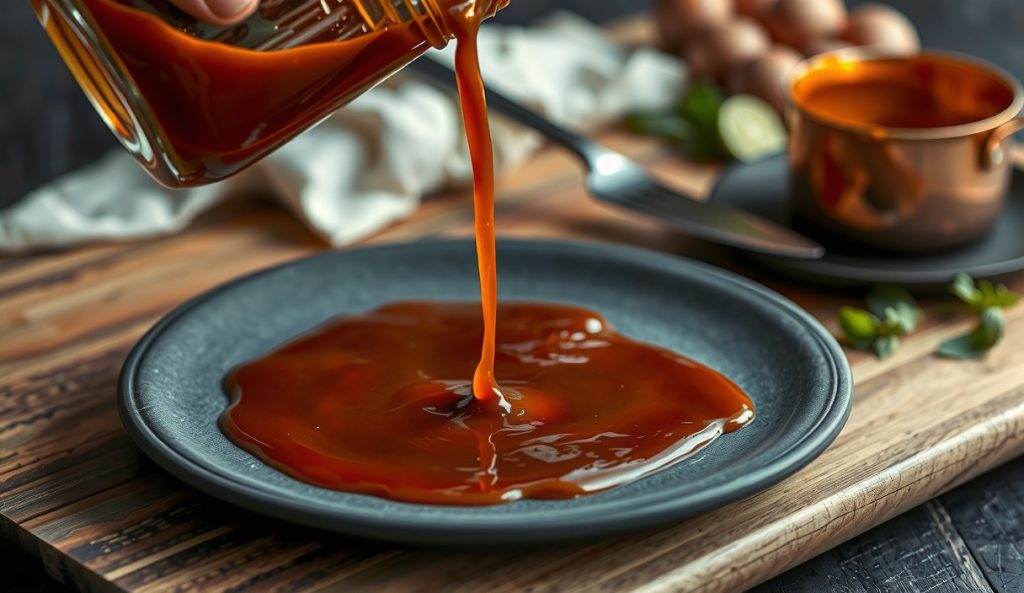
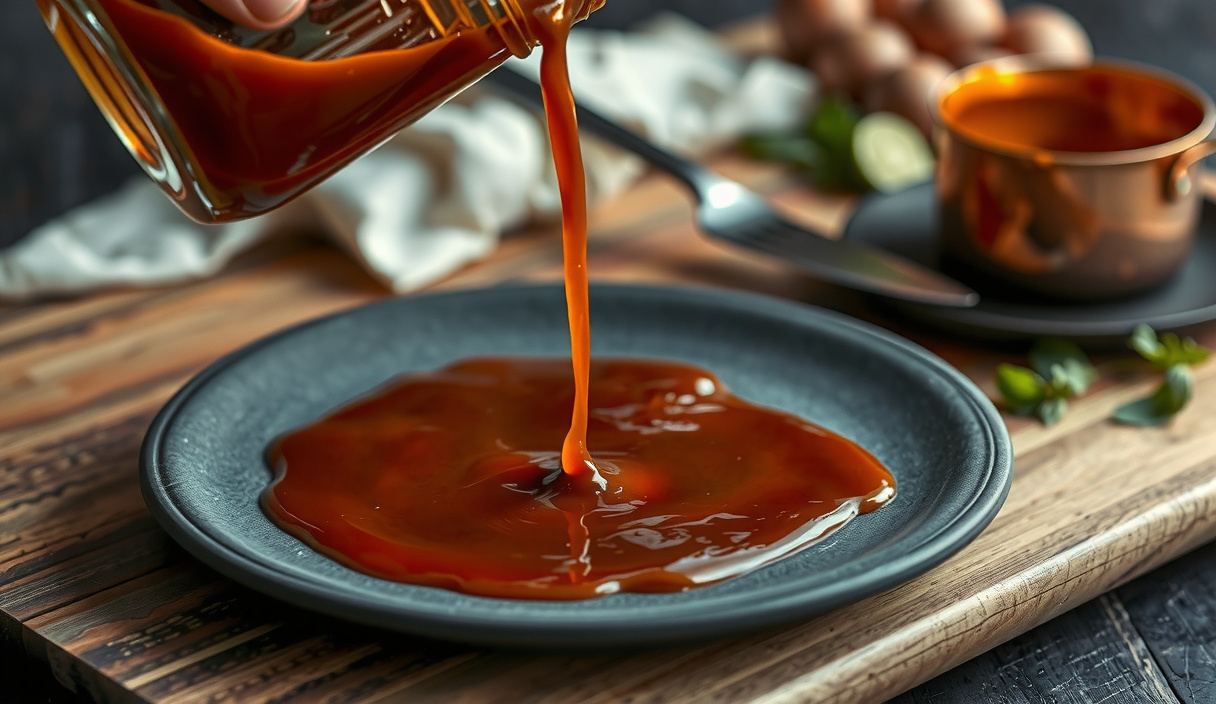
- Pull the pan from heat immediately once the desired consistency is reached. The sauce will continue to thicken as the xanthan network tightens during cooling — pull it 10% thinner than your target finished consistency. It should pour slowly from a spoon when hot, and set to a clingy, glossy consistency when cooled to 75°F.
Finishing and Storage
- Taste the sauce while still warm (approximately 140°F). Adjust acid with an additional splash of apple cider vinegar if flat; adjust salt if harsh. Allow to cool to room temperature for 10 minutes before transferring to a sealed glass jar. Refrigerate immediately. The sauce will reach its final target viscosity at refrigeration temperature (38°F to 42°F). Use within 3 weeks.1/2 cup apple cider vinegar, 1 teaspoon fine kosher salt
Notes
Nutrition
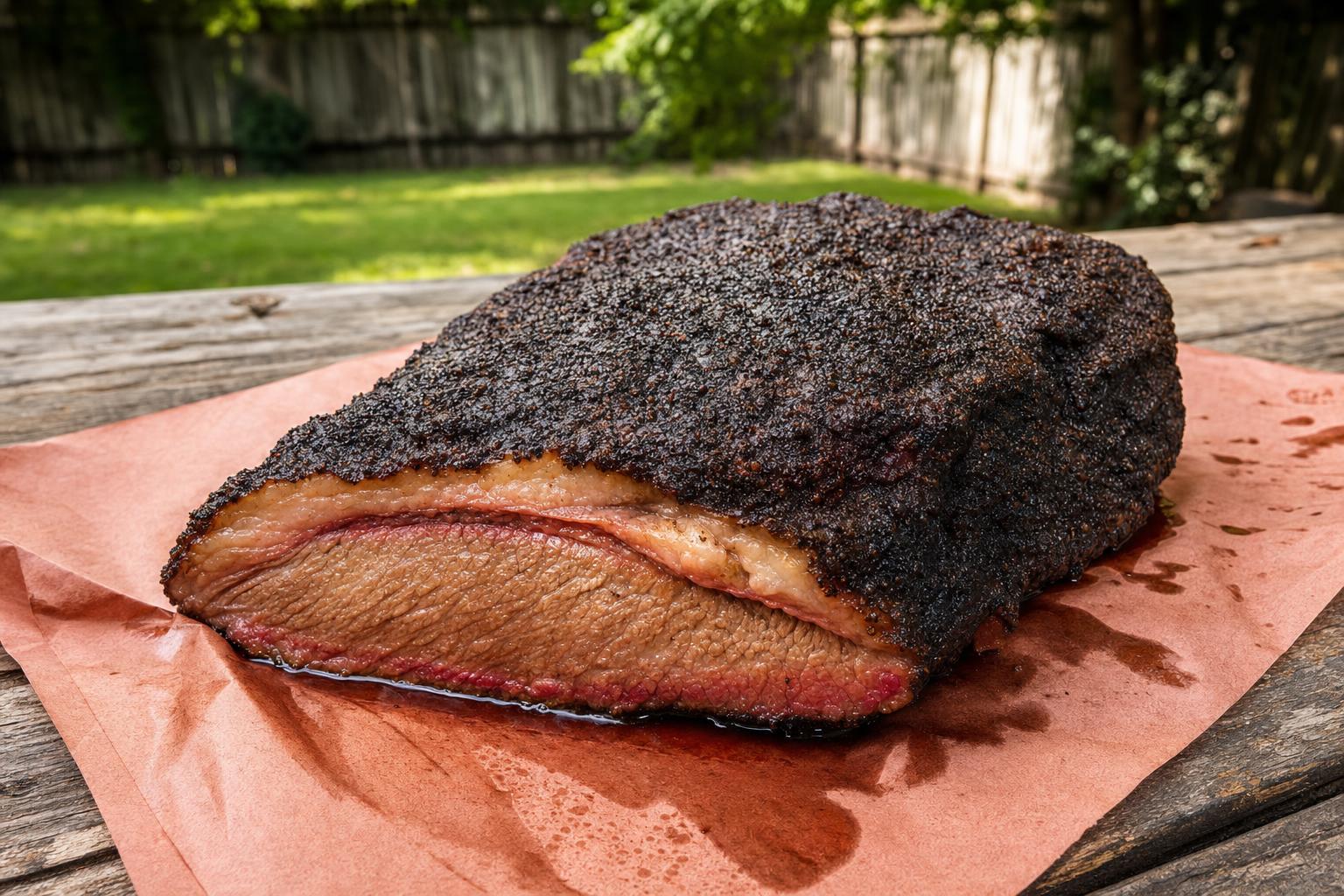
Keto BBQ sauce has a well-deserved reputation for being either thin and watery or cloyingly sweet with a synthetic aftertaste. The problem is not the sweetener — it is the physics. Commercial BBQ sauces derive their viscosity from dissolved sugars operating at concentrations above 50% w/w, which creates a continuous colloidal phase that clings, coats, and resists heat without breaking. Strip that sucrose out, and the result is a dilute aqueous phase that runs off a brisket like water off a hot griddle. This recipe solves that problem from first principles.
The second failure mode — the pale, flat sauce that never develops color — comes from using erythritol or sucralose as the sole sweetener. These molecules do not participate meaningfully in the Maillard cascade or caramelization. Allulose, a C-3 epimer of fructose, changes everything. Allulose browns at thermal thresholds as low as 110°F (43°C) above what sucrose requires, initiating Schiff base formation and Strecker degradation far earlier in the cook. The result is a genuinely mahogany-red sauce with pyrazine and furanone notes that liquid smoke alone cannot fake.
Why does this keto BBQ sauce actually work? The science
The Maillard reaction requires a reducing carbonyl group and a free amino group — and allulose qualifies as a highly reactive reducing monosaccharide. Allulose intercepts the activation energy barrier of the browning cascade at approximately 230°F (110°C), roughly 50°F lower than the threshold for sucrose-based caramelization. During the reduction phase of this sauce, as water evaporates and the continuous phase concentrates, the allulose molecules encounter free amino acids from the tomato paste and apple cider vinegar at escalating temperatures. This generates a dense population of melanoidin pigments and volatile aromatic compounds including furfural, 2-acetylpyrroline, and alkyl pyrazines — the same molecular fingerprint found in a hardwood smoke ring on a competition brisket.
Viscosity is the other half of the engineering challenge. At 0.3% w/w, xanthan gum produces a pseudoplastic (shear-thinning) continuous phase with an apparent viscosity that closely matches commercial BBQ sauces at rest — approximately 4,000 to 8,000 mPa·s — while collapsing rapidly under the mechanical shear of a brush or squeeze bottle. This is the defining property of a shear-thinning non-Newtonian fluid: the sauce pours and coats under applied force, then thickens immediately upon rest to cling to protein surfaces during a final glaze. The xanthan network is also resilient to the ionic environment here — apple cider vinegar drops the pH to roughly 3.8, well within xanthan’s stable operating range of pH 2 to 12, and the moderate sodium load from Worcestershire sauce does not collapse the polymer chains.
On the sweetener side, allulose is almost entirely absorbed in the small intestine and excreted unchanged via urine, yielding a metabolizable energy contribution of approximately 0.2 to 0.4 kcal/g versus sucrose at 4 kcal/g. The FDA has confirmed that allulose may be excluded from the total and added sugars declaration on Nutrition Facts labels, which is why the net carb count lands at 2g per 2-tablespoon serving despite a sauce that tastes fully developed and sweet. Because allulose browns so aggressively, the global thermal setpoint during the final reduction must be held at a moderate simmer — 200°F to 205°F (93°C to 96°C) — rather than a rolling boil, to prevent the rapid melanoidin accumulation that crosses from caramelized depth into acrid burnt notes.
What equipment and ingredients do I need?
- Saucepan: Use a heavy-bottomed 2-quart saucepan. Thin pans create localized hotspots that will scorch allulose before the center of the sauce has reduced properly.
- Instant-read thermometer: Non-negotiable. Confirm the sauce holds between 200°F and 205°F during reduction. Allulose begins producing harsh bitter pyrolysis compounds above 250°F (121°C) under prolonged exposure.
- Allulose: Use granular or liquid allulose. Liquid allulose hydrates faster and integrates more evenly. If using granular, whisk thoroughly before applying heat. Do not substitute erythritol — erythritol will not brown and will recrystallize on cooling into a gritty texture.
- Xanthan gum: Measure by weight if possible. The difference between 0.25% and 0.40% w/w is the difference between a pourable glaze and a paste that will not leave the jar. Disperse the xanthan in the cold liquid before heating to prevent clumping — xanthan hydrates far more uniformly below 60°F.
- Tomato paste: Provides both Maillard precursors (free glutamic acid, reducing sugars) and natural pectin that contributes fractionally to body. Use double-concentrated paste for maximum impact without added water dilution.
- Apple cider vinegar: Drops the pH to approximately 3.8, which pushes the system into an accelerated Maillard-favorable range and suppresses microbiological activity of the allulose-heavy phase over refrigerated storage. Do not substitute white vinegar — the acetate esters and malic acid from ACV contribute critical fruity-sour complexity.
- Smoked paprika: Provides TRPV1-adjacent warmth and lipid-soluble color pigments (capsanthin, capsorubin). Use Spanish smoked paprika (pimentón de la Vera) rather than generic smoked paprika for a deeper, less raw smoke character.
Keto BBQ Sauce — Allulose Base
Equipment
- 1 Heavy-bottomed 2-quart saucepan Thick base prevents allulose scorching from hotspots
- 1 Instant-read thermometer Essential for holding the 200–205°F reduction window
- 1 Whisk For dispersing xanthan gum into cold liquid without clumping
- 1 Kitchen scale For weighing xanthan gum to the 0.3% w/w target — volume measures are imprecise at this level
- 1 Glass jar with lid (1 pint) For storage; refrigerate immediately after cooling
Ingredients
Sauce Base
- 1 cup tomato paste Double-concentrated preferred; provides Maillard precursors and natural pectin body
- ½ cup apple cider vinegar Drops pH to ~3.8; use raw unfiltered for malic acid complexity
- ½ cup water Adjust to preferred finished consistency
- ⅓ cup granular allulose ~67g; browns at ~230°F via Maillard cascade — do not substitute erythritol
- 1 tablespoon Worcestershire sauce Provides nucleotide-driven umami depth; verify keto-compliant brand with no added sugars
Spice Blend
- 2 teaspoons smoked paprika Spanish pimentón de la Vera preferred for complex smoke character
- 1 teaspoon garlic powder
- 1 teaspoon onion powder
- 1 teaspoon ground black pepper Freshly ground preferred
- ½ teaspoon dry mustard powder Adds low-level TRPA1 warmth and emulsifying mucilage
- ½ teaspoon cayenne pepper Adjust to heat preference; activates TRPV1 thermoreceptors
- 1 teaspoon fine kosher salt Or to taste; adds ionic strength that blunts perceived acidity
Thickener
- 1.2 g xanthan gum Approximately 0.3% w/w of finished sauce (~400g total); measure by weight — this is approximately 1/3 teaspoon but weigh it if possible
Instructions
Disperse Xanthan (Cold Phase)
- Combine the apple cider vinegar and water in the cold saucepan. Sprinkle the xanthan gum over the surface and whisk vigorously for 60 to 90 seconds until fully dispersed with no dry clumps visible. The mixture will thicken slightly and appear slightly gelled — this is correct. Do not skip this step or add the xanthan to a hot pan. Xanthan hydrates uniformly below 60°F and clumps irreversibly when added to hot liquid.1/2 cup water, 1.2 g xanthan gum
Build the Base
- Whisk the tomato paste, allulose, and Worcestershire sauce into the xanthan-liquid mixture until smooth and fully incorporated. The allulose should dissolve completely at this stage — granular allulose dissolves more slowly than sucrose; allow 60 seconds of active whisking.1/3 cup granular allulose, 1 tablespoon Worcestershire sauce
- Add all the spice blend ingredients — smoked paprika, garlic powder, onion powder, black pepper, dry mustard powder, cayenne, and kosher salt — and whisk to fully incorporate. The mixture will be thick and brick-red at this point.2 teaspoons smoked paprika, 1 teaspoon garlic powder, 1 teaspoon onion powder, 1 teaspoon ground black pepper, 1/2 teaspoon dry mustard powder, 1/2 teaspoon cayenne pepper, 1 teaspoon fine kosher salt
Reduction Phase
- Place the saucepan over medium heat. Bring to a gentle simmer, stirring frequently. Clip or hold your instant-read thermometer to confirm the sauce reaches and holds between 200°F and 205°F (93°C to 96°C). Do not allow a rolling boil — the high evaporation rate will concentrate the allulose rapidly and push the sauce toward scorching.
- Reduce uncovered for 20 to 25 minutes, stirring every 3 to 4 minutes and scraping the bottom of the pan with a silicone spatula to prevent sticking. The sauce will appear thin and bright red for the first 10 to 12 minutes. Watch for the color shift: as the allulose concentration increases with water loss, the sauce will rapidly deepen to a dark mahogany red — this is the Maillard cascade activating at concentrated temperatures. The sauce is ready when it coats the back of a spoon thickly and a line drawn through the coating holds cleanly.
- Pull the pan from heat immediately once the desired consistency is reached. The sauce will continue to thicken as the xanthan network tightens during cooling — pull it 10% thinner than your target finished consistency. It should pour slowly from a spoon when hot, and set to a clingy, glossy consistency when cooled to 75°F.
Finishing and Storage
- Taste the sauce while still warm (approximately 140°F). Adjust acid with an additional splash of apple cider vinegar if flat; adjust salt if harsh. Allow to cool to room temperature for 10 minutes before transferring to a sealed glass jar. Refrigerate immediately. The sauce will reach its final target viscosity at refrigeration temperature (38°F to 42°F). Use within 3 weeks.1/2 cup apple cider vinegar, 1 teaspoon fine kosher salt
Notes
Nutrition
How do I nail this keto BBQ sauce every time?
- Disperse xanthan cold, not hot. Xanthan hydrates readily at room temperature and below. Adding xanthan to a hot sauce causes it to clump into gel pockets before it can distribute uniformly. Whisk the xanthan into the cold liquids with the allulose for 60 seconds, then heat the whole mixture. This is the single most common failure point in keto sauce formulation.
- Monitor temperature, not time. Sauce reduction is a function of evaporation rate, which varies dramatically with pan diameter and stove output. Target 200°F to 205°F sustained for the reduction window. If the sauce hits 220°F, pull it immediately — allulose is already browning faster than sucrose would at equivalent temperatures, and the thermal window before bitter pyrolysis is narrow.
- Expect a pale color at the start. The deep mahogany color develops during the last 10 to 15 minutes of reduction as the allulose concentration increases with water loss and the temperature stabilizes. The sauce will look brick-red and thin at the 10-minute mark — the phase transition to glossy, dark BBQ color is sudden and expected.
- Taste for acid balance before bottling. Apple cider vinegar volatilizes partially during reduction, so the acidity perceived at the finish will be softer than in the raw mixture. If the cooled sauce tastes flat, add ACV in half-teaspoon increments. If it tastes harsh, a small pinch of fine kosher salt blunts acidity through competitive receptor inhibition.
- Do not freeze this sauce. Xanthan gum is freeze-thaw stable in isolation, but the allulose phase can generate ice crystal structures that alter the mouthfeel of the sauce upon thawing. Refrigerate and use within 3 weeks.
- Scale xanthan precisely when scaling the batch. Xanthan gum scales linearly at 0.3% of total finished weight. If the recipe is doubled, double the xanthan exactly. Overages beyond 0.5% w/w produce a sauce that feels gummy and masks flavor release — viscosity-induced flavor suppression at those concentrations is real and noticeable.
What variations can I make on this keto BBQ sauce?
Carolina-style mustard BBQ: Reduce the tomato paste to 1 tablespoon and whisk in 3 tablespoons of Dijon mustard and an additional tablespoon of ACV before the reduction. Mustard seed mucilage provides secondary emulsification, and the glucosinolates contribute allyl isothiocyanate warmth that activates TRPA1 trigeminal receptors — a distinct heat profile from capsaicin. Net carbs remain within the keto window.
Alabama white BBQ variant: Abandon the tomato base entirely. Combine mayonnaise (2/3 cup), ACV (3 tablespoons), horseradish (1 tablespoon), and allulose (1 tablespoon) with the same xanthan gum load. This variation is an oil-in-water emulsion rather than an aqueous reduction — the xanthan here operates purely as a steric stabilizer for the dispersed fat droplets, not as a viscosity agent. Serve the Alabama white variant cold only; heating will break the emulsion.
Chipotle-espresso amplification: Add 1 teaspoon of instant espresso powder and one finely minced chipotle pepper in adobo (drained) to the base recipe before reduction. The espresso introduces additional Maillard precursors (reducing sugars from roasting) and bitter phenolic compounds that amplify perceived smoke. The chipotle contributes a secondary lipid-soluble capsaicinoid heat that lingers longer than paprika alone. Net carb impact from these additions is negligible.
Scaling for competition batch use: This recipe scales linearly to 1 gallon. At that scale, use a wide, heavy rondeau rather than a saucepan to maximize evaporation surface area and control the reduction rate. The xanthan at 0.3% w/w of finished volume should be pre-dispersed in 10% of the cold liquid using an immersion blender before incorporation, to avoid polymer aggregation under the high total volume. Shelf life under refrigeration extends to 4 weeks at scale due to reduced oxygen exposure in sealed gallon containers.
Frequently asked questions
Can I use a different keto sweetener instead of allulose? A blend can work, but allulose performs two jobs no other common keto sweetener replicates simultaneously: it browns authentically via the Maillard cascade, and it contributes humectancy that prevents the sauce from drying out on hot meat. Pure erythritol substitution produces a pale sauce that recrystallizes on the surface of brisket as it cools. A 70/30 blend of allulose and erythritol will work if the stove temperature is reduced by 10°F to 15°F to account for the mixed browning kinetics, but the color will be lighter than the pure allulose version.
Why does my keto BBQ sauce seem thin when hot but thick when cold? This is the expected pseudoplastic behavior of xanthan gum interacting with temperature-dependent viscosity changes in the aqueous phase. At high temperatures, water molecules have greater kinetic energy and reduce the effective entanglement of the xanthan polymer chains, lowering apparent viscosity. As the sauce cools toward refrigeration temperature, polymer chain mobility decreases and the network tightens. A sauce that brushes well at 190°F will set to a commercial-style thickness at 40°F. Adding more xanthan to compensate for thin hot behavior will produce a gummy cold sauce.
Is this sauce safe for deep ketosis, or will allulose spike insulin? Current metabolic research shows that allulose does not provoke a meaningful insulin or blood glucose response in healthy adults. Allulose is absorbed primarily in the small intestine and excreted in urine without entering glycolytic pathways at any significant rate, and the FDA has confirmed it may be excluded from sugar declarations for this reason. For individuals using continuous glucose monitors, personal responses can vary at very high single-serving doses exceeding 20 grams — but at 2 tablespoons of this sauce, allulose exposure is approximately 4 to 5 grams, well within tolerances reported across the literature.