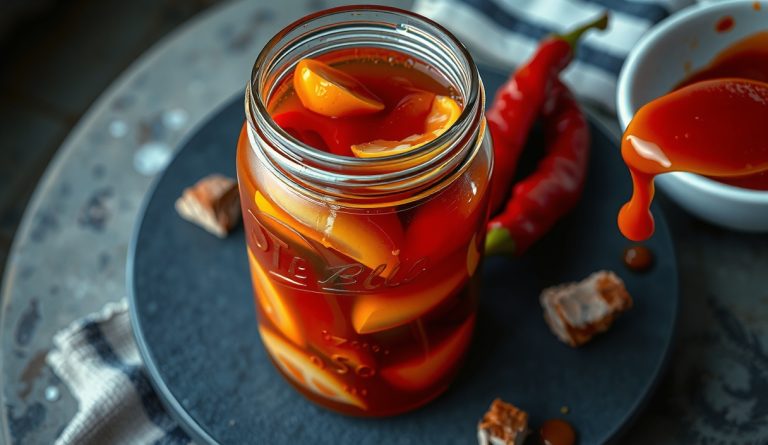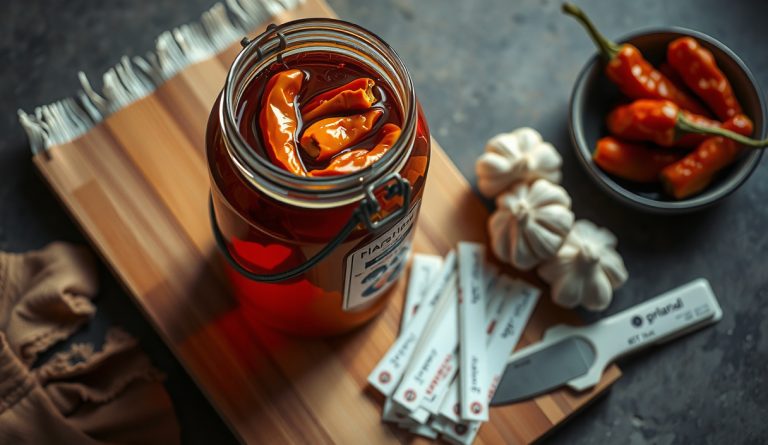

Salt performs two distinct roles in a lacto-ferment: it suppresses pathogenic and spoilage organisms by osmotic pressure while selectively favoring halotolerant Lactobacillus strains, and it draws moisture from plant tissue to create the brine environment those organisms colonize. Reducing salt therefore reduces both the competitive selection pressure on beneficial bacteria and the microbial safety margin of the ferment. This low-sodium adaptation is designed specifically for individuals with a medically indicated need for sodium restriction — it is not a casual flavor adjustment.
What changes in the low-sodium adaptation?
Brine concentration is reduced to 2% w/v — 2 grams of non-iodized salt per 100 mL of filtered water. At 2% w/v, the osmotic inhibition of non-Lactobacillus organisms is meaningfully weaker than at the canonical 3.5% w/v brine, and spontaneous fermentation relying solely on wild strains present on the pepper skins carries an elevated risk of off-flavor development or microbial competition from undesirable organisms before the pH drops into the safe zone below 4.0.
To compensate for the reduced osmotic barrier, a commercial freeze-dried Lactobacillus starter culture is added directly to the brine before the vessel is sealed. This inoculation front-loads the ferment with a high-density population of known, acid-producing organisms, effectively shortcutting the lag phase and reducing the window during which competing microbes could establish a foothold. Begin pH monitoring twice daily starting on day three — earlier than the canonical once-daily check from day four. Target a finished pH of 3.3 rather than the standard 3.4–3.6; the lower target provides an additional safety margin that compensates for the reduced salt buffer throughout the process.
What stays the same in the low-sodium version?
The smoking step, pepper preparation, submersion requirement, ambient temperature range, and blending process after fermentation are identical to the canonical method. The finished sauce’s flavor profile and heat level are unaffected by the brine adjustment — salt concentration influences microbial dynamics, not the capsaicin or smoke character of the final product.
When is the low-sodium adaptation the right choice?
This low-sodium adaptation is the correct variant when dietary sodium must be controlled for clinical reasons and a spontaneous ambient ferment at standard salinity is not viable. The adaptation is not appropriate for casual low-salt preference — the canonical 3.5% brine already produces a sauce where total sodium per serving, measured in teaspoon quantities, is modest. Reserve this adaptation for genuine medical necessity and apply the more rigorous pH monitoring protocol without exception.
Use the full method, equipment, and preparation steps from the original Lacto-Fermented Smoked Pepper Hot Sauce.