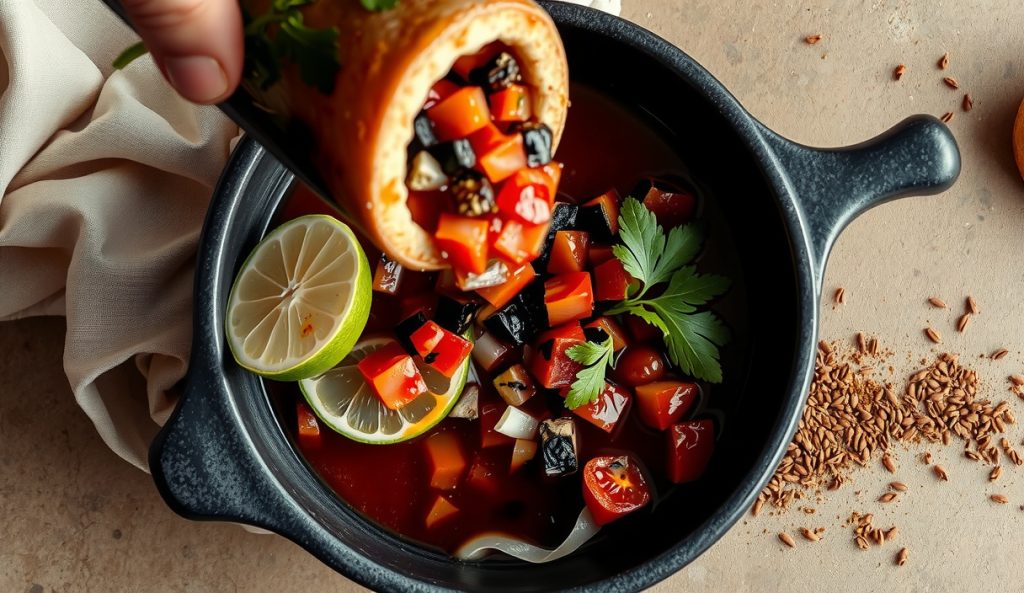
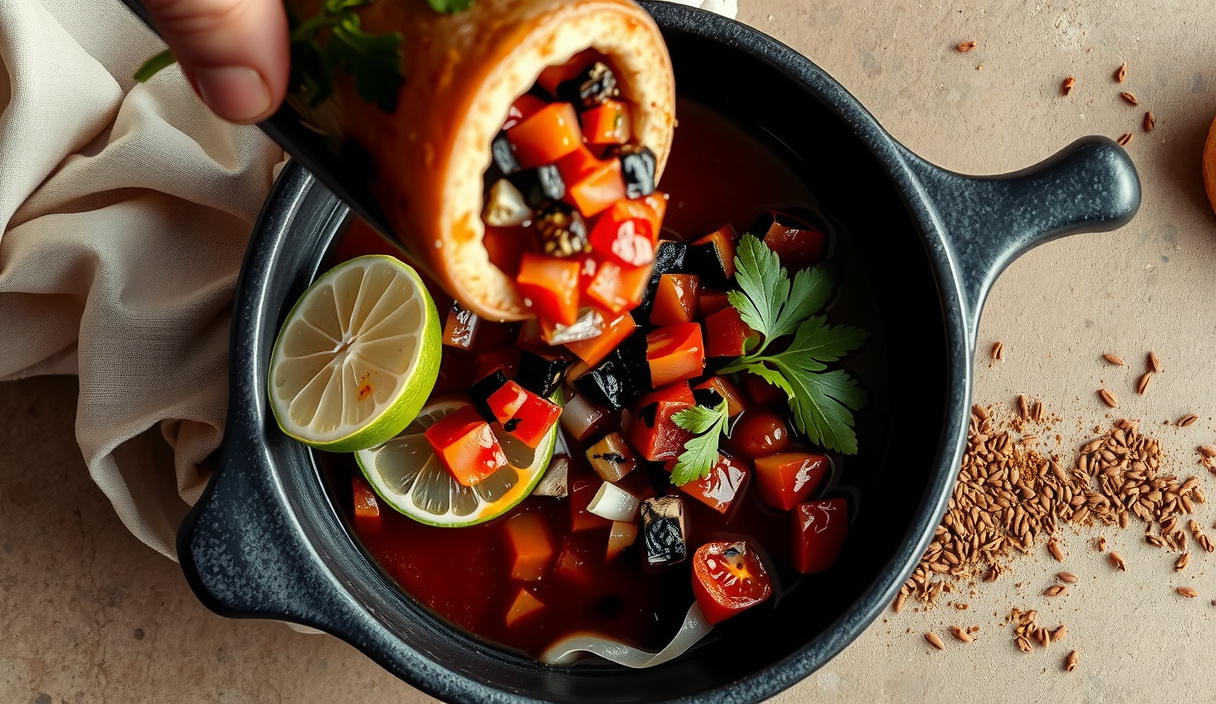
Smoked Tomato Salsa Asada — Charred Vegetable

Equipment
- 1 Smoker or covered charcoal grill Maintain 350°F. Use 1 oak or pecan wood chunk for moderate phenolic smoke.
- 1 Long tongs For rotating vegetables over direct flame safely.
- 1 Blender or food processor A standard countertop blender gives the best texture control. Immersion blenders work but provide less chunky control.
- 1 Dry skillet For toasting whole cumin seeds before grinding.
- 1 Spice grinder or mortar and pestle Grind toasted cumin immediately before using.
- 1 Rimmed baking sheet or cast-iron grate To hold vegetables in the smoker without losing them through grill grates.
Ingredients
Vegetables for smoking and charring
- 6 medium Roma tomatoes Firm and ripe, uncut, approximately 1.5 lb total
- 2 medium jalapeños Green or red; red jalapeños preferred for deeper Maillard flavor and higher sugar content
- 1 medium white onion Halved through the root, skin left on
- 6 cloves garlic Unpeeled — the skin protects moisture during the smoke and char phase
Seasoning and finish
- 3 tablespoons fresh lime juice From approximately 2 limes; add more to taste at the end
- 1 cup fresh cilantro leaves and tender stems Loosely packed; increase or omit to preference
- 1 teaspoon whole cumin seeds Toasted and ground fresh immediately before use
- 1 teaspoon Diamond Crystal kosher salt Added only after blending; adjust to taste

Instructions
Prepare the smoker
- Fire your smoker or set up your grill for indirect heat at 350°F. Add one fist-sized chunk of oak, pecan, or mesquite wood directly to the heat source. Allow the smoker to reach temperature and for the initial thick white smoke to transition to thin blue smoke — this takes 10–15 minutes. Thick white smoke contains excess moisture and incomplete combustion products that will make the salsa taste bitter and acrid.
Toast and grind the cumin
- Place a dry skillet over medium heat. Add the whole cumin seeds and toast, shaking the pan constantly, until they begin to pop and release a warm, earthy aroma — approximately 2 to 3 minutes. Immediately transfer to a spice grinder or mortar and pestle and grind to a fine powder. Set aside. Do not grind in advance; the volatile terpenes (cuminaldehyde, carvacrol) that define cumin’s aroma oxidize within minutes of grinding.1 teaspoon whole cumin seeds
Smoke the vegetables
- Arrange the Roma tomatoes, jalapeños, white onion halves (cut-side down), and unpeeled garlic cloves on the smoker grate or a rimmed baking sheet placed in the indirect heat zone. Close the lid and smoke at 350°F for 30 minutes. Do not lift the lid during this phase — every lid-lift drops the temperature by 25–50°F and bleeds the smoke atmosphere. After 30 minutes, the tomato skins will have tightened and begun to crack, the onion will show grill marks on the cut face, and the jalapeños will have softened and changed color slightly.2 medium jalapeños, 1 medium white onion, 6 cloves garlic
Direct-flame char
- Transfer the smoked vegetables to a direct heat source — the hot zone of your grill, a gas burner set to high, or directly over the coals. Using long tongs, char each vegetable for a total of 2 minutes, rotating every 30 seconds. Target 40–60% blackened skin surface on the tomatoes and jalapeños. The onion cut-face should be deeply charred and caramelized. The garlic skin will char and smoke — that is correct. Pull everything off heat immediately once the target char level is reached. Do not char beyond 2 minutes total; this is the window where pyrazine formation peaks without crossing into acrolein accumulation.2 medium jalapeños, 1 medium white onion, 6 cloves garlic
Blend the salsa
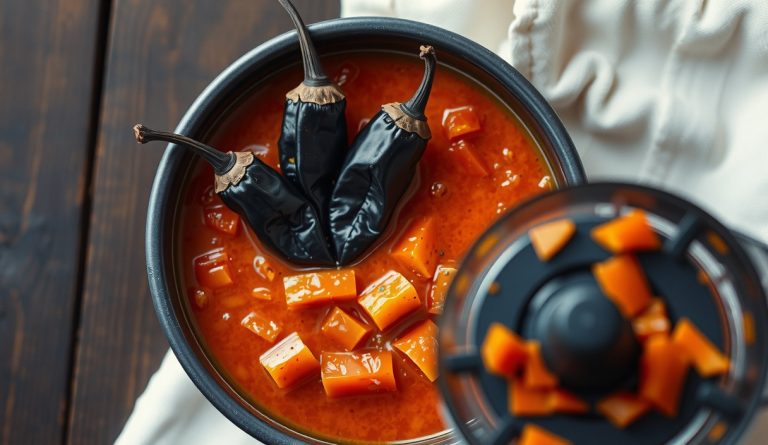
- Allow the charred vegetables to rest for 5 minutes — they will be extremely hot and will cause pressure to build in a sealed blender. Do not remove the charred skin from the tomatoes or jalapeños. Squeeze the softened garlic cloves out of their charred skins directly into the blender jar and discard the skins. Add the charred tomatoes whole, the jalapeños (stem removed; keep the seeds for full heat), and the onion quarters. Add the lime juice and fresh cilantro.6 cloves garlic, 2 medium jalapeños, 1 medium white onion, 1 cup fresh cilantro leaves and tender stems, 3 tablespoons fresh lime juice
- Pulse the blender 8 to 10 times in 1-second bursts. Check the texture after each pulse. The target is a medium-chunky consistency where identifiable pieces of tomato and jalapeño are still visible but the salsa pours easily. Do not blend continuously — continuous blending fully homogenizes the cell structure and produces a thin, smooth, restaurant-style salsa rather than the more textured home-style version. If you prefer smooth, blend for 20–30 continuous seconds.
Season and rest
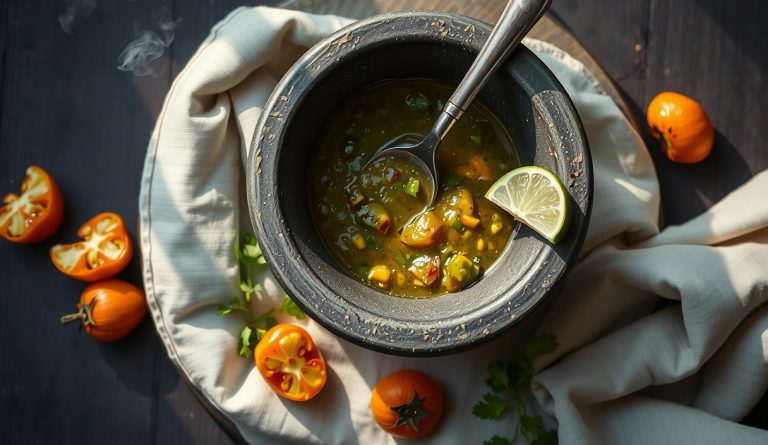
- Transfer the blended salsa to a bowl or storage jar. Add the ground toasted cumin and kosher salt. Stir to combine. Taste and adjust: more lime juice if the acid balance feels flat, more salt if the smoke character is muted (salt amplifies aroma perception via sodium-ion enhancement of taste receptor sensitivity), more cilantro if you want the green herbal contrast against the char.1 teaspoon whole cumin seeds, 1 teaspoon Diamond Crystal kosher salt
- Rest the salsa uncovered at room temperature for 20 minutes before serving. During this rest, the volatile partition equilibrium between the aqueous and minimal lipid phases stabilizes, and the Maillard-derived compounds continue to react slowly with the organic acids in the lime juice, building additional ester complexity. The salsa will taste noticeably more cohesive and rounded after the rest than it does immediately out of the blender. Serve with warm tortilla chips, as a taco topping, or alongside grilled meats.
Notes
Nutrition
The first time I tasted a proper salsa asada in a roadside taqueria outside Oaxaca, I understood immediately that the smokiness was not a seasoning — it was the structural backbone of the entire sauce. The cook had laid Roma tomatoes and jalapeños directly on glowing coals, let them blister and blacken, then smashed them into a volcanic stone molcajete with nothing but a pinch of salt. No lime. No garlic. No garnish. And it was extraordinary. That experience sent me down a decade-long rabbit hole into the physical chemistry of charred vegetable flavor, and this recipe is the result: a salsa asada engineered for maximum pyrazine depth, controlled phenolic bitterness, and a smoke-forward profile that survives the blender.
The name salsa asada literally means roasted salsa, and the distinction from fresh pico de gallo or blended tomatillo salsa is not aesthetic — it is thermodynamic. Uncooked tomatoes sit at a water activity near 0.99, their volatiles locked inside intact cellular vacuoles. The moment you apply heat — especially dry, radiant, or convective heat from a smoker or open flame — you initiate a cascade of irreversible structural and chemical transformations. The char is not incidental. It is the point.
Why does smoked tomato salsa asada work? The science
Salsa asada develops its distinctive depth through two simultaneous reaction pathways — Maillard browning and pectin breakdown — that are triggered the moment dry heat above 250°F contacts the tomato surface. Tomatoes are a composite matrix: a continuous aqueous phase containing dissolved sugars, organic acids (primarily citric and malic), and free amino acids, plus a dispersed lipid phase carrying fat-soluble carotenoids like lycopene and beta-carotene. Their cell walls are built from pectin — specifically a polygalacturonic acid backbone — and cellulose.
The Maillard cascade ignites first. Reducing sugars — glucose and fructose dominate in ripe tomatoes — condense with free amino acids such as glutamic acid, proline, and leucine through Schiff base formation and Amadori rearrangement, ultimately fragmenting via Strecker degradation into hundreds of volatile organic compounds. The most culinarily significant are the heterocyclic pyrazines (2-methylpyrazine, 2,3-dimethylpyrazine), which carry roasted, nutty, and earthy aromas detectable at concentrations as low as 10–60 ppb. These compounds form most efficiently when the surface water activity drops below 0.7 — precisely what the smoker environment achieves by simultaneously drying the tomato exterior while internal steam is still present.
Pectin breakdown runs in parallel. As tomato skin temperature climbs past 180°F, the glycosidic bonds of the polygalacturonic chains undergo thermal beta-elimination, depolymerizing the cell wall matrix and causing the characteristic skin-slip and juice collapse visible when tomatoes blister. This structural failure is essential — it releases the sequestered volatile aromatic pool into the blender.
The two-stage process — smoker first, then direct flame char — is not theatrical redundancy. Each stage accomplishes a distinct thermodynamic objective. The smoker phase at 350°F for 30 minutes operates primarily via convective and radiant heat transfer, driving the internal temperature of the tomato to approximately 160–170°F. At this range, the tomato flesh undergoes full pectin hydrolysis and the juice pools begin to concentrate, but the surface temperature stays moderate enough that Maillard onset is slow and controlled. During this phase, combustion-derived smoke compounds — guaiacol, syringol, and their methyl derivatives — adsorb onto the moist tomato surface from condensed smoke particulate. These phenolic compounds are responsible for the characteristic campfire-sweet smoke note, and they dissolve readily into the surface moisture film because the surface water activity at this stage remains above 0.8.
The direct-flame char phase — 2 minutes over open flame — then drives the surface into a fully pyrolytic zone. Surface temperatures exceed 400°F locally. Maillard products accumulate rapidly, and at hot spots exceeding 450°F, controlled carbonization produces furfural and acetylfuran — the bitter, complex undertone that distinguishes salsa asada from a simple roasted tomato sauce. The key is restraint: 2 minutes total, rotating once. Targeting 40–60% surface blackening preserves the guaiacol-pyrazine balance. Over-charring beyond 70% drives the Maillard cascade past the melanoidin stage into true carbonization, producing acrolein and acrid polycyclic aromatics that overwhelm the entire flavor profile.
Each supporting vegetable contributes a parallel flavor architecture. Jalapeño capsaicin — typically 2,500–8,000 Scoville units in ripe red jalapeños — activates TRPV1 ion channels on the trigeminal nerve, delivering chemesthetic heat the brain registers as burning pain. Because capsaicin is highly lipophilic, it remains largely in the water phase of a low-fat aqueous salsa matrix, keeping it potent and bioavailable. Charring the jalapeño adds 4-methylguaiacol and additional pyrazines from its own Maillard reaction, while the seeds contribute a grassy, slightly vegetal note from green leaf volatiles like (Z)-3-hexenal. Roasting the white onion converts its pungent propanethial S-oxide into sweet, low-volatility disulfides and polysulfides via Lenz-Zwanenburg rearrangement — the source of roasted allium’s characteristic sweet-savory depth. Garlic cloves roasted in their skin follow the same sulfur chemistry, producing diallyl disulfide and diallyl trisulfide rather than the sharp allicin of raw garlic.
What equipment and ingredients do I need?
- Smoker or covered grill: Any smoker holding a stable 350°F works. On a kettle grill, bank charcoal to one side, place a wood chunk (oak or mesquite) on the coals, and use indirect heat. The wood species matters: oak produces moderate guaiacol; mesquite produces higher syringol concentrations and a more aggressive phenolic profile. Hickory falls between them. Apple wood gives a sweeter, lower-phenol smoke — beautiful but less authentic to the asada tradition.
- Roma tomatoes: Choose firm, ripe Romas with no cracking. Their low water content relative to beefsteak means the juice concentrates faster in the smoker without turning watery in the blender. If Romas are out of season, dry-farmed Early Girl tomatoes are an excellent substitute. Avoid hydroponically grown tomatoes — lower amino acid content produces weaker Maillard depth.
- Jalapeños: Green jalapeños produce a brighter, more vegetal salsa. Red jalapeños (fully ripened on the vine) carry higher capsaicin, higher sugar content, and more complex Maillard precursors — preferred here. For pure heat without pepper flavor, substitute a single serrano.
- White onion: White onion has a sharper, higher-sulfur profile than yellow onion, which reads more clearly through the smoke. Yellow onion works but is slightly sweeter and less assertive.
- Garlic: Leave cloves unpeeled for the smoker and flame phase. The papery skin acts as a natural moisture-retaining parchment, preventing desiccation while the interior roasts. Squeeze out the softened paste when blending.
- Lime: The citric acid in fresh lime juice — approximately 6% by weight — serves two functions: it drops the salsa pH to roughly 3.8–4.0, which both preserves color by chelating metal ions that degrade chlorophyll and carotenoids, and sharpens the overall flavor profile by increasing apparent salinity perception.
- Cumin: Toast whole cumin seeds in a dry skillet until they pop and smell of warm earth — approximately 2–3 minutes at medium heat — then grind immediately. Pre-ground cumin has already lost 60–80% of its volatile terpene content (carvacrol, cuminaldehyde) to oxidative degradation during storage.
Smoked Tomato Salsa Asada — Charred Vegetable
Equipment
- 1 Smoker or covered charcoal grill Maintain 350°F. Use 1 oak or pecan wood chunk for moderate phenolic smoke.
- 1 Long tongs For rotating vegetables over direct flame safely.
- 1 Blender or food processor A standard countertop blender gives the best texture control. Immersion blenders work but provide less chunky control.
- 1 Dry skillet For toasting whole cumin seeds before grinding.
- 1 Spice grinder or mortar and pestle Grind toasted cumin immediately before using.
- 1 Rimmed baking sheet or cast-iron grate To hold vegetables in the smoker without losing them through grill grates.
Ingredients
Vegetables for smoking and charring
- 6 medium Roma tomatoes Firm and ripe, uncut, approximately 1.5 lb total
- 2 medium jalapeños Green or red; red jalapeños preferred for deeper Maillard flavor and higher sugar content
- 1 medium white onion Halved through the root, skin left on
- 6 cloves garlic Unpeeled — the skin protects moisture during the smoke and char phase
Seasoning and finish
- 3 tablespoons fresh lime juice From approximately 2 limes; add more to taste at the end
- 1 cup fresh cilantro leaves and tender stems Loosely packed; increase or omit to preference
- 1 teaspoon whole cumin seeds Toasted and ground fresh immediately before use
- 1 teaspoon Diamond Crystal kosher salt Added only after blending; adjust to taste
Instructions
Prepare the smoker
- Fire your smoker or set up your grill for indirect heat at 350°F. Add one fist-sized chunk of oak, pecan, or mesquite wood directly to the heat source. Allow the smoker to reach temperature and for the initial thick white smoke to transition to thin blue smoke — this takes 10–15 minutes. Thick white smoke contains excess moisture and incomplete combustion products that will make the salsa taste bitter and acrid.
Toast and grind the cumin
- Place a dry skillet over medium heat. Add the whole cumin seeds and toast, shaking the pan constantly, until they begin to pop and release a warm, earthy aroma — approximately 2 to 3 minutes. Immediately transfer to a spice grinder or mortar and pestle and grind to a fine powder. Set aside. Do not grind in advance; the volatile terpenes (cuminaldehyde, carvacrol) that define cumin’s aroma oxidize within minutes of grinding.1 teaspoon whole cumin seeds
Smoke the vegetables
- Arrange the Roma tomatoes, jalapeños, white onion halves (cut-side down), and unpeeled garlic cloves on the smoker grate or a rimmed baking sheet placed in the indirect heat zone. Close the lid and smoke at 350°F for 30 minutes. Do not lift the lid during this phase — every lid-lift drops the temperature by 25–50°F and bleeds the smoke atmosphere. After 30 minutes, the tomato skins will have tightened and begun to crack, the onion will show grill marks on the cut face, and the jalapeños will have softened and changed color slightly.2 medium jalapeños, 1 medium white onion, 6 cloves garlic
Direct-flame char
- Transfer the smoked vegetables to a direct heat source — the hot zone of your grill, a gas burner set to high, or directly over the coals. Using long tongs, char each vegetable for a total of 2 minutes, rotating every 30 seconds. Target 40–60% blackened skin surface on the tomatoes and jalapeños. The onion cut-face should be deeply charred and caramelized. The garlic skin will char and smoke — that is correct. Pull everything off heat immediately once the target char level is reached. Do not char beyond 2 minutes total; this is the window where pyrazine formation peaks without crossing into acrolein accumulation.2 medium jalapeños, 1 medium white onion, 6 cloves garlic
Blend the salsa
- Allow the charred vegetables to rest for 5 minutes — they will be extremely hot and will cause pressure to build in a sealed blender. Do not remove the charred skin from the tomatoes or jalapeños. Squeeze the softened garlic cloves out of their charred skins directly into the blender jar and discard the skins. Add the charred tomatoes whole, the jalapeños (stem removed; keep the seeds for full heat), and the onion quarters. Add the lime juice and fresh cilantro.6 cloves garlic, 2 medium jalapeños, 1 medium white onion, 1 cup fresh cilantro leaves and tender stems, 3 tablespoons fresh lime juice
- Pulse the blender 8 to 10 times in 1-second bursts. Check the texture after each pulse. The target is a medium-chunky consistency where identifiable pieces of tomato and jalapeño are still visible but the salsa pours easily. Do not blend continuously — continuous blending fully homogenizes the cell structure and produces a thin, smooth, restaurant-style salsa rather than the more textured home-style version. If you prefer smooth, blend for 20–30 continuous seconds.
Season and rest
- Transfer the blended salsa to a bowl or storage jar. Add the ground toasted cumin and kosher salt. Stir to combine. Taste and adjust: more lime juice if the acid balance feels flat, more salt if the smoke character is muted (salt amplifies aroma perception via sodium-ion enhancement of taste receptor sensitivity), more cilantro if you want the green herbal contrast against the char.1 teaspoon whole cumin seeds, 1 teaspoon Diamond Crystal kosher salt
- Rest the salsa uncovered at room temperature for 20 minutes before serving. During this rest, the volatile partition equilibrium between the aqueous and minimal lipid phases stabilizes, and the Maillard-derived compounds continue to react slowly with the organic acids in the lime juice, building additional ester complexity. The salsa will taste noticeably more cohesive and rounded after the rest than it does immediately out of the blender. Serve with warm tortilla chips, as a taco topping, or alongside grilled meats.
Notes
Nutrition
How do I nail this salsa asada every time?
- Do not wipe the char off the tomatoes before blending. The blackened skin carries the majority of the pyrazine and phenolic payload. Removing it produces a generic roasted tomato sauce, not salsa asada. A small amount of true carbonization on the skin is acceptable and desirable — the bitterness at these concentrations is a feature, not a bug.
- Control blending texture deliberately. A brief 5-second pulse leaves intact tomato cells that release juice slowly on the chip. A 30-second continuous blend breaks all cells, creating a uniform colloidal suspension where smoke phenolics and capsaicin distribute evenly throughout the aqueous matrix. This recipe targets medium-chunky texture: 8–10 one-second pulses.
- Season after blending, never before. Adding salt to raw tomatoes before smoking drives osmotic moisture loss and causes the skins to tighten and partially seal before smoke compounds can adsorb into the surface moisture film, measurably reducing phenolic uptake. Season at the end.
- Rest the salsa for 20 minutes before serving. Immediately after blending, volatile compounds are in a thermodynamically active state — some are still outgassing, others are redistributing between aqueous and lipid phases. After 20 minutes at room temperature, partition equilibrium stabilizes and the flavor reads more cohesive and rounded. This is directly analogous to resting meat: the matrix needs time to equilibrate.
- The char window is 40–60% surface blackening. Under 30% and the salsa is pleasant but not asada-forward. Over 70% and acrolein bitterness begins to dominate the guaiacol-pyrazine balance. Rotate the vegetables every 30 seconds during the flame phase and pull them the moment the skin is blistered black in patches but still shows some red through the char.
- Wood choice is a flavor variable. Oak gives a clean, moderate smoke platform that lets the tomato and jalapeño character lead. Mesquite produces a more aggressive, phenol-heavy smoke that competes with the vegetables. For a first batch, use oak or pecan. Once the base recipe is familiar, switch wood species to explore how the smoke phenolic profile shifts the perceived flavor balance.
What variations can I make?
Tomatillo version (salsa verde asada): Replace the Roma tomatoes with an equal weight of husked tomatillos. Tomatillos contain tomatine — a steroidal alkaloid — that gives the raw fruit a sharp, almost soapy bitterness. Heat converts tomatine to the milder tomatidine, and the char adds the pyrazine complexity that balances the natural tartness of the tomatillo’s oxalic and citric acids. The resulting salsa will be brighter, more acidic, and lower in sugar than the Roma version — perfect with fatty meats like carnitas or duck.
Árbol heat escalation: After the flame char phase, add 4–6 dried chiles de árbol (stems removed, seeds intact) directly to the blender with the other charred vegetables. Árbol contains capsaicin at roughly 15,000–30,000 Scoville units and contributes a thin, piercing heat with a bright red color contribution from its high carotenoid content. Do not smoke or char the dried chiles — they will desiccate completely. The heat from the still-warm charred tomatoes is sufficient to bloom the árbol volatiles during blending.
Low-sodium adaptation: Reduce the kosher salt to 1/4 teaspoon and add 1 tablespoon of fish sauce (Red Boat or equivalent). Fish sauce delivers glutamate and inosinate monophosphate — a synergistic umami pair that activates T1R1/T1R3 receptors exponentially more powerfully than glutamate alone. The perceived saltiness at the tongue increases without adding sodium ions, because umami suppresses bitterness and enhances the salience of salt flavor. Net sodium drops by roughly 35% with no perceptible flavor loss.
Scaling for canning: This recipe is not safe for water-bath canning as written because the pH of the charred tomato base can vary by up to 0.4 units depending on tomato ripeness and degree of char. To preserve this salsa safely, add 2 tablespoons of bottled lime juice (standardized acidity) per pint to guarantee a pH below 4.0, and process within a tested, approved salsa recipe framework. Alternatively, freeze in 1-cup portions in zip-lock bags with the air pressed out — the salsa freezes excellently for up to 4 months with minimal volatile loss because low temperature arrests oxidative degradation of the phenolic compounds.
Frequently asked questions
Can I make this without a smoker using only a gas grill or stovetop? Yes, with a trade-off. Skip the 30-minute smoke phase and instead char the vegetables directly over a high gas flame or under a broiler set to its highest setting for 8–10 minutes, turning every 2 minutes. Excellent Maillard-derived pyrazines will develop from the char, but the guaiacol and syringol from wood smoke will be absent. The result is a salsa tatemada rather than a fully smoked asada — still deeply flavored and excellent, but missing the campfire-phenolic backbone. To partially compensate, add 1/8 teaspoon of smoked paprika at the blending stage; it introduces some guaiacol via the dried pepper, though it will not fully replicate real wood smoke.
How long does smoked tomato salsa asada keep? Stored in an airtight glass jar in the refrigerator, this salsa holds well for 7–10 days. The citric acid from lime juice suppresses microbial growth by maintaining the pH below 4.2. After day 3, the flavors deepen and integrate — Maillard volatiles continue to react slowly with the aqueous phase compounds, building ester and aldehyde complexity. Many cooks prefer this salsa on day 2 or 3 for exactly this reason. Do not store in reactive metal containers; the citric acid will leach metallic off-notes into the salsa within hours.
My salsa came out too thin and watery — what went wrong? Two likely culprits: the tomatoes were too ripe and split during the smoke phase, releasing their internal juice before concentration occurred, or the blending time was too long, fully homogenizing the cell structure and allowing all cellular water to join the continuous phase at once. Fix the next batch by using firmer Romas and reducing blending to 6–8 one-second pulses maximum. If the salsa is already made and too thin, strain it through a fine-mesh sieve for 10 minutes over a bowl, discard the excess liquid, and recombine. The strained liquid makes an outstanding tomato water for Bloody Marys.