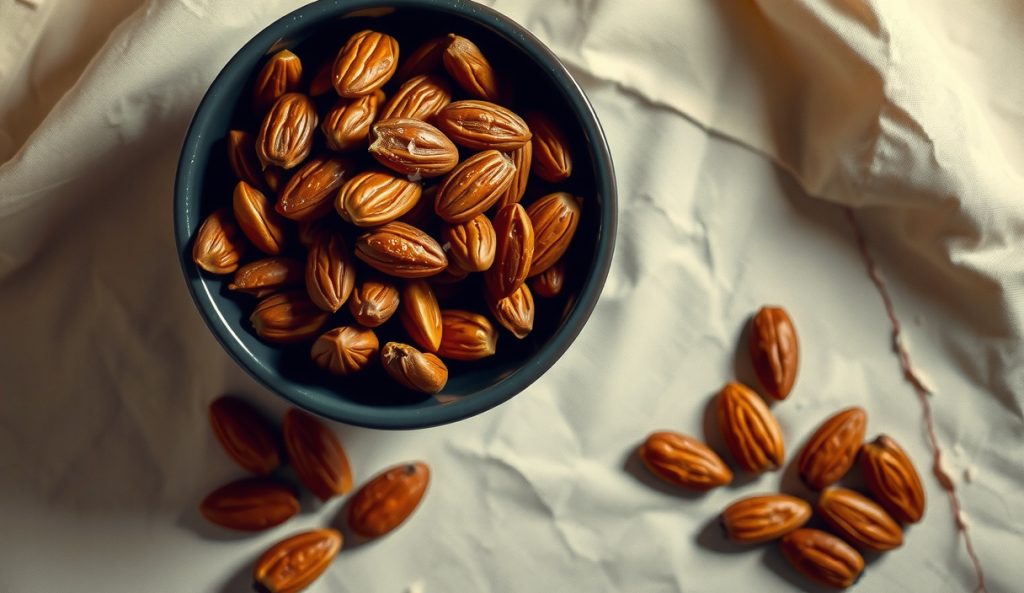
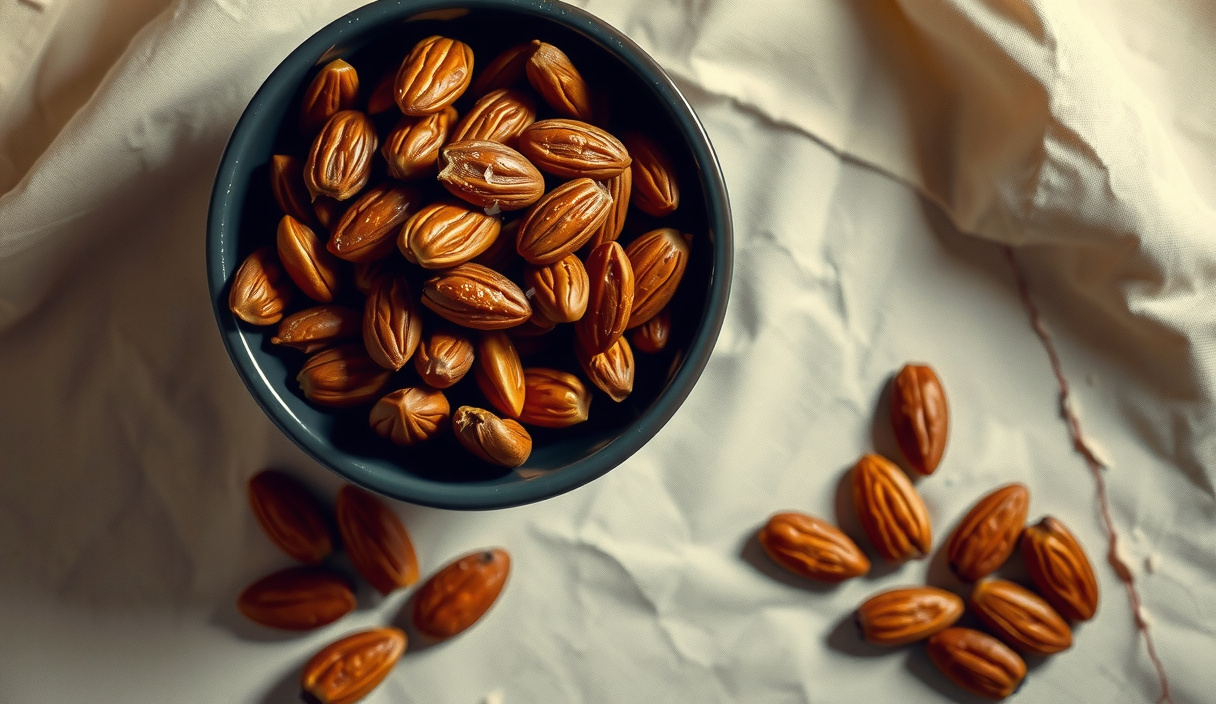
Maple-Cayenne Smoked Almonds
Equipment
- 1 Smoker or kettle grill with indirect heat setup Must hold a stable 225°F. Pellet grills, offset smokers, or kettle grills with two-zone setup all work.
- 1 Wire cooling rack Set over a half-sheet pan. Elevating the almonds allows smoke to contact all surfaces and prevents pooling of the coating.
- 1 Large mixing bowl
- 2 to 3 small chunks Wood chunks or chips (apple, cherry, or mild hickory) Soak chips in water 20 minutes if using a charcoal setup. Pellets need no soaking.
- 1 Instant-read or grill probe thermometer Optional but recommended for confirming smoker temperature at rack level.
Ingredients
- 1 lb raw whole almonds Do not use pre-roasted; surface is too dry for coating adhesion and smoke uptake.
- 3 tbsp pure maple syrup, Grade A Dark Color or Robust Taste Darker grades contain more Maillard precursors from extended sap evaporation.
- 1 tsp cayenne pepper Adjust to taste. Provides approximately 0.3% w/w capsaicin load in the finished coating.
- ¾ tsp fine sea salt Applied before smoking to accelerate surface moisture draw and suppress bitter receptor signaling.
- ½ tsp flaky sea salt For finishing immediately off the smoker while the coating is still tacky.
- 1 tsp neutral oil (such as avocado or light olive oil) Optional but helps the maple coating adhere evenly and slows initial moisture loss slightly.

Instructions
Prepare the smoker
- Fire up your smoker or set your grill for indirect heat. Target a stable 225°F at rack level — use an independent probe thermometer clipped near where the almonds will sit, not just the lid thermometer, which often reads 15 to 25°F off. Add 2 to 3 small chunks of apple or cherry wood (or a single cup of chips in a foil pouch for gas grills). Allow the smoker to reach temperature and produce thin blue smoke before the almonds go on — thick white smoke means the wood is smoldering inefficiently and will deposit acrid compounds on the coating.
Coat the almonds
- In a large bowl, combine the raw almonds, maple syrup, cayenne, fine sea salt, and oil if using. Toss thoroughly for about 60 seconds until every almond is evenly coated. The mixture should look glossy and slightly thick — no dry almonds and no pooling liquid.1 lb raw whole almonds, 3 tbsp pure maple syrup, Grade A Dark Color or Robust Taste, 1 tsp cayenne pepper, 3/4 tsp fine sea salt, 1 tsp neutral oil (such as avocado or light olive oil)
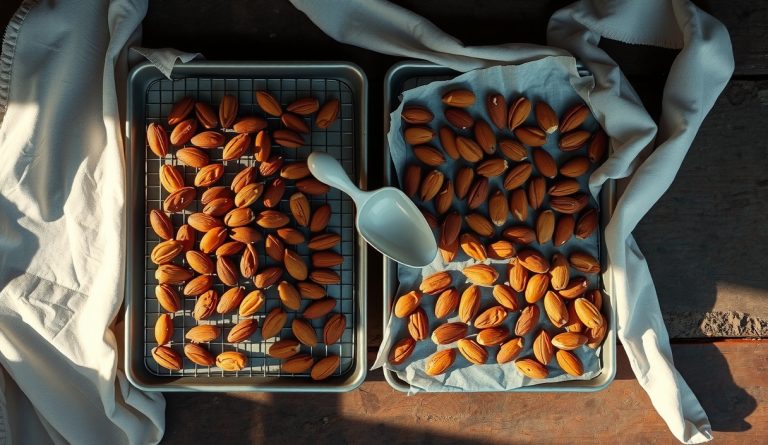
- Spread the coated almonds in a single layer on a wire rack set over a sheet pan. Every almond should have clearance from its neighbors — crowding traps steam and prevents the coating from setting evenly.1 lb raw whole almonds
Smoke
- Place the rack in the smoker. Close the lid and smoke at 225°F for the first 30 minutes without opening. Resist the urge to check — the coating needs uninterrupted heat to begin drying down from its initial high water activity state.
- At the 30-minute mark, open the smoker and stir the almonds with a spatula or tongs, turning them to expose the underside surfaces to smoke and prevent the coating from fusing to the rack. The almonds will still look tacky and pale — this is correct. Close the lid and continue.
- At the 60-minute mark, stir again. By now you should see the beginnings of amber Maillard color on the coating — the water activity has dropped sufficiently for the browning cascade to accelerate. If the coating looks dark brown or smells burnt at this stage, your smoker is running hotter than indicated; reduce heat immediately and pull at 75 to 80 minutes total.
- At 90 minutes total, the almonds should have a rich amber-to-caramel-brown coating that looks slightly tacky but no longer wet. They will feel semi-firm when pushed with a spatula but will not yet be crunchy — this is the correct pull point. The sugar glass completes its set during cooling, not on the smoker. Remove the rack.
Cool and finish
- Immediately scatter the flaky sea salt over the almonds while the coating is still tacky — this is the only window where finishing salt will adhere to the surface rather than falling off. Spread the almonds in a single layer and do not touch them for at least 15 to 20 minutes. As they cool, you will hear the coating harden from a sticky soft gel into a crisp, lacquered shell.1/2 tsp flaky sea salt
- Once fully cooled and crunchy, taste and adjust. If you want more heat, dust lightly with additional cayenne while the surface still has a trace of tack. Transfer to an airtight container and store at room temperature for up to 10 days. Do not refrigerate — ambient humidity will slowly dissolve the sugar glass and make the almonds sticky.1 tsp cayenne pepper
Notes
Nutrition
There is a specific alchemy that happens when a raw almond hits smoke at 225°F. Nothing dramatic on the outside — no violent sizzle, no aggressive char. Just a slow, deliberate transformation where the surface coating locks down, the interior warms through, and somewhere in the last half-hour the whole batch starts smelling like a campfire caramel shop. These maple-cayenne smoked almonds are the snack that earns its place on the counter.
The formula is deceptively simple: raw almonds, real maple syrup, cayenne, sea salt, and a smoker running at 225°F. But the physics underneath that simplicity are genuinely interesting, and understanding them is what separates a sticky, underdeveloped batch from one with a tight lacquered shell, deep smoke penetration, and a clean heat finish that lingers without burning.
Why do maple-cayenne smoked almonds work? The science explained
Maple-cayenne smoked almonds work because the high-moisture maple syrup coating acts simultaneously as a Maillard reactor, a smoke-phenol trap, and a capsaicin delivery vehicle — all operating in sequence across a 90-minute window at 225°F. Maple syrup is approximately 66% total dissolved solids, predominantly sucrose with a minor fraction of invert sugars (fructose and glucose) produced during evaporation. When raw almonds are tossed in maple syrup and exposed to 225°F convective heat, two things begin happening simultaneously. First, the sucrose at the almond surface undergoes hydrolysis as residual moisture drives the reaction, yielding free fructose and glucose. Those reducing monosaccharides are far more reactive Maillard participants than intact sucrose: they initiate amino-carbonyl condensation with surface amino acids on the almond’s protein fraction at lower energy thresholds, generating pyrazines, furanones, and the characteristic caramel melanoidins.
Water activity at the nut surface starts high — which is why little color appears in the first 30 minutes — then drops sharply as the aqueous phase evaporates. Once the surface water activity dips below roughly 0.7, the browning cascade accelerates visibly. The critical window is the second 30-minute interval: that is when the coating transitions from tacky to set.
Smoke phenols — principally guaiacol, syringol, and their alkyl derivatives — adsorb onto the almond surface via two mechanisms. The first is simple physical condensation onto the sticky, high-water-activity coating in the early phase of the cook: the syrup layer acts as a trap, dramatically increasing phenol retention compared to a dry-surface nut. The second mechanism kicks in as the coating vitrifies: phenols become partially encapsulated within the hardening sugar glass, which is why these almonds retain smoke character days after coming off the smoker, rather than fading within hours like many other smoked snacks. Running the smoker at 225°F rather than higher temperatures favors the generation of guaiacol-dominant smoke over acrolein-heavy combustion products — cleaner, more aromatic, with none of the acrid bite that comes from running too hot.
Cayenne contains capsaicin, which activates TRPV1 thermoreceptors on the tongue and palate. At the concentration used here — roughly 0.3% w/w of the total coating mass — the heat is assertive but not punishing. Fat-soluble capsaicin partitions into the almond’s native lipid phase during the 90-minute smoke, which extends the perceived heat duration compared to a surface-only application: the fat acts as a slow-release depot. Sea salt applied at the same time does two things: it accelerates early-stage moisture draw from the nut surface via ionic osmotic effect, speeding water-activity reduction; and at the sensory level, sodium ions competitively suppress bitter receptor signaling, letting the maple and smoke character dominate the flavor narrative.
What equipment and ingredients do I need?
- Smoker or grill with indirect heat: Any smoker or kettle grill capable of holding a stable 225°F works. Pellet grills are ideal for set-and-monitor operation. Charcoal kettles work well with a two-zone setup and a water pan for temperature damping.
- Wood choice: Apple or cherry wood gives a mild, fruit-forward smoke that does not compete with the maple. Hickory works but is assertive — use a smaller chunk or a single pellet-cup equivalent. Avoid mesquite at this low temperature; it produces acrid resinous compounds more readily at slow smoldering rates.
- Wire rack or perforated grill pan: Elevating the almonds off a solid sheet pan dramatically improves airflow and smoke contact on all surfaces. A grill basket or a quarter-sheet pan lined with a cooling rack are both excellent.
- Raw almonds (not pre-roasted): Pre-roasted almonds have already undergone Maillard development and surface dehydration. Their coating uptake is poor and they scorch easily at 225°F over 90 minutes. Start raw.
- Pure maple syrup (Grade A, Dark Color or Robust Taste): The darker grades contain more of the Maillard precursors generated during extended sap reduction, giving deeper flavor complexity. Light or Fancy grades work but taste thinner in the finished product.
- Instant-read thermometer: Optional but useful for confirming the smoker is holding 225°F, not drifting to 250°F, which risks burning the sugar coating before smoke penetration is complete.
Maple-Cayenne Smoked Almonds
Equipment
- 1 Smoker or kettle grill with indirect heat setup Must hold a stable 225°F. Pellet grills, offset smokers, or kettle grills with two-zone setup all work.
- 1 Wire cooling rack Set over a half-sheet pan. Elevating the almonds allows smoke to contact all surfaces and prevents pooling of the coating.
- 1 Large mixing bowl
- 2 to 3 small chunks Wood chunks or chips (apple, cherry, or mild hickory) Soak chips in water 20 minutes if using a charcoal setup. Pellets need no soaking.
- 1 Instant-read or grill probe thermometer Optional but recommended for confirming smoker temperature at rack level.
Ingredients
- 1 lb raw whole almonds Do not use pre-roasted; surface is too dry for coating adhesion and smoke uptake.
- 3 tbsp pure maple syrup, Grade A Dark Color or Robust Taste Darker grades contain more Maillard precursors from extended sap evaporation.
- 1 tsp cayenne pepper Adjust to taste. Provides approximately 0.3% w/w capsaicin load in the finished coating.
- ¾ tsp fine sea salt Applied before smoking to accelerate surface moisture draw and suppress bitter receptor signaling.
- ½ tsp flaky sea salt For finishing immediately off the smoker while the coating is still tacky.
- 1 tsp neutral oil (such as avocado or light olive oil) Optional but helps the maple coating adhere evenly and slows initial moisture loss slightly.
Instructions
Prepare the smoker
- Fire up your smoker or set your grill for indirect heat. Target a stable 225°F at rack level — use an independent probe thermometer clipped near where the almonds will sit, not just the lid thermometer, which often reads 15 to 25°F off. Add 2 to 3 small chunks of apple or cherry wood (or a single cup of chips in a foil pouch for gas grills). Allow the smoker to reach temperature and produce thin blue smoke before the almonds go on — thick white smoke means the wood is smoldering inefficiently and will deposit acrid compounds on the coating.
Coat the almonds
- In a large bowl, combine the raw almonds, maple syrup, cayenne, fine sea salt, and oil if using. Toss thoroughly for about 60 seconds until every almond is evenly coated. The mixture should look glossy and slightly thick — no dry almonds and no pooling liquid.1 lb raw whole almonds, 3 tbsp pure maple syrup, Grade A Dark Color or Robust Taste, 1 tsp cayenne pepper, 3/4 tsp fine sea salt, 1 tsp neutral oil (such as avocado or light olive oil)
- Spread the coated almonds in a single layer on a wire rack set over a sheet pan. Every almond should have clearance from its neighbors — crowding traps steam and prevents the coating from setting evenly.1 lb raw whole almonds
Smoke
- Place the rack in the smoker. Close the lid and smoke at 225°F for the first 30 minutes without opening. Resist the urge to check — the coating needs uninterrupted heat to begin drying down from its initial high water activity state.
- At the 30-minute mark, open the smoker and stir the almonds with a spatula or tongs, turning them to expose the underside surfaces to smoke and prevent the coating from fusing to the rack. The almonds will still look tacky and pale — this is correct. Close the lid and continue.
- At the 60-minute mark, stir again. By now you should see the beginnings of amber Maillard color on the coating — the water activity has dropped sufficiently for the browning cascade to accelerate. If the coating looks dark brown or smells burnt at this stage, your smoker is running hotter than indicated; reduce heat immediately and pull at 75 to 80 minutes total.
- At 90 minutes total, the almonds should have a rich amber-to-caramel-brown coating that looks slightly tacky but no longer wet. They will feel semi-firm when pushed with a spatula but will not yet be crunchy — this is the correct pull point. The sugar glass completes its set during cooling, not on the smoker. Remove the rack.
Cool and finish
- Immediately scatter the flaky sea salt over the almonds while the coating is still tacky — this is the only window where finishing salt will adhere to the surface rather than falling off. Spread the almonds in a single layer and do not touch them for at least 15 to 20 minutes. As they cool, you will hear the coating harden from a sticky soft gel into a crisp, lacquered shell.1/2 tsp flaky sea salt
- Once fully cooled and crunchy, taste and adjust. If you want more heat, dust lightly with additional cayenne while the surface still has a trace of tack. Transfer to an airtight container and store at room temperature for up to 10 days. Do not refrigerate — ambient humidity will slowly dissolve the sugar glass and make the almonds sticky.1 tsp cayenne pepper
Notes
Nutrition
How do I nail these almonds every time? Tips from the smoker
- Do not skip the stirring intervals. The almonds in direct contact with the rack develop hot spots and the coating on the bottom can harden unevenly or fuse the nut to the rack. Stirring at 30 and 60 minutes redistributes the coating and ensures all surfaces see smoke contact.
- Watch water activity, not color, in the first 30 minutes. The coating will look wet and pale for the first 20 to 25 minutes. This is normal — the water activity is still high and Maillard browning is suppressed. Do not raise the temperature to force faster browning; uneven caramelization and a bitter outer shell will develop before the interior has had time to absorb smoke.
- The coating sets on cooling, not on the smoker. Pull the almonds when they look slightly underdone — tacky with a light amber shell. The almonds will continue to firm and develop a hard lacquer finish as they cool on the rack over 15 to 20 minutes. If you wait until they look perfectly crunchy on the smoker, they will be rock-hard and potentially over-caramelized at room temperature.
- Spread them to cool in a single layer immediately. If you pile the almonds while hot, the residual moisture trapped between nuts will re-hydrate the sugar glass, causing them to stick together in clumps. A wire cooling rack over a sheet pan is ideal.
- Taste and salt at the end. The maple syrup and smoking process concentrate the existing salt. A very light finishing pinch of flaky salt applied the moment the almonds come off the smoker adheres to the tacky surface and provides a burst-on-the-palate contrast that the pre-smoke salt, now embedded in the glass, cannot deliver.
- Store airtight at room temperature, not the refrigerator. Refrigerator humidity will slowly attack the sugar glass, producing a sticky, soft coating within 24 hours. An airtight container at room temperature keeps the almonds crisp for up to 10 days.
What variations can I make on this recipe?
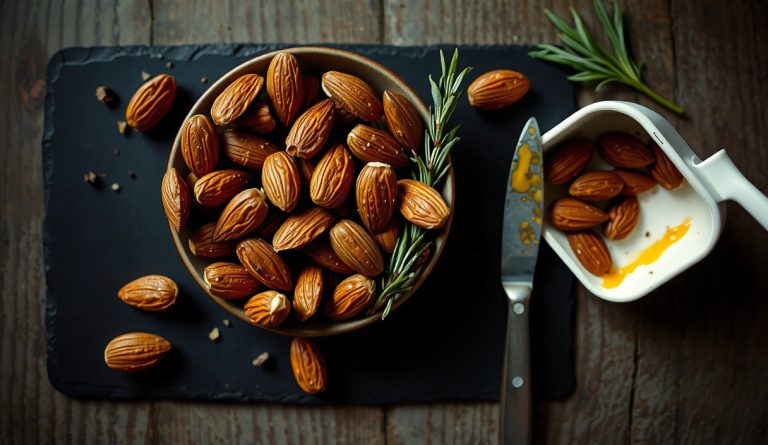
Rosemary-black pepper: Swap the cayenne for 1 teaspoon of freshly cracked black pepper and add 1 tablespoon of finely minced fresh rosemary to the coating. Rosemary contains rosmarinic acid and camphor volatiles that survive the 225°F smoke surprisingly well, lending a resinous herbal counterpoint to the maple. The piperine in black pepper activates the same TRPV1 channel as capsaicin but has a slightly lower activation threshold at lower concentrations — the heat arrives faster and dissipates faster than cayenne.
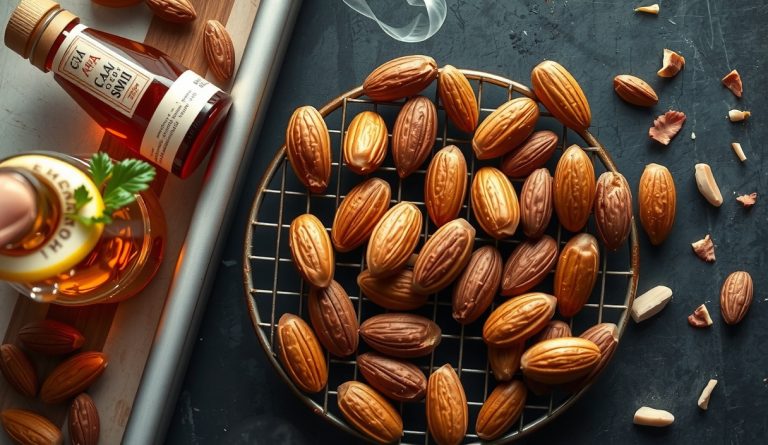
Bourbon-smoked: Replace 1 tablespoon of the maple syrup with 1 tablespoon of bourbon. The ethanol partially carries off during the first 30 minutes of smoking, leaving behind the congeners — vanilla-forward vanillin and ethyl acetate — that layer into the caramel base. Use oak or cherry wood to echo the barrel character. The water activity of the initial coating is slightly lower due to the ethanol’s co-solvent effect, so browning onset may appear 5 to 10 minutes earlier; keep a close watch during the second interval.
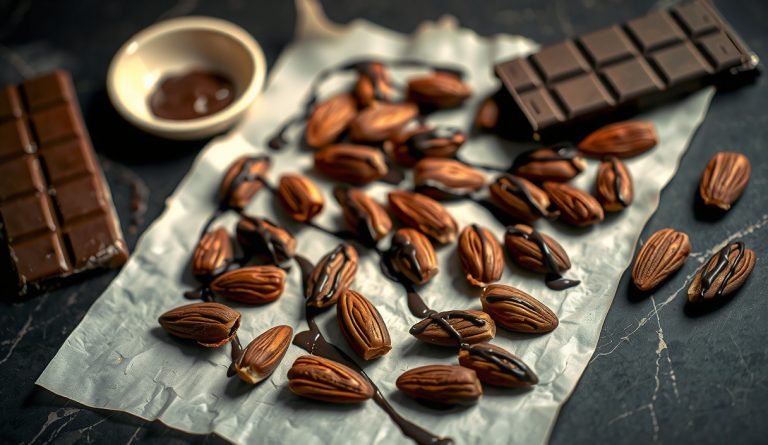
Dairy-free chocolate finish: After cooling the almonds completely — the sugar glass must be fully set, at least 20 minutes — drizzle with 1 ounce of tempered 70% dark chocolate and spread immediately on parchment. The bittersweet tannin structure of dark chocolate bridges the maple sweetness and the smoke phenols in a way that is genuinely compelling. Chill for 5 minutes only to set the chocolate, then return to room temperature storage.
Scaling: This recipe scales linearly up to about 3 pounds of almonds without adjustment. Beyond that, spreading depth on the rack becomes an issue — almonds stacked more than one layer deep will not develop even smoke contact and the interior layer will steam rather than roast. Use two racks or two sequential batches rather than crowding. The coating-to-nut ratio of roughly 1 tablespoon of maple syrup per 4 ounces of nuts remains constant at any scale.
Frequently asked questions about smoked almonds
Can I make these in an oven if I don’t have a smoker? Yes, with a compromise on smoke depth. Roast at 250°F on a wire rack for 35 to 40 minutes, stirring at 20 minutes. Excellent Maillard caramelization and the cayenne-maple character come through clearly. For smoke flavor, add 1/2 teaspoon of smoked paprika to the coating — it is not the same mechanism as phenol adsorption from real wood smoke, but the guaiacol-adjacent compounds in smoked paprika approximate the flavor direction reasonably well.
Why do my almonds taste bitter even though I followed the recipe? Bitterness is almost always a Maillard overshoot — the sugar coating has passed through the optimal melanoidin range and entered pyrolysis territory. The most common cause is a smoker running hotter than indicated: surface thermometers on most smokers read ambient air at rack level, but grates can run 15 to 25°F hotter than the dial suggests. Use an independent probe thermometer clipped near the almonds. A second cause is insufficient stirring — static contact with the rack creates localized hot zones. If a batch comes out bitter, toss the almonds lightly in a teaspoon of fresh maple syrup and a pinch of salt; the sweetness and sodium suppress bitter receptor signaling and can salvage an otherwise over-caramelized batch.
Can I use honey instead of maple syrup? Honey will work mechanically — it provides a sticky coating and contains reducing sugars — but it produces a distinctly different flavor profile. Honey is approximately 38% fructose and 31% glucose, compared to maple syrup’s sucrose-dominant profile, meaning the Maillard cascade initiates faster and at lower temperatures. Browning onset appears 10 to 15 minutes earlier and the risk of burning increases if the smoker temperature is not reduced to 210°F. The finished flavor is lighter in body and floral rather than deep-caramel; some people prefer it, especially with a mild fruit wood like apple or peach.