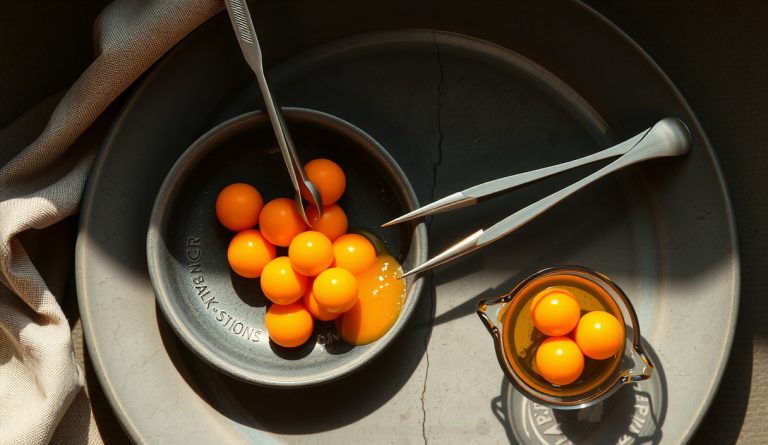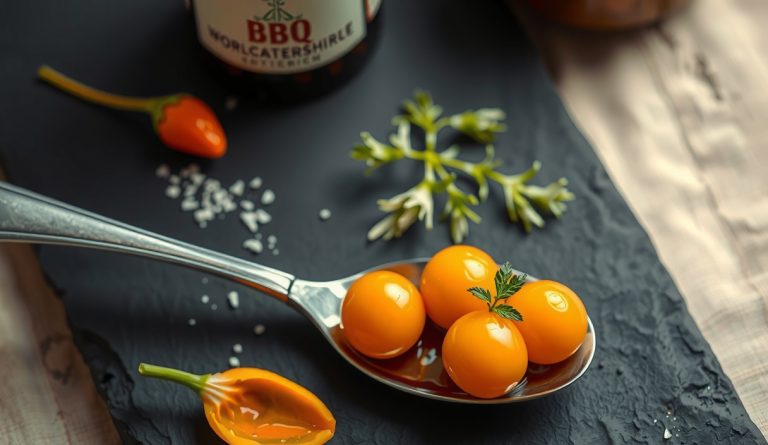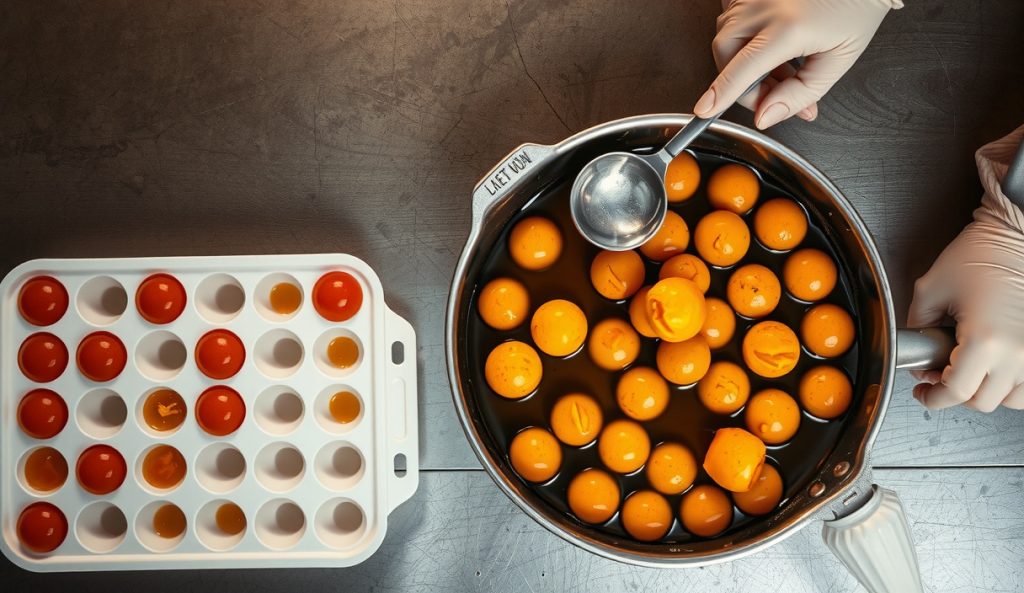
The canonical spherified mango-habanero BBQ sauce caviar recipe yields approximately 40 spheres — right-sized for a restaurant pass or a small dinner party garnish. Catering volume changes the geometry of the process entirely: you need consistent throughput, bath stability across hundreds of drops, and a holding protocol that keeps spheres intact over a multi-hour service window. With the right equipment adjustments, spherification scales cleanly to 200 or more spheres per batch without meaningful quality loss.
What changes at catering scale?
The single most important equipment change is the bath vessel: mix the sodium alginate bath in a 4-liter hotel pan rather than a standard mixing bowl. The additional surface area reduces crowding between dropping spheres and lowers the chance of spheres touching and fusing during gelation — a failure mode that becomes statistically inevitable once you exceed roughly 60 drops in a shallow bowl.
Switch from single-drop technique to a 12-cavity silicone hemisphere mold, the standard catering tool for this process. Setting 12 spheres simultaneously per pass compresses total active forming time by roughly 80 percent at scale compared to individual dropping. One operator can maintain a steady rhythm of fill, immerse, wait, transfer, rinse — eliminating the bottleneck that makes single-drop technique impractical above 40 spheres.
Run a continuous two-container rinse chain: a primary rinse vessel that receives spheres directly from the bath, and a secondary clean-water holding vessel where finished spheres accumulate. Swap the primary rinse water every 50–60 spheres. Calcium chloride carryover from the bath will harden the outer surface of spheres sitting in an unswaped rinse, producing an uneven, overdeveloped membrane on later batches.
At high volume, bath calcium concentration can rise slightly as carryover from the mold or dropper reintroduces alginate solution into the bath. If membranes thicken inconsistently in later passes, strain the bath surface with a fine-mesh skimmer to remove loose alginate residue before continuing. This is the most common cause of membrane inconsistency that emerges only at scale.
Pre-made spheres hold well for 18–24 hours refrigerated in a light coating of the original mango sauce, which acts as both a flavor equalizer and a surface-tension buffer. During this hold, residual aromatics — garlic, ginger, habanero pepper volatiles — continue to equilibrate across the membrane into the gel interior, so day-old spheres carry a fractionally more integrated flavor than freshly made ones.
What stays the same when scaling up?
Sodium alginate percentage in the dropping solution, calcium chloride bath concentration, immersion time per sphere, and membrane target thickness are all identical to the canonical recipe. The mango-habanero sauce formula itself is not modified — scale it by simple multiplication of each ingredient. No reformulation is required for yield increases up to 200 or more spheres per batch.
When is the catering-scale method the right choice?
This workflow is appropriate for any event service where spheres are being plated across 25 or more covers, for competition cook-off presentations requiring uniform garnish across multiple identical plates, or for catering setups where advance prep the day before service is operationally necessary. The 18–24 hour hold window makes the catering method the only viable approach when same-day spherification is not logistically feasible.
Use the full method, equipment, and alginate measurements from the original Spherified Mango-Habanero BBQ Sauce Caviar.