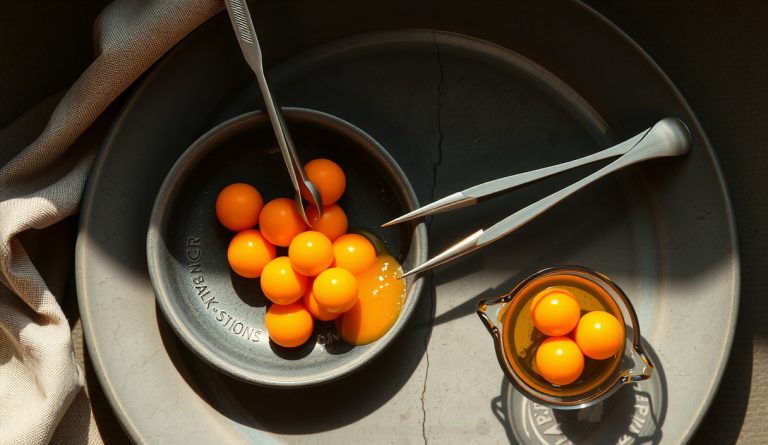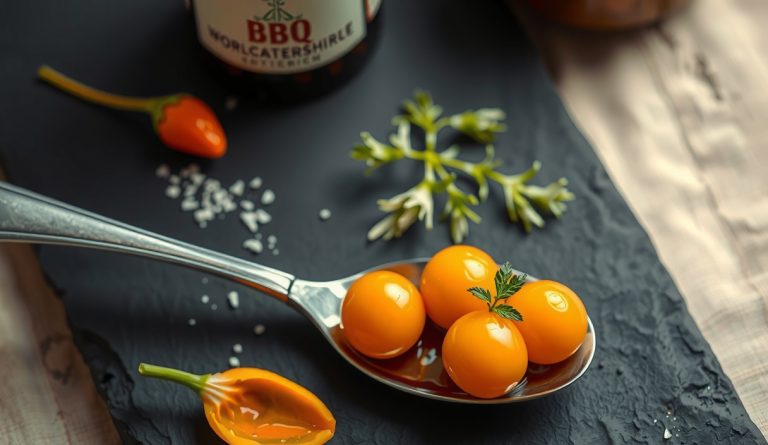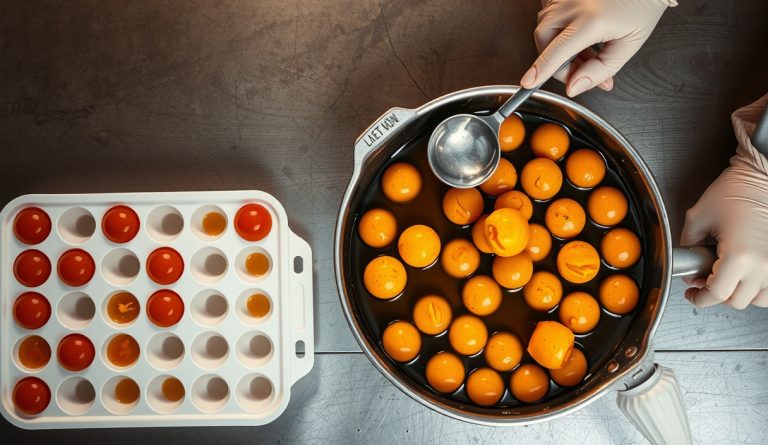
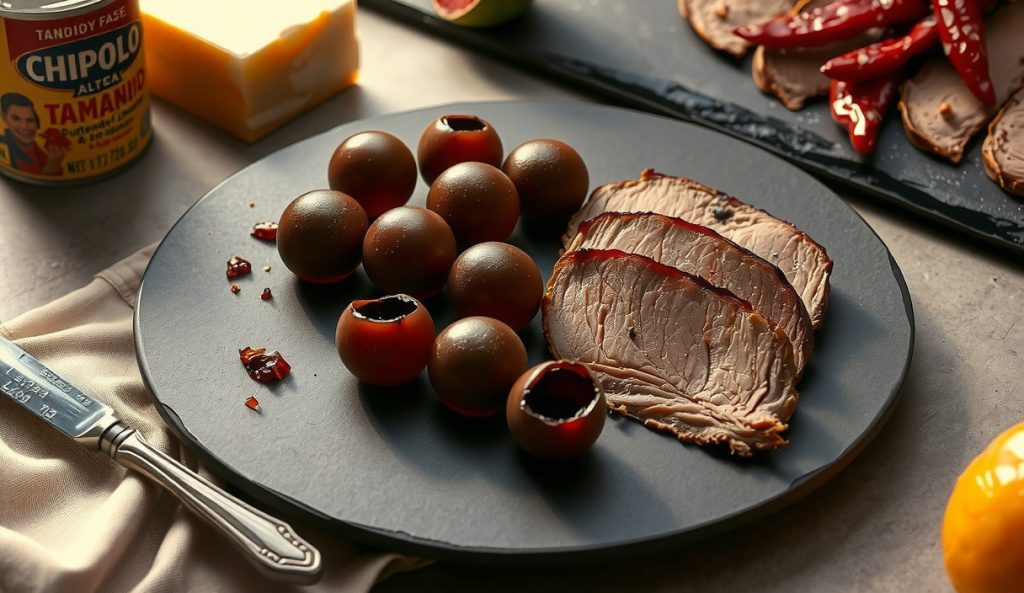
The tamarind-chipotle version of spherified BBQ sauce caviar trades the bright tropical heat of the canonical mango-habanero build for deep, smoke-forward acidity. Tamarind concentrate delivers tartaric and citric acid loads that produce a sharp, almost tannic sourness, while chipotles in adobo contribute both capsaicin heat and genuine smoke character derived from the jalapeño drying process. The resulting sphere is denser in flavor, darker in color, and substantially more compatible with the rendered fat of smoked brisket or pork belly than the original mango-habanero version.
What changes in the tamarind-chipotle version?
Blend 30 g of tamarind concentrate into the mango puree base, replacing a proportional volume of mango so the total dropping solution weight remains constant. Swap the habanero for one or two chipotles in adobo, blended completely smooth before incorporation — any fibrous chipotle fragments will partially block a fine dropper tip and produce misshapen spheres.
The critical process adjustment in this version is calcium chloride bath pH management. Tamarind concentrate is strongly acidic, with a pH that typically falls between 2.8 and 3.5 depending on concentration. As spheres are dropped into the bath, residual tamarind acidity transfers into the bath solution with each sphere, progressively lowering bath pH over a large batch run.
Calcium-alginate gelation kinetics are sensitive to pH: as the bath acidifies below approximately 4.5, divalent calcium ions begin competing with hydrogen ions for alginate carboxylate binding sites, slowing cross-link formation and producing thinner, structurally weaker membranes. Check bath pH with a strip every 40–50 spheres and replace the bath solution if you observe membranes thinning or breaking. A fresh bath takes under two minutes to prepare and is the simplest corrective measure.
The adobo sauce itself contributes residual oil and starch from the canning liquid. These do not interfere with spherification, but they will cloud the bath faster than a clean puree, making visual monitoring less reliable than pH testing in this version.
What stays the same as the original recipe?
Sodium alginate percentage, calcium chloride bath concentration, dropper gauge, immersion time, and the two-stage rinse sequence are all unchanged from the canonical mango-habanero build. Yield per batch and refrigerated hold time remain identical.
When is the tamarind-chipotle version the better choice?
Use the tamarind-chipotle variation as a plating element for smoked brisket, pork belly, or any fatty barbecue application where brightness would feel out of place and depth of flavor is the priority. The smoky acidity of the sphere cuts through rendered fat without the fruitiness that can read as dessert-adjacent on a savory plate.
The tamarind-chipotle sphere also works well as a garnish for smoked beef short ribs served in a fine-dining or competition plating context, where a dark, smoke-forward sauce element reinforces the protein rather than contrasting it.
Use the full method, equipment, and alginate measurements from the original Spherified Mango-Habanero BBQ Sauce Caviar.