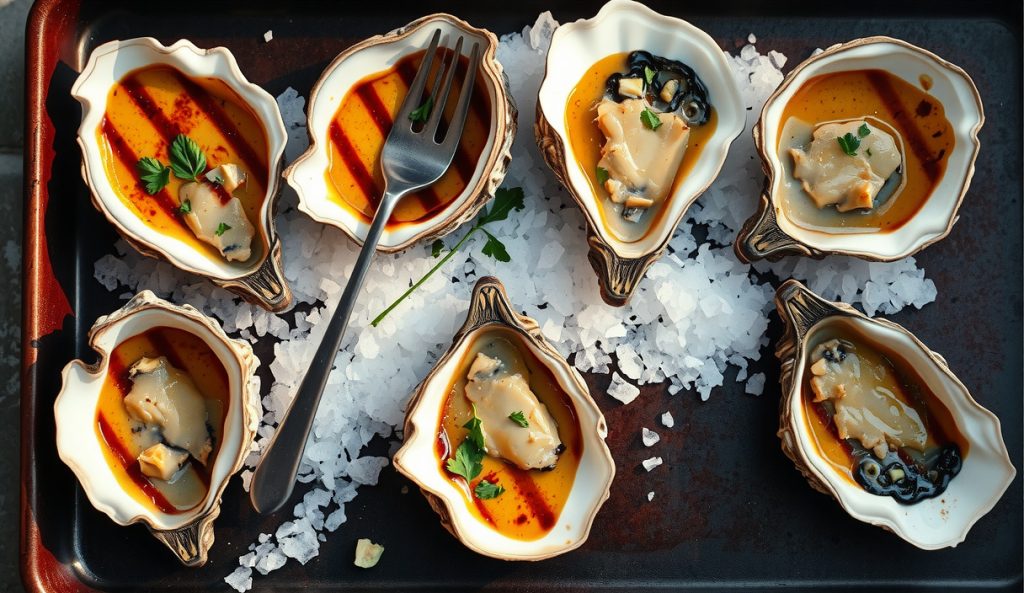
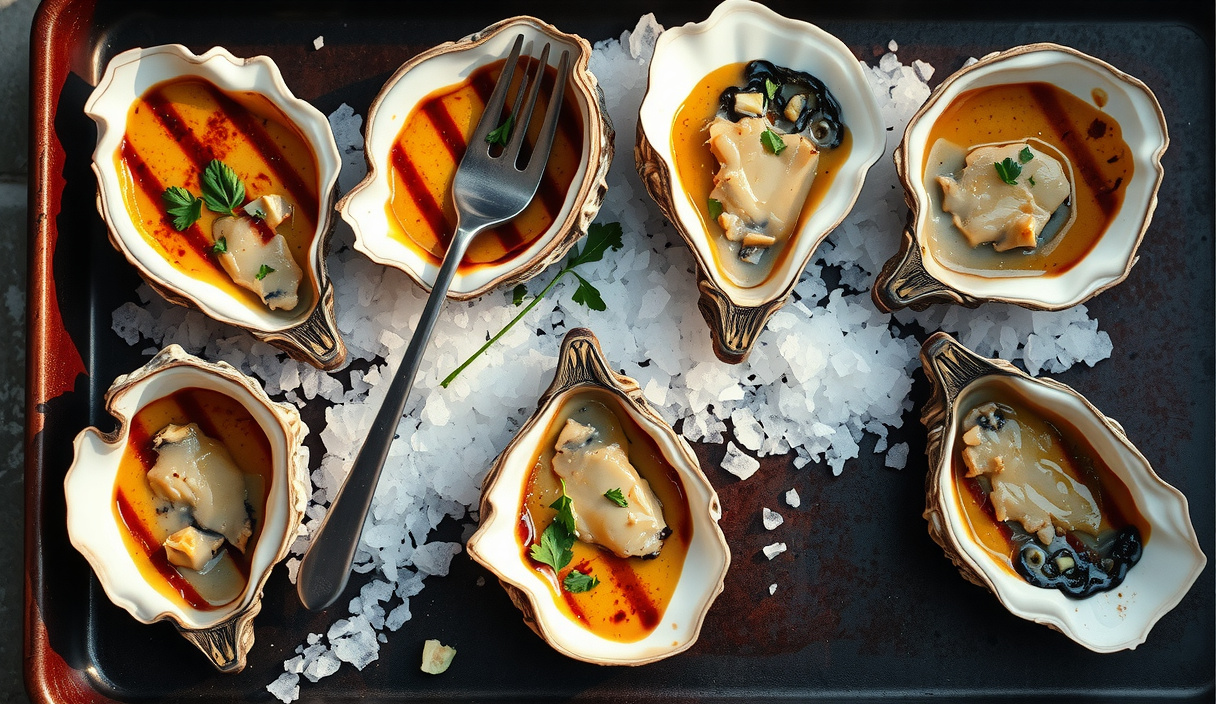
Grilled Oysters with Garlic-Parsley Butter

Equipment
- 1 Charcoal or gas grill Must reach and hold 500°F (260°C) at the grate surface. Verify with an infrared thermometer.
- 1 Infrared thermometer Essential for confirming grate temperature before committing oysters.
- 1 Sheet pan with coarse rock salt or crumpled aluminum foil Acts as a cradle to hold finished oysters level during serving and catches butter runoff.
- 1 Oyster knife For prying any oysters that do not fully open on their own.
- 1 Long-handled tongs Heat-rated for direct grill work. Use to transfer oysters and nudge open shells.
- 1 Small spoon or pastry brush For depositing compound butter into each open shell quickly.
- 1 Kitchen timer Non-negotiable. The window is 90 seconds.
Ingredients
Oysters
- 24 live oysters, deep-cupped variety (Gulf Select, Pacific, or Kumamoto) Shells must be tightly closed or snap shut when tapped. Scrub shells under cold running water before grilling.
Garlic-Parsley Compound Butter
- 8 tablespoons unsalted European-style butter (82–84% fat), softened to room temperature Higher fat content increases aroma-retention capacity. Standard American butter works but delivers slightly less richness.
- 4 cloves garlic, minced very fine Mince immediately before mixing to maximize allicin generation from the enzymatic conversion. Do not use pre-minced jarred garlic.
- 3 tablespoons fresh flat-leaf parsley, finely chopped Adds chlorophyll-green brightness and a grassy VOC layer that contrasts the butter richness.
- 1 tablespoon fresh lemon juice Shifts system to pH 4–5, amplifying perceived brininess and retronasal volatile release. Add just before serving, not into the base compound, to prevent emulsion weeping during hold.
- 1 teaspoon kosher salt
- 0.5 teaspoon freshly cracked black pepper
- 0.25 teaspoon crushed red pepper flakes Optional. Capsaicin activates TRPV1 channels and creates a mild chemesthetic heat that highlights the brine.
For Serving
- 2 cups coarse rock salt or crumpled aluminum foil Spread on a sheet pan to cradle and stabilize finished oysters during plating.
- 1 lemon, cut into wedges For additional acid at the table.
- 1 small bunch fresh parsley, for garnish Optional.

Instructions
Make the Compound Butter
- In a small bowl, combine the softened butter, minced garlic, chopped parsley, kosher salt, black pepper, and red pepper flakes if using. Mix vigorously with a fork until fully homogeneous — no streaks of plain butter remaining. Do not add lemon juice yet. Acid added now can cause the emulsion to weep during hold. Transfer to a small ramekin, cover, and hold at cool room temperature for up to 1 hour, or refrigerate for up to 5 days and bring back to spreadable consistency before service.4 cloves garlic, minced very fine, 3 tablespoons fresh flat-leaf parsley, finely chopped, 1 teaspoon kosher salt, 0.5 teaspoon freshly cracked black pepper, 0.25 teaspoon crushed red pepper flakes
Prep the Grill and Staging Area
- Light a full chimney of lump charcoal. When the coals are fully ashed over and glowing orange (about 15–20 minutes), dump into the grill and spread into an even single layer. Open all vents fully. Allow to heat for 10 minutes with the grill grate in place and the lid off. Verify surface temperature with an infrared thermometer: target 480–520°F (249–271°C). For gas grills, preheat on high with the lid closed for 10 minutes and verify the same target.
- While the grill heats, spread coarse rock salt or tightly crumpled aluminum foil across a sheet pan to a depth of about 1 inch. This is your serving and holding platform. Set it on a heatproof surface near the grill. Set out the ramekin of compound butter and your spoon or brush within arm’s reach of the grill.2 cups coarse rock salt or crumpled aluminum foil
- Scrub oyster shells under cold running water with a stiff brush to remove grit and debris. Inspect each one: any oyster with a gaping shell that does not snap closed when tapped is dead — discard it. Sort oysters so the deep, cupped side is visually identifiable. This orientation goes down on the grate.
Grill the Oysters
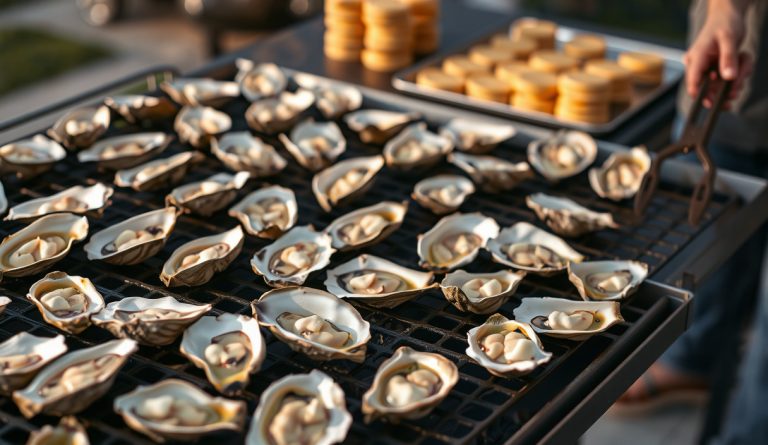
- Place oysters directly on the hot grate, deep cup down, flat lid up. Work in batches of 6 to 12 depending on your grill surface area. Do not crowd — each oyster needs direct radiant heat from the coals below. Start your timer the moment the last oyster hits the grate.
- At approximately 50–60 seconds, watch for the flat lid to crack open. This signals that the adductor muscle has denatured sufficiently and the internal steam pressure has lifted the shell. Use tongs to nudge any lid that is slow to open — apply gentle lateral pressure at the hinge side. Do not force; if the shell resists, give it another 10–15 seconds.
- The moment a shell is fully open, use your spoon to deposit approximately 1 teaspoon of compound butter directly onto the meat. The residual heat of the shell and the steam will melt the butter within 5–10 seconds, and it will immediately begin to bubble and brown against the glycogen-rich oyster surface. At 75–80 seconds, the butter should be actively bubbling. At 90 seconds total from when the oysters hit the grate, pull all oysters with tongs and transfer them immediately to the salt or foil bed on your sheet pan. The meat edges should be just curled; the liquor should be opaque and milky-gold, not evaporated. Do not exceed 90 seconds.4 cloves garlic, minced very fine, 3 tablespoons fresh flat-leaf parsley, finely chopped, 1 teaspoon kosher salt, 0.5 teaspoon freshly cracked black pepper, 0.25 teaspoon crushed red pepper flakes
Finish and Serve
- Squeeze fresh lemon juice over the oysters immediately before serving — not before, as acid weeping into the warm butter will cause the sauce to break and pool in the shell. Add a few small parsley leaves for garnish if desired. Serve directly on the salt-lined sheet pan, with lemon wedges alongside. Eat immediately — grilled oysters hold for approximately 3 minutes before the interior cools past the optimal serving temperature of 55–60°C and the texture begins to tighten.1 tablespoon fresh lemon juice, 1 lemon, cut into wedges, 1 small bunch fresh parsley, for garnish
Notes
Nutrition
The first time I dropped a raw oyster directly onto a screaming-hot grate, I expected the shell to shatter. Instead it did something far more interesting: the flat top lid popped open on its own around the 60-second mark, venting a curl of brine-scented steam, and the lip of the meat pulled back just enough to signal done before I could second-guess myself. That involuntary opening is the grill’s way of telling you the adductor muscle has hit its denaturation threshold — no knife, no towel, no wrist injury required.
What makes grilled oysters genuinely different from their raw counterparts is not just warmth. It is a specific chemical event at the meat-butter interface: oyster glycogen — the sugar that gives bivalves their distinctive sweet-brine character — becomes an accessible reducing substrate the moment heat loosens the cell matrix. Add a compound butter loaded with free amino acids from garlic and parsley, and you have a textbook Maillard-browning reaction happening in a shell the size of your palm, in under ninety seconds. The result is a flavor that raw oysters simply cannot produce: simultaneously oceanic, nutty, caramelized, and rich.
Why do grilled oysters taste so different from raw? The science
Grilled oysters develop flavors that raw oysters cannot produce because heat above 130°C (266°F) triggers a Maillard reaction between oyster glycogen and the amino acids in garlic butter — a reaction that is chemically impossible at room temperature. Oyster meat is unusually high in glycogen, the storage polysaccharide that accounts for up to 5% of the bivalve’s wet weight in peak condition. Glycogen is a branched polymer of glucose, and thermal energy above roughly 130°C at the surface begins to hydrolyze the outermost glucose units into free reducing sugars.
Simultaneously, the garlic butter delivers a concentrated supply of cysteine, lysine, and arginine — precisely the nucleophilic amino acids that condense most readily with those newly liberated carbonyls. The 500°F (260°C) grate drives localized surface temperatures well past Maillard onset almost instantly, generating the pyrazines, furanones, and sulfur-containing heterocyclic compounds responsible for the toasted, umami-forward aroma that distinguishes a grilled oyster from a steamed one.
The adductor muscle — the single, powerful cylinder of protein holding the shell halves together — begins denaturing its myosin fraction around 50°C (122°F) and loses structural integrity rapidly above 60°C (140°F), which is why the shell yawns open when the internal temperature climbs through that range. Actin, the more heat-stable myofibrillar protein, does not fully collapse until 74°C (165°F); cooking past that point destroys the water-holding capacity of the meat and produces the rubbery, shrunken texture that defines an overcooked oyster. The 90-second window at 500°F is calibrated to denature the adductor sufficiently to open the shell and warm the liquor to roughly 60–65°C while the exposed surface undergoes rapid Maillard browning — never pushing the interior past the actin-collapse threshold.
The garlic-parsley compound butter is an emulsified lipid phase that serves two simultaneous engineering roles. First, it delivers Maillard precursors directly to the hot, porous meat surface. Second, its high fat fraction (approximately 80% lipid by mass) acts as a hydrophobic solvent, trapping and slowly releasing the lipophilic aroma compounds generated during browning — extending the aromatic resonance on the palate well past the moment of consumption. A small addition of lemon juice shifts the system toward pH 4–5, which heightens the perception of brininess and amplifies retronasal volatile release by increasing the partial pressure of acidic VOCs above the shell.
What equipment and ingredients do I need?
- Oysters: Use large, deep-cupped varieties — Gulf Selects, Pacific, or Kumamoto work well. Flat-shelled Atlantic oysters are harder to stabilize on the grate. Buy them alive: the shell should be tightly closed or snap shut when tapped. Discard any that are already gaping and do not respond.
- Grill setup: You need a direct, two-zone charcoal fire or gas burners cranked to high — verified surface temperature of 500°F (260°C) at the grate. A chimney-started full load of lump charcoal dumped and vented for 10 minutes hits this range reliably. Gas grills need a 10-minute preheat with the lid closed.
- Rock salt or crumpled foil: Use a sheet pan filled with coarse rock salt or tightly crumpled aluminum foil as a holding rack. Oysters are inherently unstable on their curved shells; the salt bed or foil cradles them and catches any butter overflow during finishing.
- Butter quality: European-style butter (82–84% fat) produces a noticeably richer compound butter than standard American butter at 80%. The higher fat fraction increases the lipid solvent capacity for aroma retention.
- Garlic: Raw minced garlic, not roasted, not garlic powder. The alliin-to-allicin enzymatic conversion happens when the cell walls are ruptured by mincing; roasting would deactivate the alliinase and produce a different, sweeter flavor profile.
- Oyster knife and towel: Even though the grill opens most oysters, you should have a knife handy to pry the occasional stubborn one. A folded bar towel protects your palm.
Grilled Oysters with Garlic-Parsley Butter
Equipment
- 1 Charcoal or gas grill Must reach and hold 500°F (260°C) at the grate surface. Verify with an infrared thermometer.
- 1 Infrared thermometer Essential for confirming grate temperature before committing oysters.
- 1 Sheet pan with coarse rock salt or crumpled aluminum foil Acts as a cradle to hold finished oysters level during serving and catches butter runoff.
- 1 Oyster knife For prying any oysters that do not fully open on their own.
- 1 Long-handled tongs Heat-rated for direct grill work. Use to transfer oysters and nudge open shells.
- 1 Small spoon or pastry brush For depositing compound butter into each open shell quickly.
- 1 Kitchen timer Non-negotiable. The window is 90 seconds.
Ingredients
Oysters
- 24 live oysters, deep-cupped variety (Gulf Select, Pacific, or Kumamoto) Shells must be tightly closed or snap shut when tapped. Scrub shells under cold running water before grilling.
Garlic-Parsley Compound Butter
- 8 tablespoons unsalted European-style butter (82–84% fat), softened to room temperature Higher fat content increases aroma-retention capacity. Standard American butter works but delivers slightly less richness.
- 4 cloves garlic, minced very fine Mince immediately before mixing to maximize allicin generation from the enzymatic conversion. Do not use pre-minced jarred garlic.
- 3 tablespoons fresh flat-leaf parsley, finely chopped Adds chlorophyll-green brightness and a grassy VOC layer that contrasts the butter richness.
- 1 tablespoon fresh lemon juice Shifts system to pH 4–5, amplifying perceived brininess and retronasal volatile release. Add just before serving, not into the base compound, to prevent emulsion weeping during hold.
- 1 teaspoon kosher salt
- 0.5 teaspoon freshly cracked black pepper
- 0.25 teaspoon crushed red pepper flakes Optional. Capsaicin activates TRPV1 channels and creates a mild chemesthetic heat that highlights the brine.
For Serving
- 2 cups coarse rock salt or crumpled aluminum foil Spread on a sheet pan to cradle and stabilize finished oysters during plating.
- 1 lemon, cut into wedges For additional acid at the table.
- 1 small bunch fresh parsley, for garnish Optional.
Instructions
Make the Compound Butter
- In a small bowl, combine the softened butter, minced garlic, chopped parsley, kosher salt, black pepper, and red pepper flakes if using. Mix vigorously with a fork until fully homogeneous — no streaks of plain butter remaining. Do not add lemon juice yet. Acid added now can cause the emulsion to weep during hold. Transfer to a small ramekin, cover, and hold at cool room temperature for up to 1 hour, or refrigerate for up to 5 days and bring back to spreadable consistency before service.4 cloves garlic, minced very fine, 3 tablespoons fresh flat-leaf parsley, finely chopped, 1 teaspoon kosher salt, 0.5 teaspoon freshly cracked black pepper, 0.25 teaspoon crushed red pepper flakes
Prep the Grill and Staging Area
- Light a full chimney of lump charcoal. When the coals are fully ashed over and glowing orange (about 15–20 minutes), dump into the grill and spread into an even single layer. Open all vents fully. Allow to heat for 10 minutes with the grill grate in place and the lid off. Verify surface temperature with an infrared thermometer: target 480–520°F (249–271°C). For gas grills, preheat on high with the lid closed for 10 minutes and verify the same target.
- While the grill heats, spread coarse rock salt or tightly crumpled aluminum foil across a sheet pan to a depth of about 1 inch. This is your serving and holding platform. Set it on a heatproof surface near the grill. Set out the ramekin of compound butter and your spoon or brush within arm’s reach of the grill.2 cups coarse rock salt or crumpled aluminum foil
- Scrub oyster shells under cold running water with a stiff brush to remove grit and debris. Inspect each one: any oyster with a gaping shell that does not snap closed when tapped is dead — discard it. Sort oysters so the deep, cupped side is visually identifiable. This orientation goes down on the grate.
Grill the Oysters
- Place oysters directly on the hot grate, deep cup down, flat lid up. Work in batches of 6 to 12 depending on your grill surface area. Do not crowd — each oyster needs direct radiant heat from the coals below. Start your timer the moment the last oyster hits the grate.
- At approximately 50–60 seconds, watch for the flat lid to crack open. This signals that the adductor muscle has denatured sufficiently and the internal steam pressure has lifted the shell. Use tongs to nudge any lid that is slow to open — apply gentle lateral pressure at the hinge side. Do not force; if the shell resists, give it another 10–15 seconds.
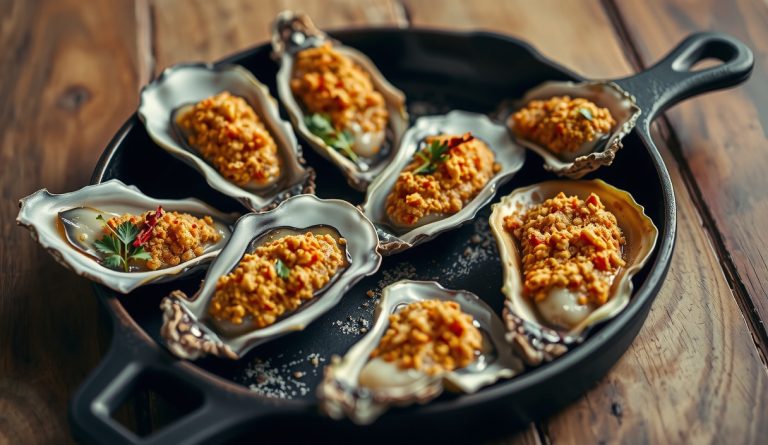
- The moment a shell is fully open, use your spoon to deposit approximately 1 teaspoon of compound butter directly onto the meat. The residual heat of the shell and the steam will melt the butter within 5–10 seconds, and it will immediately begin to bubble and brown against the glycogen-rich oyster surface. At 75–80 seconds, the butter should be actively bubbling. At 90 seconds total from when the oysters hit the grate, pull all oysters with tongs and transfer them immediately to the salt or foil bed on your sheet pan. The meat edges should be just curled; the liquor should be opaque and milky-gold, not evaporated. Do not exceed 90 seconds.4 cloves garlic, minced very fine, 3 tablespoons fresh flat-leaf parsley, finely chopped, 1 teaspoon kosher salt, 0.5 teaspoon freshly cracked black pepper, 0.25 teaspoon crushed red pepper flakes
Finish and Serve
- Squeeze fresh lemon juice over the oysters immediately before serving — not before, as acid weeping into the warm butter will cause the sauce to break and pool in the shell. Add a few small parsley leaves for garnish if desired. Serve directly on the salt-lined sheet pan, with lemon wedges alongside. Eat immediately — grilled oysters hold for approximately 3 minutes before the interior cools past the optimal serving temperature of 55–60°C and the texture begins to tighten.1 tablespoon fresh lemon juice, 1 lemon, cut into wedges, 1 small bunch fresh parsley, for garnish
Notes
Nutrition
How do I nail grilled oysters every time? Tips for success
- Verify grill temperature before you commit. An infrared thermometer aimed at the grate surface should read 480–520°F. Too cool and the Maillard reaction stalls; too hot and the shell cracks or the liquor boils away before the butter has time to meld with the meat. If you do not have an IR thermometer, a drop of water should vaporize in under one second.
- Position the deep cup down, flat lid up. This is non-negotiable. The oyster liquor pools in the deep cup and braises the meat from below while the grill heat attacks from above. Flipping the orientation spills the liquor immediately and produces a dry, scorched result.
- Do not walk away. Ninety seconds is the hard window. At 60 seconds the shell begins to open; at 75 seconds the butter should be visibly bubbling; at 90 seconds the meat edges curl and you pull. Every 15 seconds beyond that pushes the internal temperature closer to the actin-collapse zone. Set a timer.
- Add butter only after the shell opens. Dropping compound butter onto a closed shell wastes it. Watch for the lid to crack open — usually at the 50–60 second mark — then use tongs to nudge it fully open and add the butter immediately. The residual heat of the shell and the steam inside will melt it within seconds.
- Watch for liquor volume as a doneness cue. A properly cooked grilled oyster retains roughly half its original liquor, now infused with garlic butter. If the shell is bone dry, you overshot the window. Pull earlier on the next round.
- Failure mode — rubbery meat: Root cause is thermal overshoot past 74°C internal. Lower grill temperature by partially closing vents, or reduce cook time by 15 seconds per batch until you find the right calibration for your specific grill and oyster size.
What variations can I try with grilled oysters?
Cajun breadcrumb finish: Mix 2 tablespoons of fine dry breadcrumbs with 1 teaspoon of smoked paprika, a pinch of cayenne, and a pinch of dried thyme into the compound butter. The breadcrumbs provide a starchy surface that browns faster and more dramatically than butter alone, generating additional pyrazines for a deeper toast note. Watch closely — the crumbs can transition from golden to burnt in under 20 seconds at this temperature.
Mignonette compound butter: Replace the lemon juice with 1 tablespoon of champagne vinegar and stir in 1 teaspoon of finely minced shallot and a generous amount of cracked black pepper. The acetic acid in the vinegar acts as a brighter, more volatile acidulant than citric acid, producing a sharper aromatic spike that cuts through the fat and echoes a classic raw-bar mignonette. Keep the vinegar addition under 2% of the total butter mass to prevent the emulsion from breaking under heat.
Asian umami riff: Substitute the parsley with finely minced fresh ginger and the lemon juice with a teaspoon of unseasoned rice vinegar. Add half a teaspoon of white miso stirred into the butter before compounding. The miso contributes preformed glutamates and nucleotides that synergize with the oyster’s own umami compounds, triggering an exponential amplification of savory perception at the T1R1/T1R3 receptor level that dramatically exceeds what either ingredient delivers alone.
Scaling up: The recipe scales linearly to any quantity of oysters. Work in batches of 6 to 12 depending on your grill surface area — crowding reduces the radiant heat reaching each shell and extends cook time unpredictably. Prepare all compound butter in advance and hold it refrigerated; it keeps for five days. Oysters must be cooked to order; they cannot be held after cooking without pushing into overcooked territory.
Frequently asked questions about grilled oysters
Can I use a gas grill instead of charcoal? Yes, with one caveat: gas grills lack the infrared radiation contribution of glowing charcoal, which means the surface temperature at the grate is slightly lower for a given BTU setting. Compensate by preheating fully with the lid closed for at least 10 minutes and verifying with an IR thermometer before adding oysters. Flavor-wise, the difference is subtle — the dominant aromatics come from the Maillard reaction between oyster glycogen and garlic butter, not from smoke.
Do I need to shuck the oysters before grilling? No — that is the point. The heat opens them. The one exception is if you prefer to add the butter before cooking for a different presentation; in that case, shuck the oysters beforehand, discard the flat top shell, loosen the meat, and place the deep cup on the grill already buttered. Cook time shortens to about 60–70 seconds since there is no lid trapping steam.
How do I know if an oyster is bad before I cook it? A live oyster holds its shell closed against intrusion. Tap any gaping oyster — if it does not close within a few seconds, it is dead and should be discarded immediately. A properly live oyster will also feel heavy for its size (full of liquor) and smell of clean seawater, never sulfurous or ammoniated. When in doubt, throw it out; the cost of a bad oyster is not worth the risk of Vibrio exposure.