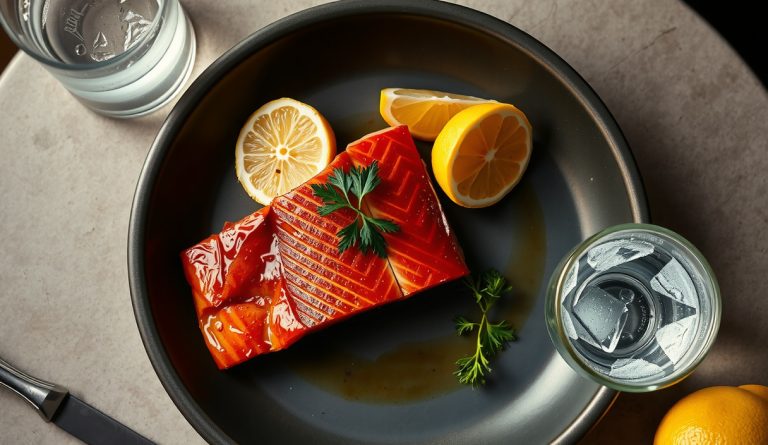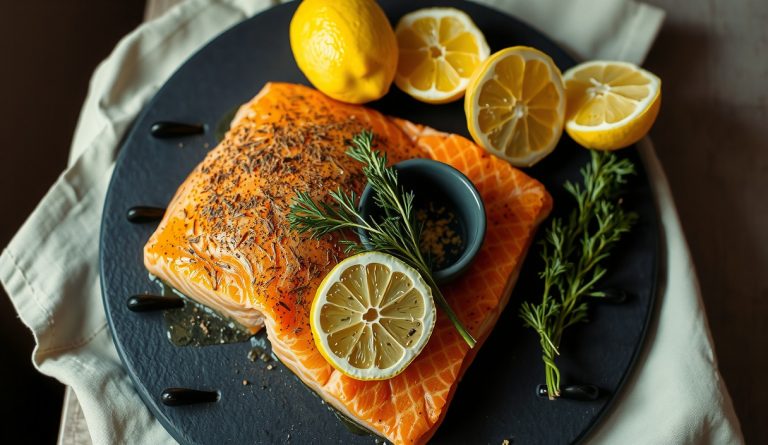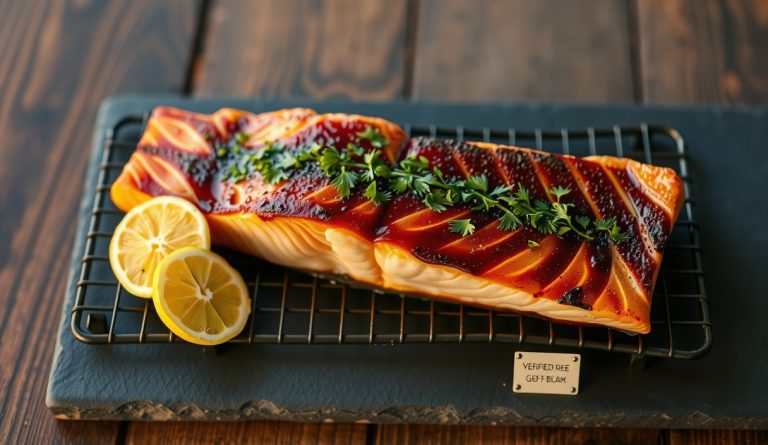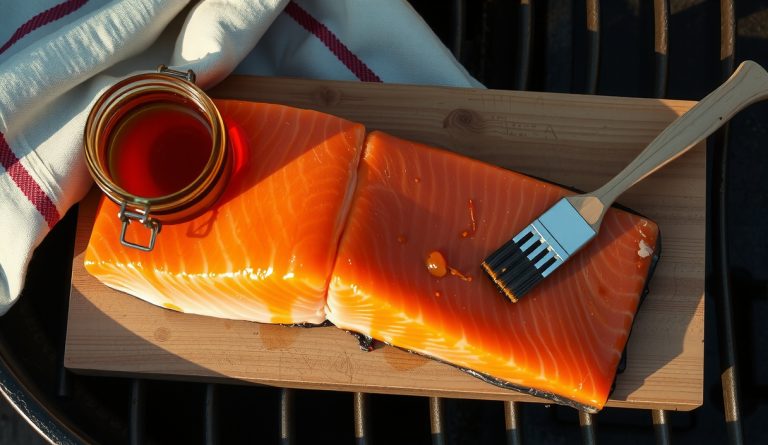
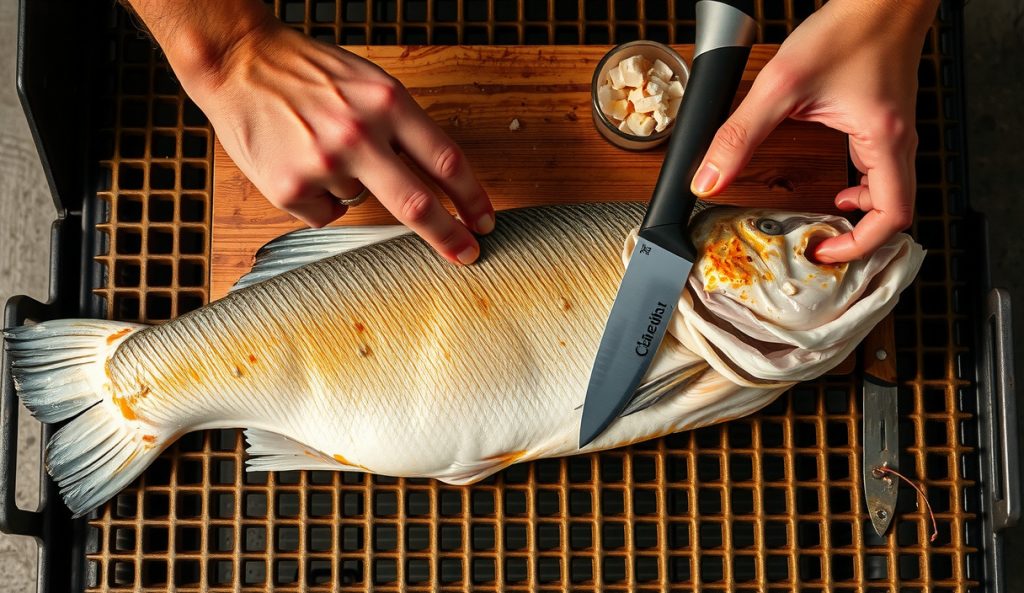
Scaling a pellet-smoked King salmon recipe from a single fillet portion up to a full side — 4 to 6 pounds of fish — is straightforward in principle but demands deliberate adjustments to cure quantity, pellicle time, cook duration, and probe placement. The core problem is geometric: the loin section and the tail section of a full King salmon side differ significantly in thickness, which means heat moves through them at different rates. Treating the whole side as a uniform piece consistently produces one of two failures — an overcooked tail or an undercooked center loin.
What changes when you scale up to a full salmon side?
Scale the cure by total fish weight using the same 3:1 salt-to-sugar ratio, calculated against every pound of the side. Apply the cure evenly across the entire flesh surface, with particular attention to the thicker loin section — that mass requires adequate salt contact to draw moisture and firm the flesh before the air-dry phase begins. The physics of diffusion favor the thinner tail automatically; the loin needs the deliberate attention.
Once the cure is rinsed off and the side is patted dry, extend the pellicle air-dry to a minimum of 2 hours. A full side presents greater total surface area and higher total moisture content than a portioned fillet, so the protein film needs additional time to form a fully tacky, cohesive layer. A patchy or partially dry pellicle on a large side produces uneven smoke adhesion and invites albumin expression — the white protein seepage — in any zones where the surface moisture was not fully evacuated.
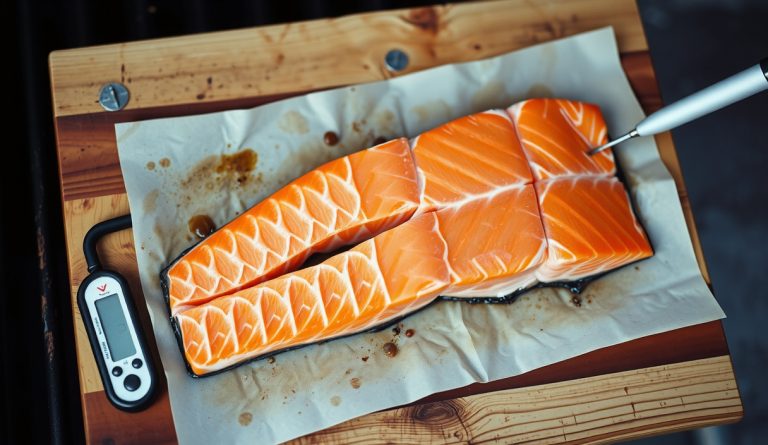
Use two instant-read or leave-in probes: one placed in the thickest part of the loin, one in a mid-section location. Do not probe the tail — the tail will outpace both readings and is best managed by visual observation. The tail begins flaking visibly as it approaches 135–140°F, which is an acceptable final temperature for that section. Cook at 180°F as written in the base recipe; expect 2.5 to 3.5 hours total depending on loin thickness. Pull the side when the loin probe reads 130°F. The tail will register higher and will have a firmer, more fully cooked texture — this is not a defect. That portion is well-suited to flaking into salads, pasta, or grain bowls where the softer, sliceable texture of the loin is less critical.
What stays the same as the base recipe?
The cure chemistry, smoker temperature, smoke wood selection, and the fundamental albumin-management logic of the method — low and slow with a fully developed pellicle — are identical to the canonical approach. Scaling up to a full side does not change the underlying technique; it changes the quantities and monitoring approach required to execute that technique correctly across a larger, geometrically non-uniform piece of fish.
When is a whole side the better choice?
A whole King salmon side is the correct format for a group of eight or more guests, for a brunch centerpiece, or for any occasion where the visual impact of presenting an intact smoked side matters. It is also the most efficient format when the intent is to produce smoked salmon for multiple uses across multiple meals — sliced loin portions for one occasion, flaked tail meat for a second. Plan the two-use strategy deliberately rather than treating the more-cooked tail section as a failure.
Use the full method, equipment, and rub measurements from the original Pellet-Smoked King Salmon, applying the cure scaling, pellicle time extension, and dual-probe placement described here.