Smoked Lobster Tails with Butter-Paprika Baste

Equipment
- 1 Offset smoker, pellet grill, or kettle grill set up for indirect heat Must hold 225°F ± 15°F stably
- 2 Alder or apple wood chunks Chunks, not chips — chips burn too fast for a 20-minute cook
- 1 Instant-read thermometer ±1°F accuracy; insert horizontally into the thickest part of the flesh
- 1 pair Heavy kitchen shears
- 1 Small saucepan For browning the butter baste
- 1 Silicone basting brush
- 1 sheet Aluminum foil For tenting during the rest
Ingredients
Lobster
- 2 cold-water lobster tails, 6 to 8 oz each, fully thawed Maine or Canadian; thaw overnight in the refrigerator
Butter-Paprika Baste
- 4 tablespoons unsalted butter European-style 84% fat butter preferred
- 3 cloves garlic, finely minced or pressed
- 1 teaspoon smoked paprika Spanish pimentón de la Vera, sweet or bittersweet
- 0.5 teaspoon kosher salt
- 0.25 teaspoon freshly ground black pepper
- 1 pinch cayenne pepper Optional; omit for a milder profile
To Finish
- 1 lemon, cut into wedges For serving
- 2 tablespoons fresh flat-leaf parsley, roughly chopped For garnish

Instructions
Fire & Baste Setup
- Set up your smoker for indirect heat and preheat to 225°F. Add two chunks of alder or apple wood to the fire and let the smoke establish to a thin blue wisp — not white billowing smoke. Allow the chamber to hold at 225°F for at least 10 minutes before loading the tails.
- While the smoker stabilizes, make the baste. Place unsalted butter in a small saucepan over medium heat. Let it melt and continue cooking, swirling occasionally, until the foam subsides and the milk solids on the bottom turn deep amber — the color of a copper penny — and the butter smells of toasted hazelnuts. This is the noisette stage, approximately 3 to 4 minutes.
- Pull the pan off heat immediately and stir in the minced garlic, smoked paprika, kosher salt, black pepper, and cayenne (if using). The residual heat will bloom the aromatics without burning them. Keep the baste warm at the side of the smoker or over the lowest possible burner flame.3 cloves garlic, finely minced or pressed, 1 teaspoon smoked paprika, 0.5 teaspoon kosher salt, 0.25 teaspoon freshly ground black pepper, 1 pinch cayenne pepper
Butterfly the Tails
- Using heavy kitchen shears, cut straight down the center of the top shell of each lobster tail, from the open end toward the tail fan, stopping just before the fan. Do not cut the underside membrane.
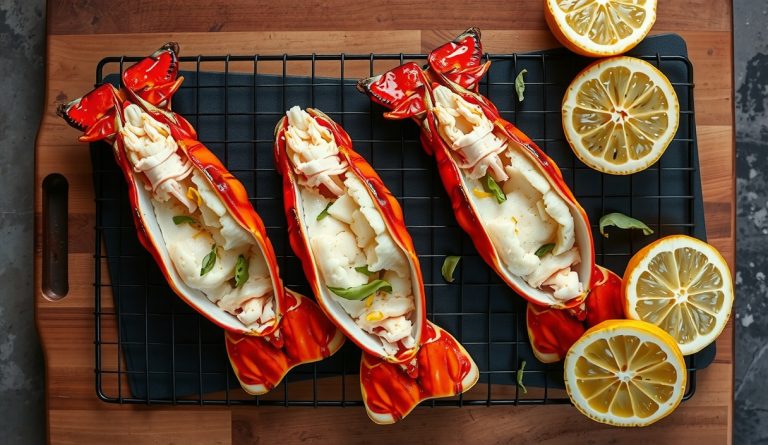
- Run your thumbs under the meat on both sides of the cut and gently press outward and upward, lifting the meat free of the shell while keeping it attached at the tail fan. Rest the meat on top of the shell — it should sit proud above the shell halves, fully exposed. Pat the flesh dry with a paper towel.
Smoke & Baste
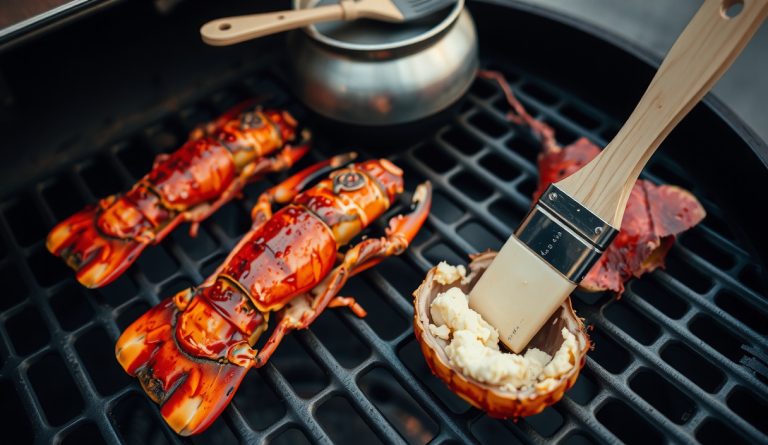
- Place the butterflied tails meat-side up on the smoker grate over indirect heat. Close the lid. Apply the first coat of baste immediately using the silicone brush, covering the exposed flesh completely.3 cloves garlic, finely minced or pressed, 1 teaspoon smoked paprika, 0.5 teaspoon kosher salt, 0.25 teaspoon freshly ground black pepper, 1 pinch cayenne pepper
- After 7 minutes, open the lid, baste again, and close. Repeat after another 7 minutes for the third and final baste coat. Insert the instant-read thermometer horizontally into the thickest part of the flesh at this point — you are looking for an internal temperature between 130°F and 135°F.
- Continue checking every 2 to 3 minutes. Pull the tails from the smoker when the thickest part reads 135°F. Total cook time will be approximately 20 to 25 minutes depending on tail size and smoker stability. Do not cook beyond 135°F on the smoker — carryover heat will finish the job.
Rest & Serve
- Transfer the tails to a warm plate and tent loosely with foil. Rest for 5 minutes — internal temperature will rise to approximately 138°F to 140°F during this window, which is precisely the target denaturation zone for tropomyosin.
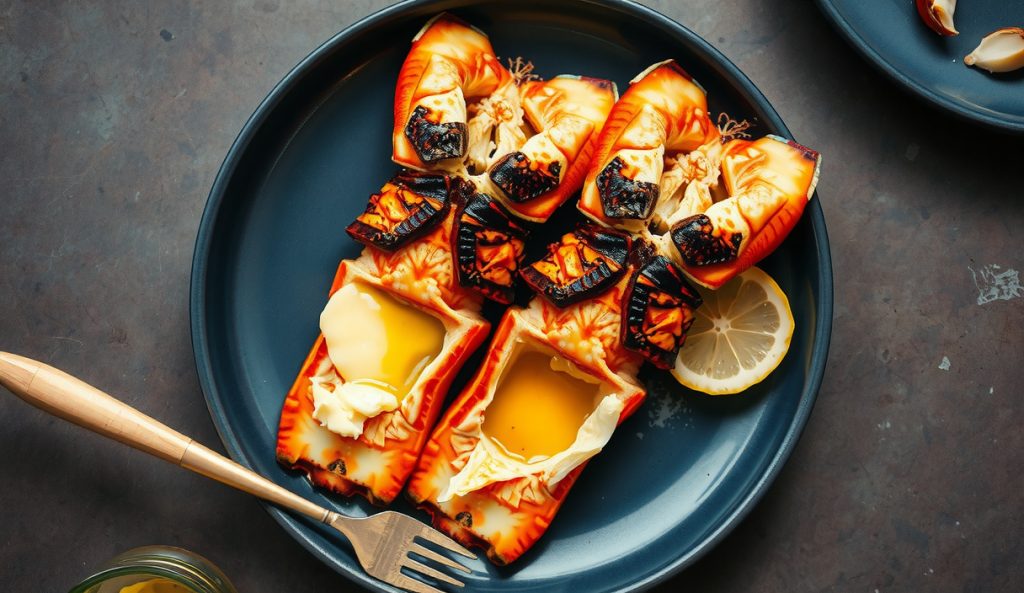
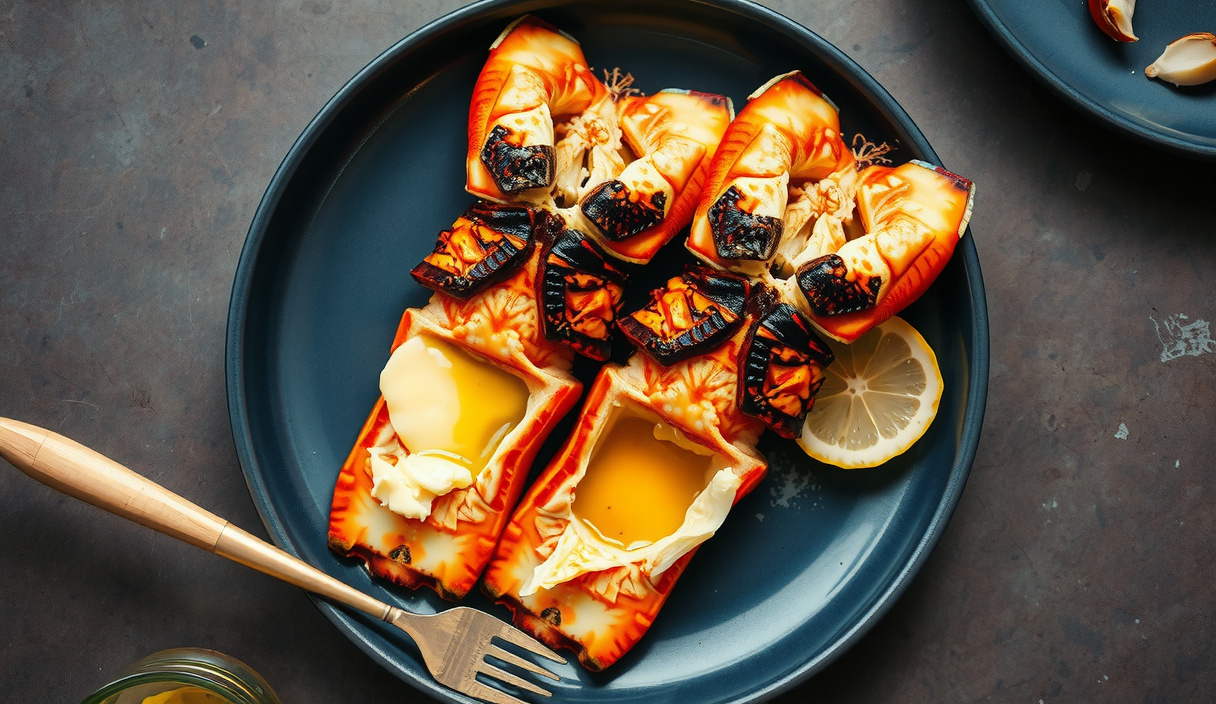
- Drizzle any remaining baste over the flesh, garnish with chopped flat-leaf parsley, and serve immediately alongside lemon wedges. The flesh should be opaque, ivory-white with a faint translucence at the very center, and part cleanly under a fork without any resistance.1 lemon, cut into wedges, 2 tablespoons fresh flat-leaf parsley, roughly chopped
Notes
Nutrition
There is a specific moment on a charcoal fire when lobster tail goes from translucent and yielding to chalky and tight, and it happens fast — inside a two-minute window that most backyard cooks blow right through. The culprit is tropomyosin, the structural protein that holds crustacean muscle fibers in alignment. Nail the temperature, and tropomyosin releases cleanly into silk. Overshoot it, and you have expensive rubber. Smoking at 225°F buys you the time to thread that needle with a thermometer instead of guesswork, while a rolling butter-paprika baste deposits fat-soluble Maillard compounds directly onto the exposed flesh every few minutes, building the crust that open-flame grilling promises but a 20-minute cook window rarely delivers.
Smoked lobster tails are a short cook — roughly 20 to 25 minutes at a 225°F chamber temperature — so fire management matters more than patience here. Get your smoker dialed and your baste warm before the tails hit the grate. The rest is thermometer discipline.
Why does smoked lobster tail work? The science
Lobster tail muscle is composed primarily of striated sarcomere fibers held together by a connective matrix dominated by tropomyosin and paramyosin. Unlike beef collagen, which requires sustained temperatures above 160°F to hydrolyze into gelatin, crustacean structural proteins undergo thermal denaturation across a comparatively narrow window. Tropomyosin destabilizes measurably between 131°F and 140°F (55°C–60°C), and once denaturation is complete the proteins irreversibly aggregate, expelling bound water and producing the firm, chalky texture that ruins a forty-dollar tail.
Pulling the lobster flesh at 135°F internal — three to five degrees below full denaturation — and resting under tented foil allows residual carryover heat to complete the structural transition without overrunning it. The result is flesh that parts easily under a fork but retains its characteristic succulence.
The 225°F smoke environment is critical precisely because it slows the rate of heat penetration into the dense muscle mass. At this chamber temperature, the thermal gradient across the tail cross-section is shallow enough that the cook has a realistic 3-to-5 minute buffer once the target zone is approached — a buffer that vanishes entirely if you push the chamber to 350°F. Wood choice is equally deliberate: alder and apple produce a restrained, sweet-phenolic smoke with low resin content, depositing volatile aldehydes and guaiacol derivatives onto the flesh without the harsh creosote notes that hickory or mesquite introduce to delicate seafood.
The butter baste serves a dual thermodynamic function: it acts as a lipophilic solvent for fat-soluble smoke aromatics on the flesh surface, and its water fraction — roughly 16% by mass in most butter — creates a micro-steam layer that delays surface desiccation between basting intervals. Smoked paprika in the baste is not decorative. Paprika contributes capsanthin and capsorubin carotenoids that deepen the coral color of the shell and introduce mild Maillard precursors; the paprika sugars and free amino acids react at surface temperatures that briefly spike well above the chamber air temperature each time the baste hits the hot shell. Garlic bloomed directly in the butter converts alliin to allicin and then to diallyl disulfide during heating, depositing sulfurous, roasty volatiles that integrate with the smoke phenolics rather than fighting them.
What equipment and ingredients do I need?
- Lobster tails: Cold-water Maine or Canadian tails (6 to 8 oz each) hold significantly better than warm-water spiny lobster. The latter has looser muscle fiber geometry and loses moisture aggressively above 130°F. Thaw completely in the refrigerator overnight — never under running water, which dilutes the natural brine in the flesh.
- Smoker: Any offset, pellet, or kettle rig that holds 225°F ± 15°F. If using a kettle, set up a two-zone fire with coals banked to one side and the tails over the cool side. Add two small chunks (not chips) of alder or apple wood.
- Wood: Alder is the traditional Pacific Northwest seafood wood and the correct call here. Apple runs slightly sweeter. Both are low-resin hardwoods that produce clean, thin blue smoke. Avoid hickory, mesquite, and pecan for this application — their phenol profiles overwhelm the lobster’s delicate sweet-brine character.
- Instant-read thermometer: Non-negotiable. The Thermapen or any probe reading within ±1°F is worth every cent on a protein this expensive. Insert the probe horizontally into the thickest part of the tail, avoiding the shell.
- Butter baste: Use unsalted butter so you control salt separately. Brown it to the noisette stage before adding garlic and paprika — the Maillard reaction in the butter itself (around 250°F–275°F in the milk solids) adds a nutty, toasty base note that raw melted butter lacks entirely.
- Basting brush: Use a silicone brush over natural bristle. Natural bristles trap butter and lose it in clumps rather than depositing a thin, even coat.
Smoked Lobster Tails with Butter-Paprika Baste
Equipment
- 1 Offset smoker, pellet grill, or kettle grill set up for indirect heat Must hold 225°F ± 15°F stably
- 2 Alder or apple wood chunks Chunks, not chips — chips burn too fast for a 20-minute cook
- 1 Instant-read thermometer ±1°F accuracy; insert horizontally into the thickest part of the flesh
- 1 pair Heavy kitchen shears
- 1 Small saucepan For browning the butter baste
- 1 Silicone basting brush
- 1 sheet Aluminum foil For tenting during the rest
Ingredients
Lobster
- 2 cold-water lobster tails, 6 to 8 oz each, fully thawed Maine or Canadian; thaw overnight in the refrigerator
Butter-Paprika Baste
- 4 tablespoons unsalted butter European-style 84% fat butter preferred
- 3 cloves garlic, finely minced or pressed
- 1 teaspoon smoked paprika Spanish pimentón de la Vera, sweet or bittersweet
- 0.5 teaspoon kosher salt
- 0.25 teaspoon freshly ground black pepper
- 1 pinch cayenne pepper Optional; omit for a milder profile
To Finish
- 1 lemon, cut into wedges For serving
- 2 tablespoons fresh flat-leaf parsley, roughly chopped For garnish
Instructions
Fire & Baste Setup
- Set up your smoker for indirect heat and preheat to 225°F. Add two chunks of alder or apple wood to the fire and let the smoke establish to a thin blue wisp — not white billowing smoke. Allow the chamber to hold at 225°F for at least 10 minutes before loading the tails.
- While the smoker stabilizes, make the baste. Place unsalted butter in a small saucepan over medium heat. Let it melt and continue cooking, swirling occasionally, until the foam subsides and the milk solids on the bottom turn deep amber — the color of a copper penny — and the butter smells of toasted hazelnuts. This is the noisette stage, approximately 3 to 4 minutes.
- Pull the pan off heat immediately and stir in the minced garlic, smoked paprika, kosher salt, black pepper, and cayenne (if using). The residual heat will bloom the aromatics without burning them. Keep the baste warm at the side of the smoker or over the lowest possible burner flame.3 cloves garlic, finely minced or pressed, 1 teaspoon smoked paprika, 0.5 teaspoon kosher salt, 0.25 teaspoon freshly ground black pepper, 1 pinch cayenne pepper
Butterfly the Tails
- Using heavy kitchen shears, cut straight down the center of the top shell of each lobster tail, from the open end toward the tail fan, stopping just before the fan. Do not cut the underside membrane.
- Run your thumbs under the meat on both sides of the cut and gently press outward and upward, lifting the meat free of the shell while keeping it attached at the tail fan. Rest the meat on top of the shell — it should sit proud above the shell halves, fully exposed. Pat the flesh dry with a paper towel.
Smoke & Baste
- Place the butterflied tails meat-side up on the smoker grate over indirect heat. Close the lid. Apply the first coat of baste immediately using the silicone brush, covering the exposed flesh completely.3 cloves garlic, finely minced or pressed, 1 teaspoon smoked paprika, 0.5 teaspoon kosher salt, 0.25 teaspoon freshly ground black pepper, 1 pinch cayenne pepper
- After 7 minutes, open the lid, baste again, and close. Repeat after another 7 minutes for the third and final baste coat. Insert the instant-read thermometer horizontally into the thickest part of the flesh at this point — you are looking for an internal temperature between 130°F and 135°F.
- Continue checking every 2 to 3 minutes. Pull the tails from the smoker when the thickest part reads 135°F. Total cook time will be approximately 20 to 25 minutes depending on tail size and smoker stability. Do not cook beyond 135°F on the smoker — carryover heat will finish the job.
Rest & Serve
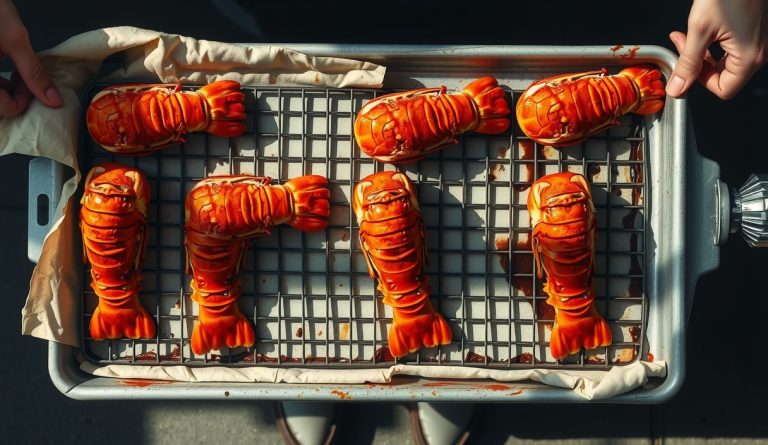
- Transfer the tails to a warm plate and tent loosely with foil. Rest for 5 minutes — internal temperature will rise to approximately 138°F to 140°F during this window, which is precisely the target denaturation zone for tropomyosin.
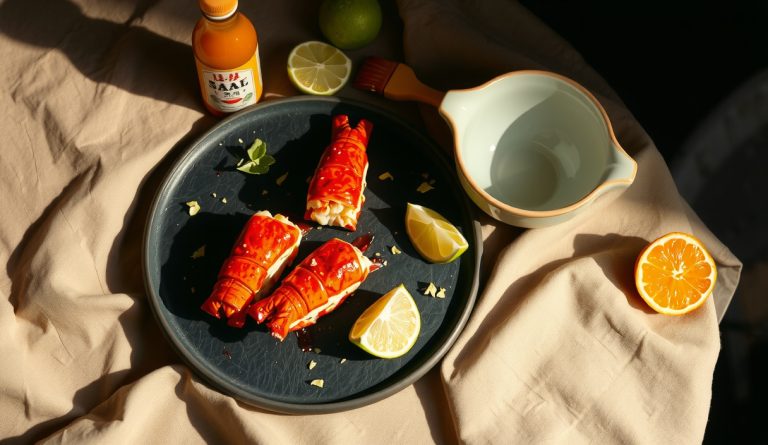
- Drizzle any remaining baste over the flesh, garnish with chopped flat-leaf parsley, and serve immediately alongside lemon wedges. The flesh should be opaque, ivory-white with a faint translucence at the very center, and part cleanly under a fork without any resistance.1 lemon, cut into wedges, 2 tablespoons fresh flat-leaf parsley, roughly chopped
Notes
Nutrition
How do I nail smoked lobster tails every time?
- Pull at 135°F, not 140°F. Carryover during a 5-minute foil rest will carry the lobster tail to 138°F–140°F. If you pull at 140°F you are resting to 143°F and the flesh will be noticeably tighter. Trust the thermometer, not the color.
- Butterfly the shell completely. Use heavy kitchen shears to cut the top shell down the centerline, then run your thumbs under the meat to lift it free while keeping the tail-fan attached. Fully exposed flesh smokes and bastes dramatically more efficiently than meat nestled inside a partially opened shell.
- Stabilize your smoker before loading. Get the chamber to 225°F and let it hold there for 10 minutes before adding tails. A temperature spike during the first few minutes of cook — common when adding cold protein to an unstabilized fire — compresses the safe window significantly.
- Baste on a tight interval. Every 7 minutes means three coats in a 20-minute cook. Fewer applications and the butter aromatics don’t have time to layer. More and you drop the smoker temperature every time you open the lid. Set a timer.
- Smoke thin and blue, not thick and white. White billowing smoke means incomplete combustion and creosote. Let your wood establish a thin blue wisp before loading the lobster tails. If you see white smoke, crack the firebox or air vents wider to increase airflow and push the combustion to completion.
- Don’t skip the noisette step in the butter. Melting butter directly and adding the aromatics gives you a flat, one-dimensional baste. The 3-to-4 minute brown-butter step generates hundreds of heterocyclic flavor compounds in the milk solids that form the aromatic backbone of the baste.
What variations can I make to the recipe?
Citrus-herb baste: Swap the smoked paprika for 1 teaspoon of finely grated Meyer lemon zest and a tablespoon of minced fresh tarragon stirred into the finished brown butter off heat. The lemon oil volatiles (primarily limonene) lift cleanly against the smoke phenolics without the acidity driving the pH below the range where the lobster flesh stays supple. Finish with a squeeze of fresh lemon at service, not during the cook — heat destroys lemon’s bright top notes in under 90 seconds.
Thai chili-lime: Add one teaspoon of sambal oelek and the zest of one lime to the baste, replacing the paprika. The capsaicin in the sambal activates TRPV1 receptors on the palate after the smoke phenolics have already registered, creating a sequential heat effect rather than a simultaneous one. Finish with a drizzle of fish sauce (2 teaspoons) stirred into the baste off heat for glutamate depth.
Scaling up: The recipe doubles or triples cleanly provided your smoker can hold 225°F with the additional cold mass loaded. Figure roughly 8 minutes of recovery time after loading a full rack. Internal temperature targets do not change with volume. Do not crowd tails — maintain at least 2 inches of clearance between each for smoke to circulate.
Pellet grill adaptation: Set your pellet grill to its lowest smoke setting (usually 180°F–200°F) for the first 12 minutes to maximize smoke deposition, then bump to 250°F for the final stretch. Most pellet grills produce less smoke at higher temperatures as combustion efficiency rises. The two-stage approach gives you smoke flavor depth while still hitting your internal temp target in a reasonable window.
Frequently asked questions about smoked lobster tails
Can I use frozen lobster tails straight from the freezer? No. Cooking lobster tails from frozen introduces a severe thermal gradient — the outer layers will be overcooked before the center reaches temperature. Thaw completely in the refrigerator for 12 to 24 hours. Pat the flesh dry before butterflying; surface moisture creates a steam barrier that delays smoke deposition.
How do I know when the butter is at the noisette stage without burning it? Watch for the foam that forms after the water fraction boils off — when the foam subsides and the milk solids on the bottom of the pan turn from pale gold to deep amber (the color of a copper penny), pull immediately from heat. The pan retains enough heat to push the solids a shade darker, so err early. You should smell toasted hazelnuts; burned butter smells acrid and bitter.
What if I don’t have alder or apple wood? Cherry is an acceptable substitute — cherry wood runs slightly bolder than apple but still well within the flavor envelope for seafood. Peach wood works similarly. If you are using a pellet grill, a pure apple or competition blend pellet will perform correctly. Avoid any pellet blend marketed as “bold” or “BBQ” — these invariably contain hickory or mesquite as a primary component.