Smoked Whole Rainbow Trout on a Pellet Grill
Equipment
- 1 Pellet grill Must hold 200°F stably in PID-controlled mode. Calibrate with an independent probe before starting.
- As needed Alder wood pellets Apple or cherry also work. Avoid hickory or mesquite.
- 1 Leave-in probe thermometer Non-negotiable. Insert into the thickest part of the shoulder behind the head, avoiding the spine.
- 1 Wire rack For pellicle drying in the refrigerator after brining.
- 1 Wide fish spatula Use two spatulas for lifting to prevent skin from tearing.
- 1 Rimmed baking sheet For brining and refrigerator pellicle stage.
Ingredients
Fish and Dry Brine
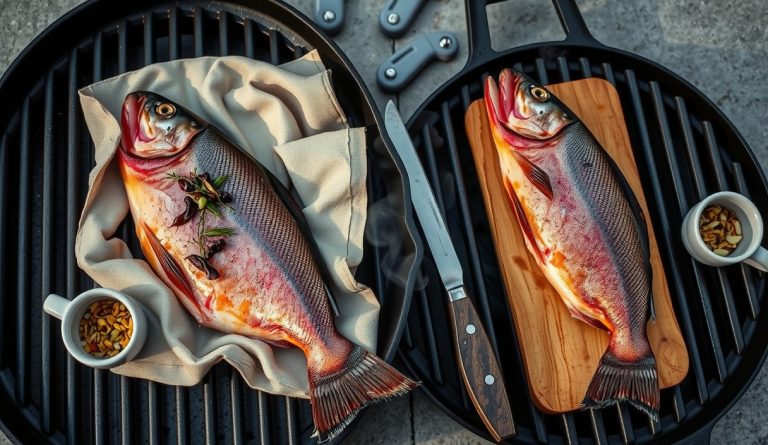
- 2 whole rainbow trout, gutted and cleaned 12–16 oz each. Ask your fishmonger to remove the gills. Butterflied is also fine — see Variations.
- 2 tablespoons Diamond Crystal kosher salt Per fish. If using Morton kosher salt, reduce to 1.5 tablespoons per fish due to higher density.
- 1 tablespoon light brown sugar Per fish. Provides reducing sugars for Maillard browning at low smoke temperatures.
- 1 teaspoon freshly ground black pepper Per fish. Coarse grind preferred.
- 1 teaspoon garlic powder Per fish. Optional but adds depth to the savory base.
For Serving
- 1 lemon, sliced into rounds For serving alongside the finished fish.
- 2 tablespoons fresh dill fronds Optional garnish.
- 2 tablespoons unsalted butter, softened Optional — rub inside the cavity just before serving for added richness.

Instructions
Dry Brine and Pellicle
- Pat the trout completely dry inside and out with paper towels, including inside the cavity. Any surface moisture will dilute the brine concentration and slow pellicle formation.
- In a small bowl, combine the kosher salt, brown sugar, black pepper, and garlic powder. Mix well. This is your dry brine.2 tablespoons Diamond Crystal kosher salt, 1 tablespoon light brown sugar, 1 teaspoon freshly ground black pepper, 1 teaspoon garlic powder
- Apply the dry brine evenly to the outside of each fish and inside the cavity. Use roughly two-thirds of the brine on the exterior and one-third inside. Place the brined trout on a wire rack set over a rimmed baking sheet.2 tablespoons Diamond Crystal kosher salt, 1 tablespoon light brown sugar, 1 teaspoon freshly ground black pepper, 1 teaspoon garlic powder
- Refrigerate uncovered for 2 hours. The salt will draw moisture to the surface via osmosis. After 2 hours, rinse the fish briefly under cold water to remove excess brine, then pat completely dry again with paper towels.
- Return the fish to the wire rack and refrigerate uncovered for an additional 30 to 60 minutes until the surface feels tacky but not wet to the touch. This is the pellicle — the thin, dried protein film that gives smoke something to bond to. Do not skip this step. A wet surface will cause the smoke to steam rather than adhere, preventing the lacquered bark from forming.
Set Up the Pellet Grill
- Fill the pellet hopper with alder, apple, or cherry wood pellets. Start the pellet grill and set the temperature to 200°F. Allow the grill to fully preheat and stabilize at 200°F — this takes 10 to 15 minutes on most units. Verify with an independent probe thermometer placed at grate level near where the fish will sit.
Smoke the Trout
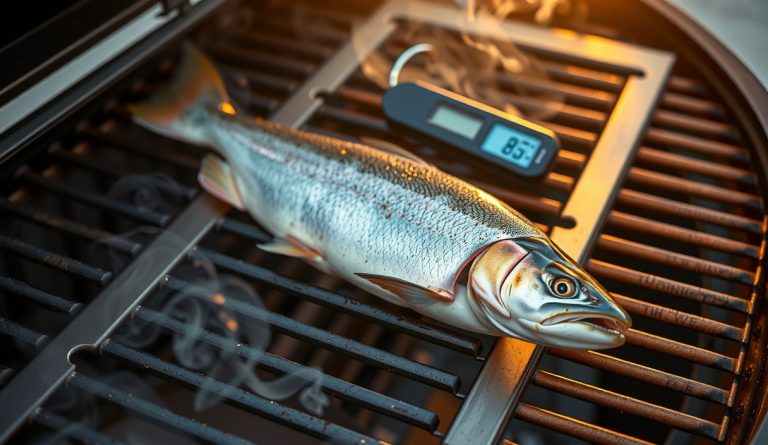
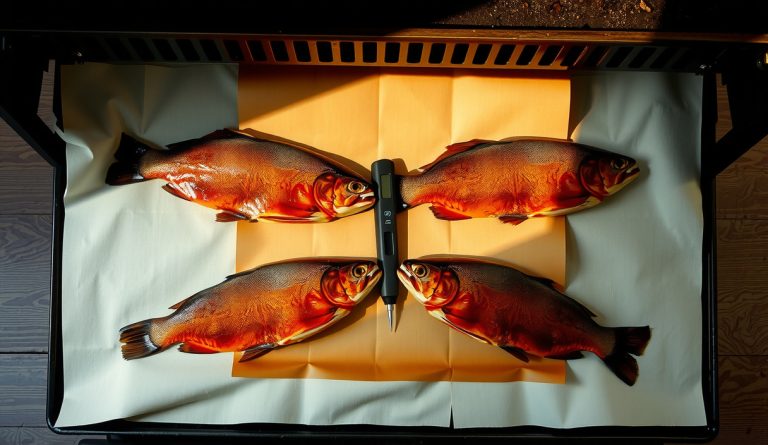
- Place the pellicled trout directly on the grill grates. For easier removal, lay a sheet of heavy-duty aluminum foil perforated with several holes (use a skewer or toothpick) under each fish — this allows smoke to circulate while preventing the skin from bonding to the grates.
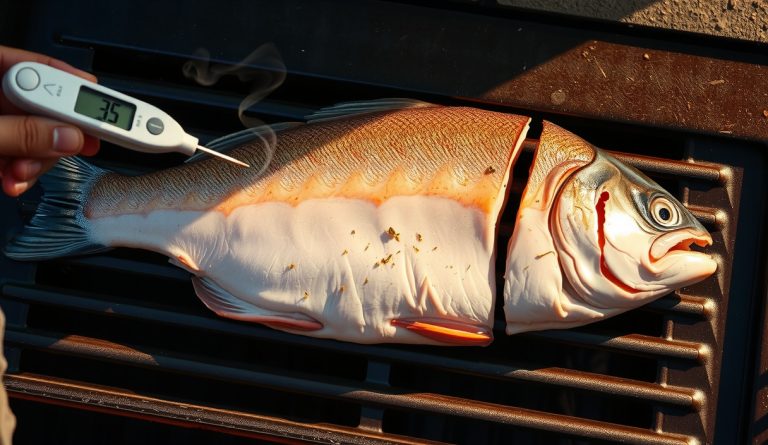
- Insert the probe thermometer into the thickest part of the shoulder flesh, just behind the head, angling toward the center and avoiding the spine. The probe tip should be approximately in the geometric center of the thickest cross-section.
- Close the lid. Smoke at 200°F, without opening the lid, until the internal temperature reaches 145°F. This will take approximately 60 to 90 minutes depending on the size of the fish and ambient air temperature. Begin checking the probe at the 55-minute mark.
- When the internal temperature reads 145°F, remove the trout from the grill immediately using two wide spatulas, lifting simultaneously from the head end and tail end to prevent the skin from tearing. Transfer to a serving platter or cutting board.
- Tent loosely with aluminum foil and rest for 5 minutes. Carryover will bring the internal temperature to approximately 147°F to 148°F. This brief rest allows moisture that has migrated toward the surface to partially redistribute and the skin to firm slightly for cleaner presentation.
Serve
- Run a knife along the dorsal line of the fish to separate the top fillet from the spine. The flesh should flake cleanly in large, moist segments. If desired, rub the cavity with softened butter just before opening for added richness. Garnish with fresh dill and lemon rounds. Serve immediately.1 lemon, sliced into rounds, 2 tablespoons fresh dill fronds, 2 tablespoons unsalted butter, softened
Notes
Nutrition
The first time I smoked a whole trout at 225°F I got what I deserved: skin like a rubber gasket and flesh that tasted like ashtray. The fix was not better wood. It was physics. Drop the smoker to 200°F, pull the fish at exactly 145°F internal, and the equation changes completely — you get bronzed, lacquered skin that parts from the flesh cleanly, a moist flake that holds together on the fork, and smoke character that reads as flavor rather than punishment. That is the only version worth making.
The method starts with a two-hour dry brine. Salt and a touch of brown sugar draw surface moisture into a thin pellicle — the tacky protein film that gives smoke somewhere to anchor. Skip this step and you skip the bark. Rainbow trout is ideal here: relatively thin cross-section, high intramuscular fat to buffer against drying, and a mild, sweet myoglobin profile that takes smoke without fighting it.
Why does smoked whole rainbow trout work? The science
Smoked whole rainbow trout cooked at 200°F reaches food-safe doneness at 145°F internal without triggering the actin-collapse cascade that expels moisture and ruins texture. Trout muscle follows the same sequential denaturation pathway as all teleost fish, but with lower threshold temperatures than warm-blooded animals. Myosin — the primary structural protein — begins to unfold and aggregate starting around 104°F (40°C), producing the tender, barely-set texture found in high-end preparations. The critical danger zone is actin, which denatures catastrophically between 140°F and 149°F (60–65°C), collapsing the myofibrillar water-holding network and violently expelling bound moisture. Holding the smoker at 200°F creates a shallow thermal gradient across the thin fillet, allowing the core to park at 145°F — exactly at FDA safety compliance for finfish — without overshooting into actin-collapse territory.
Skin toughening is a parallel failure mode driven by the dermal collagen network. At ambient temperatures above 225°F, collagen in the skin matrix undergoes rapid, irreversible thermal shrinkage — the same phenomenon that tightens chicken thigh skin into a leathery sheet. Collagen shrinkage begins near 140°F, and the rate constant approximately doubles for every 18°F rise in ambient temperature above that threshold. At 200°F, shrinkage kinetics are dramatically slowed, giving collagen time to gelatinize gently rather than contract violently, and leaving the skin pliable and edible rather than rigid.
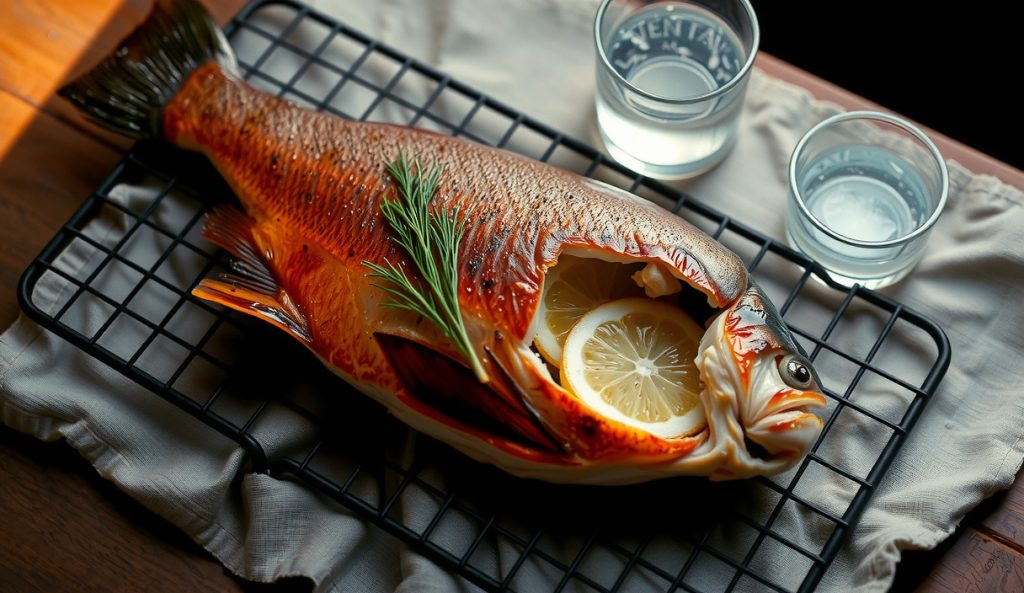
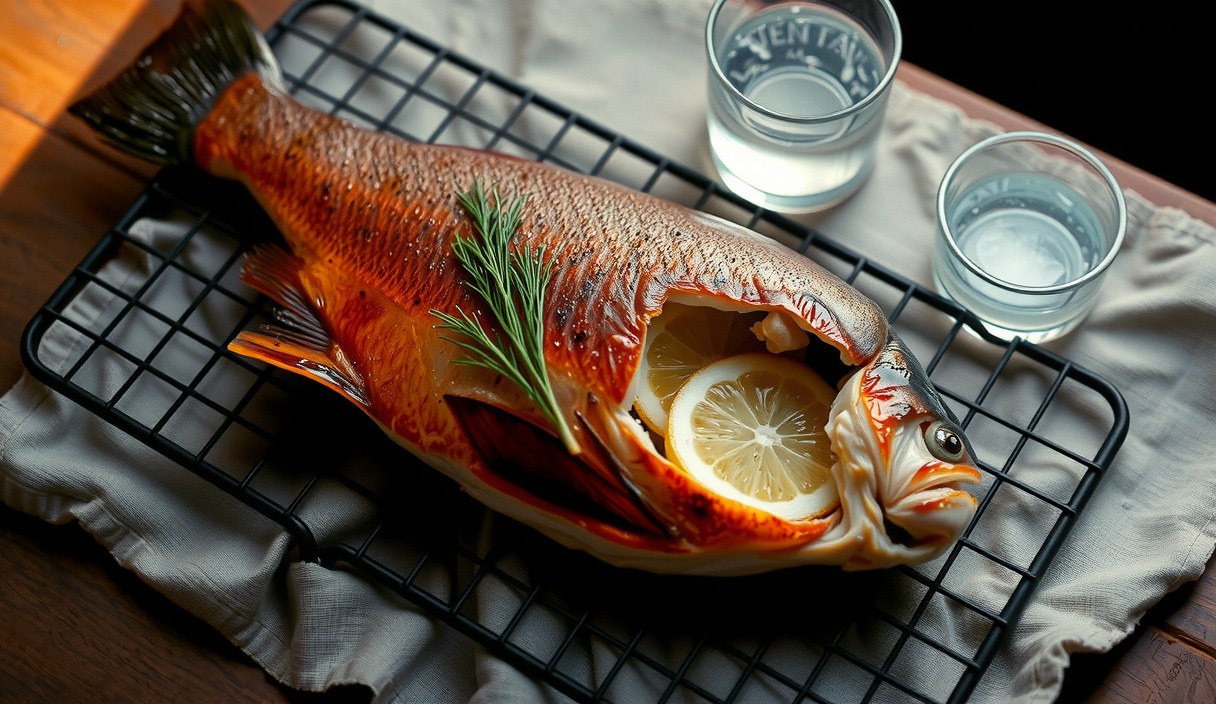
The dry brine serves a second thermodynamic role: pellicle formation. As salt draws free moisture to the surface, dissolved proteins re-concentrate and denature slightly via osmotic stress, forming a thin, tacky film with elevated water activity at the very surface — optimal for Maillard onset when combined with wood-combustion carbonyl compounds (aldehydes, ketones) from the smoke stream. The result is the mahogany lacquer visible on properly smoked fish. Brown sugar in the brine supplies additional reducing sugars that accelerate amino-carbonyl browning at the low ambient temperatures where the reaction would otherwise be sluggish. A water activity (a_w) between 0.60 and 0.75 at the pellicle surface is the sweet spot for Maillard cascade onset without requiring the surface temperatures that would toughen the skin below.
What equipment and ingredients do I need?
Pellet grill and temperature stability: This recipe demands tight temperature control. Consumer pellet grills running in PID-controlled mode typically hold within ±5°F of setpoint — acceptable for this cook. Avoid opening the lid during the cook; each opening drops chamber temperature 20–30°F and forces the pellet auger to surge, spiking volatile compounds from rapid combustion.
Wood pellets: Alder is the traditional Pacific Northwest choice for trout and for good reason — its low lignin-to-cellulose ratio produces a mild, clean smoke with aldehydic compounds that pair naturally with the fish’s sweetness. Apple and cherry are also excellent. Avoid hickory or mesquite at this delicate protein weight; their phenol-heavy smoke profiles will dominate and overwhelm the trout.
Fish selection: A whole rainbow trout of 12–16 oz gutted weight is the target. The cavity allows internal smoke penetration, and the belly fat line provides built-in moisture insurance. Farm-raised trout is perfectly appropriate — the fat-to-lean ratio is consistent and forgiving. Ask your fishmonger to butterfly the trout if you want to lay it flat for even smoke exposure.
Thermometer: A leave-in probe thermometer is non-negotiable. Insert it into the thickest part of the shoulder, just behind the head, avoiding the spine. Trout are thin fish — the difference between 140°F and 155°F internal is approximately 4 minutes at a 200°F smoker setpoint. You will miss the window without a probe.
Kosher salt: Use Diamond Crystal. Morton kosher salt is denser by volume — roughly 1.5x the salinity per tablespoon — and will over-brine the fish if substituted 1:1. If using Morton, reduce to 1.5 tablespoons per fish.
Smoked Whole Rainbow Trout on a Pellet Grill
Equipment
- 1 Pellet grill Must hold 200°F stably in PID-controlled mode. Calibrate with an independent probe before starting.
- As needed Alder wood pellets Apple or cherry also work. Avoid hickory or mesquite.
- 1 Leave-in probe thermometer Non-negotiable. Insert into the thickest part of the shoulder behind the head, avoiding the spine.
- 1 Wire rack For pellicle drying in the refrigerator after brining.
- 1 Wide fish spatula Use two spatulas for lifting to prevent skin from tearing.
- 1 Rimmed baking sheet For brining and refrigerator pellicle stage.
Ingredients
Fish and Dry Brine
- 2 whole rainbow trout, gutted and cleaned 12–16 oz each. Ask your fishmonger to remove the gills. Butterflied is also fine — see Variations.
- 2 tablespoons Diamond Crystal kosher salt Per fish. If using Morton kosher salt, reduce to 1.5 tablespoons per fish due to higher density.
- 1 tablespoon light brown sugar Per fish. Provides reducing sugars for Maillard browning at low smoke temperatures.
- 1 teaspoon freshly ground black pepper Per fish. Coarse grind preferred.
- 1 teaspoon garlic powder Per fish. Optional but adds depth to the savory base.
For Serving
- 1 lemon, sliced into rounds For serving alongside the finished fish.
- 2 tablespoons fresh dill fronds Optional garnish.
- 2 tablespoons unsalted butter, softened Optional — rub inside the cavity just before serving for added richness.
Instructions
Dry Brine and Pellicle
- Pat the trout completely dry inside and out with paper towels, including inside the cavity. Any surface moisture will dilute the brine concentration and slow pellicle formation.
- In a small bowl, combine the kosher salt, brown sugar, black pepper, and garlic powder. Mix well. This is your dry brine.2 tablespoons Diamond Crystal kosher salt, 1 tablespoon light brown sugar, 1 teaspoon freshly ground black pepper, 1 teaspoon garlic powder
- Apply the dry brine evenly to the outside of each fish and inside the cavity. Use roughly two-thirds of the brine on the exterior and one-third inside. Place the brined trout on a wire rack set over a rimmed baking sheet.2 tablespoons Diamond Crystal kosher salt, 1 tablespoon light brown sugar, 1 teaspoon freshly ground black pepper, 1 teaspoon garlic powder
- Refrigerate uncovered for 2 hours. The salt will draw moisture to the surface via osmosis. After 2 hours, rinse the fish briefly under cold water to remove excess brine, then pat completely dry again with paper towels.
- Return the fish to the wire rack and refrigerate uncovered for an additional 30 to 60 minutes until the surface feels tacky but not wet to the touch. This is the pellicle — the thin, dried protein film that gives smoke something to bond to. Do not skip this step. A wet surface will cause the smoke to steam rather than adhere, preventing the lacquered bark from forming.
Set Up the Pellet Grill
- Fill the pellet hopper with alder, apple, or cherry wood pellets. Start the pellet grill and set the temperature to 200°F. Allow the grill to fully preheat and stabilize at 200°F — this takes 10 to 15 minutes on most units. Verify with an independent probe thermometer placed at grate level near where the fish will sit.
Smoke the Trout
- Place the pellicled trout directly on the grill grates. For easier removal, lay a sheet of heavy-duty aluminum foil perforated with several holes (use a skewer or toothpick) under each fish — this allows smoke to circulate while preventing the skin from bonding to the grates.
- Insert the probe thermometer into the thickest part of the shoulder flesh, just behind the head, angling toward the center and avoiding the spine. The probe tip should be approximately in the geometric center of the thickest cross-section.
- Close the lid. Smoke at 200°F, without opening the lid, until the internal temperature reaches 145°F. This will take approximately 60 to 90 minutes depending on the size of the fish and ambient air temperature. Begin checking the probe at the 55-minute mark.
- When the internal temperature reads 145°F, remove the trout from the grill immediately using two wide spatulas, lifting simultaneously from the head end and tail end to prevent the skin from tearing. Transfer to a serving platter or cutting board.
- Tent loosely with aluminum foil and rest for 5 minutes. Carryover will bring the internal temperature to approximately 147°F to 148°F. This brief rest allows moisture that has migrated toward the surface to partially redistribute and the skin to firm slightly for cleaner presentation.
Serve
- Run a knife along the dorsal line of the fish to separate the top fillet from the spine. The flesh should flake cleanly in large, moist segments. If desired, rub the cavity with softened butter just before opening for added richness. Garnish with fresh dill and lemon rounds. Serve immediately.1 lemon, sliced into rounds, 2 tablespoons fresh dill fronds, 2 tablespoons unsalted butter, softened
Notes
Nutrition
How do I nail it every time? Tips
- Pat the fish completely dry before brining. Surface moisture dilutes the brine concentration, slowing osmotic salt migration and producing an uneven pellicle. Use paper towels inside the cavity as well as on the exterior.
- Do not rush the pellicle dry. After the brine is rinsed and the fish is patted dry, place the trout uncovered on a rack in the refrigerator for 30–60 minutes. A genuine pellicle should feel tacky but not wet to the touch. If the surface is still wet, smoke will steam rather than adhere.
- Do not exceed 200°F smoker temperature. Even 215°F will noticeably tighten the skin. If your pellet grill runs hot, calibrate it with an independent probe before starting the cook.
- Pull at 145°F, not 150°F. Carryover in a thin fish is minimal — typically 2–3°F — so pulling the trout at 145°F means you plate at approximately 147–148°F. Waiting for 150°F risks pushing the core past actin collapse.
- Use a wide spatula and lift from both ends simultaneously. Smoked trout skin tends to bond to cooking grates. A sheet of non-stick foil perforated with a skewer (to allow smoke flow) placed under the fish eliminates this failure mode entirely.
- Rest loosely tented for 5 minutes before serving. This allows surface proteins to re-absorb some migrated moisture and lets the skin firm slightly for cleaner presentation.
What variations can I try with smoked trout?
Hot-smoked vs. cold-smoked: This recipe is hot-smoke — the trout is fully cooked to food-safe temperatures inside the smoker. Cold smoking (below 85°F) is a different process that requires a cure containing nitrate or nitrite and a substantially more controlled environment for food safety. Do not substitute cold-smoke protocols for this method.
Butterflied or filleted trout: If the trout is butterflied (spine removed, opened flat), cook time drops to approximately 45–55 minutes at 200°F because the cross-sectional thickness is roughly halved. Adjust probe placement accordingly — target the thickest point of the shoulder flesh.
Scaling up for a crowd: Pellet grills handle multiple fish well as long as airflow is not restricted. Space fish at least 1 inch apart. Expect an additional 10–15 minutes of cook time when the grill is loaded, as the increased thermal mass of the protein load absorbs more heat from the chamber. Place the probe in the fish you suspect is cooking slowest — typically the one positioned directly over the hotspot deflector.
Brine flavor builds: The base dry brine is deliberately neutral to showcase the fish and smoke. For a Scandinavian profile, add 1 tablespoon of crushed juniper berries and 1 teaspoon of white pepper to the brine mixture. For a Pacific Northwest cedar plank presentation, soak a cedar plank in water for 2 hours and smoke the trout directly on it — the plank adds a secondary woody-resinous volatile layer to the overall smoke character.
Frequently asked questions about smoked whole rainbow trout
Why smoke trout at 200°F instead of the more common 225°F? The 25°F difference matters mechanically, not just in degree. At 225°F, the rate of dermal collagen shrinkage roughly doubles compared to 200°F, because the rate constant for this first-order thermal reaction scales steeply with temperature. The skin toughens in the first 20 minutes of the cook before the internal temperature even reaches 120°F. At 200°F, the collagen hydration window is preserved long enough for gentle gelatinization rather than contractile hardening.
Can I smoke trout on a charcoal kettle instead of a pellet grill? Yes, but temperature stability requires the snake method or a quality temperature controller. Set up a two-zone fire with wood chunks — not chips, which burn too fast at low temperatures — on the indirect side. A kettle will run hotter and less consistently than a pellet grill, so monitor the probe closely and be prepared to partially close the bottom vent if the temperature climbs above 210°F.
How long will smoked trout keep? Refrigerated in an airtight container, hot-smoked trout keeps for 3–4 days. The salt in the dry brine reduces water activity enough to extend the safety window slightly beyond a plain cooked fish. For longer storage, vacuum seal and freeze — the high fat content means freezer burn can occur within 2 months without vacuum sealing. Do not re-smoke from frozen; thaw completely under refrigeration overnight before eating cold or gently reheating.