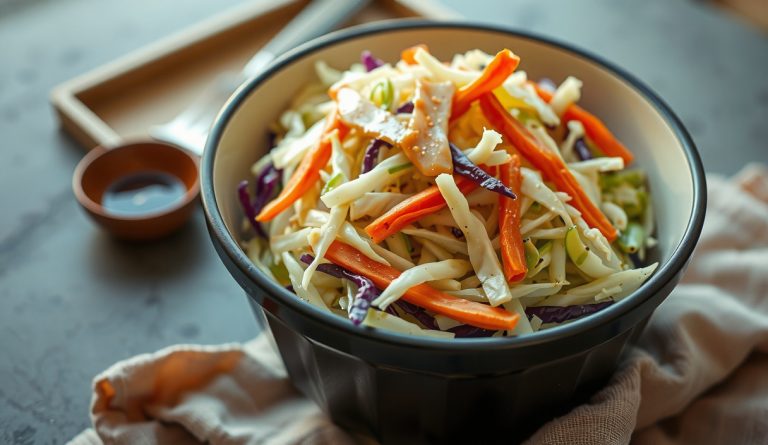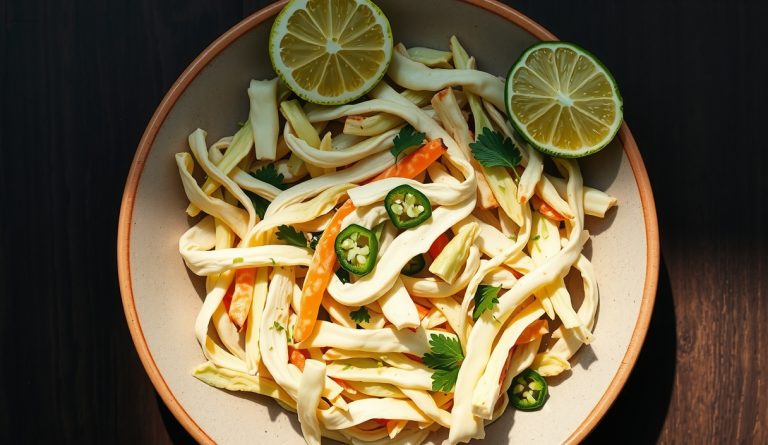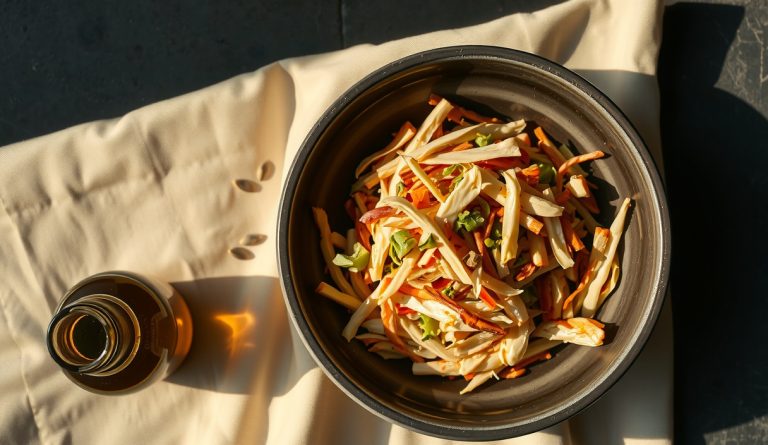
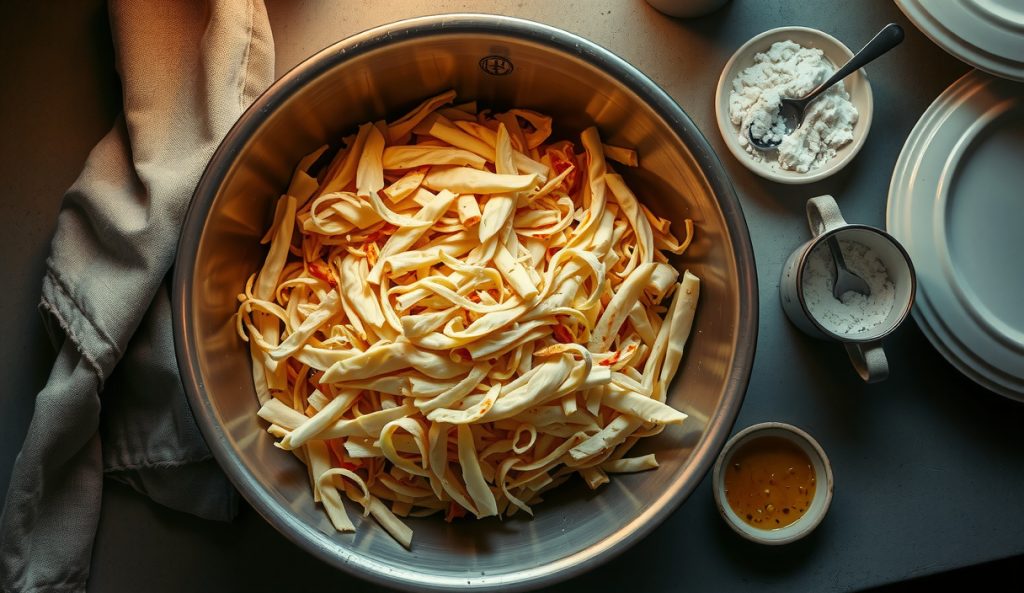
Most coleslaw recipes collapse at scale not because the ratios are wrong but because the process is not adapted to the volume. Uneven salt coverage leads to inconsistent moisture draw, and single-batch dressing of a full hotel pan means the bottom third receives three times the coating of the top third. This competition-scale variant addresses both failure modes with two straightforward procedural adjustments calibrated for 10 pounds of cabbage — a realistic competition turn-in or mid-size catering quantity.
What changes at competition scale?
Salt increases to 145 grams for 10 pounds of cabbage, maintaining the same percentage-by-weight ratio as the canonical recipe. Use a full-size hotel pan with a minimum 4-inch depth for the salt draw rather than a mixing bowl — the increased surface area ensures even salt distribution and gives the purged liquid somewhere to collect without the cabbage sitting in its own brine.
After the one-hour rest, drain and squeeze the cabbage in two or three batches using clean kitchen towels or a fine-mesh bag. Attempting to squeeze the full 10-pound volume at once leaves residual moisture in the center mass that will thin the dressing during transport. Dress the coleslaw in two large separate batches, tossing each thoroughly before combining, to ensure even coating throughout the full volume.
The critical non-linear constraint is sugar. Do not scale the sugar upward proportionally at high volume — the sweetness threshold becomes cloying even when acid is proportionally present. The human palate perceives sweetness non-linearly at quantity, and competition judges eating multiple samples are particularly sensitive to this effect. Hold the sugar at the canonical amount or increase it by no more than 20 percent, then taste and adjust from there rather than scaling mathematically. The one-hour rest holds at any scale — do not shorten it.
What stays the same as the original recipe?
Every ingredient ratio except the practical sugar ceiling scales linearly with cabbage weight. The vinegar quantity, mayonnaise, celery seed, and rest time are all proportional increases from the base formula. The core technique is identical to the canonical method — only the vessel size, squeeze method, and dressing-batch approach adapt to the volume.
When is the competition-scale version the better choice?
Use this competition-scale version for any preparation exceeding roughly 4 pounds of cabbage — competition turn-ins, catering events, large cookouts, or church-supper quantities. Below that threshold, the canonical single-batch process is more efficient and produces equivalent results.
Use the full ingredient ratios, dressing formula, and rest-time guidance from the original Pit-Master Coleslaw — Vinegar-Forward.