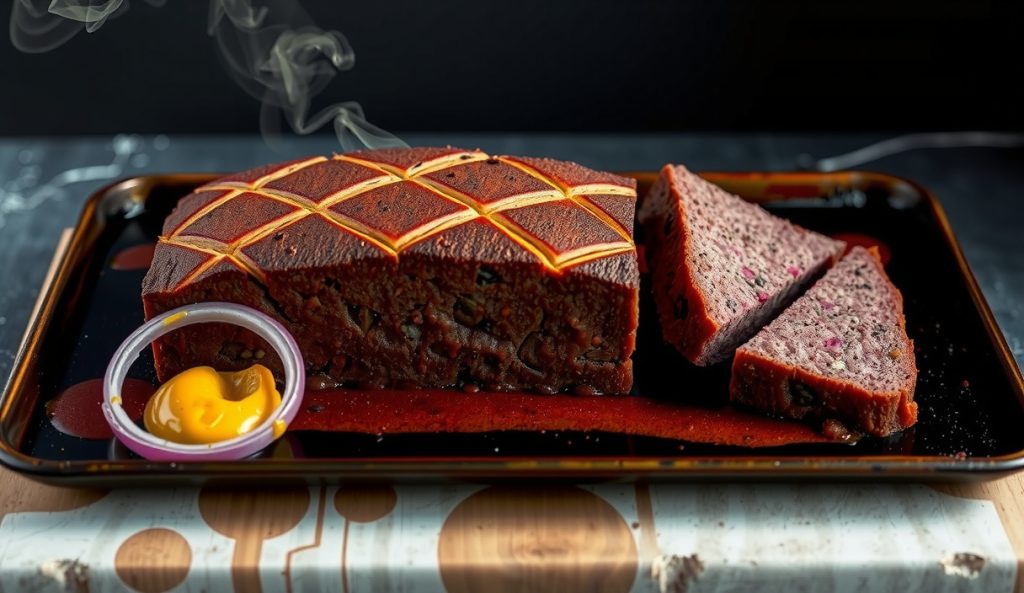
This is not a meatless bologna. Nothing is. What it is: a hickory-smoked king oyster mushroom preparation that uses every technique in the canonical recipe — scoring, mustard binder, rub, slow fire — to pursue the same table experience through a different substrate. Longer tables, not higher fences. The smoked king oyster mushroom column belongs at the same cookout, on the same butcher paper, next to the chub.
What changes when you swap the bologna for mushrooms?
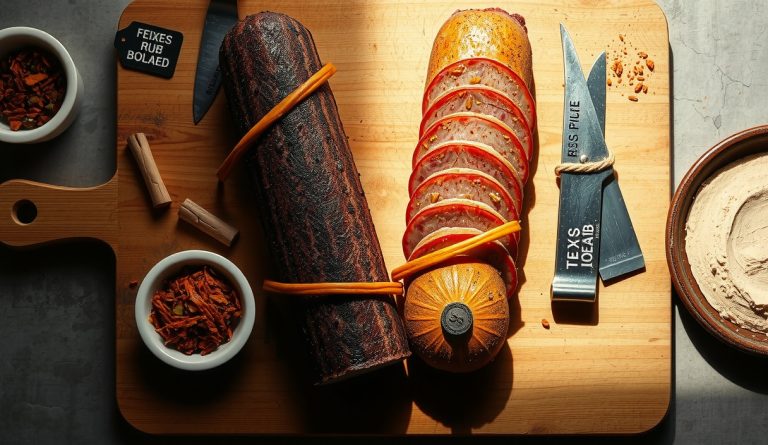
The analog: a bundled king oyster mushroom column. King oyster mushrooms (Pleurotus eryngii) have a dense, fibrous stem with a meaty chew and very low initial moisture relative to most culinary mushrooms — roughly 85–88% water compared to 92% for button mushrooms. Select 8–10 large stems of similar diameter, trim the caps flush, and bind them tightly into a cylindrical column approximately 3 inches in diameter using butcher’s twine at 1-inch intervals. This geometry approximates the cross-section of the bologna chub and allows the same scoring pattern to function mechanically. The twine compresses the stems, reduces the inter-stem air gaps, and creates a semi-unified mass that holds its shape through the full smoke session.
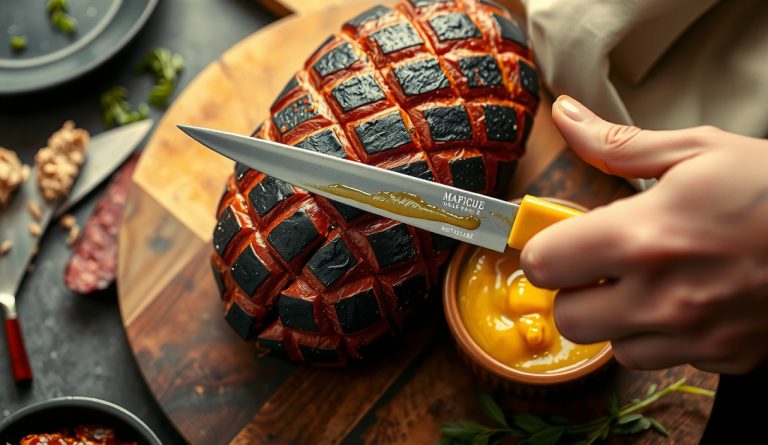
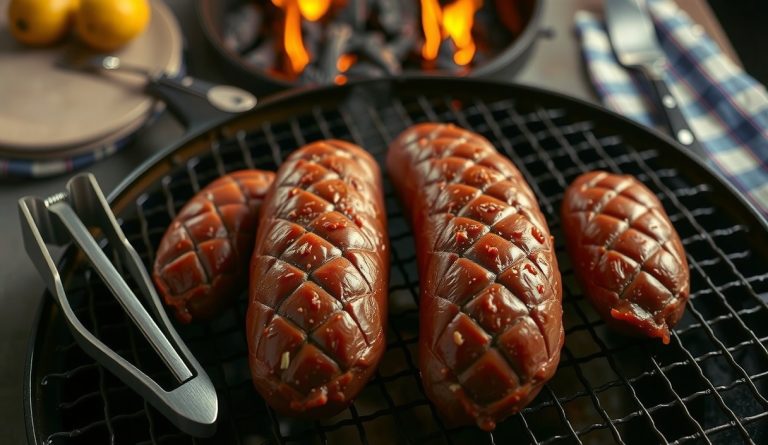
Scoring serves the same two purposes on the mushroom column as on the chub. Score the bound column in the same quarter-inch-deep diagonal grid as the canonical recipe. On bologna, the cuts break a steam-retaining casing; on the mushroom column, they massively increase surface area and open channels for smoke compound deposition directly into the stem interior. Mushroom cell walls are composed of chitin rather than the myosin-gel matrix of bologna, so the cut surfaces do not form a traditional Maillard bark at the same rate — but those surfaces, dehydrated by the smoker’s convective airflow, undergo surface browning via a combination of Maillard reactions (the stems contain free amino acids and reducing sugars) and heat-locked enzymatic browning. The result is a deeply colored, slightly chewy crust with a genuinely smoky interior.
Mustard binder and rub: identical to the canonical recipe. The emulsion chemistry of prepared yellow mustard works equally well on the hydrophilic chitin surface of the mushroom stem — the aqueous phase dissolves and anchors the rub salts and spices, and the mucilage proteins hold adhesion. Apply the full canonical rub at the same rate. The brown sugar in the rub plays a larger role on the mushroom column than on bologna: it is one of the primary Maillard-reaction substrates on the mushroom surface, alongside the mushroom’s free glutamic acid and other amino acids. Do not reduce the brown sugar quantity.
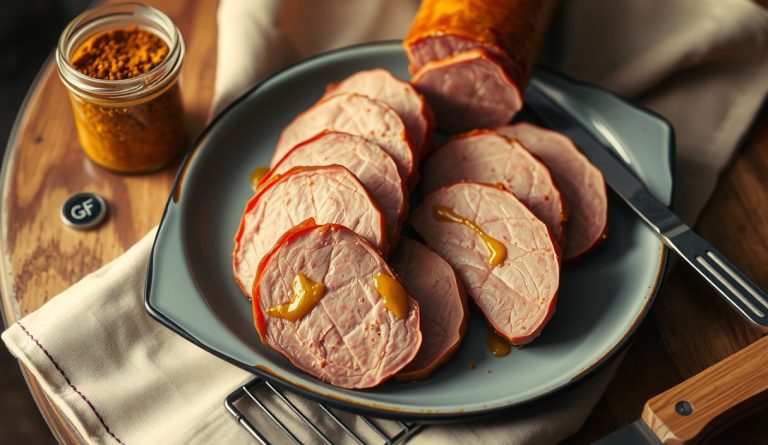
Smoke and temperature adjustments require one meaningful change. Run the smoker at 225°F over hickory, the same as the canonical recipe, but reduce the cook time to 2 to 2.5 hours. The mushroom column is not a dense protein matrix — after 2.5 hours, the outer third is well-barked and the interior is fully cooked through and smoke-penetrated. Beyond 2.5 hours, moisture loss becomes aggressive and the stems begin to collapse. Pull the column when the outer surface is firm and darkly barked and the interior reads 185°F on an instant thermometer, a probe-safe target for full cell-wall collapse and tender chew. Rest 10 minutes before slicing into half-inch rounds. A faint pink-grey halo just inside the bark — the smoke ring analog — is a real and visible phenomenon here, caused by phenolic smoke compounds reacting with the mushroom’s natural pigments rather than with myoglobin. It is visible and satisfying.
What stays exactly the same as the original smoked bologna recipe?
The following elements of the canonical smoked bologna method carry over to the mushroom column without modification:
- Quarter-inch-deep diagonal scoring grid geometry
- Prepared yellow mustard as the rub binder
- Full canonical rub composition and application rate
- Hickory wood at 225°F throughout the cook
- Service on white bread (or GF equivalent) with mustard and onion
- Butcher-paper presentation and cross-sectioned, barked-cylinder visual
When is the mushroom column the better choice?
The smoked king oyster mushroom column earns its place at a mixed table where vegetarian guests want a genuine pit experience, not an afterthought. At 225°F for 2 to 2.5 hours, the column develops hickory bark, a visible smoke halo, and the same butcher-paper presentation as the chub — giving vegetarian guests the full visual and aromatic register of the cookout. The column also stands on its own for anyone who wants to explore how smoke and Maillard chemistry behave on a fungal substrate. The flavor profile is distinct from bologna but shares enough of the hickory-bark-rub register to belong in the same conversation.
The full technique that informs every step here is documented at the original Smoked Bologna — Oklahoma Steakhouse Style recipe.