Smoked Brisket Chili
Equipment
- 1 6-quart enameled cast iron Dutch oven High thermal mass prevents scorching of the thick chili paste; essential for an even low simmer.
- 1 12-inch cast iron or carbon steel skillet For searing brisket cubes and dry-toasting chiles. Must hold sustained high heat.
- 1 High-speed blender Emulsifies the soaked chiles into a smooth paste. An immersion blender will work but produces a coarser texture.
- 1 Instant-read thermometer Confirms the braise holds 200–205°F. Prevents hard boiling that shreds the meat.
- 1 Fine-mesh strainer Optional: strain the chile paste for a silkier broth. Skip for rustic texture.
Ingredients
Smoked Brisket
- 2 lbs smoked brisket point (or point-heavy slices) Cold from the refrigerator; cut into 1-inch cubes. Bark-on is correct and preferred.
- 2 tbsp neutral oil (beef tallow or lard preferred) High smoke-point fat for searing. Tallow amplifies the beef character.
- 1 tsp kosher salt For seasoning before sear.
Ancho-Guajillo Chile Paste
- 4 dried ancho chiles (stems removed, seeded) Approximately 1.5 oz. Remove seeds for medium heat; leave one chile’s seeds for hotter result.
- 3 dried guajillo chiles (stems removed, seeded) Approximately 0.75 oz. Adds brightness and clean red color.
- 2 cups boiling water For soaking the toasted chiles. Reserve the soaking liquid.
- 4 cloves garlic Added raw to the blender with the soaked chiles.
- 1 tsp ground cumin Toasted and freshly ground if possible.
- 1 tsp dried Mexican oregano Not Mediterranean oregano—Mexican oregano has citrus and anise notes that work with dried chiles.
- 1 tsp kosher salt
Braise Base
- 1 medium yellow onion, diced Approximately 1.5 cups diced.
- 1 tbsp neutral oil For sweating the onion.
- 12 oz dark lager or amber ale Negra Modelo, Dos Equis Ámbar, or equivalent. One 12-oz bottle.
- 1 can (28 oz) fire-roasted crushed tomatoes Muir Glen or equivalent. Fire-roasting adds smokiness that reinforces the brisket.
- 1 cup low-sodium beef stock Adjust at the end if the chili thickens too much.
- 1 tbsp tomato paste Concentrated umami and color depth. Brown it in the pot for 60 seconds before adding liquid.
- 1 tbsp brown sugar Balances the acidity of the tomatoes and dried chiles. Adjust to taste.
- 1 tsp smoked paprika Amplifies the brisket smoke signature in the broth.
- 1 tsp kosher salt Starting point; taste and adjust at the end.
- 0.5 tsp black pepper, freshly ground
Masa Thickener
- 3 tbsp masa harina Maseca or Bob’s Red Mill. Must be masa harina (nixtamalized), not raw cornmeal or polenta.
- 0.25 cup cold beef stock or water For whisking with the masa harina to form a lump-free slurry before adding to the pot.
Finishing
- 1 tbsp apple cider vinegar or fresh lime juice Added off-heat. Re-volatilizes aromatics and balances richness. Do not add during active simmer.
- 2 tbsp pickled jalapeño slices Optional garnish. The brine adds acidity; the jalapeños add bright heat.
- 0.25 cup crumbled cotija or shredded sharp cheddar Optional garnish.
- 2 scallions, thinly sliced Optional garnish.
- 1 lime, cut into wedges For serving.

Instructions
Make the Chile Paste
- Heat a 12-inch cast iron skillet over medium heat until a drop of water evaporates instantly. Working in batches, place the dried ancho and guajillo chiles flat in the dry skillet. Press firmly with a spatula for 20–30 seconds per side until the skin blisters slightly, the color deepens, and the kitchen smells of warm chocolate and dried fruit—not char. Transfer immediately to a bowl.4 dried ancho chiles (stems removed, seeded), 3 dried guajillo chiles (stems removed, seeded)
- Pour boiling water over the toasted chiles. Place a small plate on top to keep them submerged. Soak for 20 minutes until completely softened. Do not discard the soaking liquid—it is part of the paste.2 cups boiling water
- Transfer the soaked chiles and 1 cup of their soaking liquid to a high-speed blender. Add the raw garlic cloves, ground cumin, dried Mexican oregano, and 1 teaspoon kosher salt. Blend on high for 60–90 seconds until completely smooth. The paste should be thick, deeply red, and glossy. Taste—it should be bold, slightly bitter, and intensely savory. Set aside.4 cloves garlic, 1 tsp ground cumin, 1 tsp dried Mexican oregano, 1 tsp kosher salt
Sear the Brisket
- Pat the brisket cubes completely dry with paper towels. Season lightly with 1 teaspoon kosher salt. Surface dryness is critical: any moisture will cause steam that delays the Maillard browning threshold.1 tsp kosher salt
- Heat the Dutch oven over high heat. Add 2 tablespoons of tallow or neutral oil and heat until shimmering and just beginning to smoke. Working in two batches, add the brisket cubes in a single layer with at least 1 inch of clearance between pieces. Sear undisturbed for 2–3 minutes per side until deeply browned on at least two faces. Transfer to a plate. Repeat with the second batch. Pour off excess rendered fat if more than 2 tablespoons remain in the pot, but leave the fond (browned bits) intact.2 tbsp neutral oil (beef tallow or lard preferred)
Build the Braise
- Reduce heat to medium. Add 1 tablespoon oil to the Dutch oven if the pot looks dry. Add the diced yellow onion and cook, stirring occasionally and scraping up the fond, for 6–8 minutes until softened and lightly golden.1 tbsp neutral oil, 1 medium yellow onion, diced
- Add the tomato paste directly to the onions. Spread it into a thin layer and cook undisturbed for 60–90 seconds until it darkens from bright red to a deeper brick color. This Maillard step concentrates the tomato’s glutamic acid load and eliminates raw, tinny notes.1 tsp smoked paprika
- Pour in the dark lager. Scrape the bottom of the pot vigorously to deglaze all fond into the liquid. Let it simmer for 2 minutes to cook off most of the alcohol.12 oz dark lager or amber ale
- Add the fire-roasted crushed tomatoes, beef stock, chile paste (all of it), brown sugar, smoked paprika, 1 teaspoon kosher salt, and black pepper. Stir to combine. Return the seared brisket cubes and any accumulated juices to the pot.1 can (28 oz) fire-roasted crushed tomatoes, 1 cup low-sodium beef stock, 1 tsp ground cumin, 1 tsp kosher salt, 0.5 tsp black pepper, freshly ground, 3 tbsp masa harina, 0.25 cup cold beef stock or water
- Bring the pot to a gentle simmer over medium heat. Reduce to medium-low to hold the braise at 200–205°F—a lazy, occasional bubble at the surface. Set the lid slightly ajar (leave a 1-inch gap). Simmer for 45 minutes, stirring every 10–15 minutes to prevent the chile paste from settling and scorching on the bottom.
Thicken with Masa Harina
- In a small bowl, whisk the masa harina into the cold beef stock or water until completely lump-free. The slurry should be the consistency of heavy cream. This pre-dispersion step is non-negotiable: adding dry masa harina directly to hot liquid creates ungelatinized pockets that never fully cook out.1 tbsp apple cider vinegar or fresh lime juice, 2 tbsp pickled jalapeño slices
- Pour the masa slurry slowly into the simmering chili while stirring constantly. Increase heat slightly to bring the pot back to 200–205°F and hold it there for 10–15 minutes, stirring frequently, until the broth visibly thickens and the raw corn aroma cooks off entirely. The finished broth should coat the back of a spoon with a light, glossy layer.1 tbsp apple cider vinegar or fresh lime juice
Finish and Serve
- Pull the pot off heat. Stir in the apple cider vinegar or lime juice. Taste and adjust salt, acid, and heat. The vinegar brightens the aromatic profile by re-volatilizing bound flavor compounds that flatten during the long braise. Do not skip this step.0.25 cup crumbled cotija or shredded sharp cheddar
- Ladle into bowls. Garnish with pickled jalapeño slices, crumbled cotija or shredded cheddar, sliced scallions, and a lime wedge. Serve immediately. For next-level service, ladle over a half-cup of cooked white rice or alongside charred flour tortillas.2 scallions, thinly sliced, 1 lime, cut into wedges
Notes
Nutrition
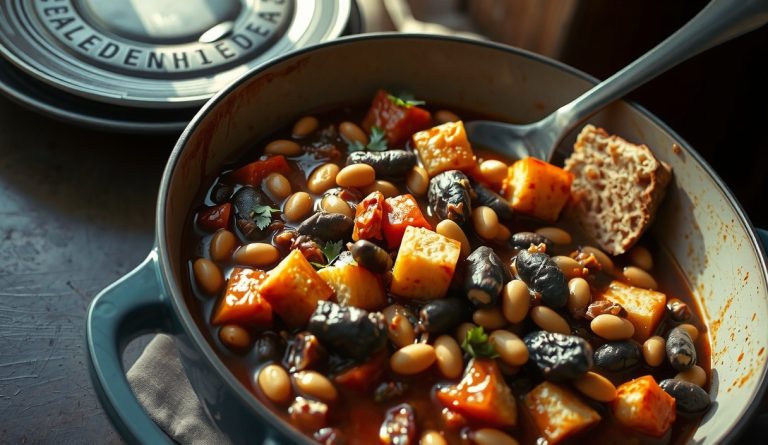
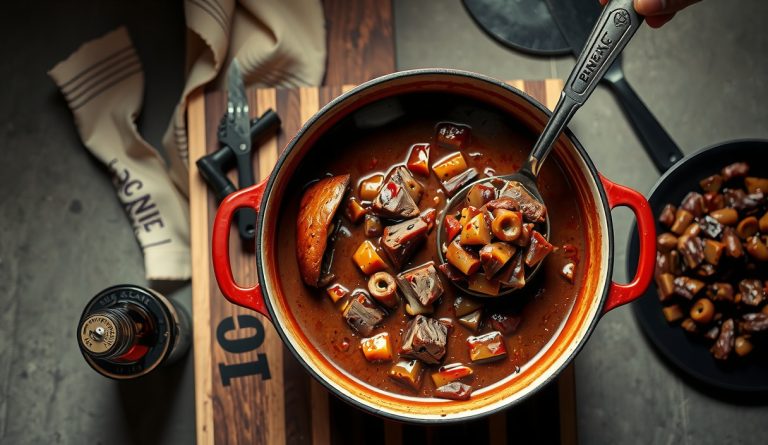
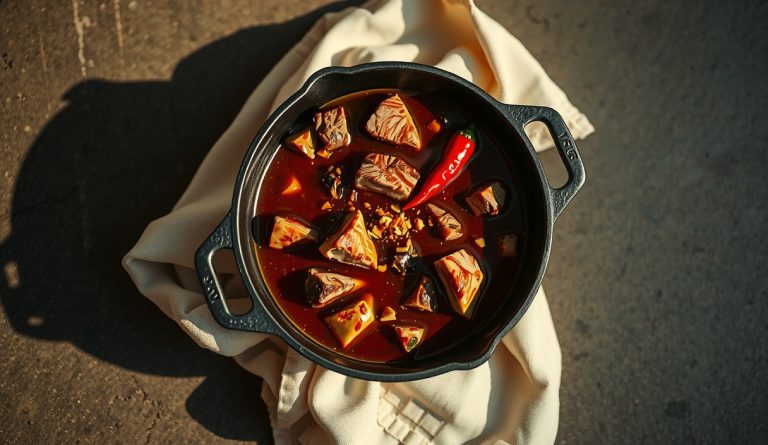
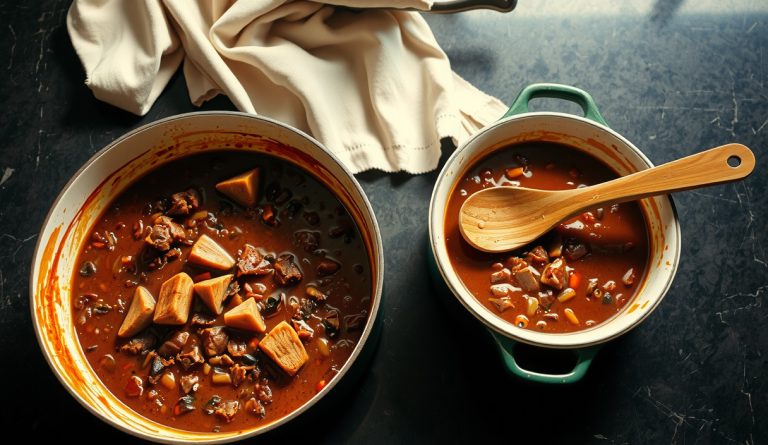
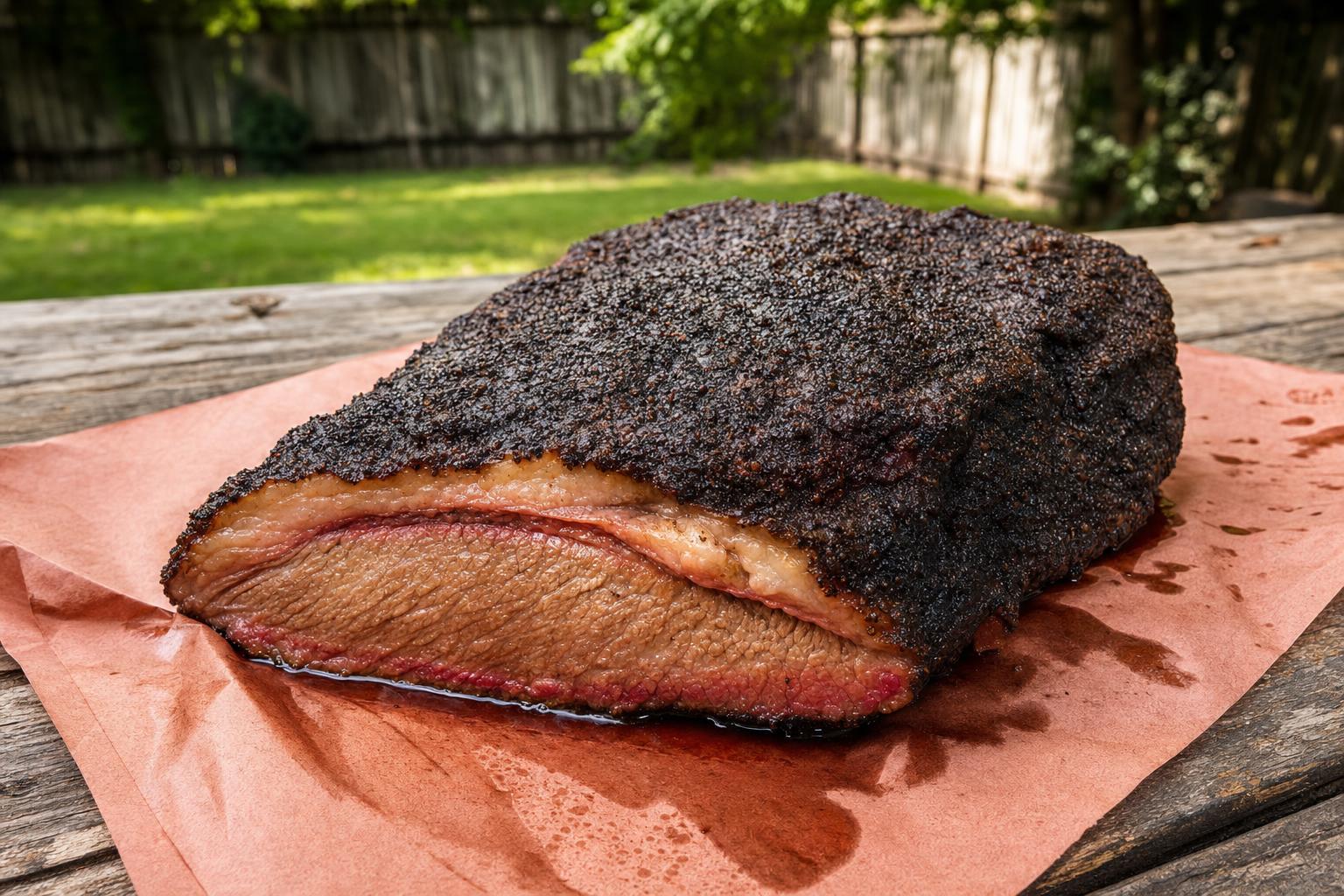
There is a moment, usually around day two after a long brisket smoke, when the point muscle has tightened in the fridge and the bark has gone slightly chewy and eating it straight off the cutting board is no longer doing it justice. That moment is the beginning of this chili. Smoked brisket chili is not a consolation prize for leftovers. It is the second act of a two-day cook, and in many ways it is the better one.
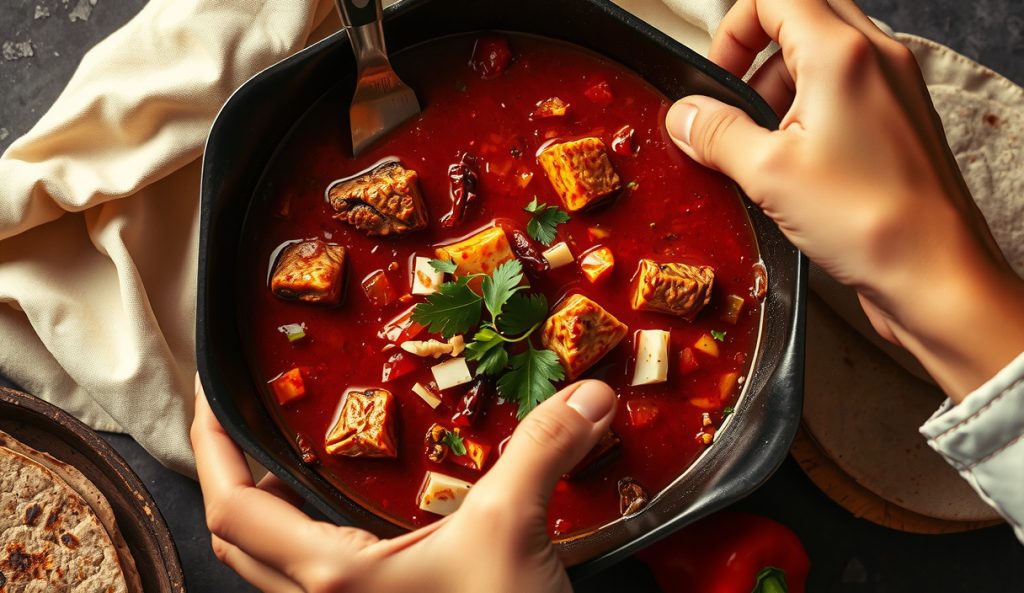
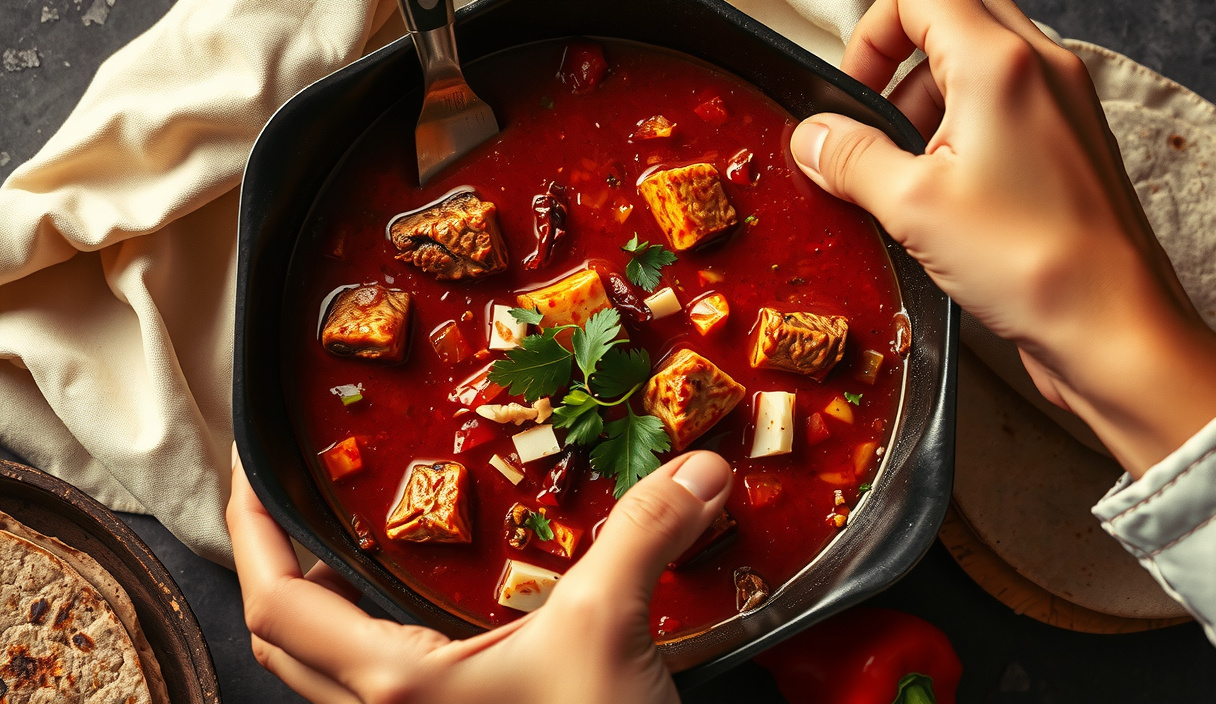
Smoked brisket chili occupies a narrow but spectacular lane between Texas no-bean chili orthodoxy and the braised beef stews of northern Mexico. The chili takes a cut already transformed once — by twelve-plus hours of oak or post oak smoke, by the stall, by the collagen-to-gelatin conversion deep inside the flat and point — and asks it to give one more performance. The braising liquid is built to complement that smoke: dark lager or a malty amber, fire-roasted tomatoes, and a hand-toasted ancho-guajillo paste delivering dried fruit, leather, and clean heat. The thickener is masa harina, the nixtamalized corn flour used for tortillas, and it does something no cornstarch or flour slurry can — it gelatinizes with flavor, adding a subtle corn-tortilla earthiness that ties the entire pot together.
Why does smoked brisket chili work? The science
Smoked brisket chili works because the brisket has already cleared its most difficult structural hurdle before it enters the pot. During the original smoke, the dense intramuscular collagen of the point — primarily Type I collagen organized into load-bearing fibers — underwent thermal hydrolysis at sustained internal temperatures above 160–170°F. That process, governed by first-order kinetics, converted the triple-helix collagen network into soluble gelatin. When you cube the cold brisket and sear it in a hot Dutch oven, you are not cooking the brisket a second time so much as reactivating that gelatin and triggering the Maillard cascade on freshly exposed surfaces.
Searing the cubed brisket at a cast-iron surface temperature above 400°F drives the amino-carbonyl browning reaction on cut faces that were previously insulated by bark. This sear adds a new layer of melanoidins and volatile pyrazines on top of the existing smoke-derived guaiacol and syringol compounds already embedded in the outer crust, producing a flavor architecture of extraordinary depth.
The chili paste is built by dry-toasting whole dried chiles until the skin blisters and the interior volatiles — capsaicin bound in the membrane near the seeds, and fat-soluble pigments called capsanthin and capsorubin — become mobile. Soaking the toasted chiles in near-boiling water for 20 minutes softens the cell walls and hydrates the capsaicinoid-rich placenta, allowing a high-speed blender to emulsify the entire structure into a stable, thick paste. The capsaicin, a trigeminal TRPV1 agonist, is fully distributed at this stage. The perceived heat level will soften only slightly over the long braise as some capsaicin binds to fat molecules in the braising liquid, lowering its effective vapor pressure and perceived intensity.
The dark beer contributes Maillard-derived melanoidins from the kilning of malt, plus mild bitterness from iso-alpha acids that balances the fat richness of the brisket point. Alcohol evaporates within the first 15 minutes of simmering, leaving behind residual sugars and organic acids that add body and complexity without sweetness.
Masa harina is the structural and flavor wildcard of smoked brisket chili. Nixtamalization — the alkaline cal-water cooking of dried corn kernels — partially gelatinizes the starch granules and denatures surface proteins, making the starch far more accessible to water than raw corn flour. When masa harina is whisked into a warm liquid and the mixture is brought above 180°F, the remaining starch granules undergo endothermic swelling and crystalline melting. Amylose chains leach out and continuous-phase viscosity increases rapidly, producing a thick, glossy broth that clings to the beef cubes. Because the starch is embedded in a complex matrix of tomato solids, fat droplets, and dissolved gelatin, the resulting thickening is smooth and body-forward — almost like a well-reduced stock — rather than starchy or gluey. At the same time, corn-tortilla volatiles including 2-aminoacetophenone and selected pyrazines volatilize into the pot and integrate with the smoke and chile aromatics, creating a flavor bridge between the two central ingredients.
What equipment and ingredients do I need?
The brisket point matters. The flat is leaner and will dry out quickly in a second cook. Use the point — the deckle — or a mix of point-heavy slices. Cold brisket cubes cleaner than warm. Aim for 1-inch cubes so the interior stays moist while the exterior browns.
Ancho and guajillo chiles are non-negotiable. Ancho (dried poblano) delivers raisin and chocolate notes with mild heat (1,000–2,000 Scoville). Guajillo contributes bright red color, moderate heat (2,500–5,000 Scoville), and a clean berry-like acidity. Together they build the structural flavor of the paste. Remove seeds and veins before toasting for a medium-spice result; leave one chile’s seeds in for noticeable heat.
Masa harina, not cornmeal. Bob’s Red Mill and Maseca are widely available. The nixtamalization process is what makes this work — raw cornmeal will not gelatinize cleanly and will taste raw even after an hour of simmering. Whisk the masa harina into cold beer or water before adding to the pot to prevent lumping.
Dark lager or amber ale. Negra Modelo, Dos Equis Ámbar, or any malt-forward beer without aggressive hop bitterness. A highly hopped IPA will turn resinous and harsh after reduction. One 12-oz bottle is correct. Save the rest of the six-pack for the cook.
Enameled cast iron Dutch oven. The high thermal mass distributes heat evenly, preventing the thick chili paste from scorching on the bottom during the final simmer. A 6-quart is the minimum. If you only have a stainless stockpot, reduce heat aggressively and stir every 10 minutes.
Smoked Brisket Chili
Equipment
- 1 6-quart enameled cast iron Dutch oven High thermal mass prevents scorching of the thick chili paste; essential for an even low simmer.
- 1 12-inch cast iron or carbon steel skillet For searing brisket cubes and dry-toasting chiles. Must hold sustained high heat.
- 1 High-speed blender Emulsifies the soaked chiles into a smooth paste. An immersion blender will work but produces a coarser texture.
- 1 Instant-read thermometer Confirms the braise holds 200–205°F. Prevents hard boiling that shreds the meat.
- 1 Fine-mesh strainer Optional: strain the chile paste for a silkier broth. Skip for rustic texture.
Ingredients
Smoked Brisket
- 2 lbs smoked brisket point (or point-heavy slices) Cold from the refrigerator; cut into 1-inch cubes. Bark-on is correct and preferred.
- 2 tbsp neutral oil (beef tallow or lard preferred) High smoke-point fat for searing. Tallow amplifies the beef character.
- 1 tsp kosher salt For seasoning before sear.
Ancho-Guajillo Chile Paste
- 4 dried ancho chiles (stems removed, seeded) Approximately 1.5 oz. Remove seeds for medium heat; leave one chile’s seeds for hotter result.
- 3 dried guajillo chiles (stems removed, seeded) Approximately 0.75 oz. Adds brightness and clean red color.
- 2 cups boiling water For soaking the toasted chiles. Reserve the soaking liquid.
- 4 cloves garlic Added raw to the blender with the soaked chiles.
- 1 tsp ground cumin Toasted and freshly ground if possible.
- 1 tsp dried Mexican oregano Not Mediterranean oregano—Mexican oregano has citrus and anise notes that work with dried chiles.
- 1 tsp kosher salt
Braise Base
- 1 medium yellow onion, diced Approximately 1.5 cups diced.
- 1 tbsp neutral oil For sweating the onion.
- 12 oz dark lager or amber ale Negra Modelo, Dos Equis Ámbar, or equivalent. One 12-oz bottle.
- 1 can (28 oz) fire-roasted crushed tomatoes Muir Glen or equivalent. Fire-roasting adds smokiness that reinforces the brisket.
- 1 cup low-sodium beef stock Adjust at the end if the chili thickens too much.
- 1 tbsp tomato paste Concentrated umami and color depth. Brown it in the pot for 60 seconds before adding liquid.
- 1 tbsp brown sugar Balances the acidity of the tomatoes and dried chiles. Adjust to taste.
- 1 tsp smoked paprika Amplifies the brisket smoke signature in the broth.
- 1 tsp kosher salt Starting point; taste and adjust at the end.
- 0.5 tsp black pepper, freshly ground
Masa Thickener
- 3 tbsp masa harina Maseca or Bob’s Red Mill. Must be masa harina (nixtamalized), not raw cornmeal or polenta.
- 0.25 cup cold beef stock or water For whisking with the masa harina to form a lump-free slurry before adding to the pot.
Finishing
- 1 tbsp apple cider vinegar or fresh lime juice Added off-heat. Re-volatilizes aromatics and balances richness. Do not add during active simmer.
- 2 tbsp pickled jalapeño slices Optional garnish. The brine adds acidity; the jalapeños add bright heat.
- 0.25 cup crumbled cotija or shredded sharp cheddar Optional garnish.
- 2 scallions, thinly sliced Optional garnish.
- 1 lime, cut into wedges For serving.
Instructions
Make the Chile Paste
- Heat a 12-inch cast iron skillet over medium heat until a drop of water evaporates instantly. Working in batches, place the dried ancho and guajillo chiles flat in the dry skillet. Press firmly with a spatula for 20–30 seconds per side until the skin blisters slightly, the color deepens, and the kitchen smells of warm chocolate and dried fruit—not char. Transfer immediately to a bowl.4 dried ancho chiles (stems removed, seeded), 3 dried guajillo chiles (stems removed, seeded)
- Pour boiling water over the toasted chiles. Place a small plate on top to keep them submerged. Soak for 20 minutes until completely softened. Do not discard the soaking liquid—it is part of the paste.2 cups boiling water
- Transfer the soaked chiles and 1 cup of their soaking liquid to a high-speed blender. Add the raw garlic cloves, ground cumin, dried Mexican oregano, and 1 teaspoon kosher salt. Blend on high for 60–90 seconds until completely smooth. The paste should be thick, deeply red, and glossy. Taste—it should be bold, slightly bitter, and intensely savory. Set aside.4 cloves garlic, 1 tsp ground cumin, 1 tsp dried Mexican oregano, 1 tsp kosher salt
Sear the Brisket
- Pat the brisket cubes completely dry with paper towels. Season lightly with 1 teaspoon kosher salt. Surface dryness is critical: any moisture will cause steam that delays the Maillard browning threshold.1 tsp kosher salt
- Heat the Dutch oven over high heat. Add 2 tablespoons of tallow or neutral oil and heat until shimmering and just beginning to smoke. Working in two batches, add the brisket cubes in a single layer with at least 1 inch of clearance between pieces. Sear undisturbed for 2–3 minutes per side until deeply browned on at least two faces. Transfer to a plate. Repeat with the second batch. Pour off excess rendered fat if more than 2 tablespoons remain in the pot, but leave the fond (browned bits) intact.2 tbsp neutral oil (beef tallow or lard preferred)
Build the Braise
- Reduce heat to medium. Add 1 tablespoon oil to the Dutch oven if the pot looks dry. Add the diced yellow onion and cook, stirring occasionally and scraping up the fond, for 6–8 minutes until softened and lightly golden.1 tbsp neutral oil, 1 medium yellow onion, diced
- Add the tomato paste directly to the onions. Spread it into a thin layer and cook undisturbed for 60–90 seconds until it darkens from bright red to a deeper brick color. This Maillard step concentrates the tomato’s glutamic acid load and eliminates raw, tinny notes.1 tsp smoked paprika
- Pour in the dark lager. Scrape the bottom of the pot vigorously to deglaze all fond into the liquid. Let it simmer for 2 minutes to cook off most of the alcohol.12 oz dark lager or amber ale
- Add the fire-roasted crushed tomatoes, beef stock, chile paste (all of it), brown sugar, smoked paprika, 1 teaspoon kosher salt, and black pepper. Stir to combine. Return the seared brisket cubes and any accumulated juices to the pot.1 can (28 oz) fire-roasted crushed tomatoes, 1 cup low-sodium beef stock, 1 tsp ground cumin, 1 tsp kosher salt, 0.5 tsp black pepper, freshly ground, 3 tbsp masa harina, 0.25 cup cold beef stock or water
- Bring the pot to a gentle simmer over medium heat. Reduce to medium-low to hold the braise at 200–205°F—a lazy, occasional bubble at the surface. Set the lid slightly ajar (leave a 1-inch gap). Simmer for 45 minutes, stirring every 10–15 minutes to prevent the chile paste from settling and scorching on the bottom.
Thicken with Masa Harina
- In a small bowl, whisk the masa harina into the cold beef stock or water until completely lump-free. The slurry should be the consistency of heavy cream. This pre-dispersion step is non-negotiable: adding dry masa harina directly to hot liquid creates ungelatinized pockets that never fully cook out.1 tbsp apple cider vinegar or fresh lime juice, 2 tbsp pickled jalapeño slices
- Pour the masa slurry slowly into the simmering chili while stirring constantly. Increase heat slightly to bring the pot back to 200–205°F and hold it there for 10–15 minutes, stirring frequently, until the broth visibly thickens and the raw corn aroma cooks off entirely. The finished broth should coat the back of a spoon with a light, glossy layer.1 tbsp apple cider vinegar or fresh lime juice
Finish and Serve
- Pull the pot off heat. Stir in the apple cider vinegar or lime juice. Taste and adjust salt, acid, and heat. The vinegar brightens the aromatic profile by re-volatilizing bound flavor compounds that flatten during the long braise. Do not skip this step.0.25 cup crumbled cotija or shredded sharp cheddar
- Ladle into bowls. Garnish with pickled jalapeño slices, crumbled cotija or shredded cheddar, sliced scallions, and a lime wedge. Serve immediately. For next-level service, ladle over a half-cup of cooked white rice or alongside charred flour tortillas.2 scallions, thinly sliced, 1 lime, cut into wedges
Notes
Nutrition
How do I nail smoked brisket chili every time?
- Dry the brisket cubes before searing. Surface moisture is the enemy of the Maillard reaction. Pat the cubes very dry with paper towels — any residual water will boil off before the surface reaches the 300°F+ threshold needed for browning, leaving gray, steamed meat instead of a deeply caramelized crust.
- Sear in batches without crowding. A single-layer sear with 1 inch of clearance between cubes keeps the pan surface above 350°F. Overcrowding drops the pan temperature, causes steam buildup, and eliminates the Maillard window entirely. Two batches for 2 pounds of meat is correct.
- Toast the chiles until fragrant but not black. Over-toasted anchos turn bitter from pyrolysis of the sugars in the dried fruit flesh. Target 30–45 seconds per side in a dry skillet over medium heat, pressing lightly with a spatula. The correct signal is the smell of warm chocolate and raisin, not char.
- Add masa harina as a slurry, not dry. Whisk 3 tablespoons of masa harina into ¼ cup of cold beer or water until completely smooth before adding to the pot. Pre-dispersing the starch granules this way prevents them from clumping into pockets of ungelatinized cornmeal floating in the broth.
- Hold the simmer at a lazy bubble, not a boil. The brisket is already fully cooked. A vigorous boil will mechanically shred the meat and cause rapid moisture expulsion from the already-denatured actin-myosin network. Target 200–205°F with the lid slightly ajar — a low convective environment that integrates flavors without destroying the chunks.
- Taste and adjust acid at the very end. A small squeeze of lime or a tablespoon of cider vinegar added off-heat brightens everything and re-volatilizes aromatic compounds that have flattened during the braise. Do not add acid earlier — acid during the main simmer accelerates starch hydrolysis and can cause the masa thickening to break down.
What variations can I make to this recipe?
Bean version. Traditional Texas chili is bean-free, and we respect that. For those who want beans, add two 15-oz cans of drained pinto or kidney beans during the last 20 minutes of simmering. Adding beans earlier causes pectin breakdown in the bean cell walls and produces a mealy, mushy texture. Late addition preserves structural integrity and allows the beans to absorb broth flavor without disintegrating.
Hotter build. The base recipe registers medium heat — noticeable but not punishing. To escalate, add 1–2 dried chiles de árbol (50,000–65,000 Scoville) to the soaking anchos and guajillos. Alternatively, a teaspoon of chipotle powder adds smoke-amplified heat that complements rather than competes with the brisket’s oak smoke profile. Do not use cayenne — its heat is sharp and one-dimensional against the complex dried-chile paste.
Beer swap. If dark lager is unavailable or a non-alcoholic version is preferred, substitute 12 oz of beef stock plus 1 tablespoon of molasses and 1 teaspoon of apple cider vinegar. The molasses reintroduces malt-derived melanoidins and residual sweetness; the vinegar provides the acid counterpoint that the beer’s carbonation and hop character normally supply. The result is slightly less complex but structurally identical.
Scaling up for a crowd. This recipe doubles cleanly. Keep the masa harina ratio at roughly 1.5 tablespoons per pound of meat to maintain the correct viscosity. When scaling to a 20-quart vessel for competition or catering, note that a wider, shallower pot will reduce more aggressively than a tall stockpot — reduce the uncovered simmer time by 10–15 minutes and check consistency before adding more masa slurry.
Frequently asked questions
Can I use raw brisket instead of smoked leftovers? Technically yes, but the dish loses its entire defining character. The smoked bark’s guaiacol and syringol compounds are irreplaceable — they create the secondary smoke layer in the broth that defines smoked brisket chili. If you must use raw brisket, smoke it to 165°F first (about 4–5 hours), let it rest, then proceed with the recipe. Do not use unsmoked beef chuck and call it the same thing.
My chili is too thick after it cools. What happened? The masa starch and dissolved gelatin from the brisket both increase viscosity dramatically as temperature drops — this is expected and correct behavior. Reheat gently over medium-low with a splash of beef stock or water, stirring continuously until the chili loosens to your target consistency. Do not boil hard to loosen it; that will cause the starch network to over-shear and produce a gluey, stringy texture.
How long does smoked brisket chili keep, and can I freeze it? Refrigerated in an airtight container, smoked brisket chili holds 4–5 days, with flavor actually improving on day two as the volatile aromatics redistribute through the fat phase. For freezing, the masa-thickened broth will break slightly upon thawing — the starch retrogrades into a firmer crystalline structure. Reheat from frozen over low heat, stirring often, and the chili will re-emulsify cleanly. Quality holds for up to 3 months frozen.