Texas-Style Hot Guts Sausage

Equipment
- 1 Meat grinder with 3/8-inch (9.5mm) grinding plate Chill all metal parts in the freezer 30 minutes before use
- 1 Sausage stuffer with 3/4-inch horn 5-lb vertical stuffer recommended; grinder attachment is a workable substitute
- 1 Offset smoker or ceramic kamado Must hold a stable 200–225°F; water pan helps stabilize temperature
- 4 to 6 Post oak or pecan wood chunks Fist-sized chunks; avoid mesquite for extended low-temp smokes
- 1 Instant-read thermometer Calibrated to within 2°F; verify with ice water bath before use
- 1 Large mixing bowl Set over ice bath during mixing to keep meat cold
- 1 Kitchen scale Gram-accurate scale required for precise cure calculation
- 1 Wire cooling rack For pellicle drying and post-smoke resting
Ingredients
Meat Mixture
- 2.5 lbs beef chuck, 80/20 lean-to-fat Cut into 1-inch cubes; chill to 34°F before grinding
- 1 lb pork shoulder (Boston butt) Cut into 1-inch cubes; chill to 34°F before grinding
- 0.5 lb pork back fat Cut into 1-inch cubes; freeze 20 minutes until firm but not rock-hard
Cure and Seasoning
- 10 grams Prague Powder #1 (pink curing salt, 6.25% sodium nitrite) Exactly 0.25% of total 4 lb meat weight by grams — do not estimate
- 28 grams kosher salt Approximately 1.75% of total meat weight; Diamond Crystal preferred
- 2 tablespoons smoked paprika Spanish pimentón de la Vera adds depth; sweet Hungarian is a milder substitute
- 1 tablespoon coarse-ground black pepper 16-mesh cracked; visible flecks in the finished link
- 1 tablespoon granulated garlic Not garlic powder; granulated hydrates more evenly through the coarse grind
- 1 teaspoon cayenne pepper Adjust to preference; this level delivers mild background heat, not frontal fire
- 1 teaspoon dry mustard powder Adds mild sulfurous depth and acts as a secondary emulsifying surfactant
- 0.25 cup ice water Keeps the mixture cold during binding; add 1 tablespoon at a time
Casings
- 4 feet natural hog casings, 32–35mm Salt-packed; soak in cold water 30 minutes, flush interior, keep in fresh cold water until use

Instructions
Grind and Mix
- Place your grinder head, grinding plate (3/8-inch), and die in the freezer for 30 minutes. Meanwhile, cut the beef chuck, pork shoulder, and pork back fat into 1-inch cubes. Spread on a sheet pan and refrigerate until the meat reaches 34–36°F and fat pieces are firm at the edges but not frozen through, about 20 minutes.1 lb pork shoulder (Boston butt), 0.5 lb pork back fat
- In a small bowl, combine the Prague Powder #1, kosher salt, smoked paprika, black pepper, granulated garlic, cayenne, and dry mustard. Whisk thoroughly so the cure is evenly distributed through the spice blend — uneven cure distribution creates pockets without nitrite protection.10 grams Prague Powder #1 (pink curing salt, 6.25% sodium nitrite), 28 grams kosher salt, 2 tablespoons smoked paprika, 1 tablespoon coarse-ground black pepper, 1 tablespoon granulated garlic, 1 teaspoon cayenne pepper, 1 teaspoon dry mustard powder
- Grind the cold meat and fat mixture once through the chilled 3/8-inch plate into a large bowl set over an ice bath. Work quickly. If the grinder starts struggling or the fat begins to smear rather than cut cleanly, the meat is warming — stop and re-chill everything for 15 minutes before continuing.1 lb pork shoulder (Boston butt), 0.5 lb pork back fat
- Sprinkle the combined cure and spice mixture evenly over the ground meat. Add the ice water one tablespoon at a time. Mix by hand or with the paddle attachment of a stand mixer on low speed for 90 seconds, until the mixture becomes slightly tacky and the proteins begin to bind — the mix will pull away from the bowl in a cohesive mass. Do not overmix past 2 minutes; fat smearing risks rise sharply with time and temperature.10 grams Prague Powder #1 (pink curing salt, 6.25% sodium nitrite), 28 grams kosher salt, 2 tablespoons smoked paprika, 1 tablespoon coarse-ground black pepper, 1 tablespoon granulated garlic, 1 teaspoon cayenne pepper, 1 teaspoon dry mustard powder, 0.25 cup ice water
- Fry off a small test patty in a dry skillet over medium heat until cooked through. Taste for salt and seasoning balance. Adjust the remaining uncooked mixture if needed, remembering that smoke will add additional salt-adjacent flavor during cooking. Re-chill the bulk mixture to 36°F before stuffing.
Stuff the Casings
- Drain the soaked hog casings and flush by running cold water through the interior of each length. Thread one end onto the 3/4-inch stuffing horn, gathering the casing onto the horn like a gathered sleeve, leaving 3 inches hanging free at the end. Tie a simple overhand knot in the hanging end.4 feet natural hog casings, 32–35mm
- Load the cold meat mixture into the stuffer cylinder and crank slowly to purge air until meat appears at the tip of the horn. Begin feeding the casing: hold the casing with light finger pressure against the horn, allowing it to fill steadily without stretching taut. Target 80% fill — the casing should feel firm but yield slightly when pressed with a finger. Overfilling is the single most common cause of casing blowout during smoking.4 feet natural hog casings, 32–35mm
- When the casing is filled, leave 3 inches of unfilled casing at the end and tie off with an overhand knot. To link: pinch the rope of sausage at 6-inch intervals and twist each link 3–4 full rotations in alternating directions (clockwise, then counterclockwise) to lock the links and prevent unraveling.
- Use a sterilized pin or sausage pricker to prick any visible air pockets — small bubbles visible under the casing. Prick at a shallow angle to release the air without tearing the casing wall. Air pockets expand during smoking and create burned, thin spots in the bark.
Pellicle Dry
- Hang the linked sausages on a wire rack or dowel rod and place them uncovered in the refrigerator for a minimum of 1 hour, or up to overnight. You are drying the casing surface to form a pellicle — a tacky, protein-rich skin that smoke compounds bond to efficiently. A wet casing repels smoke and produces a sour, creosote-tinged flavor. The links are ready when the casing surface feels dry and slightly tacky to a light touch.
Smoke
- Fire your smoker and stabilize at 200°F measured at grate level. Add 2 fist-sized chunks of post oak or pecan directly to the coals or firebox. A water pan placed between the fire and the cooking grate adds humidity that slows casing dehydration in the early stage of the cook and helps the smoke color develop evenly.
- Arrange the links on the grate with at least 1 inch of space between each one — touching links prevent airflow and create uneven bark. Insert a leave-in probe thermometer into the center of the thickest link. Close the smoker and maintain 200–210°F. Replenish wood as needed to maintain visible thin blue smoke; thick white smoke deposits bitter phenolics on the casing surface.
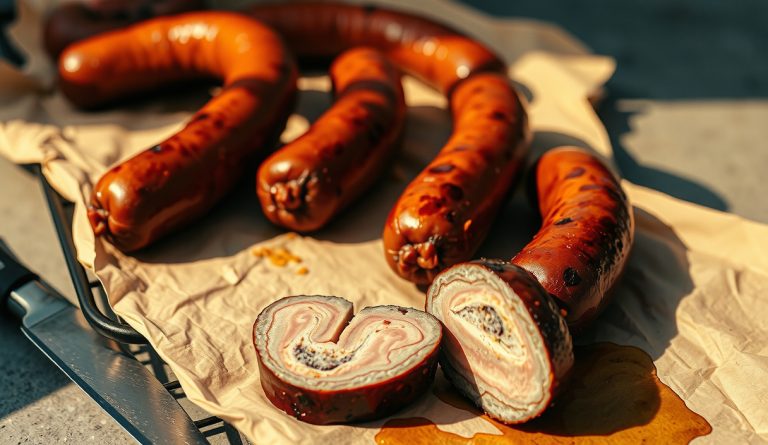
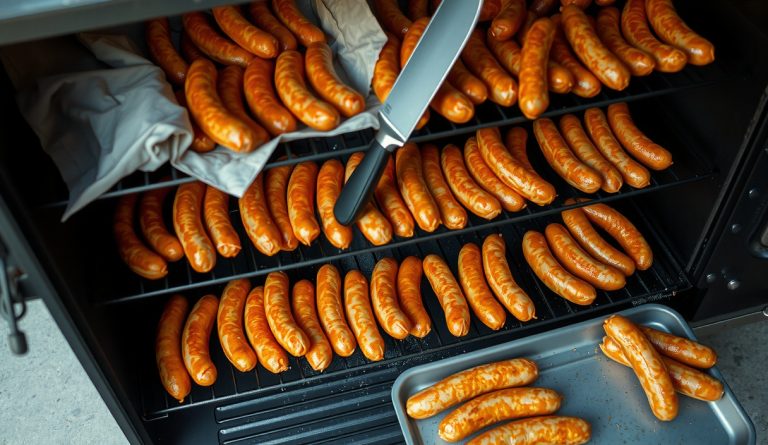
- Smoke the links until the internal temperature reads 152°F on your instant-read thermometer, approximately 3 to 3.5 hours at 200°F smoker temperature. Verify with a second spot-check of two or three links — the thinnest link will finish first. The casing should be mahogany to deep amber, firm and dry to the touch, and pull away slightly from the meat at the tie ends.
- Remove the links from the smoker and transfer to a clean wire rack. Rest uncovered at room temperature for 10–15 minutes. Do not cover or wrap — steam trapped under foil will soften the bark and prevent the casing from completing its retraction snap. The internal temperature will coast up 3–5°F during the rest; this is accounted for in the 152°F pull point.
Serve
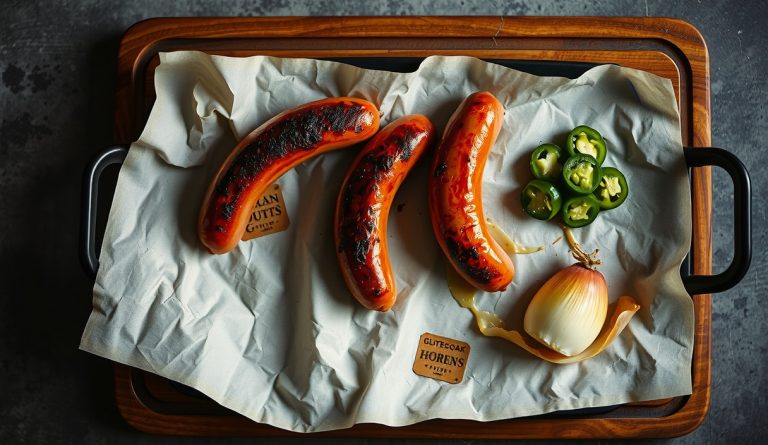
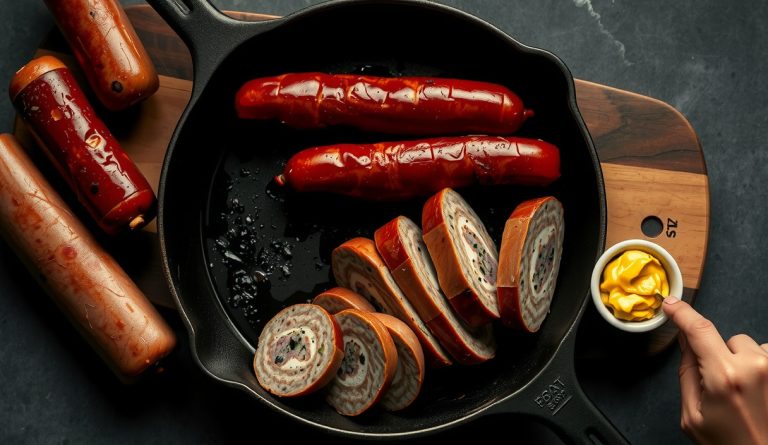
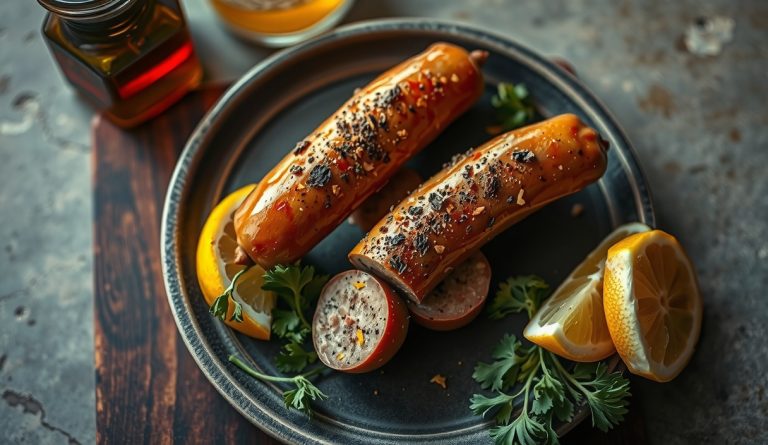
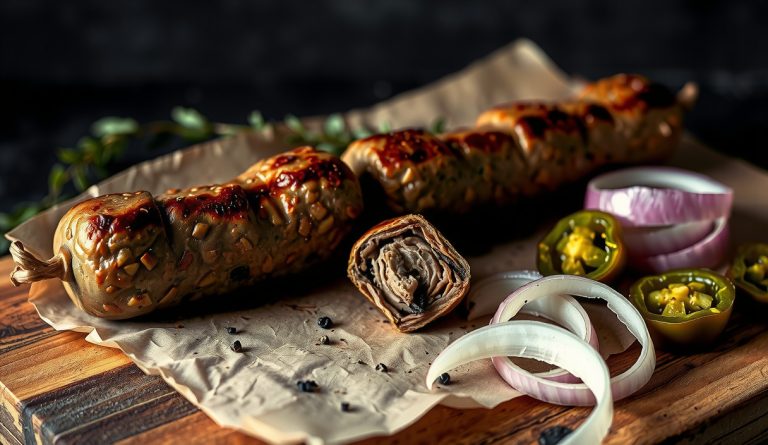
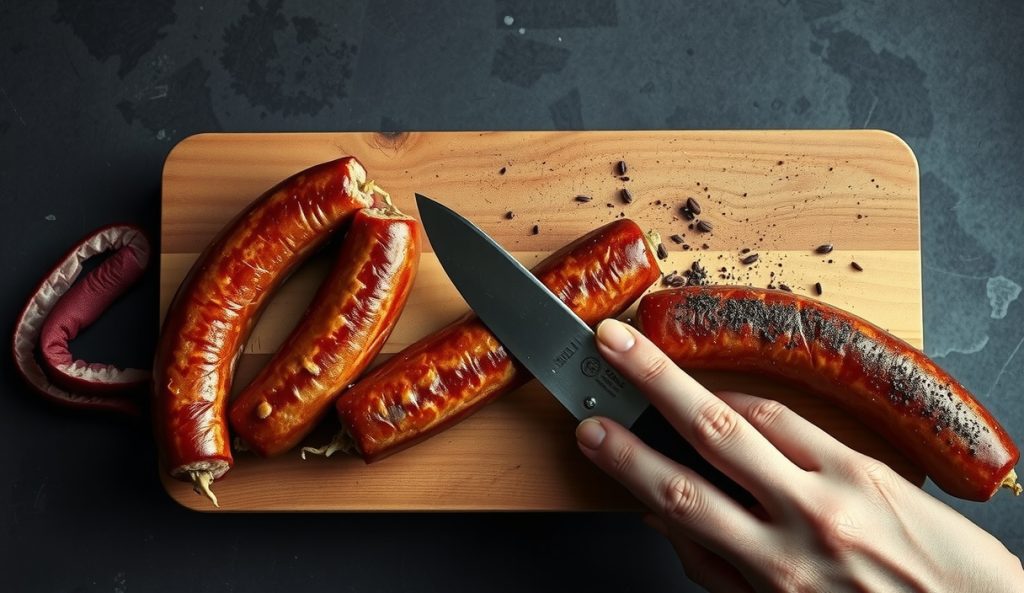
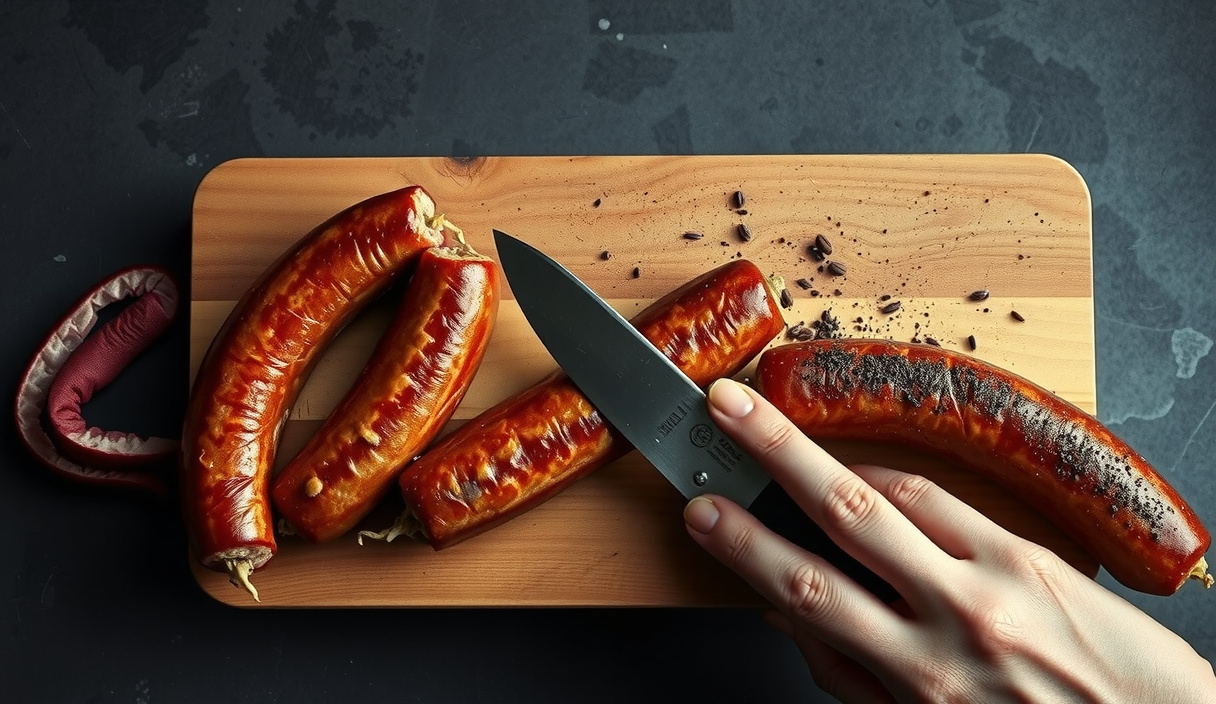
- Serve links whole, cut on the bias into thick slices, or halved lengthwise. Central Texas tradition calls for butcher paper, saltine crackers, sliced onion, and pickled jalapeños alongside. The snap test: bend a link sharply — a proper hot guts link audibly snaps at the casing without splitting the meat. If it bends silently, the casing was under-dried or the smoker temperature spiked too early, preventing the full retraction mechanism from completing.
Notes
Nutrition
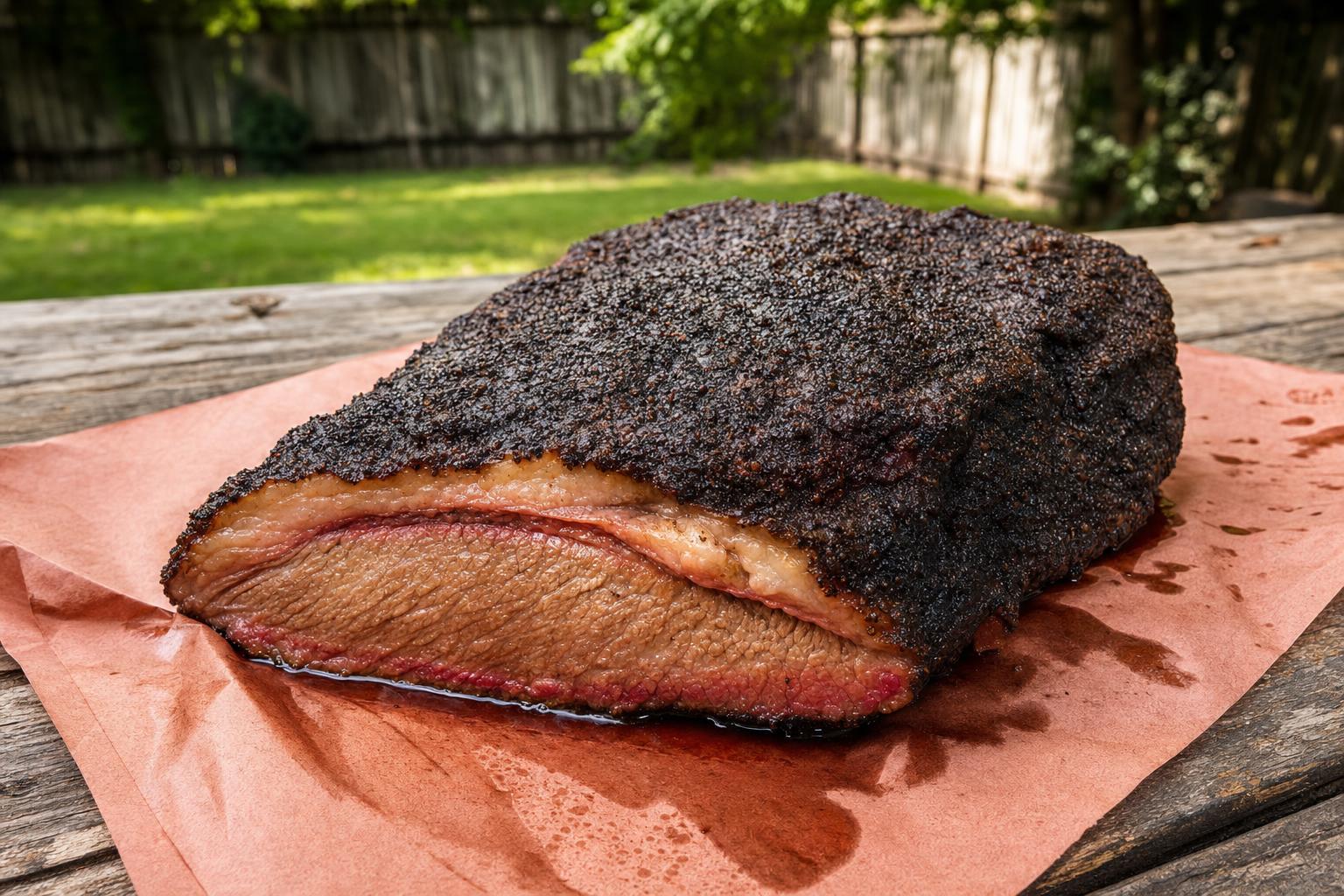
Drive down Highway 183 through Elgin, Texas on a Tuesday morning and the oak smoke hits you a quarter mile before the building does. That smell — fat rendering slowly, paprika blooming, nitrite chemistry doing its quiet work in the smokehouse — is not an accident. It is the product of a curing and smoking process refined over a century of Central Texas meat-market culture, and every variable in that process is tunable. This is our take on hot guts: coarse-ground, properly cured, hog-cased, and smoked low and slow over post oak until the protein sets and the casing snaps.
The name “hot guts” has nothing to do with heat level. It refers to the use of beef intestines as casing in the original Czech and German immigrant tradition — a distinction from the leaner, more delicate “market sausage” sold alongside it. Today most makers use hog casings for accessibility, but the philosophy stays: coarse texture, heavy smoke, fat that renders into the meat rather than pooling in a puddle on the plate.
Why does Texas-style hot guts sausage work? The science
Hot guts sausage achieves its characteristic pink interior, snapping casing, and juicy fat-laced bite through three overlapping mechanisms: nitrite chemistry, controlled low-temperature smoking, and coarse-grind fat geometry. Each mechanism is tunable, and understanding all three is what separates a competent sausage from an exceptional one.
Sodium nitrite — delivered via Prague Powder #1 at 0.25% of total meat weight — performs two simultaneous functions inside the casing. First, nitrite reacts with myoglobin to form nitrosomyoglobin, which denatures upon heating into the stable pink pigment nitrosohemochrome — the characteristic pink interior that survives cooking temperatures above 160°F. Second, and more critically, nitrite interferes with the electron transport chain of Clostridium botulinum and suppresses spore germination in the reduced-oxygen anaerobic environment inside the casing. Without cure, smoking a hog-cased sausage through the 40–140°F danger zone creates precisely the conditions botulinum toxin requires to form.
The Maillard cascade begins in earnest on the casing surface above approximately 250°F, but because the smoker runs at a conservative 200°F, the hot guts sausage operates below full Maillard onset at the surface. What develops instead is a prolonged drying phase that concentrates surface proteins and reduces water activity at the casing wall, building the mahogany bark gradually without fat rendering so fast that it blows out the casing. The coarse grind — 3/8-inch plate for the primary, no secondary grind — preserves discrete fat pockets that melt at roughly 130–145°F (the lipid solidus of pork back fat), basting the protein matrix from the inside as the sausage climbs toward the target internal temperature of 152°F.
At 152°F, myosin is fully denatured (onset near 104–120°F, complete well below 145°F) and actin approaches but does not reach its catastrophic denaturation threshold of 163–167°F — the zone where water-holding capacity collapses and the sausage turns chalky. Pulling the hot guts links at 152°F keeps them in the succulent window. The snap itself is a mechanical event during cool-down: as the collagen in the hog casing sets and the internal emulsion firms from liquid to solid gel, the casing contracts around the meat plug via protein retraction. Natural hog casings are composed largely of collagen that has undergone partial hydrolysis during smoking, leaving a semi-rigid but elastic tube that clings tightly to the cooled interior. When you bite through it, the casing resists for a fraction of a second before yielding audibly — that is stored elastic energy releasing via the crossed helical collagen architecture unique to natural casings.
What equipment and ingredients do you need?
- Meat grinder with 3/8-inch (9.5mm) plate: This is the workhorse. A 1/4-inch plate will give you a finer, emulsified texture closer to a hot dog — not what hot guts sausage calls for. The coarse grind preserves fat pockets and visible muscle fiber.
- Hog casings: Purchase salt-packed 32–35mm hog casings. Soak in cold water for at least 30 minutes, then rinse the interior by running water through them. Salt-packed casings keep for months in the refrigerator; pre-tubed packaged casings are convenient but thin and more prone to blowout.
- Prague Powder #1 (sodium nitrite cure): Not optional. Prague Powder #1 contains 6.25% sodium nitrite in a salt carrier. Do not substitute Morton Tender Quick without recalculating — the concentration is different. Do not use Prague Powder #2 (sodium nitrate) for a sausage smoked and eaten the same day; #2 is a long-cure product for whole muscles held weeks to months.
- Post oak or pecan wood: Central Texas orthodoxy demands post oak. The terpene profile is mild and the smoke is clean. Pecan adds a slightly sweeter, nuttier character. Mesquite is too aggressive for a 3–4 hour smoke at low temperature — it deposits heavy phenolic compounds that turn acrid.
- Instant-read thermometer: Non-negotiable. The 152°F internal target is simultaneously a food-safety and texture target. Guessing by color or time alone will produce either an underdone sausage or a chalky one.
- Sausage stuffer with 3/4-inch horn: A grinder stuffing attachment works in a pinch but introduces air pockets. A dedicated vertical stuffer provides continuous, even pressure and cleaner links.
Texas-Style Hot Guts Sausage
Equipment
- 1 Meat grinder with 3/8-inch (9.5mm) grinding plate Chill all metal parts in the freezer 30 minutes before use
- 1 Sausage stuffer with 3/4-inch horn 5-lb vertical stuffer recommended; grinder attachment is a workable substitute
- 1 Offset smoker or ceramic kamado Must hold a stable 200–225°F; water pan helps stabilize temperature
- 4 to 6 Post oak or pecan wood chunks Fist-sized chunks; avoid mesquite for extended low-temp smokes
- 1 Instant-read thermometer Calibrated to within 2°F; verify with ice water bath before use
- 1 Large mixing bowl Set over ice bath during mixing to keep meat cold
- 1 Kitchen scale Gram-accurate scale required for precise cure calculation
- 1 Wire cooling rack For pellicle drying and post-smoke resting
Ingredients
Meat Mixture
- 2.5 lbs beef chuck, 80/20 lean-to-fat Cut into 1-inch cubes; chill to 34°F before grinding
- 1 lb pork shoulder (Boston butt) Cut into 1-inch cubes; chill to 34°F before grinding
- 0.5 lb pork back fat Cut into 1-inch cubes; freeze 20 minutes until firm but not rock-hard
Cure and Seasoning
- 10 grams Prague Powder #1 (pink curing salt, 6.25% sodium nitrite) Exactly 0.25% of total 4 lb meat weight by grams — do not estimate
- 28 grams kosher salt Approximately 1.75% of total meat weight; Diamond Crystal preferred
- 2 tablespoons smoked paprika Spanish pimentón de la Vera adds depth; sweet Hungarian is a milder substitute
- 1 tablespoon coarse-ground black pepper 16-mesh cracked; visible flecks in the finished link
- 1 tablespoon granulated garlic Not garlic powder; granulated hydrates more evenly through the coarse grind
- 1 teaspoon cayenne pepper Adjust to preference; this level delivers mild background heat, not frontal fire
- 1 teaspoon dry mustard powder Adds mild sulfurous depth and acts as a secondary emulsifying surfactant
- 0.25 cup ice water Keeps the mixture cold during binding; add 1 tablespoon at a time
Casings
- 4 feet natural hog casings, 32–35mm Salt-packed; soak in cold water 30 minutes, flush interior, keep in fresh cold water until use
Instructions
Grind and Mix
- Place your grinder head, grinding plate (3/8-inch), and die in the freezer for 30 minutes. Meanwhile, cut the beef chuck, pork shoulder, and pork back fat into 1-inch cubes. Spread on a sheet pan and refrigerate until the meat reaches 34–36°F and fat pieces are firm at the edges but not frozen through, about 20 minutes.1 lb pork shoulder (Boston butt), 0.5 lb pork back fat
- In a small bowl, combine the Prague Powder #1, kosher salt, smoked paprika, black pepper, granulated garlic, cayenne, and dry mustard. Whisk thoroughly so the cure is evenly distributed through the spice blend — uneven cure distribution creates pockets without nitrite protection.10 grams Prague Powder #1 (pink curing salt, 6.25% sodium nitrite), 28 grams kosher salt, 2 tablespoons smoked paprika, 1 tablespoon coarse-ground black pepper, 1 tablespoon granulated garlic, 1 teaspoon cayenne pepper, 1 teaspoon dry mustard powder
- Grind the cold meat and fat mixture once through the chilled 3/8-inch plate into a large bowl set over an ice bath. Work quickly. If the grinder starts struggling or the fat begins to smear rather than cut cleanly, the meat is warming — stop and re-chill everything for 15 minutes before continuing.1 lb pork shoulder (Boston butt), 0.5 lb pork back fat
- Sprinkle the combined cure and spice mixture evenly over the ground meat. Add the ice water one tablespoon at a time. Mix by hand or with the paddle attachment of a stand mixer on low speed for 90 seconds, until the mixture becomes slightly tacky and the proteins begin to bind — the mix will pull away from the bowl in a cohesive mass. Do not overmix past 2 minutes; fat smearing risks rise sharply with time and temperature.10 grams Prague Powder #1 (pink curing salt, 6.25% sodium nitrite), 28 grams kosher salt, 2 tablespoons smoked paprika, 1 tablespoon coarse-ground black pepper, 1 tablespoon granulated garlic, 1 teaspoon cayenne pepper, 1 teaspoon dry mustard powder, 0.25 cup ice water
- Fry off a small test patty in a dry skillet over medium heat until cooked through. Taste for salt and seasoning balance. Adjust the remaining uncooked mixture if needed, remembering that smoke will add additional salt-adjacent flavor during cooking. Re-chill the bulk mixture to 36°F before stuffing.
Stuff the Casings
- Drain the soaked hog casings and flush by running cold water through the interior of each length. Thread one end onto the 3/4-inch stuffing horn, gathering the casing onto the horn like a gathered sleeve, leaving 3 inches hanging free at the end. Tie a simple overhand knot in the hanging end.4 feet natural hog casings, 32–35mm
- Load the cold meat mixture into the stuffer cylinder and crank slowly to purge air until meat appears at the tip of the horn. Begin feeding the casing: hold the casing with light finger pressure against the horn, allowing it to fill steadily without stretching taut. Target 80% fill — the casing should feel firm but yield slightly when pressed with a finger. Overfilling is the single most common cause of casing blowout during smoking.4 feet natural hog casings, 32–35mm
- When the casing is filled, leave 3 inches of unfilled casing at the end and tie off with an overhand knot. To link: pinch the rope of sausage at 6-inch intervals and twist each link 3–4 full rotations in alternating directions (clockwise, then counterclockwise) to lock the links and prevent unraveling.
- Use a sterilized pin or sausage pricker to prick any visible air pockets — small bubbles visible under the casing. Prick at a shallow angle to release the air without tearing the casing wall. Air pockets expand during smoking and create burned, thin spots in the bark.
Pellicle Dry
- Hang the linked sausages on a wire rack or dowel rod and place them uncovered in the refrigerator for a minimum of 1 hour, or up to overnight. You are drying the casing surface to form a pellicle — a tacky, protein-rich skin that smoke compounds bond to efficiently. A wet casing repels smoke and produces a sour, creosote-tinged flavor. The links are ready when the casing surface feels dry and slightly tacky to a light touch.
Smoke
- Fire your smoker and stabilize at 200°F measured at grate level. Add 2 fist-sized chunks of post oak or pecan directly to the coals or firebox. A water pan placed between the fire and the cooking grate adds humidity that slows casing dehydration in the early stage of the cook and helps the smoke color develop evenly.
- Arrange the links on the grate with at least 1 inch of space between each one — touching links prevent airflow and create uneven bark. Insert a leave-in probe thermometer into the center of the thickest link. Close the smoker and maintain 200–210°F. Replenish wood as needed to maintain visible thin blue smoke; thick white smoke deposits bitter phenolics on the casing surface.
- Smoke the links until the internal temperature reads 152°F on your instant-read thermometer, approximately 3 to 3.5 hours at 200°F smoker temperature. Verify with a second spot-check of two or three links — the thinnest link will finish first. The casing should be mahogany to deep amber, firm and dry to the touch, and pull away slightly from the meat at the tie ends.
- Remove the links from the smoker and transfer to a clean wire rack. Rest uncovered at room temperature for 10–15 minutes. Do not cover or wrap — steam trapped under foil will soften the bark and prevent the casing from completing its retraction snap. The internal temperature will coast up 3–5°F during the rest; this is accounted for in the 152°F pull point.
Serve
- Serve links whole, cut on the bias into thick slices, or halved lengthwise. Central Texas tradition calls for butcher paper, saltine crackers, sliced onion, and pickled jalapeños alongside. The snap test: bend a link sharply — a proper hot guts link audibly snaps at the casing without splitting the meat. If it bends silently, the casing was under-dried or the smoker temperature spiked too early, preventing the full retraction mechanism from completing.
Notes
Nutrition
How do you nail Texas hot guts every time? Tips
- Keep everything below 38°F during mixing: Fat smearing is the most common failure mode in sausage-making. When pork fat warms above 45°F during grinding and mixing, the fat cells rupture and coat the protein matrix in a greasy film that cannot re-emulsify. Chill grinder parts in the freezer for 30 minutes before starting, and work in a cold room or over an ice bath.
- Do not overstuff the casings: Stuff to about 80% capacity. The meat expands as it heats and the casing has almost no stretch reserve. Overstuffed links blow out at the shoulder seam during the first hour of smoking, releasing fat into the fire and leaving a misshapen, dried-out link.
- Dry the surface before smoking: Hang or rack the stuffed links uncovered in the refrigerator for at least 1 hour, or up to overnight. Drying the casing surface lowers water activity so smoke compounds adhere efficiently. A wet casing repels smoke and produces a sour, acrid flavor from condensing creosote.
- Manage smoker temperature carefully in the first hour: The 40–140°F danger zone must be transited in under 4 hours. At 200°F smoker temperature with 32–35mm diameter links, the internal temperature will typically cross 140°F in 90–120 minutes. If the smoker runs cool, push it briefly to 225°F to ensure safe transit, then pull back.
- Rest before cutting: Pull the links at 152°F and rest uncovered on a rack for 10–15 minutes. This allows the internal gelatin matrix to set and the casing to contract fully around the meat. Cutting immediately releases juice that the cooled protein network has not yet reabsorbed.
- The snap test: A properly made hot guts link should audibly snap when bent sharply — not crack like a dried stick, not bend silently like a hot dog. If the link bends without snapping, the casing dried unevenly or the smoke temperature was too high too early, causing the casing to set before the internal fat rendered fully.
What variations can you make on hot guts sausage?
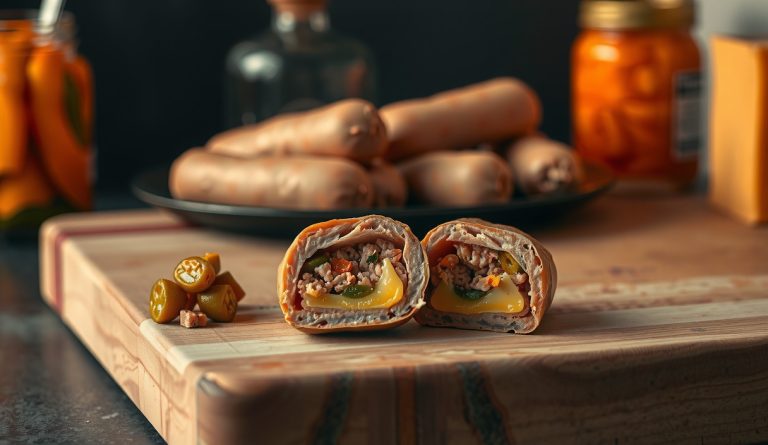
Jalapeño-Cheese Hot Guts: Fold in 4 oz of diced pickled jalapeños and 4 oz of 1/4-inch cubed high-temperature cheddar (regular cheddar will melt and pool) per pound of meat mixture after the initial mixing step, before stuffing. The pickled jalapeños contribute acidity that lightly denatures the surface proteins of the surrounding meat, creating a subtle textural contrast at the pepper interface. High-temp cheddar is engineered with a modified fat phase that resists full melt up to 400°F, keeping the cheese cubes intact through the smoke.
All-Beef Version: Substitute the pork shoulder with additional beef chuck and increase the pork back fat to 30% of the total weight. Pure beef hot guts were the historic Central Texas standard at many Black-owned barbecue establishments, reflecting what was available and affordable. The flavor profile shifts toward iron-forward and smoke integration is more pronounced because beef has less intramuscular fat buffering than pork. All-beef links benefit from an extra 30 minutes of smoke time to compensate for leaner overall fat distribution.
Scaling for a Party: This recipe scales linearly — the cure ratio of 0.25% Prague Powder #1 by total meat weight must be calculated precisely regardless of batch size. Smoking time does not scale with batch mass: link diameter governs heat penetration. A smoker loaded with 20 pounds of 32mm links will hit 152°F internal in roughly the same time as one loaded with 5 pounds, assuming consistent smoker temperature and airflow. The only variable is recovery time after loading cold meat — a full smoker may drop to 175°F and require 20–30 extra minutes to recover.
Collagen Casing Option: If hog casings are unavailable or a more consistent diameter is needed for competition presentation, 32mm edible collagen casings work with the same stuffing technique. Collagen casings will not snap with exactly the same acoustic quality as natural hog casing — collagen casings are engineered from a single-direction fiber orientation while natural casings have a crossed helical collagen architecture that produces more elastic energy storage — but they produce a clean, consistent link and are far more forgiving for beginners.
Frequently asked questions about Texas hot guts sausage
Can I cook hot guts sausage on a grill instead of a smoker? A grill will cook the sausage but will not replicate the result. Hot guts require a prolonged, low-temperature smoke to dry the casing, render fat slowly, and develop bark without scorching. A gas or charcoal grill running indirect at 300°F will cook the interior in 25–30 minutes but leave the casing pale and rubbery because there is insufficient time for the Maillard-adjacent drying reactions to build color and snap. If no smoker is available, use a kettle grill with a two-zone fire, a drip pan, and a chunk of post oak or pecan on the coals, targeting 225°F dome temperature.
Why is the interior of hot guts sausage still pink after reaching 152°F internal? The pink color is nitrosohemochrome — a thermally stable pigment formed when sodium nitrite reacts with myoglobin and then denatures upon heating. Nitrosohemochrome is chemically distinct from the pink of an undercooked, uncured protein. A verified 152°F reading from a calibrated thermometer confirms the sausage is fully safe. This is the same chemistry responsible for the pink smoke ring in brisket and the interior color of cured deli meats.
How long can stuffed hot guts links be stored before smoking? Stuffed, cured links can be held refrigerated for up to 48 hours before smoking. Beyond 48 hours, water activity at the casing surface increases and the nitrite has more opportunity to oxidize before doing its work during cooking. For longer storage, freeze the raw links individually on a sheet pan, then transfer to vacuum bags. Smoke from frozen, adding approximately 45–60 minutes to the total smoke time, and verify internal temperature as always.