Smoked Turkey Legs — State-Fair Style

Equipment
- 1 Offset smoker, kettle grill, or pellet smoker Must hold a steady 275°F chamber temperature
- 1 Instant-read or leave-in probe thermometer Calibrated; pull target is 175°F
- 1 Large food-safe brining vessel or zip-lock bag Must fully submerge all four legs
- 1 Wire cooling rack set over a sheet pan For pellicle formation in the refrigerator
- 4 Cherry wood chunks Fist-sized chunks, not chips
- 2 Hickory wood chunks Fist-sized chunks; 2:1 cherry-to-hickory ratio
Ingredients
Brine
- 1 gallon cold water Divided: use 1 quart hot to dissolve salts, add 3 quarts ice cold
- ½ cup Diamond Crystal kosher salt About 120g by weight; reduce to 1/3 cup if using Morton kosher
- ¼ cup granulated white sugar
- 1 teaspoon Prague Powder #1 (Pink Curing Salt #1) 6.25% sodium nitrite; do not substitute or exceed this dose for 4 legs (~3.5 lbs total)
- 1 tablespoon black peppercorns Lightly cracked
- 4 cloves garlic Smashed
- 2 sprigs fresh thyme
- 2 bay leaves
Turkey
- 4 turkey legs 12–16 oz each; not pre-injected or pre-brined
Dry Rub
- 2 teaspoons coarse black pepper
- 1 teaspoon garlic powder
- 1 teaspoon onion powder
- 1 teaspoon smoked paprika
- ½ teaspoon cayenne pepper Optional; adds heat without obscuring the cured flavor

Instructions
Brine
- Combine 1 quart of hot water with the kosher salt, sugar, and Prague Powder #1 in a large pot. Stir until completely dissolved — undissolved nitrite creates uneven curing. Add the peppercorns, garlic, thyme, and bay leaves. Pour in the remaining 3 quarts of cold water. The brine must be fully cold before the meat goes in; warm brine starts surface cooking and raises food-safety risk.1/2 cup Diamond Crystal kosher salt, 1/4 cup granulated white sugar, 1 teaspoon Prague Powder #1 (Pink Curing Salt #1), 1 tablespoon black peppercorns, 4 cloves garlic, 2 sprigs fresh thyme, 2 bay leaves
- Submerge the turkey legs completely in the cold brine. Use a plate or zip-lock bag filled with water as a weight if needed. Refrigerate for 24 hours. Do not go shorter — nitrite diffusion into the thickest part of the drumstick needs the full time. Do not go longer than 36 hours or the legs will be noticeably salty.4 turkey legs
Pellicle Formation
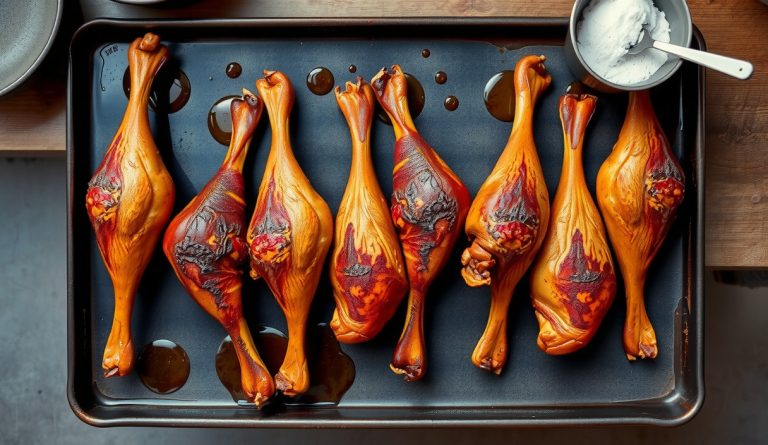
- Remove the legs from the brine. Rinse briefly under cold water and pat completely dry with paper towels. Place on a wire rack set over a sheet pan — do not stack. Return to the refrigerator uncovered for 1 to 2 hours. The surface will transition from glistening to tacky and slightly matte. This is the pellicle: a dried protein-rich surface layer that smoke adheres to and on which the Maillard reaction fires properly. Skipping this step results in a steamed, pale exterior no matter how long you smoke.4 turkey legs
Rub and Fire Up
- Mix the black pepper, garlic powder, onion powder, smoked paprika, and cayenne in a small bowl. Apply the rub all over the legs immediately before they go into the smoker — the tacky pellicle surface holds it without needing oil. Preheat your smoker to a stable 275°F. Add 4 cherry chunks and 2 hickory chunks to the fire box or ash pan.2 teaspoons coarse black pepper, 1 teaspoon garlic powder, 1 teaspoon onion powder, 1 teaspoon smoked paprika, 1/2 teaspoon cayenne pepper
Smoke
- Place the legs directly on the grate with at least 1 inch of clearance between them. Insert a probe thermometer into the thickest part of the largest leg, not touching bone. Close the smoker and maintain 275°F chamber temperature throughout. Add wood chunks every 45–60 minutes as needed to maintain a thin blue smoke — thick white billowing smoke produces acrid, over-smoked bark.4 turkey legs
- Expect a stall between 155–160°F internal where the temperature plateaus for 20–35 minutes. This is evaporative cooling at the surface — surface moisture absorbs heat as fast as the smoker delivers it, locking the boundary layer at 212°F. Hold temperature, resist the urge to foil (foiling steams the bark soft), and wait it out. The stall breaks when the surface fully dries and evaporative cooling ceases.
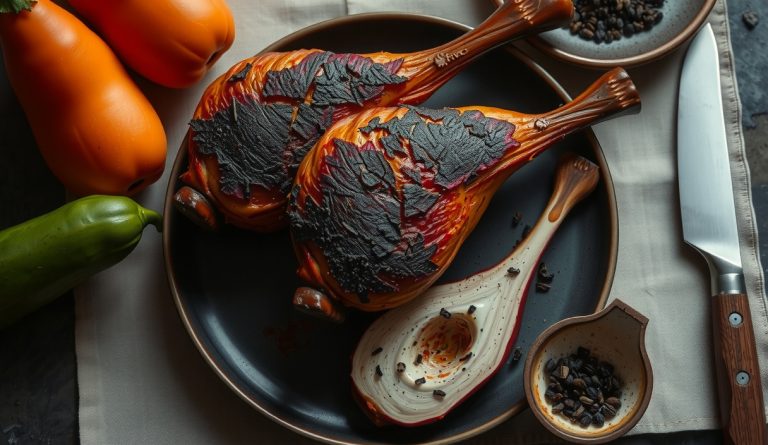
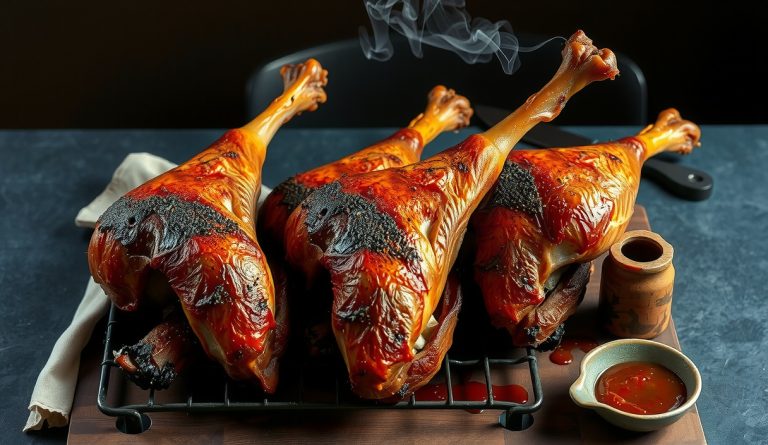
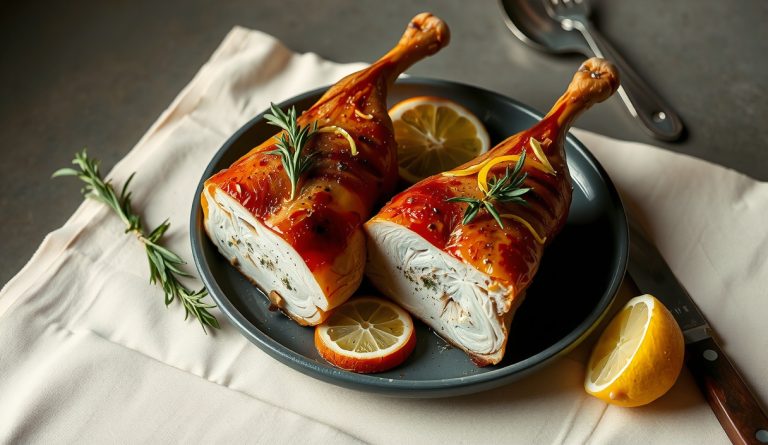
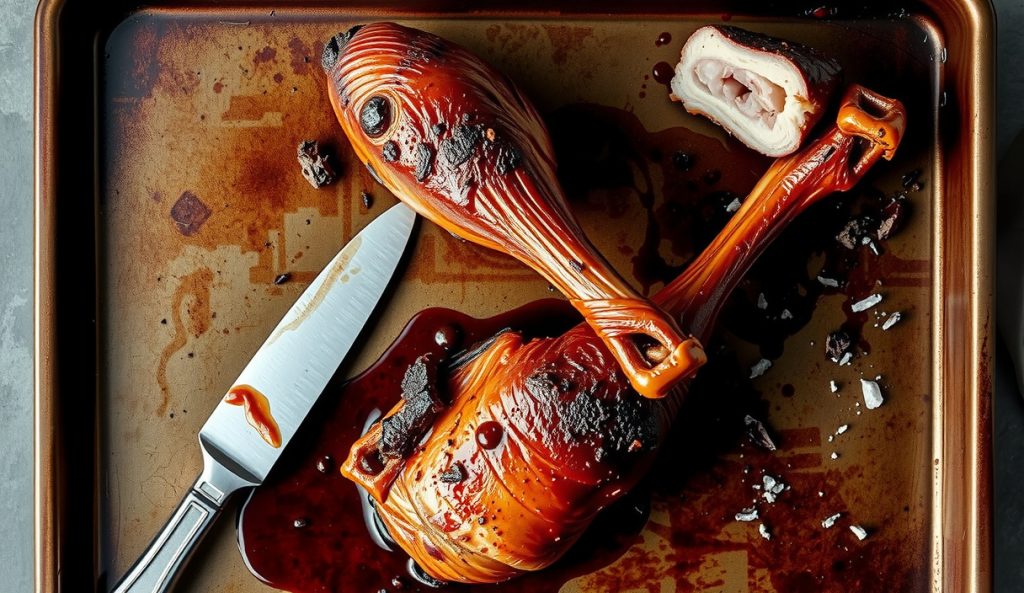
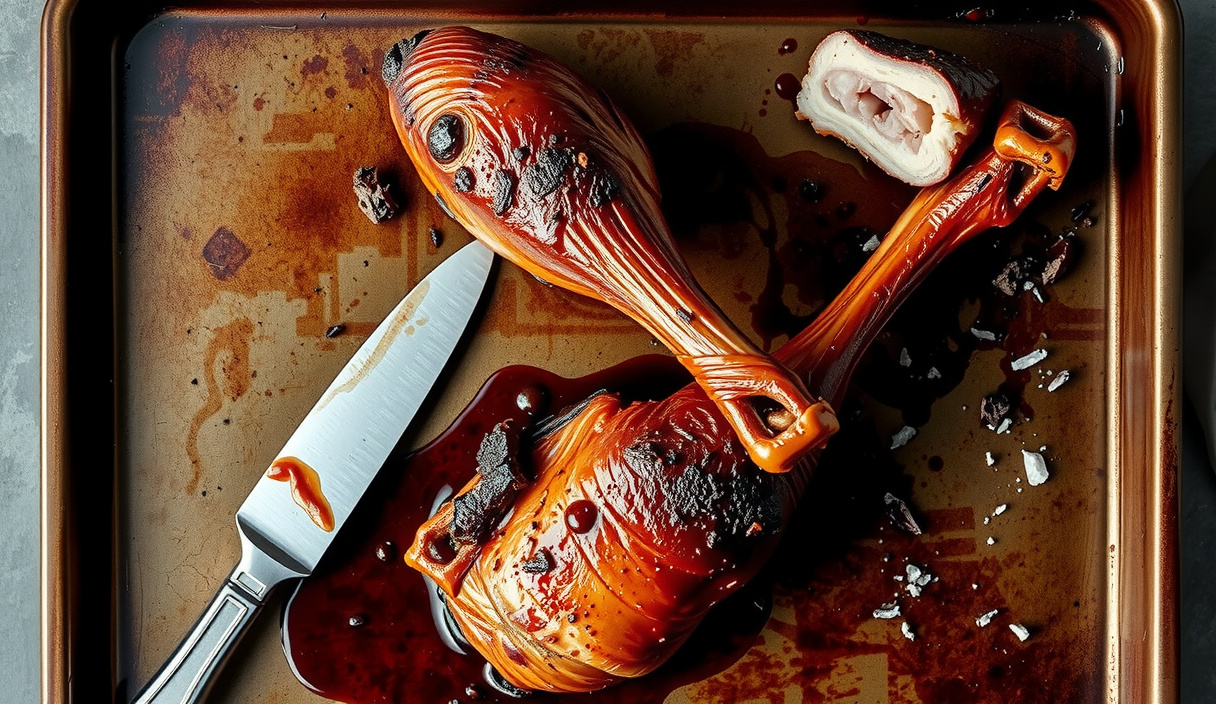
- Pull the legs when the internal temperature reads 175°F at the thickest point. Total smoke time at 275°F is typically 2.5 to 3.5 hours depending on leg size and smoker airflow. The exterior should be deep mahogany, the bark set firm and dry. The interior will be distinctly pink — this is correct and expected from the nitrite cure.4 turkey legs
Rest and Serve
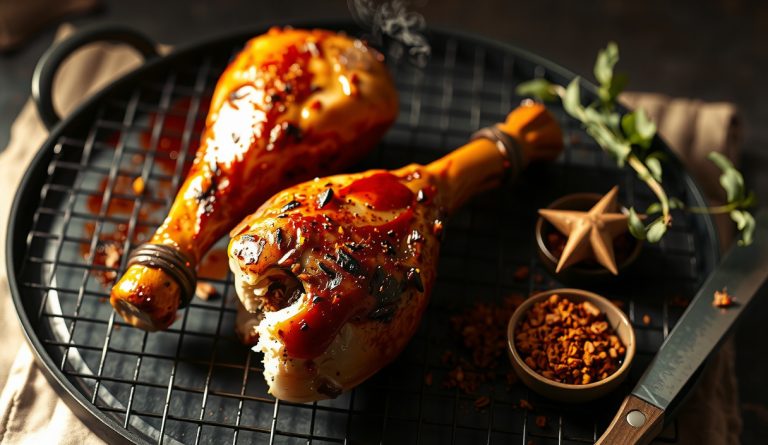
- Transfer the legs to a clean board or platter. Tent loosely with aluminum foil and rest for 15 minutes. During the rest, the gelatin generated by collagen hydrolysis redistributes through the muscle matrix, firming the texture and sealing in juiciness. Cutting immediately releases a significant portion of this moisture. Serve directly — no sauce required, though a thin apple cider vinegar mop on the side complements the smoke and cured salt without competing with them.4 turkey legs
Notes
Nutrition
There is a specific memory encoded in the smell of smoked turkey legs: sunscreen, sawdust, and a crowd of thousands. The leg is enormous — the size of a small club — and it leaves your hands orange and your forearms sticky. You eat it standing up. You eat all of it. That is the state-fair turkey leg experience, and it is not an accident. It is the product of a very deliberate, very old set of meat-curing and smoking physics that we are going to break down completely.
What separates a state-fair turkey leg from a backyard smoked drumstick is the brine — specifically, the pink salt (sodium nitrite) in that brine. The nitrite converts muscle myoglobin into the stable pink nitrosomyoglobin pigment that survives cooking, giving the meat its unmistakable hammy, cured character. Without it, you get smoked poultry. With it, you get something that reads as smoked ham and poultry simultaneously. That flavor crossover is exactly the target. This recipe walks you through the full 24-hour cure, the two-stage smoke, and the science behind why every step works the way it does.
Why does a state-fair turkey leg taste like cured ham? The science
The brine performs three simultaneous functions: osmotic seasoning, moisture augmentation, and nitrite chemistry. Salt diffuses down its own concentration gradient into the muscle matrix, seasoning the interior rather than just the surface. Simultaneously, dissolved solutes lower the water activity of the brine below the meat’s own fluid, driving net water absorption into the muscle cells. A properly brined turkey leg gains roughly 6–10% of its raw weight in retained moisture — critical insurance against the long smoke ahead.
The Prague Powder #1 in the cure (sodium nitrite at 6.25% w/w in the mix) donates nitrite ions that react with myoglobin under acidic conditions in the muscle, forming nitrosomyoglobin. This compound is thermally stable: it holds its pink color all the way through a 175°F cook, which is why a cured smoked turkey leg reads as pink while an uncured one looks grey-tan. Nitrite also inhibits lipid oxidation and Clostridium botulinum proliferation during the low-oxygen smoke environment — a genuine food-safety function, not just color cosmetics.
At the smoke stage, collagen kinetics take over. Turkey legs are loaded with connective tissue — the drumstick is a working muscle full of type I collagen cross-links. Collagen begins thermal shrinkage at roughly 60–65°F, expelling intramuscular fluid. The formulation trick is to smoke at 275°F — aggressive enough to push through the evaporative stall quickly — and pull at 175°F internal, well past the 160–170°F zone where collagen hydrolyzes from rigid triple-helix strands into soluble gelatin. That gelatin re-deposits within the muscle fibers as the leg rests, producing the slick, dense, slightly sticky interior that makes state-fair legs uniquely satisfying.
Maillard reaction onset on the surface requires a dry exterior — any surface water holds the boundary layer at 212°F and stalls browning. Drying the legs uncovered in the refrigerator for at least 1 hour post-brine (pellicle formation) removes this evaporative cooling barrier and allows bark to develop quickly in the first hour of smoking. Skipping this step produces steamed, pale skin regardless of smoker temperature.
Wood choice amplifies the flavor architecture. Cherry and hickory together provide a dual VOC profile: cherry smoke contributes lower-molecular-weight phenolics with a mild, slightly sweet character, while hickory delivers syringol and guaiacol — the heavy, creosote-adjacent compounds responsible for the aggressive smokiness characteristic of fairground fare. Too much hickory alone turns acrid; cherry alone is too subtle for this application. A 2:1 cherry-to-hickory ratio by wood volume is the sweet spot.
What equipment and ingredients do I need?
- Prague Powder #1 (Pink Curing Salt #1): This is not Himalayan pink salt. Prague Powder #1 is a precisely measured mixture of 6.25% sodium nitrite and 93.75% sodium chloride, tinted pink to prevent confusion. Do not substitute. The dosage here — 1 teaspoon per 5 pounds of meat — conforms to USDA-validated cure ratios. Do not exceed it.
- Turkey legs: Source legs that are 12–16 oz each for fair-style proportions. Larger heritage-breed legs work beautifully but may need 30 extra minutes of smoke time. Avoid pre-injected or pre-brined legs from the grocery store — read the label for sodium content above 75mg per 4oz serving as a tell.
- Smoker setup: Any offset, kettle, or pellet smoker capable of holding a steady 275°F works. A water pan is optional — the brine provides enough internal moisture insurance. Chamber temperature is more important than smoker type.
- Wood: Cherry and hickory chunks (not chips) for offsets and kettles; pellets in corresponding flavors for pellet grills. Chips burn too fast at 275°F and produce harsh, uncontrolled smoke pulses.
- Probe thermometer: Non-negotiable. Pull temperature is 175°F at the thickest part of the drumstick, not touching bone. Going to 165°F leaves collagen under-converted; going past 185°F starts drying the actin network irreversibly.
Smoked Turkey Legs — State-Fair Style
Equipment
- 1 Offset smoker, kettle grill, or pellet smoker Must hold a steady 275°F chamber temperature
- 1 Instant-read or leave-in probe thermometer Calibrated; pull target is 175°F
- 1 Large food-safe brining vessel or zip-lock bag Must fully submerge all four legs
- 1 Wire cooling rack set over a sheet pan For pellicle formation in the refrigerator
- 4 Cherry wood chunks Fist-sized chunks, not chips
- 2 Hickory wood chunks Fist-sized chunks; 2:1 cherry-to-hickory ratio
Ingredients
Brine
- 1 gallon cold water Divided: use 1 quart hot to dissolve salts, add 3 quarts ice cold
- ½ cup Diamond Crystal kosher salt About 120g by weight; reduce to 1/3 cup if using Morton kosher
- ¼ cup granulated white sugar
- 1 teaspoon Prague Powder #1 (Pink Curing Salt #1) 6.25% sodium nitrite; do not substitute or exceed this dose for 4 legs (~3.5 lbs total)
- 1 tablespoon black peppercorns Lightly cracked
- 4 cloves garlic Smashed
- 2 sprigs fresh thyme
- 2 bay leaves
Turkey
- 4 turkey legs 12–16 oz each; not pre-injected or pre-brined
Dry Rub
- 2 teaspoons coarse black pepper
- 1 teaspoon garlic powder
- 1 teaspoon onion powder
- 1 teaspoon smoked paprika
- ½ teaspoon cayenne pepper Optional; adds heat without obscuring the cured flavor
Instructions
Brine
- Combine 1 quart of hot water with the kosher salt, sugar, and Prague Powder #1 in a large pot. Stir until completely dissolved — undissolved nitrite creates uneven curing. Add the peppercorns, garlic, thyme, and bay leaves. Pour in the remaining 3 quarts of cold water. The brine must be fully cold before the meat goes in; warm brine starts surface cooking and raises food-safety risk.1/2 cup Diamond Crystal kosher salt, 1/4 cup granulated white sugar, 1 teaspoon Prague Powder #1 (Pink Curing Salt #1), 1 tablespoon black peppercorns, 4 cloves garlic, 2 sprigs fresh thyme, 2 bay leaves
- Submerge the turkey legs completely in the cold brine. Use a plate or zip-lock bag filled with water as a weight if needed. Refrigerate for 24 hours. Do not go shorter — nitrite diffusion into the thickest part of the drumstick needs the full time. Do not go longer than 36 hours or the legs will be noticeably salty.4 turkey legs
Pellicle Formation
- Remove the legs from the brine. Rinse briefly under cold water and pat completely dry with paper towels. Place on a wire rack set over a sheet pan — do not stack. Return to the refrigerator uncovered for 1 to 2 hours. The surface will transition from glistening to tacky and slightly matte. This is the pellicle: a dried protein-rich surface layer that smoke adheres to and on which the Maillard reaction fires properly. Skipping this step results in a steamed, pale exterior no matter how long you smoke.4 turkey legs
Rub and Fire Up
- Mix the black pepper, garlic powder, onion powder, smoked paprika, and cayenne in a small bowl. Apply the rub all over the legs immediately before they go into the smoker — the tacky pellicle surface holds it without needing oil. Preheat your smoker to a stable 275°F. Add 4 cherry chunks and 2 hickory chunks to the fire box or ash pan.2 teaspoons coarse black pepper, 1 teaspoon garlic powder, 1 teaspoon onion powder, 1 teaspoon smoked paprika, 1/2 teaspoon cayenne pepper
Smoke
- Place the legs directly on the grate with at least 1 inch of clearance between them. Insert a probe thermometer into the thickest part of the largest leg, not touching bone. Close the smoker and maintain 275°F chamber temperature throughout. Add wood chunks every 45–60 minutes as needed to maintain a thin blue smoke — thick white billowing smoke produces acrid, over-smoked bark.4 turkey legs
- Expect a stall between 155–160°F internal where the temperature plateaus for 20–35 minutes. This is evaporative cooling at the surface — surface moisture absorbs heat as fast as the smoker delivers it, locking the boundary layer at 212°F. Hold temperature, resist the urge to foil (foiling steams the bark soft), and wait it out. The stall breaks when the surface fully dries and evaporative cooling ceases.
- Pull the legs when the internal temperature reads 175°F at the thickest point. Total smoke time at 275°F is typically 2.5 to 3.5 hours depending on leg size and smoker airflow. The exterior should be deep mahogany, the bark set firm and dry. The interior will be distinctly pink — this is correct and expected from the nitrite cure.4 turkey legs
Rest and Serve
- Transfer the legs to a clean board or platter. Tent loosely with aluminum foil and rest for 15 minutes. During the rest, the gelatin generated by collagen hydrolysis redistributes through the muscle matrix, firming the texture and sealing in juiciness. Cutting immediately releases a significant portion of this moisture. Serve directly — no sauce required, though a thin apple cider vinegar mop on the side complements the smoke and cured salt without competing with them.4 turkey legs
Notes
Nutrition
How do I nail it every time? Tips and technique
- Do not skip the pellicle step. Wet legs dropped straight from brine into the smoker produce steamed, pale surfaces. The 1-to-2-hour uncovered rest in the fridge dries the exterior enough for smoke to adhere and Maillard reactions to fire. Watch for the surface to transition from glistening to tacky — that tacky stage is the target.
- Manage your stall. Turkey legs hit a stall around 155–160°F as surface evaporation absorbs heat as fast as the smoker delivers it. At 275°F this stall lasts roughly 20–35 minutes — shorter than at 225°F. Do not open the smoker. Do not foil the legs (foiling steams the bark soft). Hold temperature and wait it out.
- Rest fully before eating. A 15-minute rest allows the gelatin that mobilized during cooking to redistribute and cool slightly, firming up interior texture and preventing juice loss on the first bite. Tent loosely with foil to retain heat without steaming the bark.
- Bark failure means a wet surface or temperature spikes. If the legs look pale and rubbery after 2 hours, either the pellicle was insufficient or the smoker is running wet. Crack the vents, increase airflow, and give the legs another 30 minutes uncovered before troubleshooting further.
- Color check: The deep pink interior is correct and expected — it is nitrosomyoglobin, not undercooked meat. Verify doneness with a thermometer, not color. A turkey leg at 175°F internal is safe regardless of how pink it looks inside.
- Salt calibration: The brine is intentionally assertive. If you are sensitive to sodium, reduce the kosher salt from 1/2 cup to 1/3 cup but keep the Prague Powder dose fixed — reducing cure salt is a food-safety issue, reducing table salt is not.
What variations can I make to this recipe?
Spice-forward crust: Add 2 tablespoons of coarsely ground black pepper and 1 tablespoon of smoked paprika to the dry rub. The paprika contributes additional red pigment (capsanthin) and its own Maillard-active amino-carbonyl precursors that deepen bark color. Apply the rub immediately before smoking, after the pellicle has formed, so it adheres to the tacky surface.
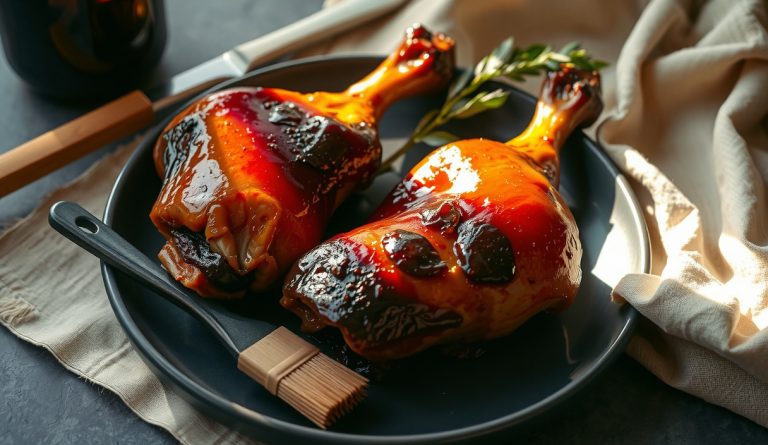
Sweet glaze finish: In the last 20 minutes of the smoke, brush the turkey legs with a thin layer of unsulfured molasses thinned 1:1 with apple cider vinegar. The reducing sugars in molasses re-accelerate Maillard browning on the already-hot surface, producing a lacquered, caramelized outer shell without turning the bark gummy. Pull at 175°F as normal — the glaze window is too short to affect the internal cure.
Scaling for a crowd: The brine scales linearly. Double or triple the batch using the same ratios — Prague Powder stays at 1 teaspoon per 5 pounds of total meat weight. In a large vessel or food-safe bucket, ensure all legs are fully submerged. The legs hold well refrigerated post-brine for up to 48 hours before smoking, giving flexibility for large events.
No-nitrite version: To make smoked turkey legs without the cured color and flavor, omit the Prague Powder and increase the kosher salt by 1 tablespoon. The result is a well-seasoned, beautifully smoked leg — grey-beige inside and tasting of smoked poultry rather than cured meat. The smoke protocol and pull temperature of 175°F remain identical. Both versions are excellent; they are simply different products.
Frequently asked questions about smoked turkey legs
Is it safe to eat a pink turkey leg? Yes — when the turkey leg has been brined with Prague Powder #1 and cooked to an internal temperature of 175°F, the pink color is safe. The color comes from nitrosomyoglobin, a stable cured-meat pigment, not from undercooked protein. Verify doneness with a calibrated probe thermometer, not by color alone. This is identical to why a fully cooked ham or corned beef is pink.
Can I use table salt instead of kosher salt in the brine? Technically yes, but reduce the volume by roughly 25% — table salt has a finer crystal and packs more densely by volume than Diamond Crystal or Morton kosher. By weight, the two are equivalent. Always keep the Prague Powder dose fixed by weight, not volume, when scaling.
My smoker runs hot — can I smoke at 250°F instead of 275°F? Yes. At 250°F expect roughly 30–45 extra minutes of total cook time. Collagen conversion still completes fully as long as the turkey leg reaches 175°F internal; the lower temperature simply extends the stall and slows the overall timeline. Bark development will be slightly less aggressive. Do not go below 225°F — at that temperature the stall can extend dramatically and the leg risks prolonged time in the 130–155°F bacterial growth range.