Plant-Based Smoked Mushroom Burnt Ends

Equipment
- 1 Offset smoker or kettle grill with indirect setup Maintain stable 250°F at grate level. Use a separate grate thermometer — dome thermometers read 15–25°F cooler.
- 2 Cherry or apple wood chunks Fist-sized chunks, not chips. Chips combust too fast and produce acrid smoke spikes.
- 1 Wire cooling rack over half-sheet pan For pre-smoke refrigerator dry and for resting post-cook.
- 1 Sharp boning or chef’s knife For clean crosshatch scoring without tearing the mycelial tissue.
- 1 Pastry brush Silicone preferred — natural bristle scorches on second glaze pass.
- 1 Instant-read thermometer Used for grate temp monitoring, not internal mushroom temp.
Ingredients
Mushrooms
- 2 lbs king trumpet mushroom stems Stems only, minimum 1.5-inch diameter. Caps reserved for another use. Patted dry, then uncovered on a rack in the refrigerator for 1–2 hours before cooking.
Dry Rub
- 1 tbsp smoked paprika Spanish pimentón de la vera preferred for its phenol-rich smoke character.
- 1 tbsp dark brown sugar Provides Maillard-active reducing sugars and caramel precursors at the surface.
- 1.5 tsp kosher salt Diamond Crystal. If using Morton, reduce to 1 tsp.
- 1 tsp garlic powder
- 1 tsp onion powder
- 0.75 tsp freshly ground black pepper Coarsely ground. Fine-ground over-penetrates and turns acrid under prolonged smoke.
- 0.5 tsp ground cumin
- 0.25 tsp cayenne pepper Adjust to heat preference. TRPV1 activation from capsaicin enhances perceived savory depth.
Hoisin-Maple Glaze
- 0.25 cup hoisin sauce Check label for fish sauce — some brands include it. Lee Kum Kee vegetarian hoisin is plant-based certified.
- 2 tbsp pure maple syrup Grade B (dark) preferred — higher concentration of reducing sugars accelerates Maillard onset at lower temperatures.
- 2 tbsp soy sauce Low-sodium preferred. Provides free glutamate and sodium synergistically for umami depth.
- 1 tbsp rice vinegar Corrects glaze pH toward 4.5–5.0, preventing cloying sweetness and brightening the finish.
- 1 tsp grated fresh ginger Provides gingerol-driven mild heat and volatile aromatics that survive only the last glaze pass.
- 1 tsp toasted sesame oil Added to glaze off-heat only. Delicate methyl pyrazines and furanones in sesame oil volatilize above 250°F.
For Serving
- 2 stalks scallions, green tops only, thinly sliced Green tops are low-FODMAP; white bulbs are high-fructan. Green parts provide fresh sulfur-volatile contrast to the deep roasted notes.
- 1 tsp toasted sesame seeds

Instructions
Prep the Mushrooms
- Trim the base of each king trumpet stem to expose a clean, flat face. Slice stems crosswise into 1.5-inch rounds or, if stems are long, leave whole. Using a sharp knife, score each flat face in a crosshatch pattern — cuts approximately 1/2 inch apart, 3/4 inch deep, at 45-degree angles to each other. Work both flat faces of each piece.
- Pat all surfaces thoroughly dry with paper towels. Place mushrooms cut-side up on a wire rack over a sheet pan. Transfer to the refrigerator, uncovered, for at least 1 hour and up to 2 hours. This step drives down surface water activity — without it, the smoker will steam the mushrooms for the first 30–40 minutes rather than building bark. Do not skip.
Make the Dry Rub
- Combine smoked paprika, dark brown sugar, kosher salt, garlic powder, onion powder, black pepper, cumin, and cayenne in a small bowl. Whisk until homogeneous — the brown sugar tends to clump; break up any lumps before applying.1 tbsp dark brown sugar, 1.5 tsp kosher salt, 1 tsp garlic powder, 1 tsp onion powder, 0.75 tsp freshly ground black pepper, 0.5 tsp ground cumin, 0.25 tsp cayenne pepper
- Remove mushrooms from the refrigerator. Apply rub generously to all surfaces, using your fingers to press and work the spice mix deep into the crosshatch scores. The scores are your seasoning delivery system — the interior tissue should visibly receive rub. Season all flat faces, sides, and any exposed top surfaces. Let the rubbed mushrooms sit at room temperature for 15 minutes while the smoker comes to temperature.1 tbsp dark brown sugar, 1.5 tsp kosher salt, 1 tsp garlic powder, 1 tsp onion powder, 0.75 tsp freshly ground black pepper, 0.5 tsp ground cumin, 0.25 tsp cayenne pepper
Fire the Smoker and First Smoke Phase
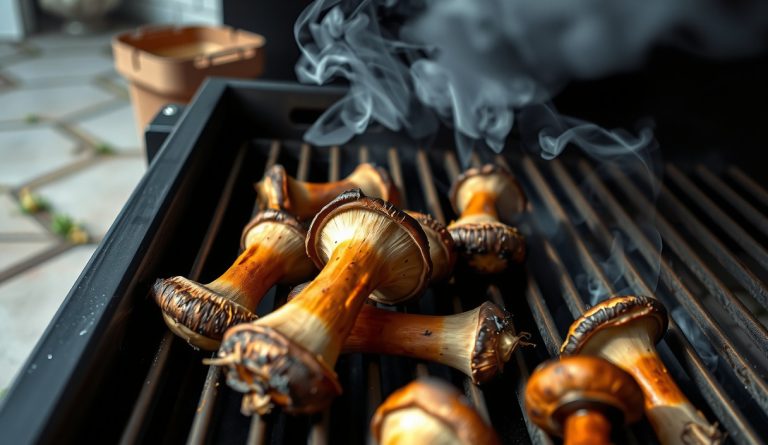
- Set up your smoker for indirect heat at a stable 250°F measured at grate level. Add 1–2 fist-sized chunks of cherry or apple wood to the coals or firebox — not chips. Allow the smoke to turn thin and blue before loading the mushrooms. White billowing smoke deposits acrid creosote; thin blue smoke deposits desired phenolic compounds and organic acids.
- Place mushrooms cut-face up on the grate with at least 1 inch of clearance between pieces. Close the lid. Smoke at 250°F for 90 minutes, rotating the pieces to a cooler or hotter zone as needed at the 45-minute mark to ensure even exposure. Do not lift the lid more than once during this phase — each lid lift drops grate temperature by 25–40°F and extends actual cook time.
- At 90 minutes, check the mushrooms: the cut faces should look matte, visibly shrunken at the edges, and show color development from golden-brown to deep amber. The surface should feel dry and firm to a light press. If any faces still look wet or pale, close the lid and continue for 15–20 additional minutes. Do not glaze a wet surface.
Make the Glaze
- While mushrooms are in their first smoke phase, combine hoisin sauce, maple syrup, soy sauce, and rice vinegar in a small saucepan over medium-low heat. Stir until homogeneous and just barely simmering — about 2 minutes. Remove from heat. Stir in grated ginger and toasted sesame oil. The sesame oil goes in off-heat only; its volatile aromatics flash off rapidly above 250°F. Allow glaze to cool to room temperature. It should coat a spoon thickly and fall in a slow ribbon. If it is too thin, return to low heat and reduce by 15–20% before cooling.0.25 cup hoisin sauce, 2 tbsp pure maple syrup, 2 tbsp soy sauce, 1 tbsp rice vinegar, 1 tsp grated fresh ginger, 1 tsp toasted sesame oil
Glaze and Second Smoke Phase
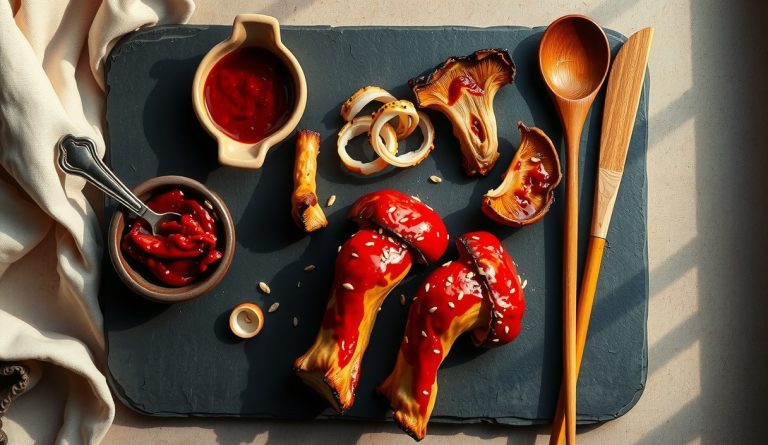
- Remove mushrooms from the smoker. Working quickly, apply a thin, even coat of glaze to all scored faces using a pastry brush. Thin coat means you can still see the surface texture through the glaze — not pooling in the scores. Return glazed mushrooms to the smoker cut-face up. Close the lid. Smoke for 15 minutes at 250°F.0.25 cup hoisin sauce, 2 tbsp pure maple syrup, 2 tbsp soy sauce, 1 tbsp rice vinegar, 1 tsp grated fresh ginger, 1 tsp toasted sesame oil
- Open the smoker, apply a second thin coat of glaze to all faces. The first coat should now be tacky and show darkening — this is the second Maillard event building on the first crust. Return to the smoker for a final 15 minutes. Total second-phase time: 30 minutes. Watch carefully: if the glaze appears to be blackening rather than darkening to mahogany, your grate temperature has exceeded 280°F — move mushrooms to a cooler zone immediately.0.25 cup hoisin sauce, 2 tbsp pure maple syrup, 2 tbsp soy sauce, 1 tbsp rice vinegar, 1 tsp grated fresh ginger, 1 tsp toasted sesame oil
Rest and Serve
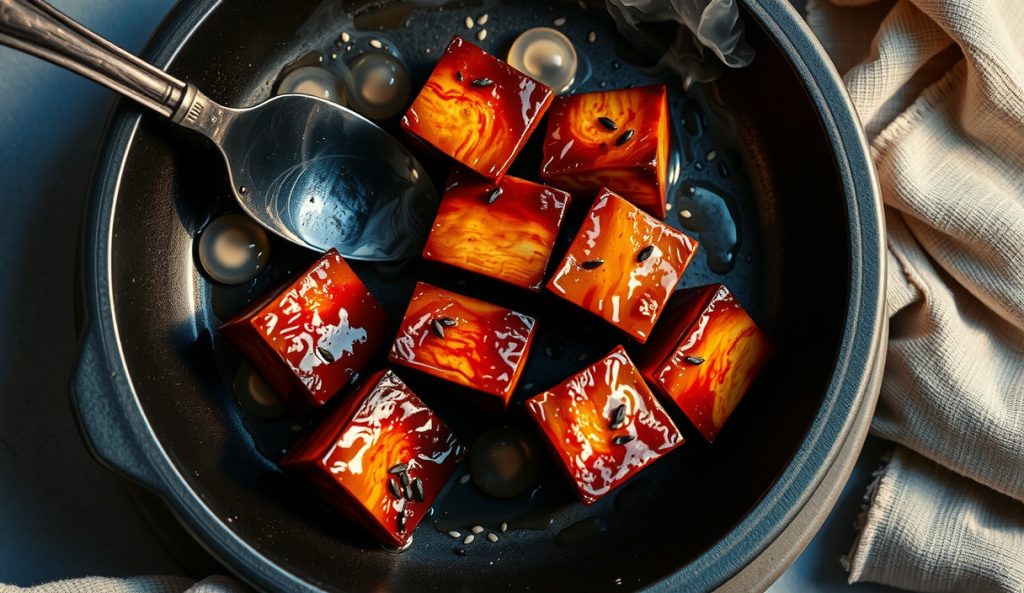
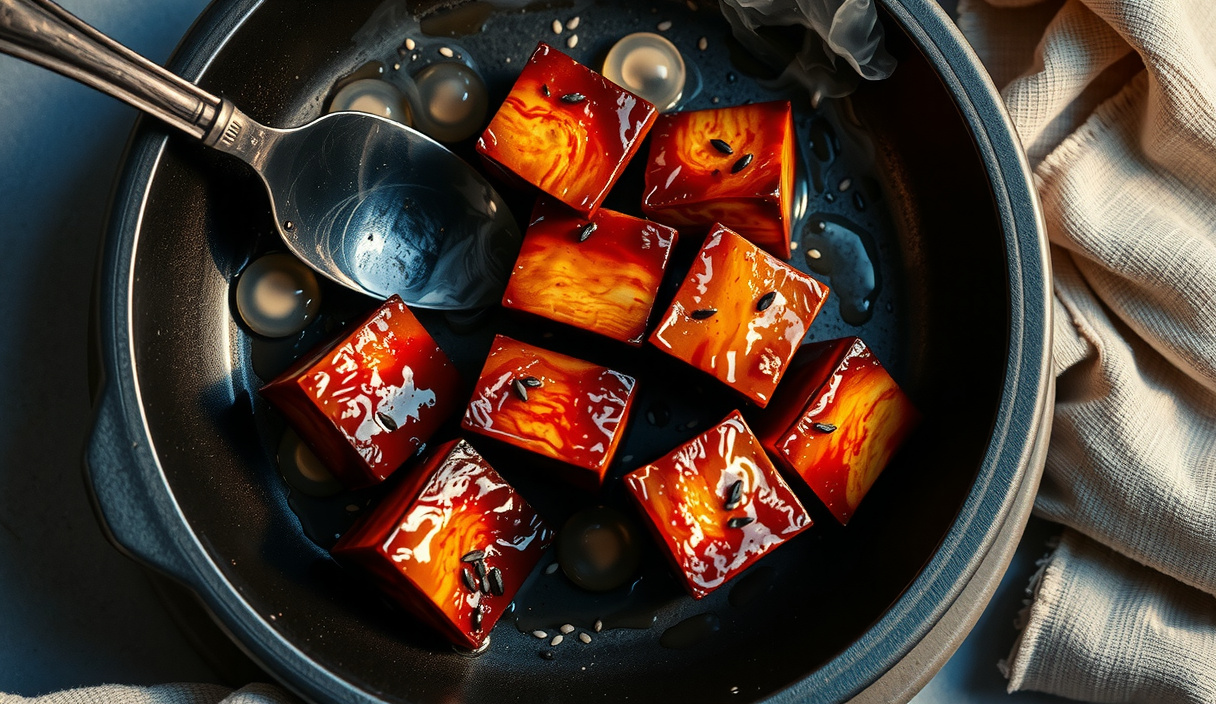
- Transfer mushrooms to a wire rack or warm cast-iron skillet. Rest for 10 minutes uncovered — do not cover or the steam will soften the bark you just built. During this rest, the glaze firms from a running liquid to the tacky, sticky consistency characteristic of proper burnt end bark, and volatile aromatics partially re-adsorb onto the cooled surface.
- Arrange on a serving platter or keep in the cast-iron. Scatter sliced scallion greens and toasted sesame seeds over the top. Serve immediately — these lose heat quickly. If serving buffet-style, keep in a warm cast-iron skillet or chafing dish at 140°F to hold glaze consistency.2 stalks scallions, green tops only, thinly sliced, 1 tsp toasted sesame seeds
Notes
Nutrition
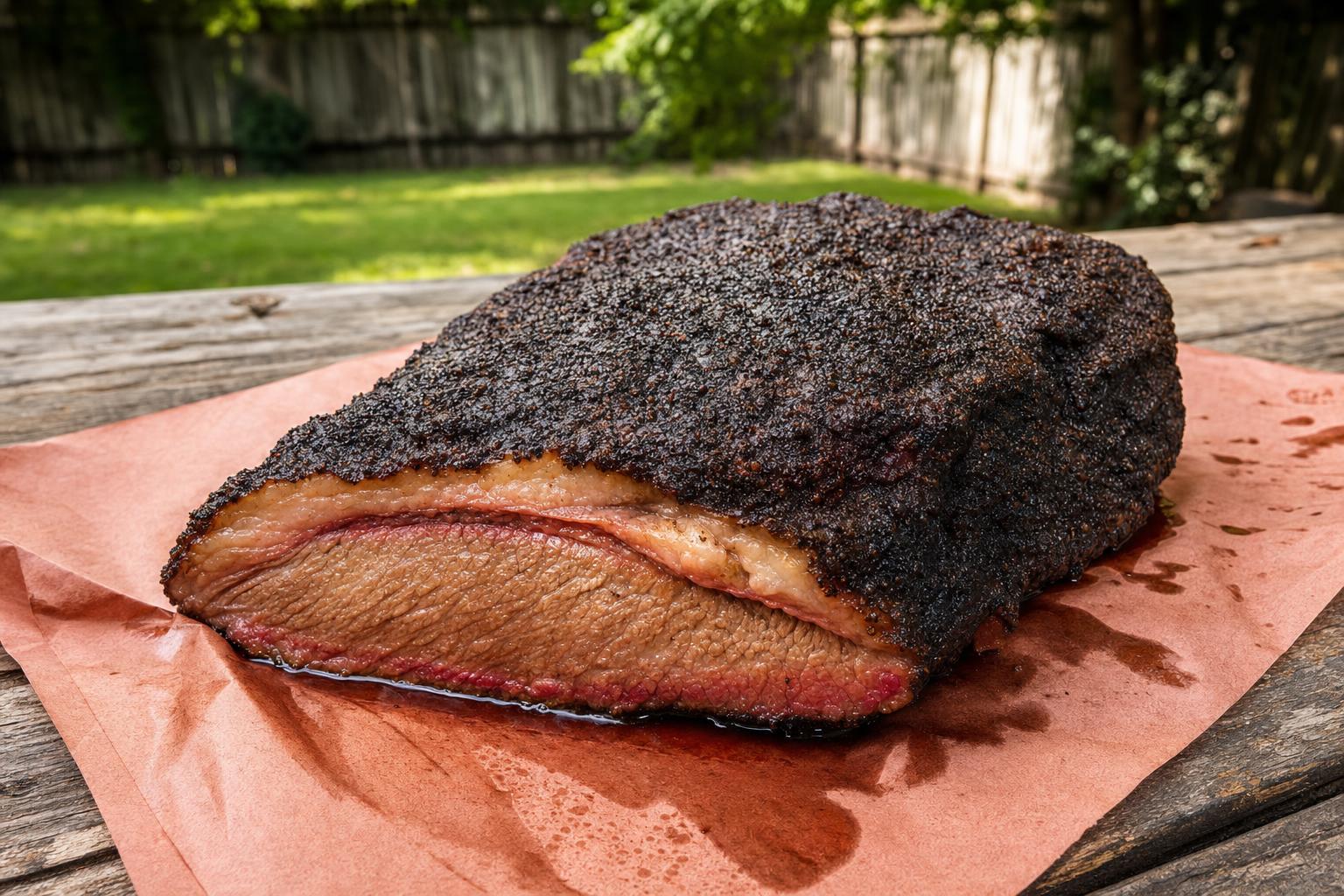
I want to be straight with you: I did not set out to make a mushroom dish. I set out to reverse-engineer the textural physics of a Kansas City burnt end — that specific cube of brisket point that has spent twelve hours in a smoker, been cubed, sauced, and returned to the heat until every face is lacquered bark and the interior collapses into something between a gel and a braise. The question was whether king trumpet mushroom stems, sliced thick and scored crosshatch, could be coaxed through the same thermodynamic sequence. After a lot of fire and a lot of soy, the answer is yes — with mechanisms that are genuinely different from meat but functionally analogous at the plate.
King trumpet stems are not a passive substitute. Their mycelial protein architecture — dense, interlocking chitin and beta-glucan networks — resists compression in a way that most vegetables do not. Score them aggressively, season into the cuts, and the smoke has a path in. Glaze them at the right moment and the sugars in that glaze hit a desiccated, protein-rich surface at exactly the temperature where the Maillard cascade runs hot. What comes off the smoker is dark, sticky, structurally coherent, and aggressively savory. Where Flavor Meets the Flame.
Why do smoked mushroom burnt ends work? The science
Smoked mushroom burnt ends work because king trumpet stems replicate the thermodynamic conditions of brisket bark formation through analogous — not identical — protein and polysaccharide chemistry. The Maillard reaction, the non-enzymatic browning cascade between nucleophilic amino groups and electrophilic carbonyl groups, begins in earnest on mushroom surfaces around 280–300°F, well above the evaporative ceiling of 212°F that keeps wet surfaces pale. King trumpet stems are unusually protein-dense for a vegetable: roughly 20–25% dry-weight protein, dominated by glutamic acid and lysine residues. Glutamic acid is a potent Maillard participant and simultaneously the primary umami tastant activating T1R1/T1R3 receptors. Crosshatch scoring increases the surface area exposed to convective hot airflow, accelerating local desiccation at the cut faces. Once water activity at the surface drops below approximately 0.7, the Maillard kinetics accelerate sharply and melanoidins begin to accumulate — the dark, aromatic pigment-flavor complexes responsible for what the brain reads as bark. This is identical in mechanism to brisket bark formation; only the substrate proteins differ.
The glaze is not decoration — it is a deliberate Maillard reload. After the first smoke phase, the mushroom surface is largely desiccated and protein-denatured. Applying a reducing-sugar-rich glaze (hoisin, maple, soy) floods that desiccated surface with fresh amino-carbonyl reaction partners at water activity 0.50–0.65. Returning the glazed mushroom pieces to the smoker for 30 minutes allows a second, rapid browning event on top of the first crust layer, building depth through layered melanoidin complexity. The lipophilic volatile organic compounds generated — pyrazines, furanones, sulfur-bearing thiophenes from the mushroom’s native glutathione — partition into the residual surface-fat phase of the glaze oil, slowing their volatilization and creating the sustained aromatic resonance you associate with well-cooked meat.
The mycelial beta-glucan matrix of king trumpet also behaves like collagen under prolonged heat — not identically, but analogously. At 250°F over 90 minutes, the semi-crystalline chitin scaffold in the cell walls softens progressively via beta-elimination of the polysaccharide backbone. Moisture migrates outward from the interior cells toward the surface, driven by the smoker’s low-humidity concentration gradient. The interior does not fully desiccate, however, because the dense cross-linked beta-glucan network retains bound water through hydrogen bonding — the same mechanism that keeps a well-cooked brisket deckle from turning to dust even after hours at temperature. The result is an exterior that is firm, caramelized, and bark-like while the interior yields with a gentle press. This textural contrast — the defining feature of a great burnt end — is entirely achievable here by managing time and temperature rather than relying on animal collagen.
What equipment and ingredients do you need?
King trumpet mushroom stems: Do not substitute portobello or cremini. You need the dense, fibrous stem architecture of Pleurotus eryngii. Look for stems at least 1.5 inches in diameter. Asian grocery stores and well-stocked co-ops carry them year-round. Discard the small caps or save them for another use — only the stems behave correctly here.
The crosshatch score: Cut 3/4-inch deep on a 45-degree grid, spacing cuts about 1/2 inch apart. This is not optional. The crosshatch score creates surface area for smoke penetration, provides channels for the dry rub to season interior tissue, and gives the glaze pockets to collect in during the second cook. A shallow score produces a pale, unsatisfying exterior.
Wood choice: Cherry or apple wood produces a moderate, fruit-forward smoke that does not overpower the mushroom’s native umami. Hickory works if you want a more assertive smoke signature, but use a single chunk — king trumpet stems absorb smoke aggressively. Mesquite is too harsh for 90 minutes of exposure.
The glaze: Hoisin is the structural backbone — high sugar, umami-rich, and viscous enough to coat without running. Maple syrup provides hygroscopic reducing sugars (primarily glucose and fructose) that lower the Maillard activation threshold relative to sucrose. Toasted sesame oil is added off-heat only — its delicate volatile esters flash off above 250°F. Rice vinegar provides a pH correction that keeps the glaze from becoming cloying.
Smoker temperature management: A stable 250°F with indirect heat is the target. If your smoker runs hot at the edges, rotate the mushrooms at the 45-minute mark. An instant-read probe is not useful here — use visual and tactile cues: the surface should look matte-dry and slightly shrunk at the 90-minute mark before glazing.
Plant-Based Smoked Mushroom Burnt Ends
Equipment
- 1 Offset smoker or kettle grill with indirect setup Maintain stable 250°F at grate level. Use a separate grate thermometer — dome thermometers read 15–25°F cooler.
- 2 Cherry or apple wood chunks Fist-sized chunks, not chips. Chips combust too fast and produce acrid smoke spikes.
- 1 Wire cooling rack over half-sheet pan For pre-smoke refrigerator dry and for resting post-cook.
- 1 Sharp boning or chef’s knife For clean crosshatch scoring without tearing the mycelial tissue.
- 1 Pastry brush Silicone preferred — natural bristle scorches on second glaze pass.
- 1 Instant-read thermometer Used for grate temp monitoring, not internal mushroom temp.
Ingredients
Mushrooms
- 2 lbs king trumpet mushroom stems Stems only, minimum 1.5-inch diameter. Caps reserved for another use. Patted dry, then uncovered on a rack in the refrigerator for 1–2 hours before cooking.
Dry Rub
- 1 tbsp smoked paprika Spanish pimentón de la vera preferred for its phenol-rich smoke character.
- 1 tbsp dark brown sugar Provides Maillard-active reducing sugars and caramel precursors at the surface.
- 1.5 tsp kosher salt Diamond Crystal. If using Morton, reduce to 1 tsp.
- 1 tsp garlic powder
- 1 tsp onion powder
- 0.75 tsp freshly ground black pepper Coarsely ground. Fine-ground over-penetrates and turns acrid under prolonged smoke.
- 0.5 tsp ground cumin
- 0.25 tsp cayenne pepper Adjust to heat preference. TRPV1 activation from capsaicin enhances perceived savory depth.
Hoisin-Maple Glaze
- 0.25 cup hoisin sauce Check label for fish sauce — some brands include it. Lee Kum Kee vegetarian hoisin is plant-based certified.
- 2 tbsp pure maple syrup Grade B (dark) preferred — higher concentration of reducing sugars accelerates Maillard onset at lower temperatures.
- 2 tbsp soy sauce Low-sodium preferred. Provides free glutamate and sodium synergistically for umami depth.
- 1 tbsp rice vinegar Corrects glaze pH toward 4.5–5.0, preventing cloying sweetness and brightening the finish.
- 1 tsp grated fresh ginger Provides gingerol-driven mild heat and volatile aromatics that survive only the last glaze pass.
- 1 tsp toasted sesame oil Added to glaze off-heat only. Delicate methyl pyrazines and furanones in sesame oil volatilize above 250°F.
For Serving
- 2 stalks scallions, green tops only, thinly sliced Green tops are low-FODMAP; white bulbs are high-fructan. Green parts provide fresh sulfur-volatile contrast to the deep roasted notes.
- 1 tsp toasted sesame seeds
Instructions
Prep the Mushrooms
- Trim the base of each king trumpet stem to expose a clean, flat face. Slice stems crosswise into 1.5-inch rounds or, if stems are long, leave whole. Using a sharp knife, score each flat face in a crosshatch pattern — cuts approximately 1/2 inch apart, 3/4 inch deep, at 45-degree angles to each other. Work both flat faces of each piece.
- Pat all surfaces thoroughly dry with paper towels. Place mushrooms cut-side up on a wire rack over a sheet pan. Transfer to the refrigerator, uncovered, for at least 1 hour and up to 2 hours. This step drives down surface water activity — without it, the smoker will steam the mushrooms for the first 30–40 minutes rather than building bark. Do not skip.
Make the Dry Rub
- Combine smoked paprika, dark brown sugar, kosher salt, garlic powder, onion powder, black pepper, cumin, and cayenne in a small bowl. Whisk until homogeneous — the brown sugar tends to clump; break up any lumps before applying.1 tbsp dark brown sugar, 1.5 tsp kosher salt, 1 tsp garlic powder, 1 tsp onion powder, 0.75 tsp freshly ground black pepper, 0.5 tsp ground cumin, 0.25 tsp cayenne pepper
- Remove mushrooms from the refrigerator. Apply rub generously to all surfaces, using your fingers to press and work the spice mix deep into the crosshatch scores. The scores are your seasoning delivery system — the interior tissue should visibly receive rub. Season all flat faces, sides, and any exposed top surfaces. Let the rubbed mushrooms sit at room temperature for 15 minutes while the smoker comes to temperature.1 tbsp dark brown sugar, 1.5 tsp kosher salt, 1 tsp garlic powder, 1 tsp onion powder, 0.75 tsp freshly ground black pepper, 0.5 tsp ground cumin, 0.25 tsp cayenne pepper
Fire the Smoker and First Smoke Phase
- Set up your smoker for indirect heat at a stable 250°F measured at grate level. Add 1–2 fist-sized chunks of cherry or apple wood to the coals or firebox — not chips. Allow the smoke to turn thin and blue before loading the mushrooms. White billowing smoke deposits acrid creosote; thin blue smoke deposits desired phenolic compounds and organic acids.
- Place mushrooms cut-face up on the grate with at least 1 inch of clearance between pieces. Close the lid. Smoke at 250°F for 90 minutes, rotating the pieces to a cooler or hotter zone as needed at the 45-minute mark to ensure even exposure. Do not lift the lid more than once during this phase — each lid lift drops grate temperature by 25–40°F and extends actual cook time.
- At 90 minutes, check the mushrooms: the cut faces should look matte, visibly shrunken at the edges, and show color development from golden-brown to deep amber. The surface should feel dry and firm to a light press. If any faces still look wet or pale, close the lid and continue for 15–20 additional minutes. Do not glaze a wet surface.
Make the Glaze
- While mushrooms are in their first smoke phase, combine hoisin sauce, maple syrup, soy sauce, and rice vinegar in a small saucepan over medium-low heat. Stir until homogeneous and just barely simmering — about 2 minutes. Remove from heat. Stir in grated ginger and toasted sesame oil. The sesame oil goes in off-heat only; its volatile aromatics flash off rapidly above 250°F. Allow glaze to cool to room temperature. It should coat a spoon thickly and fall in a slow ribbon. If it is too thin, return to low heat and reduce by 15–20% before cooling.0.25 cup hoisin sauce, 2 tbsp pure maple syrup, 2 tbsp soy sauce, 1 tbsp rice vinegar, 1 tsp grated fresh ginger, 1 tsp toasted sesame oil
Glaze and Second Smoke Phase
- Remove mushrooms from the smoker. Working quickly, apply a thin, even coat of glaze to all scored faces using a pastry brush. Thin coat means you can still see the surface texture through the glaze — not pooling in the scores. Return glazed mushrooms to the smoker cut-face up. Close the lid. Smoke for 15 minutes at 250°F.0.25 cup hoisin sauce, 2 tbsp pure maple syrup, 2 tbsp soy sauce, 1 tbsp rice vinegar, 1 tsp grated fresh ginger, 1 tsp toasted sesame oil
- Open the smoker, apply a second thin coat of glaze to all faces. The first coat should now be tacky and show darkening — this is the second Maillard event building on the first crust. Return to the smoker for a final 15 minutes. Total second-phase time: 30 minutes. Watch carefully: if the glaze appears to be blackening rather than darkening to mahogany, your grate temperature has exceeded 280°F — move mushrooms to a cooler zone immediately.0.25 cup hoisin sauce, 2 tbsp pure maple syrup, 2 tbsp soy sauce, 1 tbsp rice vinegar, 1 tsp grated fresh ginger, 1 tsp toasted sesame oil
Rest and Serve
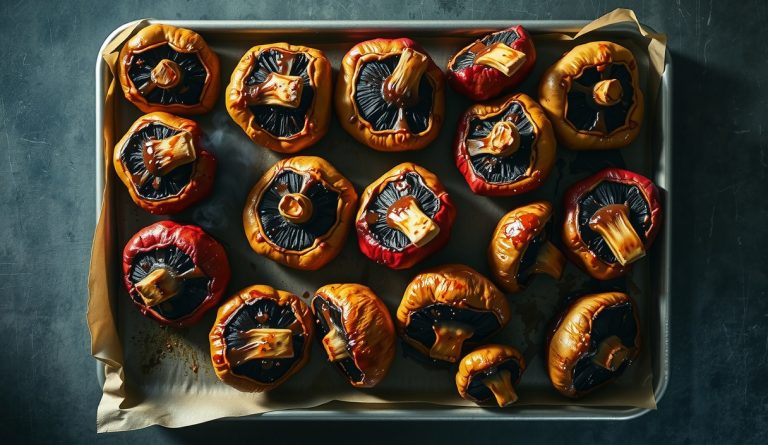
- Transfer mushrooms to a wire rack or warm cast-iron skillet. Rest for 10 minutes uncovered — do not cover or the steam will soften the bark you just built. During this rest, the glaze firms from a running liquid to the tacky, sticky consistency characteristic of proper burnt end bark, and volatile aromatics partially re-adsorb onto the cooled surface.
- Arrange on a serving platter or keep in the cast-iron. Scatter sliced scallion greens and toasted sesame seeds over the top. Serve immediately — these lose heat quickly. If serving buffet-style, keep in a warm cast-iron skillet or chafing dish at 140°F to hold glaze consistency.2 stalks scallions, green tops only, thinly sliced, 1 tsp toasted sesame seeds
Notes
Nutrition
How do I nail smoked mushroom burnt ends every time?
- Dry the mushrooms aggressively before seasoning. Pat cut faces with paper towels, then let the mushrooms sit uncovered on a rack in the refrigerator for 1–2 hours. Surface water activity above 0.85 will trap the mushrooms at the evaporative ceiling of 212°F — they will steam, not sear. A dry surface is non-negotiable for bark formation.
- Season into the scores, not just over the surface. Use your fingers to work the dry rub into the crosshatch cuts. The cuts are your seasoning delivery system into the interior tissue — if you skip this step, the interior is bland and the exterior tastes like rub, not cohesive bark.
- Do not glaze too early. The surface must be visibly desiccated and matte before glazing. If the mushroom face still looks glossy and wet at 60 minutes, give the mushrooms another 20–30 minutes. Glazing a wet surface produces a steamed, sticky exterior that never develops bark.
- Apply the glaze thin and in two passes. One heavy coat traps steam under the glaze layer and prevents the second Maillard event. Apply a thin coat, return the mushrooms to the smoker for 15 minutes, then apply a second thin coat and finish for 15 more minutes.
- Rest them before serving. Like meat, glazed mushroom burnt ends benefit from a 10-minute rest off heat. The internal cell moisture redistributes, and the volatile aromatic compounds that flashed off the exterior during the final glaze cycle partially re-adsorb onto the cooled surface layer.
- Serve in cast iron or on a thick wooden board. Mushroom burnt ends lose heat fast because they lack the fat content of brisket. Hot cast iron holds ambient temperature at the surface, keeping the glaze molten and aromatic through service.
What variations can I make on this recipe?
Korean gochujang glaze: Swap the hoisin in the glaze for an equal mass of gochujang thinned with 1 tablespoon of rice wine (mirin). Gochujang provides capsaicin-driven TRPV1 heat — a distinct trigeminal sensation — alongside fermented glutamate depth from the doenjang base of the paste. The result reads closer to Korean barbecue than American BBQ, but the burnt-end textural logic is identical.
All-wood smoke, no charcoal: If you are running a pellet smoker, set it to its lowest smoke-generating temperature (usually 180–200°F) for the first 60 minutes, then bump to 250°F for the remaining 30 minutes before glazing. The extended low-temperature phase maximizes smoke-ring penetration into the porous mushroom tissue before the surface seals under bark formation.
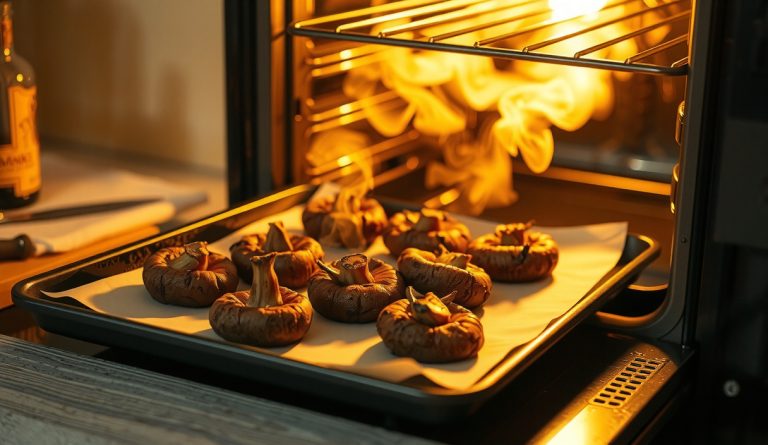
Indoor oven method: Set your oven to 275°F on convection. Place mushrooms on a wire rack over a sheet pan. Add 1/2 teaspoon of smoked paprika and 1/4 teaspoon of liquid smoke to the dry rub to compensate for absent combustion-derived volatile organic compounds. Roast for 75 minutes, glaze twice as described, and finish under the broiler for 90 seconds per side to achieve surface caramelization. The actual smoke ring will be absent, but the Maillard chemistry and glaze physics are fully reproducible in an oven.
Scaling for a crowd: This recipe scales linearly. For 8 servings, double all quantities and use a full-size sheet rack in your smoker. Do not stack the mushrooms — they need airflow on all scored faces. At large scale, the glaze benefits from an additional tablespoon of tamarind paste for depth, as flavor-per-unit-volume perception drops in high-viscosity matrices when surface area per serving decreases.
Frequently asked questions
Can I use oyster mushrooms instead of king trumpet? Oyster mushrooms have a far more delicate, thin-walled cellular structure — they will desiccate completely and turn papery at 250°F over 90 minutes. If oyster mushrooms are all you have, cut the smoke time to 45 minutes, glaze once, and finish at 325°F for 10 minutes. The texture will be crispier and less meaty, but the flavor is excellent.
Why does my glaze burn on the second smoke pass? A burning glaze means the smoker is running hot — likely above 275°F at the grate level. The sugars in hoisin and maple syrup begin pyrolyzing (not caramelizing — actually burning to acrid carbon) above 320°F. Check grate temperature with a surface probe, not the dome thermometer, which reads cooler. Move the mushrooms to a cooler zone, or reduce total second-phase time to 20 minutes.
How do I store and reheat leftover mushroom burnt ends without losing the bark? Store leftover mushroom burnt ends uncovered in the refrigerator — covering traps steam and softens the bark overnight. To reheat, place the mushrooms in a 325°F oven on a wire rack for 12–15 minutes until the surface re-crisps. Do not microwave: the rapid internal steam generation will turn the bark into a lacquered paste. A brief 60-second pass under a hot broiler at the end restores surface gloss and heat without compromising texture.