
Smoked Baked Potatoes — Bacon-Cheddar Stuffed

Equipment
- 1 Smoker or kettle grill Set up for indirect heat, 350°F grate-level temperature. Hickory, apple, or cherry wood.
- 1 Instant-read or leave-in probe thermometer Target 205–210°F internal for fully gelatinized starch.
- 1 Cast iron skillet For rendering the bacon.
- 1 Box grater Shred cheddar fresh from the block — pre-shredded cheddar has anti-caking coating that inhibits melt.
- 1 Fork or metal skewer For piercing potatoes before smoking.
Ingredients
Potatoes
- 4 large russet potatoes 12–14 oz each; scrubbed and thoroughly dried
- 2 tablespoons neutral high-smoke-point oil avocado or vegetable oil; or rendered bacon fat for extra flavor
- 2 teaspoons kosher salt for the skin
Bacon
- 8 slices thick-cut bacon at least 1/4-inch slices; cut into 1/2-inch lardons
Toppings
- 6 oz sharp aged cheddar hand-shredded from a block; about 1.5 cups loosely packed
- 1 cup full-fat sour cream cold, directly from the refrigerator
- ¼ cup fresh chives thinly sliced; add at plating only
- ½ teaspoon freshly ground black pepper for finishing
- flaky sea salt for finishing

Instructions
Fire & Prep
- Fire up your smoker or kettle grill for indirect heat. Bring the grate-level temperature to a steady 350°F. Add your chosen wood — hickory, apple, or cherry — and let it establish a thin blue smoke before the potatoes go on. White billowing smoke indicates incomplete combustion; wait for it to clear.
- Scrub the russet potatoes under cold water and dry them completely with a kitchen towel. Any surface moisture will suppress skin crisping during the first half of the cook. Pierce each potato 6 to 8 times with a fork or metal skewer, penetrating about 1 inch deep. This vents internal steam pressure and prevents the skin from rupturing.
- Rub each potato all over with the oil, then season aggressively with kosher salt on all surfaces. The oil creates a lipophilic film that captures smoke phenolics; the salt draws surface moisture outward osmotically, accelerating skin desiccation.2 tablespoons neutral high-smoke-point oil, 2 teaspoons kosher salt
Smoke
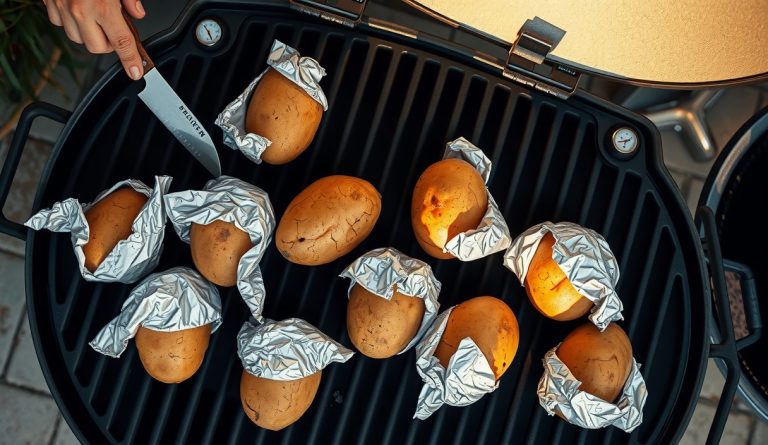
- Place the potatoes directly on the grate over the indirect zone, spaced at least 2 inches apart to allow smoke circulation. Close the lid and smoke at 350°F for 85 to 95 minutes, without opening the lid until the 80-minute mark.
- At 80 minutes, insert a probe thermometer into the thickest part of a potato. You are targeting 205–210°F internal. At 205°F, the starch matrix is fully gelatinized and the interior will be genuinely fluffy. Potatoes reading 185–190°F may look done externally but will feel dense and gluey inside. Continue smoking until the target temperature is reached — larger potatoes may need the full 95 minutes or slightly beyond.
- Remove the potatoes from the smoker and rest them uncovered for 5 minutes. Splitting immediately releases a burst of steam that partially rehydrates the dry, crisp skin surface.
Bacon
- While the potatoes smoke during the final 20 minutes, cook the bacon lardons in a cold cast iron skillet over medium heat. Starting in a cold pan allows fat to render gradually, producing evenly crisped pieces rather than charred exteriors with undercooked centers. Cook, stirring occasionally, until the lardons are deep golden-brown and the fat has fully rendered, about 10 to 12 minutes. Transfer to a paper-towel-lined plate. Reserve 1 tablespoon of the rendered fat for the potato interior if desired.8 slices thick-cut bacon
Load & Serve
- After resting, cut a deep cross into the top of each potato. Push both ends toward each other to burst the interior open and create a generous cavity. Use a fork to lightly fluff the interior starch — this increases the surface area available to absorb the toppings.
- Immediately add the shredded cheddar into the hot potato cavity. The residual heat at 200°F+ will melt the cheese into a cohesive, glossy layer within 60 to 90 seconds. Do not add sour cream simultaneously — the cold dairy will drop the internal temperature below the melt threshold, leaving cheese shards rather than a melted layer.6 oz sharp aged cheddar
- Once the cheese has melted, crown each potato with the crispy bacon lardons, then add a generous spoonful of cold sour cream. Finish with freshly ground black pepper, a pinch of flaky sea salt, and the fresh chives. Chives go on last, at plating — their volatile organosulfur compounds degrade rapidly on a hot surface. Serve immediately.8 slices thick-cut bacon, 1 cup full-fat sour cream, 1/4 cup fresh chives, 1/2 teaspoon freshly ground black pepper, flaky sea salt
Notes
Nutrition
There is a moment, somewhere around the 75-minute mark on an offset smoker, when the skin of a russet potato transforms. It goes from pale and damp to taut, dark tan, and just slightly blistered at the creases. The starch inside has been quietly converting sugars, the skin has been desiccating under radiant heat, and the whole surface is primed for a Maillard cascade that turns a humble spud into something worth talking about. That is the promise of the smoked baked potato — and it is a promise this recipe delivers on every time.
The finishing combination here has been locked in for years: thick-cut bacon crisped in a cast iron, a sharp aged cheddar that melts under residual heat rather than a broiler, a generous crown of cold sour cream, and a fistful of fresh chives cut at the last second. It is pitmaster comfort food. And once you understand the physics driving every step, you will never go back to an oven-only potato again.
Why does a smoked baked potato work? The science
A smoked baked potato works because smoke accelerates surface desiccation and deposits flavor-active phenolic compounds, while the smoker’s heat simultaneously drives starch gelatinization — two independent pathways that an oven cannot replicate simultaneously at the same rate. A russet potato is roughly 79% water by mass, locked inside a network of starch granules and cell walls reinforced by pectin. When heat is applied, two processes race each other.
First, starch gelatinization: amylose and amylopectin absorb water and swell irreversibly beginning around 140–160°F internal, creating the fluffy, mealy interior texture that defines a perfect baked potato. Second, surface desiccation: the skin loses free moisture via evaporative phase change, and once surface water activity drops below the threshold that locks surface temperature at 212°F, the skin temperature can finally climb into the 250–300°F range where Maillard browning and localized dehydration produce the papery-crisp exterior.
Smoke accelerates the surface desiccation pathway. Convective smoke flow at 350°F delivers compounds like guaiacol and syringol — phenolic volatiles from smoldering hardwood — that condense on the cool, moist potato skin and contribute both flavor and a mild surface pH shift that subtly encourages faster drying and browning.
Piercing is not optional. Inside a sealed potato at 350°F, internal vapor pressure can build significantly as starch-bound water converts to steam. The skin is low in permeability and restricts that vapor escape. Without venting, the accumulated pressure can rupture the skin in a dramatic steam burst — inconvenient at best, dangerous at worst when reaching into a smoker. Six to eight fork or skewer punctures through the skin create controlled channels that equalize pressure continuously throughout the cook, keeping the skin intact and avoiding a soggy steamed interior from condensed moisture pooling.
The fat coating applied to the skin before smoking serves a dual mechanical and flavor function. A thin layer of neutral high-smoke-point oil — or rendered bacon fat for full commitment — lowers the effective surface water activity slightly, encourages uniform browning across the entire surface rather than patchy desiccation, and provides a lipophilic solvent phase for smoke-derived phenolic volatiles to dissolve into, extending their aromatic persistence on the palate. Salt applied at the same moment seasons the skin and drives osmotic pressure outward, pulling a small amount of interior moisture to the surface where it evaporates faster, hardening the skin more aggressively over the 90-minute cook window.
What equipment and ingredients do you need?
The smoker. Any indirect-heat rig — offset, kettle, pellet grill, or ceramic kamado — will work at 350°F. The target is a clean, thin blue smoke rather than a heavy white billowing smoke. White smoke carries too many incompletely combusted compounds (creosote-adjacent volatiles) that turn the skin bitter. Hickory, apple, or cherry wood all complement the starchy sweetness of the potato and the smoky-salt profile of the bacon topping. Avoid mesquite at this temperature; its higher phenol concentration can overwhelm a mild potato skin in 90 minutes.
Russet potatoes. Large russets — 12 to 14 oz each — are non-negotiable here. Their high starch content (primarily type 2 amylose-rich structure) gelatinizes into an exceptionally fluffy, low-moisture crumb compared to waxy or all-purpose varieties. Waxier potatoes like Yukon Golds hold their cell structure better after gelatinization, which reads as dense and creamy rather than mealy and cloudlike. For a loaded baked potato, the mealy interior that absorbs butter and sour cream is essential — waxy varieties repel them.
Sharp aged cheddar. Use a block and shred it yourself. Pre-shredded cheddar is coated in anti-caking agents — typically potato starch or cellulose — which coat the cheese particles and physically block the fat from flowing freely when heat is applied. The result is a gritty, non-cohesive melt. Hand-shredded cheese melts into a continuous, glossy, emulsified layer the moment it hits the hot potato interior.
Thick-cut bacon. Aim for at least 1/4-inch slices. Thin bacon renders out completely, leaving mostly crisp protein shards with very little fat left to carry flavor. Thick-cut bacon retains a balance of rendered fat and intact protein texture — chewy-crisp, not brittle — which provides a meaningful textural counterpoint to the fluffy potato interior.
Sour cream, full-fat. The emulsified fat phase in full-fat sour cream provides a thermodynamic buffer: the sour cream releases its lipophilic aromatics slowly on the palate rather than volatilizing all at once. Low-fat sour cream is predominantly an aqueous gel, which can feel thin and acidic without the creamy coating sensation that makes the topping cohesive.
Smoked Baked Potatoes — Bacon-Cheddar Stuffed
Equipment
- 1 Smoker or kettle grill Set up for indirect heat, 350°F grate-level temperature. Hickory, apple, or cherry wood.
- 1 Instant-read or leave-in probe thermometer Target 205–210°F internal for fully gelatinized starch.
- 1 Cast iron skillet For rendering the bacon.
- 1 Box grater Shred cheddar fresh from the block — pre-shredded cheddar has anti-caking coating that inhibits melt.
- 1 Fork or metal skewer For piercing potatoes before smoking.
Ingredients
Potatoes
- 4 large russet potatoes 12–14 oz each; scrubbed and thoroughly dried
- 2 tablespoons neutral high-smoke-point oil avocado or vegetable oil; or rendered bacon fat for extra flavor
- 2 teaspoons kosher salt for the skin
Bacon
- 8 slices thick-cut bacon at least 1/4-inch slices; cut into 1/2-inch lardons
Toppings
- 6 oz sharp aged cheddar hand-shredded from a block; about 1.5 cups loosely packed
- 1 cup full-fat sour cream cold, directly from the refrigerator
- ¼ cup fresh chives thinly sliced; add at plating only
- ½ teaspoon freshly ground black pepper for finishing
- flaky sea salt for finishing
Instructions
Fire & Prep
- Fire up your smoker or kettle grill for indirect heat. Bring the grate-level temperature to a steady 350°F. Add your chosen wood — hickory, apple, or cherry — and let it establish a thin blue smoke before the potatoes go on. White billowing smoke indicates incomplete combustion; wait for it to clear.
- Scrub the russet potatoes under cold water and dry them completely with a kitchen towel. Any surface moisture will suppress skin crisping during the first half of the cook. Pierce each potato 6 to 8 times with a fork or metal skewer, penetrating about 1 inch deep. This vents internal steam pressure and prevents the skin from rupturing.
- Rub each potato all over with the oil, then season aggressively with kosher salt on all surfaces. The oil creates a lipophilic film that captures smoke phenolics; the salt draws surface moisture outward osmotically, accelerating skin desiccation.2 tablespoons neutral high-smoke-point oil, 2 teaspoons kosher salt
Smoke
- Place the potatoes directly on the grate over the indirect zone, spaced at least 2 inches apart to allow smoke circulation. Close the lid and smoke at 350°F for 85 to 95 minutes, without opening the lid until the 80-minute mark.
- At 80 minutes, insert a probe thermometer into the thickest part of a potato. You are targeting 205–210°F internal. At 205°F, the starch matrix is fully gelatinized and the interior will be genuinely fluffy. Potatoes reading 185–190°F may look done externally but will feel dense and gluey inside. Continue smoking until the target temperature is reached — larger potatoes may need the full 95 minutes or slightly beyond.
- Remove the potatoes from the smoker and rest them uncovered for 5 minutes. Splitting immediately releases a burst of steam that partially rehydrates the dry, crisp skin surface.
Bacon
- While the potatoes smoke during the final 20 minutes, cook the bacon lardons in a cold cast iron skillet over medium heat. Starting in a cold pan allows fat to render gradually, producing evenly crisped pieces rather than charred exteriors with undercooked centers. Cook, stirring occasionally, until the lardons are deep golden-brown and the fat has fully rendered, about 10 to 12 minutes. Transfer to a paper-towel-lined plate. Reserve 1 tablespoon of the rendered fat for the potato interior if desired.8 slices thick-cut bacon
Load & Serve
- After resting, cut a deep cross into the top of each potato. Push both ends toward each other to burst the interior open and create a generous cavity. Use a fork to lightly fluff the interior starch — this increases the surface area available to absorb the toppings.
- Immediately add the shredded cheddar into the hot potato cavity. The residual heat at 200°F+ will melt the cheese into a cohesive, glossy layer within 60 to 90 seconds. Do not add sour cream simultaneously — the cold dairy will drop the internal temperature below the melt threshold, leaving cheese shards rather than a melted layer.6 oz sharp aged cheddar
- Once the cheese has melted, crown each potato with the crispy bacon lardons, then add a generous spoonful of cold sour cream. Finish with freshly ground black pepper, a pinch of flaky sea salt, and the fresh chives. Chives go on last, at plating — their volatile organosulfur compounds degrade rapidly on a hot surface. Serve immediately.8 slices thick-cut bacon, 1 cup full-fat sour cream, 1/4 cup fresh chives, 1/2 teaspoon freshly ground black pepper, flaky sea salt
Notes
Nutrition
How do you nail it every time? Tips and technique
- Do not skip the piercing step. Six to eight punctures per potato with a fork or metal skewer. Internal steam needs an exit route or you risk blowouts mid-cook.
- Oil and salt before smoking, not after. The oil creates a continuous lipophilic film that captures phenolic smoke compounds. Salt applied to a dry skin draws surface moisture out osmotically, accelerating skin desiccation and crisping.
- Check doneness with a probe, not just time. Target 205–210°F internal. At this temperature, the starch matrix has fully gelatinized and the interior is as fluffy as it will ever get. A potato that reads 190°F may look done externally but will feel gluey and dense inside.
- Rest 5 minutes before splitting. Splitting immediately releases a burst of steam that partially rehydrates the dry skin surface you just worked 90 minutes to achieve. A short rest lets the steam equilibrate internally.
- Add cheddar to the hot interior first, then sour cream. The cheese needs the residual heat of the potato to melt into a cohesive layer. Sour cream added simultaneously drops the internal temperature too fast, leaving unmelted cheese shards.
- Chives last, always. Fresh allium volatile compounds — primarily propyl and allyl disulfides — are highly heat-labile. Adding chives to a hot potato causes rapid volatilization of these aromatics within 30 seconds. Cut them fresh and add at plating.
What are the best variations on a smoked baked potato?
Southwestern loaded. Substitute the cheddar for a pepper jack, swap chives for pickled jalapeño rings and fresh cilantro, and replace sour cream with a chipotle crema (blitz full-fat sour cream with one canned chipotle in adobo and a squeeze of lime). The capsaicin in jalapeño activates TRPV1 receptors, which amplifies the perception of the smoky char on the potato skin — a cross-modal interaction that makes the smoke flavor read as significantly more intense.
BBQ pulled pork topped. Split and fluff the smoked potato, load the potato with freshly pulled smoked pork shoulder, a drizzle of house vinegar sauce, and a spoonful of tangy coleslaw. The coleslaw provides acetic acid contrast that cuts through the fat of the pork and the starch of the potato, resetting the palate between bites. This build converts the potato from a side into a fully autonomous main course.
Dairy-free build. Replace sour cream with a cashew-based cultured cream (blitz 1 cup soaked cashews with 2 tablespoons lemon juice, 1 tablespoon apple cider vinegar, and a pinch of salt until smooth), and use a plant-based cheddar shred with a starch-fat emulsion base. Most plant-based cheeses require slightly higher heat to initiate flow — hold the potato split-side-up under a broiler for 60 to 90 seconds to achieve a genuine melt before topping.
Scaling up for a crowd. The 90-minute smoke window accommodates up to 8 potatoes on a standard 22-inch kettle with indirect heat without meaningfully extending cook time, provided smoker temperature holds at 350°F and potatoes are spaced at least 2 inches apart to allow smoke circulation. Above 8 potatoes, the combined evaporative load from the skins can noticeably drop the dome temperature — compensate by increasing fuel load and checking temperature every 20 minutes.
Frequently asked questions about smoked baked potatoes
Can I finish smoked baked potatoes in the oven if I run out of fuel? Yes. Transfer the potatoes to a 400°F conventional oven if the smoker temperature drops mid-cook. Starch gelatinization will complete normally, but the flavor will shift to a lighter smoke profile — more of an oven baked potato with a hint of smoke — rather than a fully developed smoked skin, because additional smoke deposition on the skin stops the moment the potatoes leave the smoker.
Why do smoked baked potatoes sometimes come out gummy inside even after 90 minutes? Two likely causes: the potato was too wet going in (rinse and dry thoroughly before oiling), or the smoker was running below 350°F due to a temperature drop. At lower temperatures, internal gelatinization proceeds more slowly and unevenly, and the starch matrix can set in a partially organized state that feels gluey. Always verify smoker temperature with a calibrated grate-level probe — the lid thermometer commonly reads 20–30°F higher than actual cooking temperature at the grate.
Can bacon be prepped ahead of time for smoked baked potatoes? Yes, and doing so often improves texture. Bacon cooked 2 to 4 hours ahead and held at room temperature undergoes a minor re-crystallization of its rendered fat as it cools, which creates a slightly firmer, crunchier bite than freshly cooked bacon. Reheat briefly in a dry skillet just before serving to re-render the surface fat and restore crisp. Avoid microwaving — the rapid, uneven heating causes protein contraction that toughens the slices significantly.