Smoked Sweet Potatoes with Brown Sugar Bourbon Butter

Equipment
- 1 Smoker or covered kettle grill Set up for indirect heat, target 250°F chamber temperature
- 2-3 Cherry or apple wood chunks Soaking optional; chunks preferred over chips for longer burn
- 1 Leave-in probe thermometer Critical for monitoring internal temperature through the β-amylase window
- 1 Small mixing bowl For the compound butter
- 1 Fork or stand mixer For whipping the compound butter
Ingredients
Sweet Potatoes
- 4 medium sweet potatoes (Garnet or Jewel variety, 6–8 oz each) Uniform size is important — avoid large potatoes
- 1 tablespoon neutral oil (avocado or vegetable) For rubbing the skin
- 1 teaspoon kosher salt For the skin
Brown Sugar Bourbon Butter
- 6 tablespoons unsalted butter Room temperature — not melted
- 3 tablespoons dark brown sugar Packed; dark brown preferred for higher molasses content
- 2 tablespoons wheated bourbon Maker’s Mark, Weller, or equivalent; high-rye bourbons compete with sweetness
- ½ teaspoon fine sea salt
- ¼ teaspoon ground cinnamon Optional but recommended
- ⅛ teaspoon cayenne pepper Optional — adds a TRPV1 chemesthetic counterpoint to the sweetness

Instructions
Prepare the Smoker
- Set up your smoker or kettle grill for indirect cooking. Target a stable 250°F chamber temperature. For a charcoal kettle, bank coals to one side and place 2 to 3 cherry or apple wood chunks directly on the coals. For a pellet grill, load with fruit-wood pellets and set to 250°F. Allow the smoker to fully stabilize at temperature before loading the potatoes — rushing this step causes temperature spikes that shorten the β-amylase enzymatic window.
Prep the Sweet Potatoes
- Scrub the sweet potatoes thoroughly under cold water and dry completely. Rub each potato all over with a thin film of neutral oil, then sprinkle with kosher salt on all surfaces. The oil helps the skin crisp and promotes the surface Maillard reaction during smoking. Do not pierce the potatoes — keeping the skin intact traps internal steam, which supports creamy interior texture.1 tablespoon neutral oil (avocado or vegetable), 1 teaspoon kosher salt
Make the Bourbon Butter
- In a small bowl, combine the room-temperature butter, dark brown sugar, bourbon, fine sea salt, cinnamon (if using), and cayenne (if using). Beat with a fork until fully integrated into a smooth, cohesive compound butter — this takes about 2 minutes. The mixture should look like a pale brown paste with no visible separation. If the butter is too cold and won’t incorporate, let it sit at room temperature 10 more minutes and try again. Do not melt the butter — a melted butter mixture will pool and separate rather than forming a proper compound.6 tablespoons unsalted butter, 3 tablespoons dark brown sugar, 2 tablespoons wheated bourbon, 1/2 teaspoon fine sea salt, 1/4 teaspoon ground cinnamon, 1/8 teaspoon cayenne pepper
- Transfer the compound butter onto a sheet of plastic wrap or parchment, roll into a log, and refrigerate until ready to use. Remove from the refrigerator 15 minutes before the potatoes come off the smoker so it softens slightly.6 tablespoons unsalted butter, 3 tablespoons dark brown sugar, 2 tablespoons wheated bourbon, 1/2 teaspoon fine sea salt, 1/4 teaspoon ground cinnamon, 1/8 teaspoon cayenne pepper
Smoke the Sweet Potatoes
- Place the oiled, salted sweet potatoes directly on the grate in the indirect heat zone, with at least 1 inch of space between each potato for full smoke airflow. Insert a leave-in probe thermometer into the thickest part of the largest potato. Close the lid.1 tablespoon neutral oil (avocado or vegetable), 1 teaspoon kosher salt
- Smoke at 250°F for approximately 85 to 95 minutes, maintaining the temperature as steadily as possible. Watch the probe: between 135°F and 170°F internal, β-amylase is actively converting starch to maltose — this is the enzymatic sweet spot. Do not interrupt this phase by lifting the lid or spiking the temperature. The potato will spend roughly 45 to 60 minutes climbing through this window at 250°F.
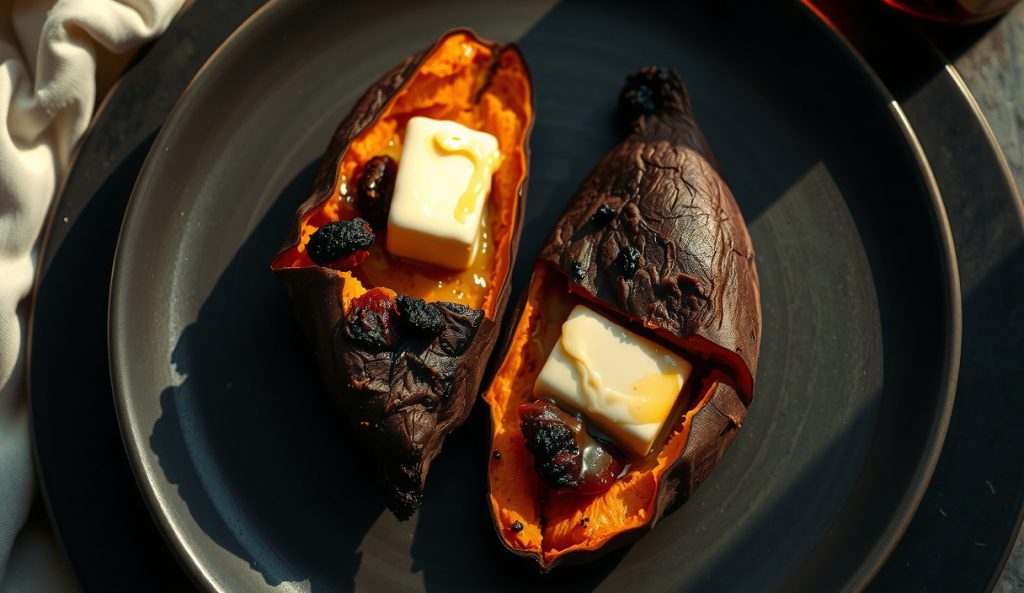
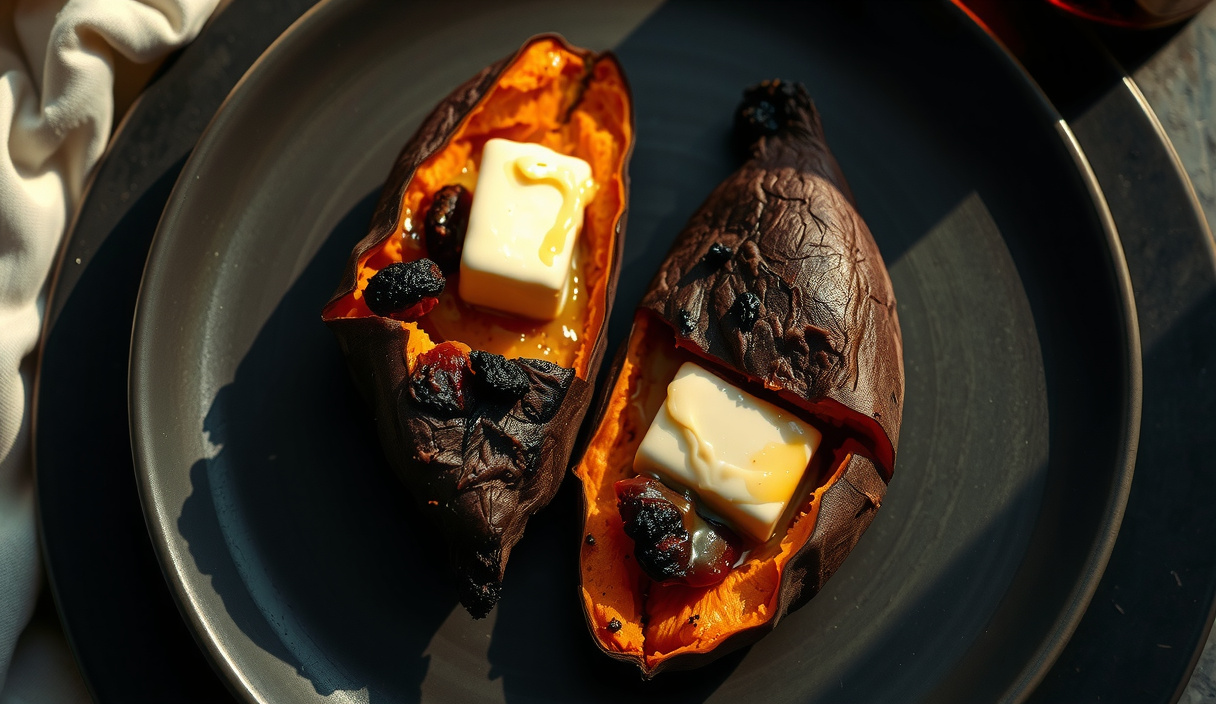
- Continue smoking until the internal temperature reaches 205°F to 210°F. At this point, the starches are fully gelatinized and the flesh will be completely creamy and soft when probed. The skin should be wrinkled, slightly leathery, and deeply colored — this is correct. Remove the potatoes from the smoker.
Rest, Split, and Finish
- Rest the smoked sweet potatoes on a cutting board for 5 minutes before splitting. This allows internal vapor pressure to equilibrate, preventing volatile aromatics from blowing off the surface in a rush of steam at service.
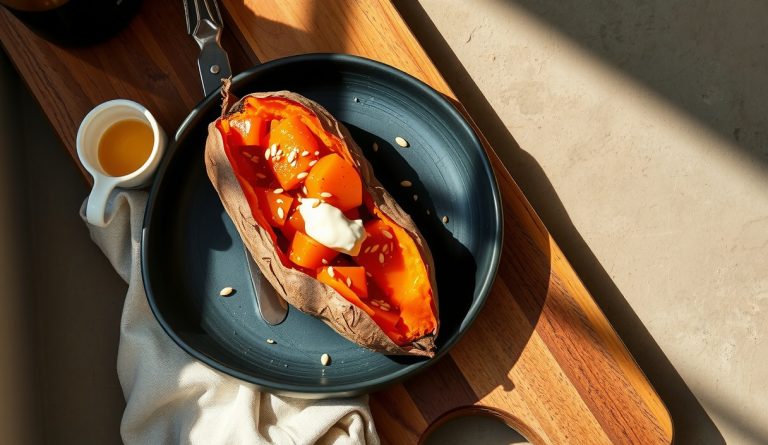
- Using a sharp knife, split each potato lengthwise, cutting about three-quarters of the way through. Gently press the ends toward each other to open the split and fluff the interior flesh with a fork. The flesh should be visibly glistening, deeply amber-colored, and pull apart easily into creamy strands.
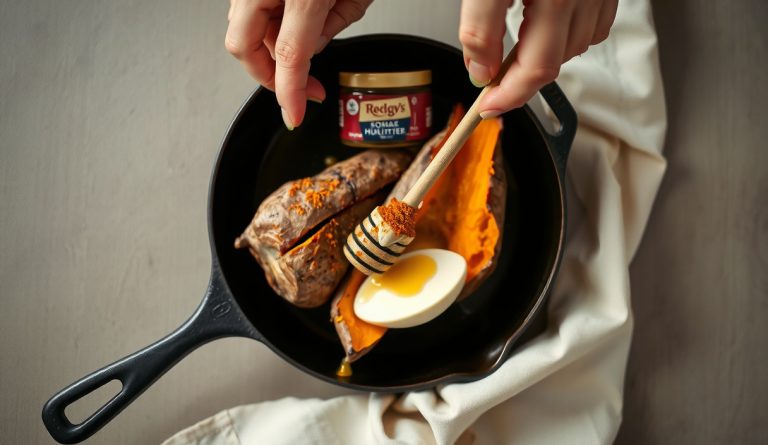
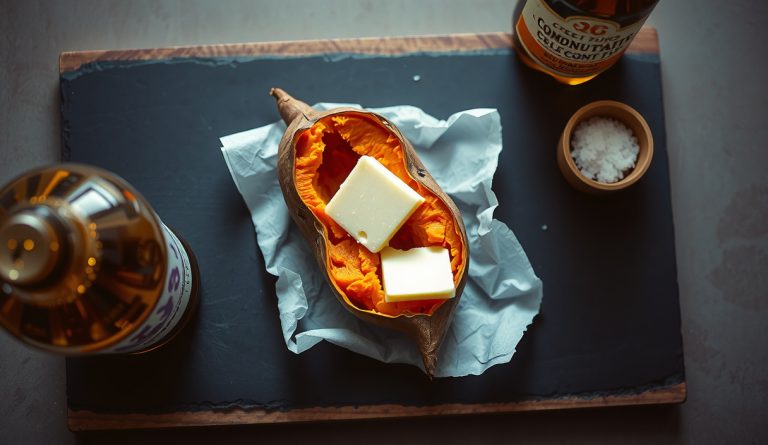
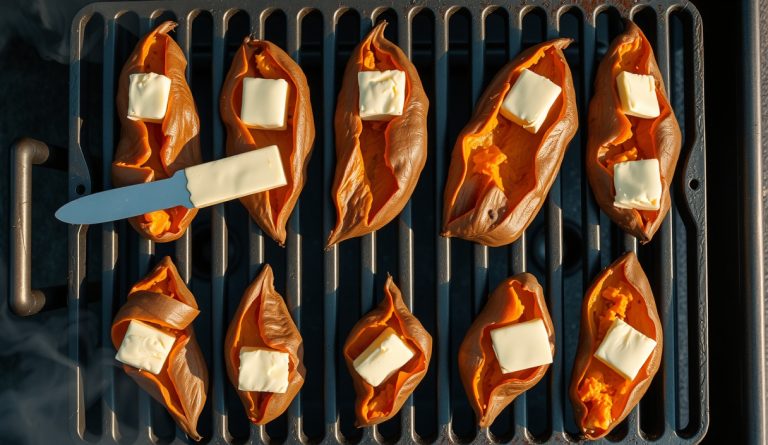
- While the potatoes are still blazing hot, place a generous tablespoon and a half of the bourbon brown sugar compound butter directly into the split of each potato. The residual heat of the flesh — 175°F to 190°F at the surface — will melt the butter, create a brief Maillard reaction from the brown sugar contacting the hot flesh, and volatilize the bourbon esters into the air. Serve immediately.6 tablespoons unsalted butter, 3 tablespoons dark brown sugar, 2 tablespoons wheated bourbon, 1/2 teaspoon fine sea salt, 1/4 teaspoon ground cinnamon, 1/8 teaspoon cayenne pepper
Notes
Nutrition
The first time I split open a sweet potato that had spent ninety minutes over cherry smoke at 250°F, I thought something had gone wrong. The flesh was so intensely sweet — almost molasses-level — that it seemed impossible from something I had simply set on a grate and largely ignored. Nothing had gone wrong. Something had gone very, very right.
The oven-baked sweet potato is good. The smoked sweet potato cooked at the right temperature is in a different category entirely. The difference is not smoke flavor — though that is significant — it is enzyme chemistry. Once you understand what is happening inside the potato during that first hour at low heat, you will never go back to the oven version for occasions that matter.
Why does a smoked sweet potato taste so much sweeter? The science
Smoked sweet potatoes taste dramatically sweeter than oven-baked ones because low smoker heat keeps the potato’s internal temperature inside the active range of β-amylase — a native enzyme that converts starch directly into sweet-tasting maltose sugar — for 45 to 60 minutes instead of 20 to 25 minutes. β-amylase is a glycoside hydrolase that cleaves maltose units from the ends of amylose and amylopectin chains, systematically dismantling complex starch into simple sugar. Its optimal activity window runs from roughly 135°F to 170°F internal temperature, and the enzyme is irreversibly denatured once the tissue exceeds approximately 175°F.
At a 250°F smoker temperature, a whole sweet potato climbs slowly through that enzymatic window, delivering 45 to 60 minutes of active starch-to-maltose conversion before the interior pushes past the 175°F denaturation ceiling. An oven running at 400°F rockets the interior past 175°F in 20 to 25 minutes, cutting the conversion window roughly in half and leaving measurably less maltose — and measurably less perceived sweetness — in the finished potato. The long, low temperature hold is not a bug. It is the mechanism.
Simultaneously, the sweet potato’s outer skin undergoes Maillard browning and early-stage caramelization. The skin surface dehydrates under convective smoke airflow, driving local water activity (aw) well below 0.7 at the peel boundary. Below that threshold, the Maillard cascade — amino-carbonyl condensation initiated by Strecker degradation pathways — runs efficiently, producing hundreds of volatile melanoidin compounds responsible for the toasted, nutty, smoky complexity in the finished skin. The sweet potato’s native sugars (sucrose, glucose, fructose) and its free amino acids provide an abundant Maillard substrate pool, independent of the smoke itself.
The smoke layers on additional phenolic volatile organic compounds — primarily guaiacol, syringol, and 4-methylguaiacol from hardwood lignin pyrolysis — that bind to the surface and penetrate the outer centimeter of flesh, adding a wood-resin depth that complements rather than overwhelms the sweetness. The brown sugar bourbon butter applied post-smoke is a calculated flavor amplifier, not a mask. Brown sugar (sucrose with retained molasses) contributes additional reducing sugars that complete a brief, residual Maillard reaction on the hot flesh surface when the butter melts in. Bourbon adds ethanol-carried volatile esters — ethyl acetate, ethyl hexanoate, isoamyl acetate — that volatilize rapidly off the hot surface, delivering an aromatic spike that primes retronasal olfaction before the first bite. The fat phase (butter) coats lipophilic aroma compounds from both the smoke and the bourbon, slowing their release and extending aromatic persistence from a single flash to a long, resonant finish.
What equipment and ingredients do I need?
- Smoker or covered kettle grill: Any setup capable of holding an indirect 250°F chamber works. Pellet grills running fruit-wood pellets are the easiest. Charcoal kettle with a two-zone fire and wood chunks delivers more smoke density and is the preferred approach here.
- Wood choice: Cherry and apple are the default. Both are mild, high-sugar hardwoods whose combustion produces lower concentrations of polycyclic aromatic compounds than heavier woods like hickory or mesquite. Their phenolic VOC profile — predominantly syringol-group compounds — reads as subtly fruity-smoky, pairing cleanly with the sweet potato’s maltose-forward profile. Avoid oak or hickory; the tannic depth fights the sweetness.
- Sweet potato selection: Look for uniform, medium potatoes (6 to 8 oz each). Avoid the giant supermarket specimens — their greater diameter means the center spends less time in the β-amylase window before the outer layers overshoot 175°F. Garnet and Jewel varieties are high in β-amylase activity. Purple or Japanese sweet potatoes have a drier, lower-sugar profile and will not respond as dramatically to the low-smoke method.
- Bourbon: Use a wheated bourbon (Weller, Maker’s Mark, or equivalent). High-rye bourbons introduce a spicy, grain-forward volatile profile that competes with the sweetness. A wheated mash bill delivers softer vanilla and caramel esters that integrate cleanly with the brown sugar and smoke.
- Brown sugar: Choose dark brown sugar over light brown. The higher molasses content provides more residual reducing sugars for surface Maillard activity and more butanoic-acid-derived flavor compounds — the characteristic molasses depth that anchors the compound butter.
- Thermometer: This recipe lives and dies by internal temperature during the low-heat hold. A leave-in probe thermometer lets you watch the β-amylase window in real time and confirms the finished 205°F to 210°F target.
Smoked Sweet Potatoes with Brown Sugar Bourbon Butter
Equipment
- 1 Smoker or covered kettle grill Set up for indirect heat, target 250°F chamber temperature
- 2-3 Cherry or apple wood chunks Soaking optional; chunks preferred over chips for longer burn
- 1 Leave-in probe thermometer Critical for monitoring internal temperature through the β-amylase window
- 1 Small mixing bowl For the compound butter
- 1 Fork or stand mixer For whipping the compound butter
Ingredients
Sweet Potatoes
- 4 medium sweet potatoes (Garnet or Jewel variety, 6–8 oz each) Uniform size is important — avoid large potatoes
- 1 tablespoon neutral oil (avocado or vegetable) For rubbing the skin
- 1 teaspoon kosher salt For the skin
Brown Sugar Bourbon Butter
- 6 tablespoons unsalted butter Room temperature — not melted
- 3 tablespoons dark brown sugar Packed; dark brown preferred for higher molasses content
- 2 tablespoons wheated bourbon Maker’s Mark, Weller, or equivalent; high-rye bourbons compete with sweetness
- ½ teaspoon fine sea salt
- ¼ teaspoon ground cinnamon Optional but recommended
- ⅛ teaspoon cayenne pepper Optional — adds a TRPV1 chemesthetic counterpoint to the sweetness
Instructions
Prepare the Smoker
- Set up your smoker or kettle grill for indirect cooking. Target a stable 250°F chamber temperature. For a charcoal kettle, bank coals to one side and place 2 to 3 cherry or apple wood chunks directly on the coals. For a pellet grill, load with fruit-wood pellets and set to 250°F. Allow the smoker to fully stabilize at temperature before loading the potatoes — rushing this step causes temperature spikes that shorten the β-amylase enzymatic window.
Prep the Sweet Potatoes
- Scrub the sweet potatoes thoroughly under cold water and dry completely. Rub each potato all over with a thin film of neutral oil, then sprinkle with kosher salt on all surfaces. The oil helps the skin crisp and promotes the surface Maillard reaction during smoking. Do not pierce the potatoes — keeping the skin intact traps internal steam, which supports creamy interior texture.1 tablespoon neutral oil (avocado or vegetable), 1 teaspoon kosher salt
Make the Bourbon Butter
- In a small bowl, combine the room-temperature butter, dark brown sugar, bourbon, fine sea salt, cinnamon (if using), and cayenne (if using). Beat with a fork until fully integrated into a smooth, cohesive compound butter — this takes about 2 minutes. The mixture should look like a pale brown paste with no visible separation. If the butter is too cold and won’t incorporate, let it sit at room temperature 10 more minutes and try again. Do not melt the butter — a melted butter mixture will pool and separate rather than forming a proper compound.6 tablespoons unsalted butter, 3 tablespoons dark brown sugar, 2 tablespoons wheated bourbon, 1/2 teaspoon fine sea salt, 1/4 teaspoon ground cinnamon, 1/8 teaspoon cayenne pepper
- Transfer the compound butter onto a sheet of plastic wrap or parchment, roll into a log, and refrigerate until ready to use. Remove from the refrigerator 15 minutes before the potatoes come off the smoker so it softens slightly.6 tablespoons unsalted butter, 3 tablespoons dark brown sugar, 2 tablespoons wheated bourbon, 1/2 teaspoon fine sea salt, 1/4 teaspoon ground cinnamon, 1/8 teaspoon cayenne pepper
Smoke the Sweet Potatoes
- Place the oiled, salted sweet potatoes directly on the grate in the indirect heat zone, with at least 1 inch of space between each potato for full smoke airflow. Insert a leave-in probe thermometer into the thickest part of the largest potato. Close the lid.1 tablespoon neutral oil (avocado or vegetable), 1 teaspoon kosher salt
- Smoke at 250°F for approximately 85 to 95 minutes, maintaining the temperature as steadily as possible. Watch the probe: between 135°F and 170°F internal, β-amylase is actively converting starch to maltose — this is the enzymatic sweet spot. Do not interrupt this phase by lifting the lid or spiking the temperature. The potato will spend roughly 45 to 60 minutes climbing through this window at 250°F.
- Continue smoking until the internal temperature reaches 205°F to 210°F. At this point, the starches are fully gelatinized and the flesh will be completely creamy and soft when probed. The skin should be wrinkled, slightly leathery, and deeply colored — this is correct. Remove the potatoes from the smoker.
Rest, Split, and Finish
- Rest the smoked sweet potatoes on a cutting board for 5 minutes before splitting. This allows internal vapor pressure to equilibrate, preventing volatile aromatics from blowing off the surface in a rush of steam at service.
- Using a sharp knife, split each potato lengthwise, cutting about three-quarters of the way through. Gently press the ends toward each other to open the split and fluff the interior flesh with a fork. The flesh should be visibly glistening, deeply amber-colored, and pull apart easily into creamy strands.
- While the potatoes are still blazing hot, place a generous tablespoon and a half of the bourbon brown sugar compound butter directly into the split of each potato. The residual heat of the flesh — 175°F to 190°F at the surface — will melt the butter, create a brief Maillard reaction from the brown sugar contacting the hot flesh, and volatilize the bourbon esters into the air. Serve immediately.6 tablespoons unsalted butter, 3 tablespoons dark brown sugar, 2 tablespoons wheated bourbon, 1/2 teaspoon fine sea salt, 1/4 teaspoon ground cinnamon, 1/8 teaspoon cayenne pepper
Notes
Nutrition
How do I nail smoked sweet potatoes every time?
- Do not wrap the sweet potato in foil during the smoke. Foil traps surface moisture, preventing the aw drop needed for Maillard browning on the skin and blocking smoke penetration entirely. Bare potato on the grate only.
- Watch the internal temperature, not just the clock. Ambient conditions, potato size, and grate position all affect the rate. Pull the sweet potato when the internal temperature reaches 205°F to 210°F — at that point the flesh is fully gelatinized and the texture is creamy rather than fibrous or chalky. Below 200°F and the center is mealy.
- Rest the sweet potato 5 minutes before splitting. This allows vapor pressure inside to equilibrate. Splitting immediately causes a rush of steam that carries volatile aromatics off the surface before you can capture them during service.
- Make the bourbon butter at room temperature. Softened butter — not melted — whips into a stable emulsion with the brown sugar and bourbon. Melted butter pools rather than integrates, the water phase separates from the fat, and the compound butter texture is lost entirely.
- Apply the compound butter while the sweet potato is still blazing hot. The residual surface temperature of 175°F to 190°F flesh is required to melt the butter compound smoothly and trigger the brief, residual Maillard reaction from the brown sugar. A cold potato gets cold butter, and the flavor cascade stops.
- The skin is edible and worth eating. The smoked, Maillard-browned skin on a properly cooked sweet potato is one of the most underrated bites in BBQ. Encourage guests not to discard it.
What variations work with this recipe?
Miso-maple instead of bourbon-brown sugar: Substitute 2 tablespoons of white shiro miso and 2 tablespoons of pure maple syrup for the brown sugar and bourbon in the compound butter. Miso introduces glutamate-rich savoriness and a lactic fermentation depth that pivots the dish from American barbecue sweet toward a Japanese-influenced umami-sweet register. Miso also supplies its own reducing sugars and free amino acids, sustaining Maillard reactivity on the hot flesh surface.
Spiced chipotle-honey for heat seekers: Replace the brown sugar with an equal volume of raw honey and add 1 teaspoon of chipotle powder and a pinch of cayenne to the compound butter. Chipotle reintroduces a smoke-specific Maillard character from the drying process of the chili, while capsaicin activates TRPV1 trigeminal receptors, producing a chemesthetic heat counterpoint to the sweetness. Honey’s high fructose content provides faster Maillard browning on contact than sucrose-based brown sugar.
Dairy-free version: Replace the butter in the compound with refined coconut oil. Coconut oil at room temperature has a similar plastic-fat consistency to butter and whips acceptably with brown sugar and bourbon. The flavor profile shifts slightly — coconut oil lacks butterfat’s diacetyl and butyric acid notes — so increase the bourbon by 1 teaspoon and add a small pinch of fine sea salt to restore the savory counterpoint that butterfat provides.
Scaling for a crowd: This recipe scales linearly. The only operational constraint is grate space and ensuring uniform potato size across the batch so all potatoes reach temperature simultaneously. Do not stack potatoes — each potato needs direct, unrestricted smoke airflow on all sides. A standard 22-inch kettle fits 4 to 5 medium sweet potatoes in the indirect zone comfortably. Scale the compound butter at 1.5 tablespoons per potato served.
Frequently asked questions
Can I use a gas grill instead of a charcoal smoker? Yes, with a smoke box or foil packet of wood chips placed over a lit burner. Set the burners to their lowest setting on one side, place potatoes on the unlit side, and target 250°F with the lid closed. Gas grills produce less smoke density than charcoal setups, so smoke flavor will be lighter — but the β-amylase enzymatic benefit is identical, because it is driven entirely by the low-temperature hold, not the smoke itself.
Why 250°F specifically? Can I run hotter to save time? Running hotter sacrifices the enzymatic window. At 325°F chamber temperature, the sweet potato interior climbs through the 135°F to 170°F β-amylase zone in roughly 25 to 30 minutes instead of 45 to 60 minutes — cutting potential starch-to-maltose conversion time by one-third to one-half. At 400°F, the potato behaves essentially like an oven-baked potato with incidental smoke flavor: structurally fine, but with fundamentally less sweetness. The 250°F target is the minimum-time investment for maximum enzymatic payoff.
My sweet potato skin is wrinkled and leathery — did I overcook it? No, wrinkled and leathery skin is correct and expected. The low-temperature, extended smoke environment dehydrates the outer skin significantly, causing the characteristic crinkled, tightened appearance. The interior will be perfectly creamy. Leathery skin on a smoked sweet potato is a textural feature — it concentrates Maillard flavor compounds and provides a pleasant chew that contrasts beautifully with the creamy interior. If the skin has cracks that have turned hard and dry rather than pliable-leathery, the potato likely pushed past 210°F internally — still safe to eat, but slightly past the ideal texture window.