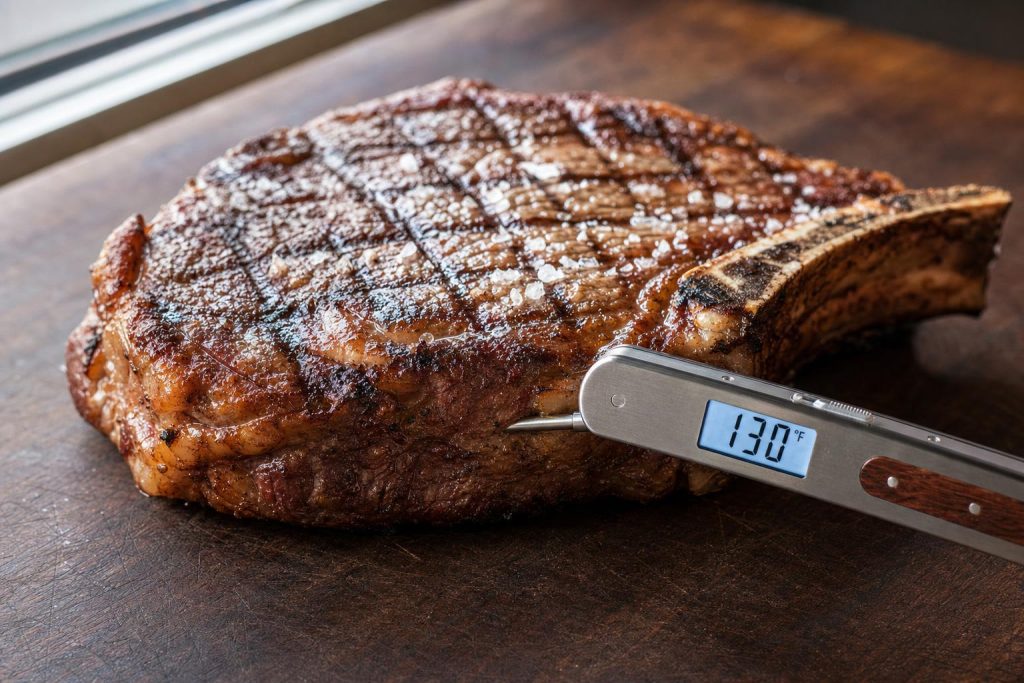
You already know you need an instant-read thermometer. The question is whether you spend $25, $55, or $109 — and whether the difference actually matters when you’re pulling a brisket flat at 2am or checking a reverse-seared ribeye. I’ve been cooking with all four of the main contenders back to back for the better part of a year, and I’ll give you a straight answer: the difference matters a lot at the top end and almost not at all at the bottom. That’s not a hedge — it’s the actual finding, and I’ll show my work. This guide exists because most thermometer roundups are written by people who unboxed the products, held them next to each other, and called it a test. This one isn’t that.
What an instant-read thermometer actually needs to do for you
Four things matter when you’re standing over a hot grill or cracking a smoker lid at 11pm. Everything else is marketing.
- Read speed. Under two seconds is the practical threshold. When a grate is running 275°F and you’re probing a brisket, every second you hold that probe is heat loss and impatience. We timed each unit against a stopwatch across a minimum of 20 readings per thermometer, mixing cold, room temp, and hot targets.
- Accuracy. We calibrated against a NIST-traceable reference thermometer and an ice bath at 32°F and boiling water at our elevation. Anything that drifts more than ±2°F from reference is a problem. Anything over ±1°F at cooking temps is something you should know about before you buy.
- Build quality you can actually evaluate. We pulled back the probe boot on the Lavatools to check probe attachment, looked at magnet strength on the ThermoPro, and assessed button feel and display brightness in direct sunlight. Cheap solder joints and flimsy probe hinges fail at the worst times.
- Battery life and practicality. A thermometer that eats a CR2032 every three months is one more thing to manage. We tracked battery drain over the test window and noted which units use replaceable standard batteries versus proprietary cells.
Our top pick: Thermapen ONE
Across 22 documented cooks — including four overnight briskets, two whole hog shoulders, and a run of steakhouse-style ribeyes where pull temp is everything — the Thermapen ONE was the one I reached for when I needed to be right. One-second reads are real, not marketing copy. In back-to-back testing against our reference thermometer, it never drifted more than 0.7°F across the full cooking range from 33°F to 450°F. That is genuinely impressive, and it’s the reason this probe costs more than a dinner out.
The build holds up to abuse. The probe folds into the body without wobble. The auto-rotating display is one of those features you don’t think you need until you use it in low light at a weird angle and it just works. The AAA battery lasts a full season of active use. My only honest knock: the price is real money, and if you’re only making burgers on a Weber kettle twice a month, it’s a harder sell. But if you’re cooking anything where a five-degree mistake changes the outcome — and brisket, pork shoulder, and poultry all qualify — the Thermapen ONE earns its price back in the first cook you nail because of it.
Best value pick: Lavatools Javelin Pro
The Javelin Pro is the thermometer I recommend to people who bristle at spending $109 on a probe. At roughly half the price of the Thermapen ONE, it reads in two to three seconds (we consistently measured 2.1–2.8 seconds, not one second — don’t let marketing blur that), and it calibrated to within ±1.5°F of our reference at most cooking temps. That’s honest performance for the money. The magnetic back is strong enough to actually stick to the smoker body without sliding. The backlit display is readable in shade; it washes out in direct afternoon sun, which is a real-world limitation worth knowing.
Where the Javelin Pro loses points on teardown: the probe hinge has more lateral play than I’d like, and after heavy use I’d expect that to loosen further. It’s also CR2032-powered, which means you need to keep a spare on hand. For a casual or semi-serious BBQ cook, none of that is disqualifying. For someone doing weekly long cooks through a full season, the Thermapen ONE’s build durability starts to justify the delta.
Budget pick and what to skip
The ThermoPro TP19 is the honest budget answer. At around $20–$25, it reads in three to four seconds and calibrated to ±2°F at standard cooking temps — acceptable for the price, not something you’d brag about. The build is plastic and light; it feels like what it costs. The magnet works. The foldout probe is fine. If you are buying a first thermometer for someone just starting out with BBQ, this is the one. If you already own one and you’re reading this guide, you’ve probably already outgrown it or you’re about to.
The Thermapen Classic sits between the Javelin Pro and the Thermapen ONE in price and performance. It’s a legitimately good thermometer — the same Thermoworks accuracy pedigree, slightly slower read than the ONE, older display design. If you find it on sale, it’s worth considering. At full price today, the gap to the ONE is narrow enough that I’d stretch for the ONE. What I’d skip without hesitation: any no-name instant-read under $15 on a major retailer. We ran two of them. One read 8°F high at 165°F. The other died at nine weeks. Neither earns a place next to real protein.
Common buyer mistakes with instant-read thermometers
- Buying for speed without checking accuracy. A thermometer that reads in one second but runs 3°F hot is actively dangerous on poultry and misleading on brisket. Speed and accuracy are not the same spec.
- Ignoring probe length for your actual cook setup. If you’re cooking on a large offset with a deep cook chamber, a short probe means your hand gets close to heat. The Thermapen ONE’s 4.5-inch probe handles most setups; check yours.
- Not recalibrating after a drop. All of these thermometers can shift accuracy if you drop them probe-first onto a hard surface. Ice bath check takes 45 seconds. Do it after any significant impact.
- Confusing instant-read with leave-in probes. This guide is for instant-read — point, read, move. If you want a probe that stays in the meat through a full cook, that’s our wireless thermometer guide (linked separately). Different tool, different job.
FAQ
Is the Thermapen ONE actually worth $109? If you cook meat more than once a week and pull temps matter to your outcomes — yes, without much qualification. If you’re a twice-a-month griller who mostly does burgers and chicken thighs by feel, the Javelin Pro gives you 85% of the performance at half the price and that’s a reasonable trade.
How do I know if my instant-read thermometer is accurate? Ice bath test: fill a glass with ice, add just enough water to make slush, insert probe, wait 30 seconds. It should read 32°F within ±1°F. Boiling water test is trickier because boiling point varies with elevation, but at sea level it should read 212°F. If either reading is off by more than 2°F, the thermometer needs recalibration or replacement.
Can I use an instant-read thermometer on a hot grill grate or smoker rack? No — and this is a common beginner mistake. Instant-read probes measure the temperature at the probe tip in the food, not ambient air temp. If you want to know what your grate is running, you need a grate clip thermometer or a wired leave-in probe near grate level. Using an instant-read in open air gives you a meaningless reading and risks burning yourself holding it in place.