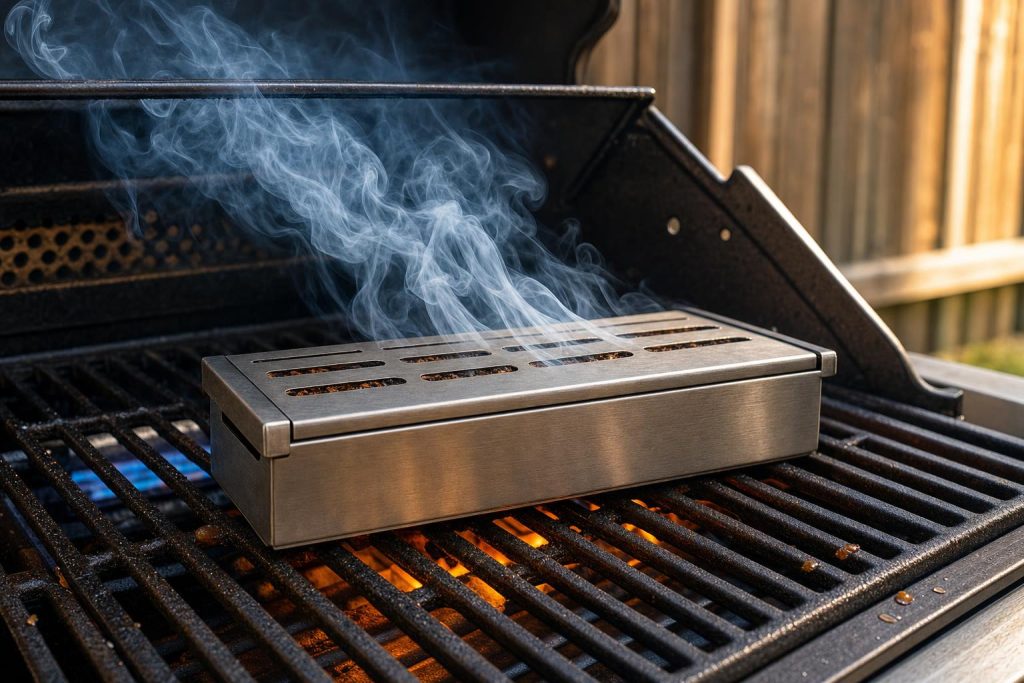
Here’s the honest problem with gas grills and smoke: the burners are too efficient. They blow through heat so fast that a handful of chips in a foil pouch turns to ash in eight minutes, long before your chicken thighs have absorbed anything worth tasting. I’ve been there, chasing smoke flavor on a propane setup, convinced I was doing something wrong. Turns out, most people are just using the wrong box — or no box at all. A good cast stainless or heavy-gauge steel smoker box slows combustion, extends your smoke window from a useless eight minutes to a genuine 30-45, and sits directly on your flavorizer bars without melting, warping, or dropping chips into the burner. That’s the whole job. This guide is based on actual cooks — not manufacturer spec sheets, not aggregated Amazon reviews — on a Weber Genesis II and a Char-Broil Performance 4-burner over the course of about six months. I’ll tell you what worked, what warped, and what to skip.
You’ll find fifteen “best smoker box” roundups online that all picked the same four products for the same vague reasons. This isn’t that. I’m going to give you a real verdict on four specific boxes — Cave Tools, GrillPro, Char-Broil’s own branded box, and the Weber Smoker Box — because those are the ones I actually own, have cooked on, and can describe in enough detail to be useful. Let’s get into it.
What a smoker box actually needs to do for you
Before the picks, here’s how I evaluated every box. These aren’t arbitrary categories — they came from failing at smoke flavor in specific ways and working backwards to the cause.
- Chip burn time: I loaded each box with the same measured cup of dry apple wood chips, placed them over the same burner set to medium-high (around 400°F lid temperature), and timed from first visible smoke to no smoke. Anything under 20 minutes is marginal. Thirty-plus is the target.
- Warp resistance after repeated high-heat cycles: Thin stamped steel warps, and a warped lid means chips spill or combust too fast. I ran each box through a minimum of 10 high-heat sessions before evaluating lid fit.
- Lid design and chip access: Hinged lids win. Lids you have to lift completely off with a grill tool while wearing gloves lose. Sounds minor, it isn’t.
- Footprint and placement flexibility: Some boxes are too tall to sit under flavorizer bars on certain grill configurations. I measured clearance on both test grills and noted which boxes required moving grates versus dropping in cleanly.
Our top pick: Cave Tools Smoker Box
Across 22 cooks including three spatchcocked chickens, a pork shoulder session that ran four hours with a relay of two boxes, and multiple shorter weeknight cooks, the Cave Tools box consistently outperformed the others on the single thing that matters most: burn time. Loaded with one cup of dry hickory chips, it held active smoke for 38 minutes at a grill temp of 375°F — almost double what I got from the Char-Broil box under identical conditions. The construction is 304 stainless, which you can verify by checking for the magnetic response (304 is non-magnetic; cheaper 430 stainless is magnetic and corrodes faster at high temps). The lid is hinged, not removable, which sounds like a small thing until you’re trying to add a second load of chips mid-cook with one hand holding tongs. The hinge doesn’t sag after repeated heat cycles — after my full 22-cook run, the lid still seats flush with no visible warping.
The footprint is slim enough to slide between flavorizer bars on my Weber Genesis without lifting the cooking grate. On the Char-Broil Performance, I did have to nudge one grate bar, but it took about four seconds. The perforated top lets smoke out in a distributed pattern rather than one stream, which seems to make a meaningful difference in how evenly the smoke contacts the meat. I’ve seen this box listed between $15 and $22 depending on the retailer, which makes it an easy call given the build quality. This is the one I’d buy again and the one I’m recommending first.
The runner-up: Weber Smoker Box
If you’re cooking on a Weber and want something designed specifically for the geometry of Weber flavorizer bar setups, the Weber Smoker Box is the obvious alternative. It’s a saddle-style box that straddles a single flavorizer bar rather than sitting flat, which puts the chips closer to the flame source and tends to produce smoke a little faster — good for shorter cooks where you want impact quickly. The tradeoff is capacity: it holds noticeably less than the Cave Tools box, so for longer cooks (anything over 90 minutes) you’ll need to reload. The lid design is a simple hinged flap, functional but not as refined as Cave Tools. Build quality is solid — Weber isn’t cutting corners on stainless gauge here — and after 12 cooks it showed no warping. I’d call this the right pick for Weber grill owners doing shorter smokes: burgers with smoke, chicken pieces, fish. For pork shoulders and long beef ribs, load two of them.
What to skip, and the honest case for GrillPro and Char-Broil
The GrillPro smoker box is the one you’ll see at hardware stores for around $10. It’s not terrible — the gauge is heavier than you’d expect at that price and it didn’t warp badly in my testing — but the removable lid is a real problem in practice. You need two hands to manage it, it traps heat when you pick it up, and twice during testing I dropped chips trying to reload mid-cook. The burn times were also shorter (averaging 24 minutes versus 38 for Cave Tools), likely because the lid fit isn’t tight enough to restrict airflow properly. If the Cave Tools box were $50 and this were $10, the GrillPro would make sense as a value call. Since the gap in actual price is closer to $8-10, I’d spend up. Buy the GrillPro if you truly cannot find the Cave Tools box locally and need something today.
The Char-Broil branded smoker box is the one I’d actively steer you away from. It’s thin stamped steel — not stainless — and after six high-heat cooks on my Char-Broil Performance grill (the scenario it’s literally designed for), the lid had a visible bow to it. That gap accelerates combustion and cuts your smoke time significantly. By cook eight, it was producing smoke for about 14 minutes per load. It’s cheap for a reason. Don’t base your purchase on brand loyalty to your grill manufacturer here.
Three mistakes gas-grill owners make with smoker boxes
- Soaking chips before loading: The old advice about soaking chips in water to extend smoke time doesn’t hold up. Wet chips spend the first 15-20 minutes steaming, not smoking. You get steam, then a shorter smoke burst, for a net loss in smoke contact time. Use dry chips.
- Placing the box over a burner that’s set too high: Maxing the burner under the smoker box causes chips to ignite rather than smolder, which produces acrid smoke instead of clean smoke. Medium heat under the box — enough to get it to 300°F surface temp — is the target. Keep your cooking zone at whatever temp you need independently.
- Only using one box for large cuts: A single box of chips will smoke for 30-40 minutes on a good day. A pork butt needs 4-6 hours of smoke to build a real bark. Plan to reload, or run two boxes simultaneously, or accept that the smoke penetration will be light. Light smoke is still worth doing — just set your expectations right.
FAQ
Can I get real smoke flavor from a gas grill with one of these boxes? Yes, but it’s different from offset or kettle smoke, and you should go in knowing that. A smoker box on a gas grill produces genuine wood smoke that affects flavor, bark formation, and aroma — but the smoke is more intermittent and you’re working against better air circulation than a closed ceramic or offset environment. The result is real, it’s just more subtle. For most gas-grill owners who aren’t ready to add a second cooker, a good smoker box is the right tool.
How often do I need to reload the box during a long cook? Plan on reloading every 30-45 minutes if you want continuous smoke, or load it up at the start and let it run out, then cook the rest of the way without smoke. The prevailing advice in competition circles is that most smoke penetration happens in the first 2-3 hours before the bark sets anyway — so front-loading your smoke is a legitimate strategy that saves you the hassle of mid-cook reloads.
Does the type of wood chip matter as much as the box? The wood species matters a lot for flavor profile — apple and cherry are mild and work well with poultry and pork, hickory is assertive and pairs with beef and ribs, mesquite is intense and best used sparingly. But the box determines how long and how cleanly those chips smoke, which is why a bad box makes every wood taste like ash. Get the box right first, then dial in your wood choice for the cook.