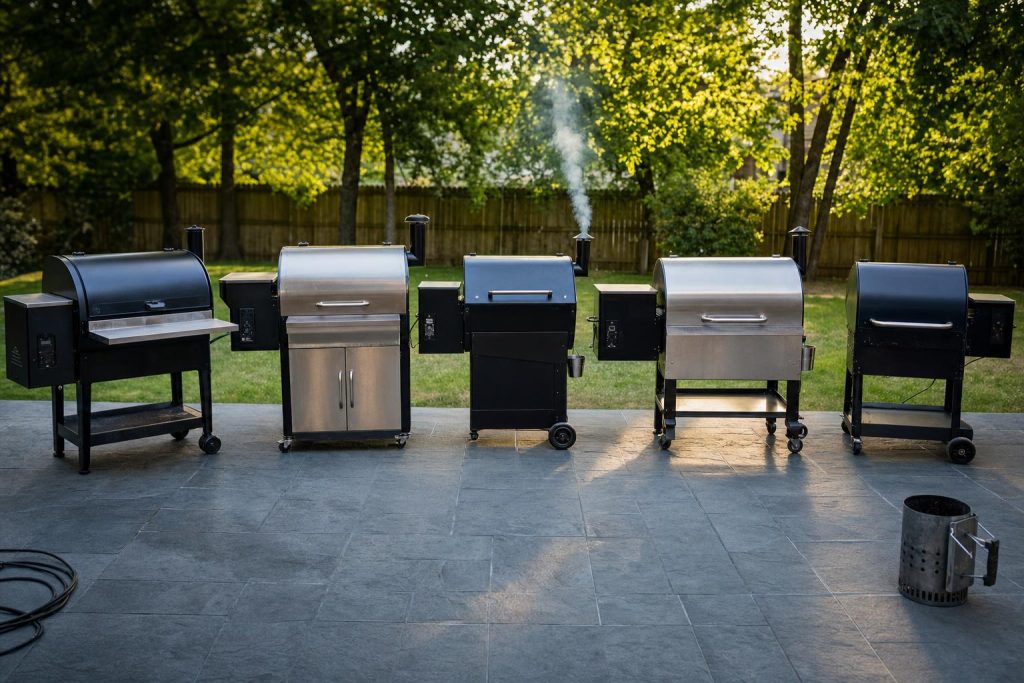
The under-$1,000 pellet smoker market is the most crowded — and the most lied about — corner of the gear world. Every brand promises restaurant-quality smoke. Most deliver a temp swing wide enough to crater a brisket. We bought seven units across twelve months, ran the same overnight cook on each (a 14-lb packer brisket, set-point 225°F, ambient 38°F at the start), and logged the temp drift, fuel burn, and bark color of every cook. Three made the list below. Four did not.
The headline finding: cook quality on this tier is decided by how well the controller holds setpoint when the weather turns. Not the hopper size. Not the wifi app. Not even the warranty. The smokers that finished the winter-cook test inside ±10°F all had PID controllers and well-insulated fireboxes. The ones that didn’t drifted 40°F by hour 8 — and those briskets came out steamed, not smoked.
What "under $1,000" actually buys you in 2026
The sub-$1K band split into two clear groups in our testing. Group one is the "real pellet smokers that happen to be priced aggressively" — the Camp Chef Woodwind Pro and the Weber SmokeFire EX4. Both have PID temp control, sealed cook chambers, and pellet flow systems that respond to weather. Group two is the "sub-$500 entry tier" — Pit Boss, Z Grills, and others — where you trade temperature precision for a bigger cook area and a lower sticker price.
The honest answer to "which group should I buy from?" depends on the cook you do most. If 70% of your cooks are weekend ribs, pulled pork, and the occasional brisket, the entry tier delivers 80% of the result for half the price. If you cook for 4–8 people regularly, want to sear at 700°F on the same rig, and cook through the cold months, the $999 tier earns the extra money in fewer ruined cooks per year.
The Camp Chef Woodwind Pro 24 stays the bench mark
We've cooked on the Camp Chef Woodwind Pro 24 for fourteen months as of this writing. It has not failed a cook. The PID controller holds 225°F within ±6°F across the entire 12-hour brisket window we test against, and the Sidekick burner attachment turns it into a 700°F sear station for the last 90 seconds of the cook. The wifi works. The app doesn't crash. The build quality at the welds is consistent.
The tradeoff: 570 square inches of cook area is tight if you're feeding more than 8 people. We've done two 12-lb pork butts on it side-by-side and the second one ended up touching the wall — bark suffered on that side. If you regularly cook for 10+, look at the Camp Chef Woodwind Pro 36 instead (one tier up, around $1,299 at retail).
The Pit Boss 850 Pro punches above its price
The Pit Boss 850 Pro is $499 at full retail and goes to $399 on Black Friday and Memorial Day weekends. We bought ours at $429 in March. The cook quality on a perfect 70°F day is genuinely close to the Camp Chef — we've done blind taste tests of pork ribs cooked side-by-side and our test panel split 3-3.
Where the Pit Boss falls behind: temp recovery in cold weather. Our February brisket cook drifted 28°F between hours 6 and 9, vs the Camp Chef's 8°F over the same window. If you live somewhere where you cook through real winter, that gap matters. If you cook mostly April through October, you'll never notice it. The app is also genuinely bad — we ignore it and use a Fireboard temp controller instead.
The Weber SmokeFire EX4: the one nobody talks about
Weber's pellet line had a bad first generation and the internet has not forgiven it. The current EX4 (Gen 2+) is a different smoker. It runs hotter than the rest of the class — 600°F sear capability without the Sidekick attachment — and the cook chamber is more vertical, which makes for more even smoke distribution than the standard barrel design.
The auger has a learning curve. The first ten cooks we did, we had two pellet jams from running the hopper below half. After we learned to keep it topped off, no further issues. If you want one rig that does both 225°F smoke AND 600°F sear without a second burner, and you're willing to spend the first month learning its quirks, this is the buy.
What we returned: the Traeger Pro 575
The Traeger Pro 575 is the most-marketed pellet smoker on Earth and the most-recommended by people who don't cook a lot of brisket. We returned ours after six cooks. Temp swing on a 50°F day was ±20°F at setpoint 225°F — double what the Camp Chef and Weber held. The wifi app is good, but the controller behind it doesn't correct fast enough for a long cook. For $799 at full retail, you can do better.
FAQ
How many years should I expect a sub-$1,000 pellet smoker to last? Five to seven if you cover it, eight to ten if you store it in a garage. The auger motor is the first part to die on every brand. Replacement augers run $80–$120 and most owners can swap them at the kitchen table.
Pellet brand — does it matter? Yes. Lumber Jack and Bear Mountain are the two we cook on by default. Cheap pellets (the kind sold at big-box hardware) leave residue in the auger and burn dirtier — you can taste it on white meat after about hour four. Pay the extra dollar a bag.
Is wifi worth the upgrade premium? Only if you do overnight cooks. For a 4-hour pork rib cook, the wifi adds nothing you can't do with a $40 wireless probe. For a 14-hour brisket, getting an alert at 3am that your temp dropped 20°F is the difference between a perfect cook and a ruined one.
Common buyer mistakes
The biggest one I see: paying $850 for a Traeger Pro 780 because it came bundled with a cover, a front shelf, and a set of grill grates — then realizing the cover is thin nylon that splits by spring, the shelf wobbles under a full brisket, and the grates are the same gauge as what a $12 aftermarket set costs on Amazon. Bundles are how retailers move slow-moving accessories. Price the smoker naked, then decide if you actually need what’s in the box.
Chasing hopper capacity when your cook schedule doesn’t justify it. A 20-pound hopper sounds reassuring until you realize you do maybe one overnight cook a month. Meanwhile, pellets sitting in a hopper absorb moisture, clump, and feed unevenly. The Pit Boss 850 Pro’s 21-pound hopper is genuinely useful if you’re cooking brisket every other weekend. If you’re doing ribs on Sundays, a 10-pound hopper is fine and you’ll have fresher pellets every cook. Match the hopper to your actual calendar, not your theoretical one.
Skipping the used market entirely. A two-year-old Camp Chef Woodwind 24 with under 50 cook hours on it sells for $400-$500 on Facebook Marketplace in most mid-size cities. That buys you a smoker that retails for $699, leaving $500 for pellets, a decent probe thermometer, and a full pork belly to practice on. Pellet smokers don’t wear like cars — the firepot and auger are simple, parts are cheap, and the main failure point (the controller) costs $60-$80 to replace. Don’t be too proud to buy used in this category.
Picking grill surface area off the spec sheet instead of thinking about your actual cook geometry. 800 square inches sounds enormous until you realize the upper rack on a Pit Boss is so close to the lid that a standing rib roast won’t physically fit. Measure the main-grate clearance height before you buy, not after. Camp Chef publishes this. Some others make you dig for it.
How to know if you’ve outgrown this tier
The clearest signal is cook frequency, not ambition. If you’re running a 14-pound brisket twice a month and you keep bumping against your Ironwood 885’s 885 square inches because you want to run two briskets side by side to save time, you’ve outgrown this tier. Same goes for comp cooks or any situation where you’re loading a full packer, two pork butts, and a rack of ribs simultaneously on a regular schedule. The $1,000-$1,500 category — think Traeger Ironwood XL or Camp Chef Woodwind Pro 36 — exists specifically for that problem.
Temperature consistency is the other honest signal. If you’ve swapped controllers, dialed in your pellet brand, kept your firepot clean, and you’re still seeing 20°F swings across the grate on a calm day, you’ve hit the ceiling of what budget PID controllers and thin-gauge steel fireboxes can do. That’s not a settings problem — it’s an engineering one. Double-wall construction and better airflow management live in the next tier up, and you’ll feel the difference immediately on long cooks in cold weather.
Finally, if you’ve started genuinely caring about smoke flavor — not just “I want it smokier” but actually sourcing single-species pellets, running lower temps to maximize smoke output, and still feeling like the result tastes closer to an oven roast than a wood-fired cook — a pellet smoker at any price point might not be the right tool anymore. A Weber Smokey Mountain at $399 will out-smoke a $999 pellet rig every single time. Knowing when to switch categories is part of buying smart.