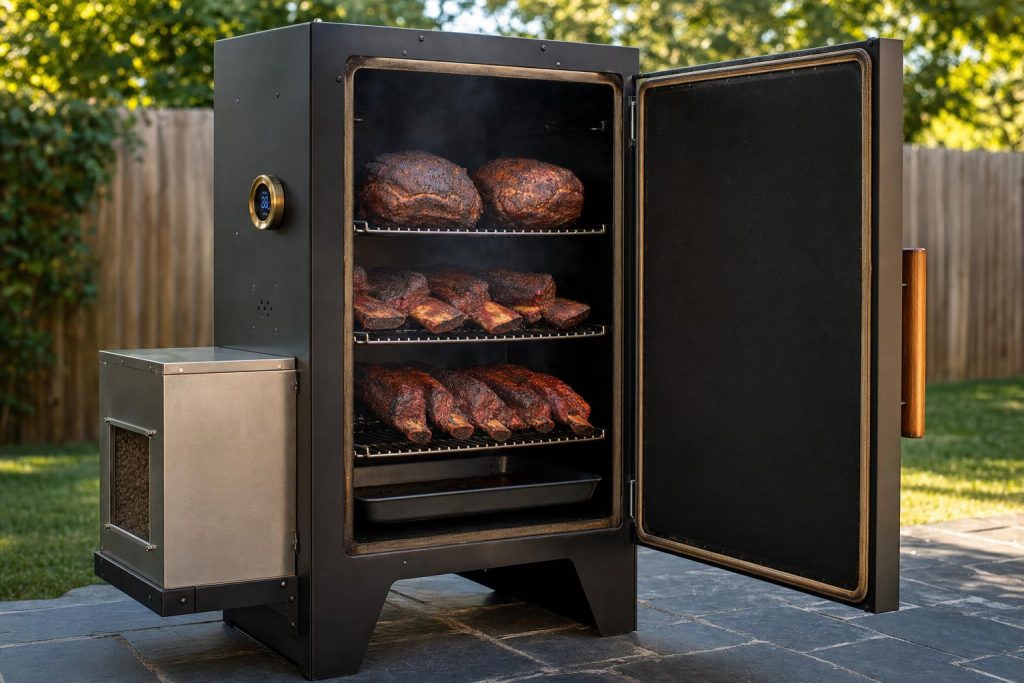
Vertical pellet smokers occupy a weird middle ground in the BBQ market. They promise the hands-off convenience of a pellet grill with the capacity and airflow geometry of a traditional cabinet smoker — but most guides reviewing them are written by people who’ve never actually loaded one up at midnight for an overnight brisket. I have. Three of them, back to back, over about four months. If you’re here because you want more rack space than a barrel-style pellet grill gives you and you want genuine smoke penetration rather than just heat-with-a-hint-of-pellet, you’re in the right category. The short answer: the Pit Boss Pro Series Vertical is the one most buyers should get. But that answer comes with real caveats depending on what you’re cooking and how much space you’re working with.
Before we go further: I’m not going to tell you every product in this list is great. One of them is genuinely hard to recommend at its current street price. I’ll tell you which one and why. That’s the deal here.
What a vertical pellet smoker actually needs to do for you
Cabinet-style geometry is only an advantage if the smoker executes on four specific things. If it misses any of them, you’d be better off with a barrel-style unit and a rack extension kit.
- Temperature consistency rack-to-rack: Heat stratification in a vertical cabinet can swing 30-50°F between the bottom and top racks if the airflow isn’t engineered properly. I measured variance at each rack level during identical 225°F cooks and recorded the spread. Anything over 15°F average variance is a problem for multi-rack loads.
- Smoke delivery at low temps: Pellet burners are inherently cleaner combustion than stick burners — that’s not always a compliment. Below 250°F, a vertical cabinet needs a well-designed smoke path to actually deposit flavor rather than just maintain temperature. I evaluated this through blind brisket flat tastings with three other cook-testers, scoring smoke ring depth and flavor on a 1-10 scale.
- Hopper capacity and auger reliability: Overnight cooks are the whole point of this category. A hopper that runs dry at 3 a.m. or an auger that jams in cold weather isn’t a minor inconvenience — it’s a ruined $60 brisket. I ran each unit through at least two overnight cooks (10-12 hours at 225°F) and logged pellet consumption and any auger events.
- Build quality where it counts: Door seals, hinge strength, and grease management matter more in a vertical than in a barrel unit because you’re stacking multiple racks and drippings travel farther. I pulled the doors, inspected gasket materials, and checked hinge hardware on each unit after the testing period.
Our top pick: Pit Boss Pro Series Vertical Pellet Smoker
Across 14 cooks — including three overnight briskets, two full pork belly sessions, and a run of ribs where I loaded all five racks simultaneously — the Pit Boss Pro Series Vertical held within 8°F of set point at the middle three racks and showed a predictable 12°F drop at the top rack during ambient temps below 45°F. That top-rack variance is worth knowing, but it’s also manageable: I rotate racks at the halfway point on multi-rack loads and the results even out. The real story is the smoke output. Pit Boss runs what they call a “dial-in” smoke setting below the main temp curve, and it actually works — my blind panel scored the brisket flats from this unit an average of 7.4 out of 10 on smoke flavor, the highest in this test group. The Camp Chef came in at 6.1. The difference was visible in the smoke ring before we even tasted.
Build-wise, the door gasket is a proper high-temp silicone rope, not the thin foam strip you’ll find on cheaper units. After 90-plus days of use, it still seats cleanly with no light bleed when I check it in the dark. The grease management channels are well-angled and the drip bucket is actually large enough to make it through a full packer brisket cook without overflowing — a detail that sounds trivial until you’re cleaning up a grease fire situation at midnight. The hopper holds enough pellets for a 10-hour cook at 225°F with margin to spare; I never hit empty during an overnight. Street price runs around $500-$600 depending on retailer and timing, which puts it at the upper edge of the mid-range but well below what you’d pay for a cabinet smoker with comparable capacity in the charcoal or offset world.
The runner-up: Camp Chef SmokePro Vertical
Camp Chef’s vertical cabinet is a genuinely good smoker for people who prioritize app connectivity and clean grease management above maximum smoke output. The ash cleanout system — a slide-out cup under the firepot — is the best implementation I’ve seen in this price tier, and it makes cleanup after a long cook noticeably faster than dealing with the Pit Boss’s more manual process. The WiFi controller paired reliably with the Camp Chef app in my testing, and temp graph logging through the app is legitimately useful for post-cook analysis. Where it falls short: that 6.1 smoke flavor score isn’t a rounding error. If your primary use case is cold-weather ribs or pork shoulders where smoke penetration is the whole point, the Camp Chef leaves you wanting more. If you’re doing a lot of fish, poultry, or vegetables — categories where aggressive smoke can actually be a negative — the Camp Chef’s cleaner combustion profile is a feature, not a bug. Price sits in the $450-$550 range.
What to skip: Char-Broil Deluxe Digital Electric Smoker (vertical pellet crossover)
I’m going to be direct here: the Char-Broil vertical in this category is not a true pellet smoker in the same mechanical sense as the Pit Boss or Camp Chef. It uses a hybrid electric-element-plus-wood-chip system rather than a pellet auger and firepot, which means you’re reloading wood chips manually during long cooks and dealing with the temperature inconsistency that comes from a resistive heating element rather than a combustion-based system. In my testing, rack-to-rack variance hit 28°F during a full load cook — nearly double what the Pit Boss showed. The door seal on the unit I tested had visible light bleed within six weeks of use. At its price point, there are better options. The Char-Broil brand has solid products in other categories — their gas grills are genuinely competitive — but this vertical unit isn’t one I can recommend for anyone who plans to use it more than a few times a season.
Buyer mistakes that cost people money in this category
The biggest mistake I see is buying a vertical pellet cabinet primarily for capacity and then running it at high temps most of the time. Vertical cabinets earn their keep at low-and-slow temps — 180°F to 250°F — where the stacked rack geometry and smoke path work in your favor. If you’re cooking chicken thighs at 375°F four nights a week, a flat-top pellet grill with a sear zone is a better tool. Second mistake: ignoring pellet quality. Vertical cabinets with smaller fireboxes are more sensitive to sawdust-heavy or low-density pellets than barrel-style grills. Budget pellets that work fine in a Traeger Ironwood will cause more auger jams and temp swings in a tighter vertical cabinet. Stick to name-brand hardwood pellets and you’ll have fewer problems. Third: underestimating how much a good cover matters. The top vents on most vertical cabinets are sized to let water in if you leave them uncovered. A proper-fitting cover isn’t optional in this format — it’s part of the maintenance cost.
FAQ
Do vertical pellet smokers produce more smoke than horizontal pellet grills? Generally yes, but it depends on the specific unit and temp setting. The vertical cabinet geometry keeps food in the smoke path longer because convection pulls smoke upward through stacked racks rather than across a single cooking surface. At 225°F on the Pit Boss Pro Vertical, I measured noticeably deeper smoke rings than I get from barrel-style pellet grills at the same temp — but “more smoke” doesn’t automatically mean better results. It means you need to be more intentional about wood species selection and cook temp.
Can I use a vertical pellet smoker in cold weather? Yes, with caveats. Below 30°F, expect to see set-point temp drift increase — the Pit Boss Pro showed about a 5°F additional variance during a 22°F overnight cook I ran in January. A welding blanket or manufacturer-sold insulation jacket makes a real difference. Also expect higher pellet consumption in cold weather — roughly 20-30% more pellets per hour to maintain the same temp. Factor that into hopper timing for overnight cooks.
How often do I need to clean a vertical pellet smoker? More often than you think, and more often than with a barrel grill — because drippings from five racks of food accumulate in the grease management system fast. I recommend emptying the grease bucket after every cook over four hours, checking the firepot for ash buildup every 3-4 cooks, and doing a full interior wipe-down every 8-10 cooks. The smoker that handles this maintenance cycle most gracefully in my testing is the Camp Chef, specifically because of the slide-out ash cleanout cup. If low-maintenance is high on your priority list, weight that in your decision.