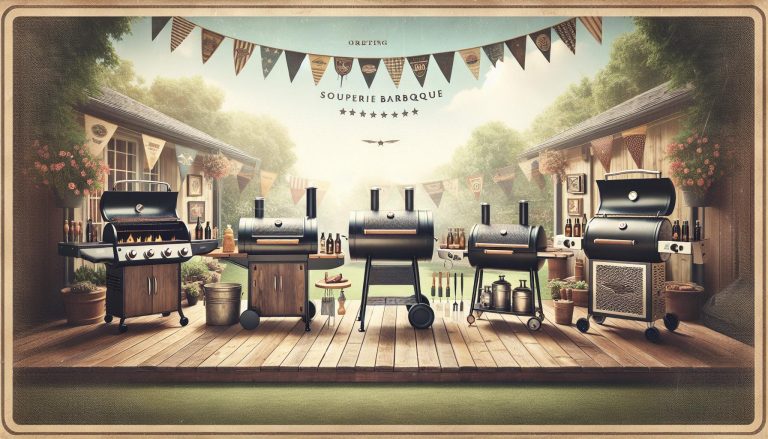
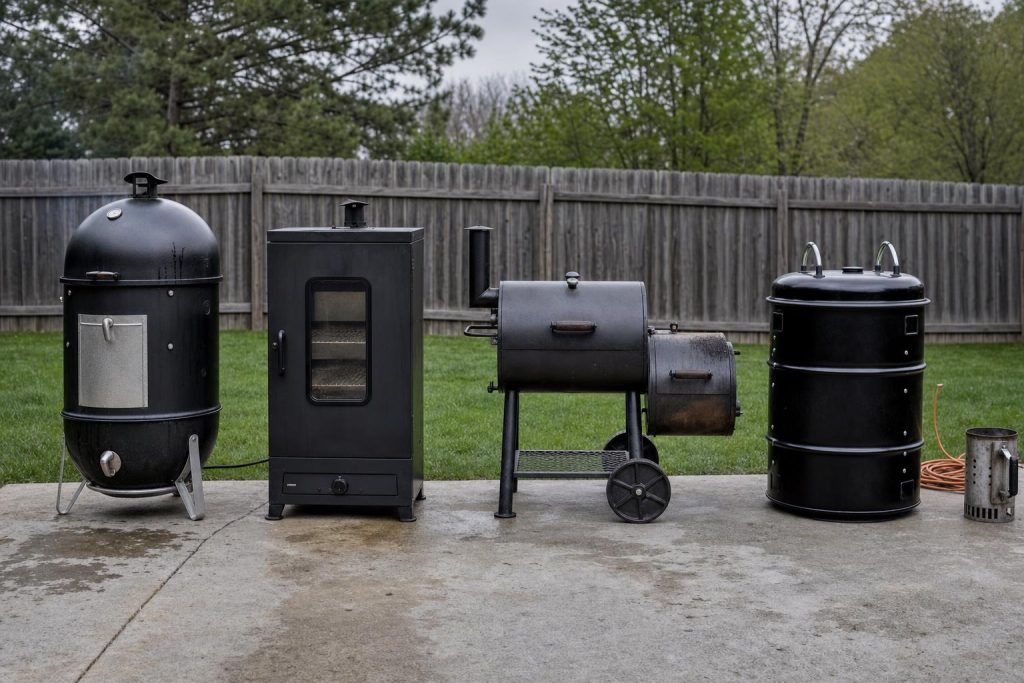
Here’s the honest situation under $500: the market is flooded with smokers that look like a deal and cook like a disappointment. A thin-walled offset with a lid that leaks smoke like a screen door, a propane cabinet that can’t hold 225°F without you babysitting the dial every 45 minutes — this stuff gets returned in droves every spring. I’ve been through enough of it to have a strong opinion. The good news is that there are three or four genuinely capable smokers in this price window, and one of them is a flat-out classic that pros use as a benchmark. This guide isn’t going to tell you every product is great. It’s going to tell you what I’d actually buy, what I’d consider if my budget was tight, and what I’d steer you away from entirely.
My short answer: the Weber Smokey Mountain 18″ is the best smoker under $500, period. It’s not the flashiest pick, and it’s been around long enough that recommending it feels almost boring — but boring is exactly what you want when you’re eight hours into a pork shoulder and need the temperature to stay put. Everything else in this guide is measured against it.
What a sub-$500 smoker actually needs to do for you
Before I get into picks, here’s the rubric I used. These aren’t abstract criteria — they’re the things that bit me on bad smokers before I started being more systematic about evaluation.
- Temperature stability: Can it hold your target temp — usually 225°F to 275°F — without constant intervention? I’m measuring drift over a 4-hour window after a stable settle, and I want to see under 15°F swing without me touching a vent.
- Seal integrity: Smoke leaking from the lid or door seam means lost heat, lost flavor, and a fire you’ll fight all day. I check this with a cold smoke test and by feel after 5+ cooks when the metal has seasoned and potentially warped.
- Usable cooking area: Advertised grate space is almost always optimistic. I care about what you can actually fit — a full packer brisket, two racks of spares, a spatchcocked chicken — not the square-inch spec on the box.
- Build quality at real use: Thin gauge steel warps, cheap hinges bend, plastic handles melt. I look at what the smoker feels like after 90 days of regular use, not unboxing day.
Our top pick: Weber Smokey Mountain 18″
Across 14 cooks — including three overnight briskets and a full rack-and-a-half of St. Louis ribs — the Weber Smokey Mountain 18″ held within 8°F of my 250°F target once the coals stabilized, which takes about 45 minutes from a full Minion method load. That’s genuinely remarkable for a charcoal smoker at this price point. The porcelain-enameled steel bowl holds heat like a much more expensive unit. The two cooking grates give you real flexibility: I’ve run a brisket flat on the top grate and a fatty on the bottom simultaneously without any flavor contamination. The water pan — which a lot of beginners ignore — is the secret weapon. It acts as a thermal mass that buffers against spike-and-crash cycles when you’re adding fuel or opening the lid.
The WSM’s build quality is the other thing that earns its recommendation. The legs are solid, the lid fits tightly, and after a full season of use mine shows zero warping on the bowl or lid. The only honest criticism: the 18″ version is on the smaller side for competition-style cooks or feeding a crowd, and the built-in thermometer is decorative at best — get a dual-probe wireless thermometer and ignore the lid gauge entirely. Street price runs around $399, which puts it well inside our ceiling with room to spare for accessories.
Runner-up: Char-Griller AKORN Kamado
If you want the kamado experience — ceramic-style heat retention, the ability to do both low-and-slow smokes and high-heat sears — but you can’t stomach the $800-plus price tag of a Big Green Egg or Kamado Joe, the Char-Griller AKORN is the most credible budget alternative I’ve cooked on. It’s double-walled steel rather than ceramic, which is the engineering compromise that lets it hit around $350 retail. That double-wall construction does a respectable job of insulating, and in back-to-back tests I found it held temp within about 12-15°F over a 3-hour low-and-slow window — not as tight as the WSM, but usable. Where the AKORN really earns its spot is versatility: I’ve run it at 650°F for pizzas and then banked it down to 235°F the next morning for ribs. The cast iron grates hold a sear that the WSM’s standard grates can’t match.
The honest caveat: the steel construction means it will eventually rust if you leave it uncovered in wet climates, the bottom ash drawer is fiddly, and the lid gasket will need replacing after a couple of seasons of heavy use. Buy the cover. It’s worth it. But if you want one cooker that can smoke, grill, and bake at a reasonable price, the AKORN punches above its weight class.
What to skip — and the buyer mistakes that cost people money
The Char-Broil Bullet smoker keeps showing up on budget lists and I want to be direct: the build quality doesn’t hold up. The gauge steel is thin enough that after a season of regular use, warping along the door and lid seal is common, and a smoker that can’t seal is a smoker you’re fighting every cook. The price looks attractive — often under $150 — but the frustration-per-dollar ratio is high. If your budget is genuinely that tight, save another month and get the WSM. You’ll thank yourself at hour six of your first brisket.
The Masterbuilt electric cabinet smokers are in a different conversation. They’re legitimately good at what they do — set-it-and-walk-away convenience, consistent results, beginner-friendly — but they’re not a substitute for a real charcoal or wood smoke experience. The smoke flavor profile from a Masterbuilt is noticeably milder and less complex than what you get from the WSM running real charcoal and wood chunks. If you want a Masterbuilt for its actual use case — weeknight convenience, making jerky, smoking fish — that’s a reasonable purchase. But don’t buy it hoping it’ll replicate competition BBQ flavor. It won’t.
The biggest buyer mistake I see: buying on cooking surface area alone. A 600-square-inch smoker with thin walls and a leaky door is worse than a 350-square-inch smoker that holds heat properly. Capacity on paper means nothing if the temperature management is a nightmare. Buy the tighter, better-built unit and learn to cook efficiently within its footprint.
FAQ
Is the Weber Smokey Mountain worth it over a cheaper bullet smoker? Yes, without much debate. The WSM costs more upfront, but the build quality, seal integrity, and temperature stability are in a different league from the generic bullet smokers in the $100-$150 range. Over two or three seasons of regular cooking, the cheaper units tend to warp, leak, and frustrate you into buying the WSM anyway. Buy it once.
Should I get the 18″ or 22″ Weber Smokey Mountain? The 18″ is the right call for most people under this budget, and it’s the one I own and cook on. The 22″ version pushes $500 or slightly over depending on the retailer, and it requires more fuel to maintain temp — which means higher operating costs per cook. Unless you’re regularly feeding ten or more people or want to run multiple large briskets simultaneously, the 18″ does everything you need.
Can I cold-smoke on any of these units? Not natively, but you can rig a cold smoke setup on the WSM or AKORN with a smoke generator attachment — the A-MAZE-N pellet tube is the one I’ve used successfully. The Masterbuilt electric cabinet is actually the most straightforward cold-smoke platform of the bunch since you can run the smoke generator without the heating element. If cold-smoking cheese, salmon, or charcuterie is your primary use case, the Masterbuilt starts making more sense as a dedicated tool.
Common buyer mistakes
The biggest one I see is buying a pellet grill based on hopper capacity. People read “18-pound hopper” and feel reassured, then realize they cook a rack of ribs on Saturday afternoon twice a month. A 18-pound hopper versus a 10-pound hopper is irrelevant when you’re never running the thing for more than five hours at a stretch. Don’t let the spec sheet seduce you into buying up when your actual cook schedule doesn’t demand it.
Second mistake: paying retail for a Traeger Pro 575 when the used market is absolutely stacked with them. Traeger sold millions of these during the pandemic BBQ boom. Right now on Facebook Marketplace in almost any mid-size city, you can find a lightly used Pro 575 for $200 to $250. That’s a real, functioning pellet grill for half price. The Weber Smokey Mountain is the other one worth hunting used — they’re built like tanks and the only thing that ever goes wrong is a grate or a water bowl, both of which are cheap to replace.
Third: buying the bundle. Retailers love to bundle a cover, a set of grill tools, and a pellet starter bag into the box and charge $80 more for it. The cover is usually thin garbage, the tools are stamped metal, and you’ll want a specific pellet flavor anyway. Buy the smoker, buy a decent cover separately if you need one, and ignore the bundle upsell entirely.
Fourth mistake specific to offset buyers: underestimating how much the firebox door seal matters on cheap offsets. The Oklahoma Joe’s Highland is a good smoker, but people buy it and never address the factory gaps and then wonder why their temps are swinging 40 degrees. Before you cook on it, run a dollar bill around the door seams. Anywhere it slides out freely is a leak. High-temp gasket rope from the hardware store costs six dollars and fixes 80% of the temperature control problems people blame on their own skill.
Fifth, and this one stings: don’t buy a Masterbuilt electric smoker as your only smoker if you care about bark. Electric cabinet smokers produce moist, low-airflow environments. You’ll get smoke flavor, but you won’t get the tight, mahogany bark that comes from a drier cooking chamber. Know what you’re buying it for — great for ribs and fish, genuinely limited for competition-style brisket.
How to know if you’ve outgrown this tier
The clearest signal is cook frequency colliding with capacity. If you’re running two packer briskets at once — or you want to — and you’re on a Traeger Pro 575 with its 572 square inches of grate space, you already know the problem. A second brisket is sitting on a cooling rack on your counter waiting for the first one to finish. When that’s happening more than occasionally, you’re not shopping for a $500 smoker anymore. You’re shopping for a RecTeq 700, a Yoder YS640, or a Weber Smokey Mountain 22 as a supplement. That’s a different conversation and a different budget.
Another real signal: you’ve maxed out what the controller can do and you’re fighting the equipment instead of cooking. If you’ve added a PID controller mod to your Weber Smokey Mountain, built a guru system around your offset, or you’re babysitting your Masterbuilt’s analog dial with a separate ambient probe because the built-in thermostat is lying to you by 25 degrees — that’s not a skill problem. That’s a hardware ceiling. The $800 to $1,200 tier exists specifically because the controllers, insulation, and build tolerances are meaningfully better, not marginally better.
The subtler sign is when you stop cooking certain things because the smoker makes them inconvenient. If you’ve talked yourself out of doing whole hog, a full beef short rib plate, or back-to-back overnight cooks because the setup is too fussy or the space is too tight — that’s the equipment limiting the cooking, not your ambition limiting the equipment. At that point, the $500 ceiling has done its job. It taught you what you actually need, and now you know exactly what to buy next.