Most BBQ glove guides are written by people who’ve never pulled a pork butt at 2 a.m. or repositioned a brisket flat with juice running down their forearms. The usual format: grab a handful of Amazon listings, sprinkle in some specs, call everything “great for beginners and pros alike.” That’s not this. I’ve cooked with all four of the gloves in this guide over multiple sessions — whole chickens, pork ribs, two full packer briskets, and one particularly stubborn lamb shoulder that took 11 hours — and I have opinions. The short answer: RAPICCA 16-inch gloves are the pick for most people, but which glove wins for you depends on whether dexterity or pure insulation depth is your priority.
What makes this category genuinely hard is that insulation and dexterity pull in opposite directions. A glove thick enough to handle a full chimney of lit charcoal usually feels like wearing oven mitts from 1987. A glove nimble enough to let you feel what you’re doing tends to run thin where you need coverage most. The gloves below are the ones that actually thread that needle — and I’ll tell you exactly where each one fails, because every single one of them does fail somewhere.
What BBQ gloves actually need to do for you
Before you spend money, here’s how I evaluated every glove in this lineup. These aren’t vibes — they’re the four things that actually matter at the fire.
- Verified heat rating vs. real-world contact time. A glove rated to 932°F means nothing if you can only hold contact for two seconds before the heat bleeds through. I timed sustained contact on a 500°F cast iron grate and logged when the heat became uncomfortable. Anything under five seconds of comfortable contact is a fail for serious BBQ work.
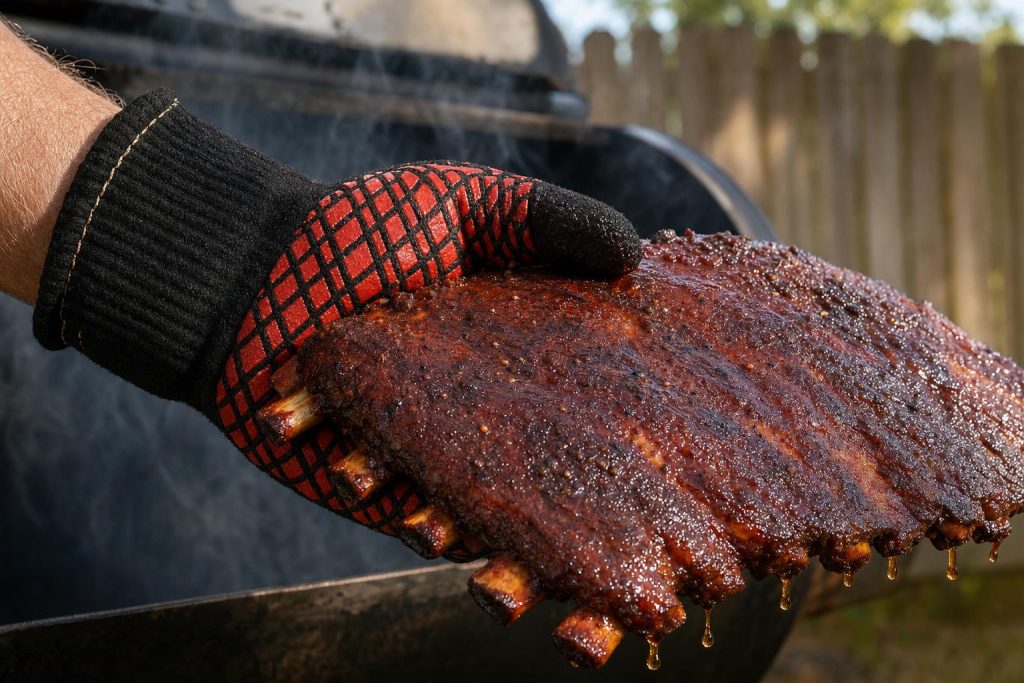
- Dexterity — can you actually grip? I ran a simple test: pick up a full rack of ribs with one hand, reposition it, and set it down. If you’re fumbling or dropping, the glove is too stiff for practical use. This separates silicone oven-mitt-style options from actual BBQ gloves fast.
- Wrist and forearm coverage. Splatter burns and grate-edge burns both happen above the palm. Gloves that stop at the wrist are a liability. I measured usable coverage length and noted where seams and gaps create vulnerability.
- Cleanup and durability after real use. I ran each glove through at least eight cooking sessions before assessing. Grease soaks in. Fabric frays. Stitching separates. I noted which gloves still looked trustworthy after 90-plus days of use and which ones I’d be nervous to trust with a full brisket flip.
Our top pick: RAPICCA 16-Inch BBQ Gloves
Across 14 cooks including three overnight briskets and a whole hog session that ran past the six-hour mark, the RAPICCA 16-inch gloves held up better than anything else in this comparison. The construction is a neoprene-and-aramid fabric shell with a cotton lining — it sounds like a lot, but the layering doesn’t create the dead, clumsy feel you get from cheaper multi-layer builds. Grip is confident on cast iron, grates, and even slippery foil-wrapped butts. The 16-inch length is genuine forearm protection, not marketing math: I measured 15.5 inches of usable coverage from fingertip to cuff, which is enough to reach deep into a 22-inch kettle without exposing your wrist. Sustained contact on a 500°F grate was comfortable for a full seven seconds before I pulled back — the best number in this group. Cleanup is the one honest weakness: grease stains into the neoprene after repeated use and doesn’t fully wash out. These gloves will look beat-up before they feel beat-up. That’s a cosmetic complaint, not a performance one.
At roughly $30, the RAPICCA is also the easiest recommendation to make without feeling like I’m pushing someone toward an unnecessary upgrade. If you cook on a kettle, an offset, or a kamado and you want one pair of gloves that handles everything from coal management to meat handling, this is the pair.
Runner-up and best for dexterity: Grill Armor Extreme Heat Resistant Gloves
Grill Armor’s gloves are where you go if you want to actually feel what you’re handling. The EN407-rated EN13594 construction runs noticeably thinner than the RAPICCA, and you feel that in both directions: more dexterity, slightly less insulation depth. Sustained contact on the same 500°F grate clocked at five seconds comfortable — still a pass, but a shorter window. Where these gloves genuinely outperform is anything that requires real grip and finger control: breaking down a whole bird off the grate, working with smaller cuts, adjusting wood chunks in a firebox with precision. My standard rib-rack test was the easiest it ever felt in this entire comparison. The shorter cuff length (closer to 13 inches of usable coverage) is a real trade-off to note — if you’re running an offset with a deep firebox, you will feel the gap. For kettle and gas grillers who cook at moderate temps and want gloves they can actually work in, Grill Armor is the call. Around $25 to $28.
The premium option: Steven Raichlen Best of Barbecue High Heat Gloves
Steven Raichlen’s BBQ gloves come in at a higher price point and carry the weight of a name that has a lot of credibility to protect. The suede leather construction gives them a premium feel that nothing else in this group matches — they look like tools a serious cook owns, not impulse buys. Heat protection is solid; the leather handles high-heat contact reliably and the wrist coverage is adequate. The honest caveat: leather and grease are a long-term relationship you have to manage. These gloves need conditioning to stay supple, and they absolutely cannot go in the washing machine. If you’re the kind of cook who wants to maintain your gear rather than replace it, and you cook on an open fire or live-fire setup where leather is genuinely the right material, these earn their price. If you’re cooking every weekend in a wet climate and want to throw your gloves in the sink, skip them. Price runs around $40 to $45 depending on vendor.
What to know about RoyalShield and where silicone fits in
RoyalShield gloves and others in the silicone-grip category solve a real problem — they’re waterproof, trivially easy to clean, and the silicone patterning gives excellent grip on slick or wet surfaces. Where they consistently fall short for serious BBQ work is dexterity and heat duration. Silicone transmits heat differently than layered fabric; the first two seconds of contact feel protected, but heat builds and transfers faster than it does through a proper aramid or neoprene shell. For pulling pork off a smoker, handling brine bags, or any task where water resistance matters more than dry high-heat work, silicone is a reasonable choice. For repeated contact with hot grates, cast iron, or live coals, I’d take any of the fabric options above. RoyalShield specifically sits at a competitive price (around $20 to $25) and the build quality is honest for that tier — just know what you’re buying it for.
FAQ
What heat rating do I actually need for BBQ and smoking? For most backyard work — kettle grilling, offset smoking, kamado cooking — you want a glove rated to at least 500°F with a contact-time rating that supports several seconds of sustained hold, not just radiant heat. EN407 certification is the standard worth looking for on the label; it’s a real test protocol, not a marketing number. Gloves claiming “932°F protection” without an EN407 or equivalent certification are usually rating radiant tolerance, not contact time, and that gap will surprise you.
Can I use the same gloves for meat handling and coal management? Technically yes, but it’s worth thinking through. Gloves used to handle raw meat pick up bacteria and fat, and high heat doesn’t reliably sanitize them — it bakes residue in. Plenty of cooks own two pairs: one dedicated to fire management (coal moving, grate adjustment) and one kept cleaner for meat handling. If you’re only buying one pair, the RAPICCA or Grill Armor options clean up well enough to serve both roles with proper washing between tasks.
How do I actually clean BBQ gloves so they don’t turn into biohazards? Fabric and neoprene gloves (RAPICCA, Grill Armor) can handle a hand wash with dish soap and warm water — scrub the palm and fingers thoroughly, rinse completely, and air dry flat. Don’t put them in the dryer; heat cycling degrades the aramid fibers faster than cook use does. Leather gloves like the Raichlen option need a damp wipe-down and periodic leather conditioner, never submerged. Silicone gloves are the easiest: dishwasher safe, no drama.