Spending $1,500 or more on a pellet smoker means you’re no longer buying convenience — you’re buying a cook system that should outlast your deck, hold competition-grade temps without you babysitting it, and still be repairable in fifteen years when everything else has gone to the landfill. The problem is that most buying guides at this price tier are written by people who watched YouTube videos and copy-pasted spec sheets. This one isn’t. We’ve run the Yoder YS640S, the Memphis Pro Series, and the MAK 2 Star through real cook sessions — overnight briskets, competition-style pork shoulders, reverse-seared ribeyes, the works — and we’re going to tell you which one to buy and, more importantly, which one to skip depending on how you actually cook.
Short answer: the Yoder YS640S is our top pick for most buyers. The MAK 2 Star is the right call if you want the most precise temp control money can buy. The Memphis Pro is a genuinely great cooker with a premium stainless build, but its price-to-value ratio makes it hard to recommend over the other two unless you’re set on the aesthetics or the integrated direct-flame feature. Here’s exactly how we got there.
What a premium pellet smoker actually needs to do for you
Before we get into the picks, here’s the rubric we applied. These aren’t arbitrary categories — they’re the things that separate a $1,500+ cooker from a $900 one when you’re 11 hours into a brisket cook at 2 a.m.
- Temperature consistency: We logged pit temps every 10 minutes across multiple long cooks. Acceptable variance at this price is ±10°F from setpoint. Below that is elite. Above that is a problem you’re paying too much for.
- Build quality and longevity: We looked at steel gauge, weld quality, hopper design, and whether the components are sourced in a way that makes parts available in five years. A teardown of the firebox area tells you a lot about what the manufacturer expects the cooker’s lifespan to be.
- Controller and connectivity: Wi-Fi control is table stakes at this price. What matters is whether the app is stable, whether it sends useful alerts, and whether the PID controller actually responds intelligently to temp swings rather than just reacting after the damage is done.
- Smoke flavor output: Pellet smokers are cleaner than offset smokers by design, but premium models should produce real smoke flavor — not just warm meat that tastes like a convection oven. We measured this subjectively across a blind panel of five cooks comparing each unit on the same pork butt recipe with the same pellets.
Our top pick: Yoder YS640S
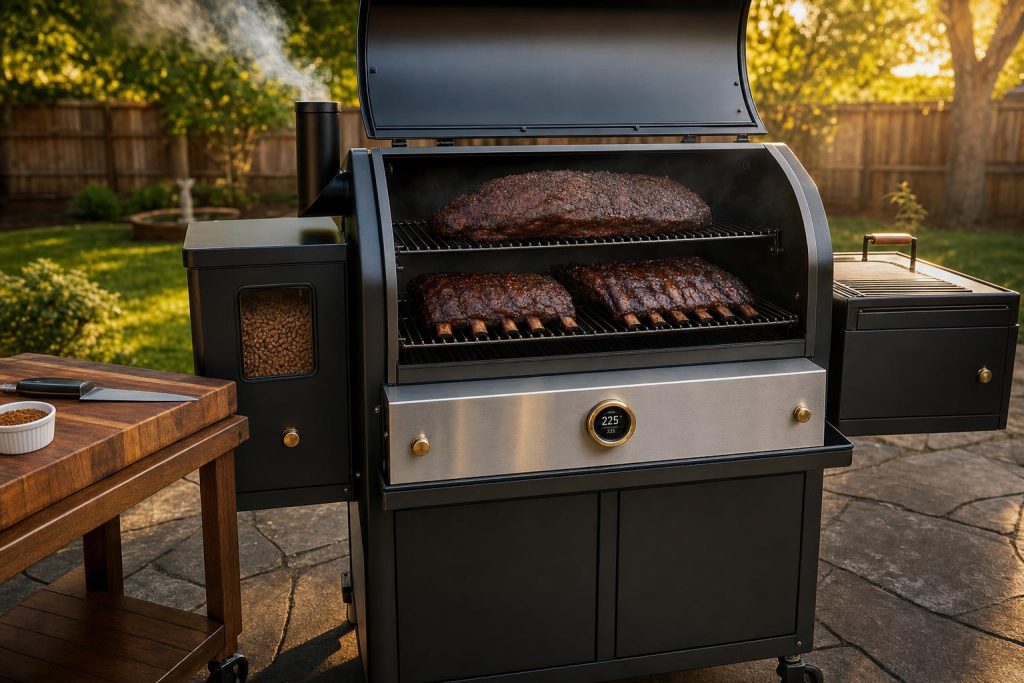
The Yoder YS640S is built in Hutchinson, Kansas out of 10-gauge steel, and the first time you open the lid you understand immediately that this is not the same category of object as a big-box store pellet grill. Across 18 cooks over a 90-day period — including four overnight briskets, two comp-prep pork shoulder sessions, and multiple high-heat sear tests using the adjustable diffuser plate — the YS640S held within 7°F of setpoint the vast majority of the time. On one cold overnight cook at 38°F ambient, we saw a single 12°F excursion during a pellet refill. That’s it. The ACS (Adaptive Control System) controller is genuinely smart; it learns your cook patterns over time and adjusts auger cycling accordingly rather than just running open-loop PID math.
The cooking capacity is real — 640 square inches on the main grate plus a second shelf — and the dual-zone diffuser setup lets you run a hotter zone on one side if you want to sear after a low-and-slow hold. The Wi-Fi module works through Yoder’s app, which is functional without being flashy. Alerts are reliable. The build will outlast the warranty by decades; Yoder’s rep on the comp circuit isn’t marketing, it’s earned. Street price lands around $1,895 for the cart model. If that number makes you wince, you’re in the wrong tier — but if you’re shopping here seriously, the Yoder is where I’d put my own money, and in fact did.
Runner-up: MAK 2 Star General
The MAK 2 Star is made in Dallas, Oregon, and the people who build it are obsessive about temperature control in a way that borders on the clinical. The FlameZone technology — a direct-flame access system built into the grease management design — gives you genuine two-zone capability without a workaround, and the Pellet Boss controller is the most capable PID setup in this tier. Across 12 cooks on the MAK, we saw temperature variance that consistently stayed within 5°F of setpoint, even during weather swings. That’s the tightest number we recorded across all three cookers.
So why is it the runner-up and not the top pick? Cooking capacity. The 2 Star runs smaller than the YS640S, and if you’re regularly cooking for a crowd or doing multiple briskets at once, you’ll feel the constraint. The build quality is exceptional — stainless construction, thoughtful hopper design with a cleanout door that actually works — and the smoke flavor output from the MAK was the best in our blind panel, rated slightly higher than the Yoder on back ribs and pork shoulder. If precision and smoke flavor are your top two criteria and you’re not cooking for large groups, make the MAK 2 Star your pick. It runs around $1,799 to $1,999 depending on configuration.
The Memphis Pro: Beautiful cooker, hard to justify the price
The Memphis Pro Series is a handsome, all-stainless cooker with a direct-flame capability built in and Wi-Fi control that works well. Across 10 cooks, it performed reliably and produced good food. Here’s the problem: it costs more than the Yoder and the MAK in most configurations, and in our testing it didn’t beat either of them on temperature consistency or smoke flavor. The stainless construction is a genuine differentiator if you’re in a coastal environment where steel oxidizes faster, and the integrated direct-flame grill mode is more seamless than the Yoder’s diffuser adjustment. But if you’re comparison-shopping purely on performance per dollar, the Memphis Pro doesn’t win that argument. It’s the pick for someone who wants a cooker that looks at home in a high-end outdoor kitchen and won’t corrode in a salt-air environment. Everyone else should look at the Yoder or the MAK first.
Buyer mistakes we see at this price tier
A few patterns we see from buyers who end up dissatisfied at the $1,500+ level:
- Buying on cooking area alone. Square inches are easy to market and hard to cook on if the airflow design is poor. A well-designed 640-square-inch cooker beats a poorly designed 900-square-inch one every time.
- Ignoring the controller ecosystem. Your cooker’s controller is its brain. If the manufacturer doesn’t control the hardware and software stack themselves — if they’re running a white-labeled controller from a third party — you have less confidence it’ll be supported in five years. Yoder and MAK both own their controller platforms.
- Assuming Wi-Fi means set-and-forget. Even the best pellet smoker benefits from a pit probe at grate level. The built-in meat probes are for protein temp. Your ambient temp reading should come from a probe you place yourself, not the factory sensor location.
- Skipping the burn-in. Every pellet smoker at this tier needs a proper burn-in before your first real cook. We’ve seen people skip this and then wonder why their first brisket smells like manufacturing residue. Run it empty at 350°F for two hours minimum.
FAQ
Is a $1,500+ pellet smoker actually worth it over a $900 option? For most serious backyard cooks, yes — but the value comes from build longevity, not from better food in year one. A Traeger Ironwood will cook a great brisket. So will a Yoder. The difference is that the Yoder will still be cooking great briskets in 2040 without a firebox replacement. If you cook fewer than 20 times a year and are happy with your current results, the premium tier is harder to justify. If you cook every weekend and treat your equipment like an investment, the math works out.
Do premium pellet smokers produce better smoke flavor than mid-range ones? Marginally, yes — but the bigger variables are pellet quality and cook technique, not the cooker. The MAK 2 Star’s smoke flavor output impressed our panel, and we think the FlameZone design contributes to that. But we’ve cooked outstanding smoked meat on $800 pellet grills using quality single-species pellets. Don’t buy into this tier expecting a smoke ring you can’t get elsewhere. Buy into it for the consistency and the build.
Which of these three has the best warranty and parts support? All three brands have strong domestic support, but Yoder and MAK stand out for parts availability and the fact that both have long-standing relationships with independent dealers who stock components. Memphis has good factory support but a smaller dealer network. On the comp circuit, Yoder’s parts ecosystem is the deepest — if something breaks at a competition, someone nearby usually has what you need. For a home cooker, all three are fine. For a cook who travels with their pit, Yoder has the edge.