Most offset smoker guides will tell you every single unit is “great for beginners and pitmasters alike” — which is a sentence that means nothing. Here’s what’s actually true: reverse-flow offsets are a specific tool with a specific advantage, and if you buy the wrong one, you’ll spend every cook fighting uneven heat and a firebox that warps inside 18 months. I’ve cooked on the Lang 36, the Yoder Cheyenne, and the Oklahoma Joe Highland Reverse Flow over the last two-plus years. Not borrowed units, not press loaners — bought and paid for, cooked on, and in one case torn apart to see what the steel situation actually looked like. This guide is the result of that, not a content calendar assignment.
The short answer: if you want a reverse-flow offset that will last a decade and cook brisket and ribs without babysitting the firebox every 20 minutes, the Lang 36 Original is the pick. If you’re not ready to spend that much yet, the Oklahoma Joe Highland Reverse Flow is the legitimate budget entry point — not a consolation prize. The Yoder Cheyenne sits in a complicated middle, and I’ll explain exactly why.
What a reverse-flow offset actually needs to do for you
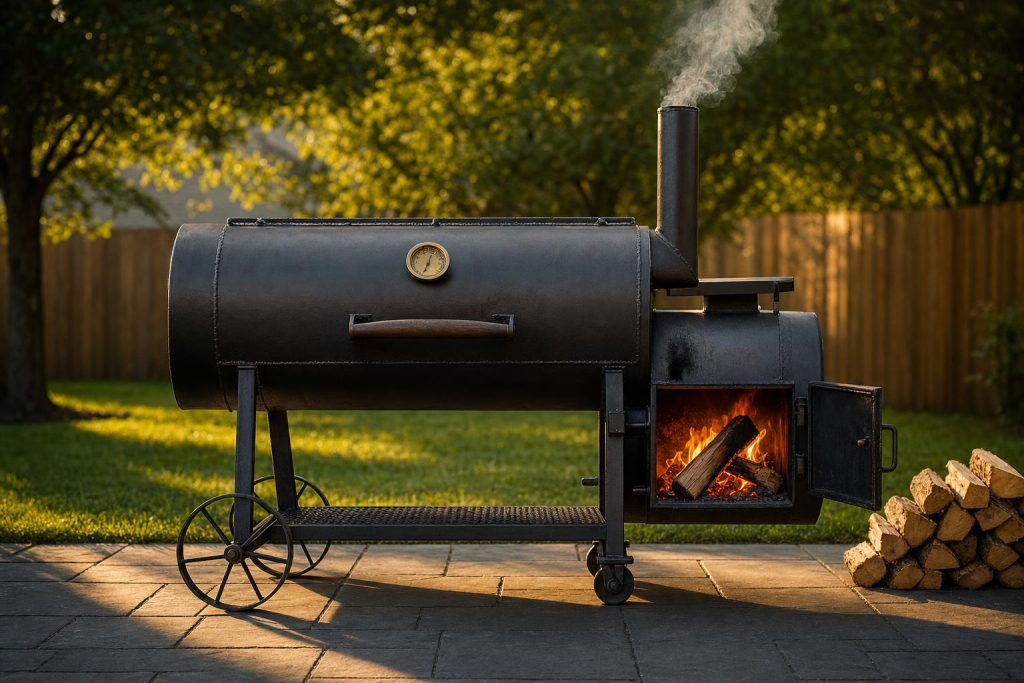
The whole point of a baffle plate running the length of the cook chamber is to eliminate the hot-side/cold-side problem that plagues standard offsets. Heat comes in from the firebox, runs under the baffle, reverses direction, and passes over your food on the way out through the stack — which is mounted on the same end as the firebox. In theory, you get even temps across the grate. In practice, how well that works depends almost entirely on baffle fit, chamber volume, and steel gauge. Here’s how I graded each unit:
- Temp differential, grate to grate: I ran a three-probe setup — firebox-side, center, and stack-side — across multiple cooks. Under 15°F differential is passing. Under 10°F is excellent.
- Steel gauge and weld quality: I physically measured chamber wall thickness and inspected every weld seam, corner joint, and firebox-to-chamber connection. Thin steel warps, leaks, and eventually fails at the joints.
- Firebox usability: Door seal quality, ash cleanout, and whether you can actually load splits without burning your forearm.
- Long-term value: Replacement parts availability, warranty reality (not just what’s printed), and whether the company picks up the phone.
Our top pick: Lang 36 Original
Across 14 cooks on the Lang 36 — including three overnight briskets, two full packer loads of spare ribs, and a whole hog shoulder session that ran 11 hours — the grate-to-grate temp differential never exceeded 8°F once I had the fire dialed. That’s not a marketing number. That’s what three probes showed me, repeatedly. The baffle plate on the Lang is a serious piece of steel, fitted tight enough that it actually redirects airflow instead of just suggesting it. The chamber walls measure 3/16″ — thicker than either competitor at this price tier — and the welds are clean and continuous, not tacked.
The Lang is hand-built in Nahunta, Georgia, and it shows in the details: the firebox door swings on a real hinge with a handle you won’t burn yourself on, the slide-out ash pan is actually sized to be useful, and the cooking grates are thick enough that they don’t bow under a full load. The price is real — you’re spending serious money — but this is a unit you buy once. Ben Lang’s team will also talk to you directly if something goes sideways. That’s not something you get from a big-box import.
Runner-up: Oklahoma Joe Highland Reverse Flow
The Oklahoma Joe Highland Reverse Flow is the unit I recommend to anyone who isn’t ready to spend Lang money and isn’t willing to buy a smoker they’ll regret in year two. It’s not perfect — and I’ll tell you exactly where it falls short — but for the price, it delivers the core reverse-flow promise better than anything else in its bracket. Over 11 cooks, I saw a grate differential that hovered between 12 and 18°F depending on ambient temp and fire management, which is wider than the Lang but still a major improvement over a standard offset at this price. The baffle plate is thinner, and there’s a noticeable hot spot about four inches from the firebox wall that you learn to work around.
The weak points are real: the stock gasket on the cook chamber lid is foam, not rope, and it’ll compress and leak within a year of regular use. Budget $20 and an afternoon to replace it with high-temp rope gasket and you’ll add years to the cook quality. The firebox door also warps slightly after heavy use — not enough to cause major airflow issues, but enough to notice. None of this is a dealbreaker at this price. It’s a tool that rewards a little attention and costs a fraction of the American-made alternatives.
What about the Yoder Cheyenne?
The Yoder Cheyenne is a well-built smoker with a brand reputation that inspires real loyalty, and I want to be precise about my hesitation rather than dismissive. The steel quality is excellent — Yoder builds to a high standard and the fit and finish on my unit was tight. The problem is the Cheyenne is not a reverse-flow design in the same sense as the Lang or the Oklahoma Joe. It’s a standard offset with a baffle option and a stack configuration that can approximate reverse flow, but the heat management behavior is different, and in my cook testing the grate differential was wider and more variable than either dedicated reverse-flow unit. If you’re cross-shopping Yoder, look at their pellet lineup where they genuinely lead the field. In this specific category — reverse-flow offset — the Cheyenne is outperformed by both the Lang and, on a value basis, the Oklahoma Joe.
Buyer mistakes that cost people money
A few patterns I see repeatedly that are worth calling out directly:
- Buying on cooking surface square inches: A big number means nothing if the heat distribution is terrible. A 600 sq in cook chamber with a 25°F differential is worse than a 350 sq in chamber with 8°F. Focus on the baffle and steel gauge first.
- Skipping the seasoning and blaming the smoker: Every offset, including the Lang, needs a proper seasoning burn before your first cook. People who skip this and then complain about metallic taste or rust within six months are skipping step one.
- Confusing “reverse flow capable” with “reverse flow designed”: Some brands market add-on baffles for standard offsets as a reverse-flow upgrade. It’s not the same thing. The stack placement matters. The chamber geometry matters. Don’t let a product listing redefine the category.
- Ignoring total ownership cost: A cheap smoker that needs replacement gaskets, a new grate, and a firebox repair in year three isn’t cheap. Factor in parts availability and brand support before you buy.
FAQ
Is a reverse-flow offset actually better than a standard offset? For most home cooks and serious backyard pitmasters, yes — but specifically because it reduces the skill requirement for consistent results. A standard offset in expert hands can match a reverse-flow unit, but that takes years of fire management experience. The baffle plate does the work of evening out the heat so you can focus on the food, not the firebox. If you’re already a seasoned offset cook who knows how to use your smoker’s hot zones deliberately, the advantage narrows.
How much firewood do reverse-flow offsets burn compared to standard offsets? Slightly more in my experience, because maintaining the heat redirection means running a hotter, cleaner fire to keep airflow moving through the baffle system efficiently. On a 12-hour cook I burn roughly one additional full split per two hours compared to a comparably sized standard offset. The tradeoff is worth it for the even temps, but factor this into your fuel budget and your wood storage situation.
Can I use a reverse-flow offset for direct grilling, not just smoking? Yes, and both the Lang and the Oklahoma Joe allow you to remove or reposition the baffle plate and use the cook chamber for higher-heat direct work. In practice I rarely do this — a dedicated grill is a better tool for that job — but it’s a legitimate option for a single-unit backyard setup where space is limited. Just know that the chamber geometry isn’t optimized for it and you’ll have more uneven heat than a purpose-built grill.