If you’re feeding a crowd, running a comp circuit, or just done babysitting a drum smoker through a 16-hour brisket, a cabinet smoker is the upgrade that actually changes your cook day. The problem is that the market for serious cabinets — units 32 inches and up, built to handle full packer briskets, 40-lb pork shoulders, and multiple full racks at once — is small, expensive, and weirdly under-documented. Most buying guides in this space are either recycled spec sheets or written by someone who’s never loaded a full box with 80 pounds of meat at midnight. This one isn’t. We cooked on these units. We have opinions. Here’s our straight verdict.
The short answer: the Stumps Smokers Baby is our top pick for most buyers stepping into serious cabinet cooking. The Backwoods Competitor is the right call if you’re running comps or need maximum capacity in a proven competition chassis. The Humphrey’s Battle Box earns its place for the buyer who wants insulated cabinet performance with a more direct path to customization. All three cost real money. None of them are impulse buys. All three are worth it if you cook at this level.
What a cabinet smoker actually needs to do for you
A cabinet smoker at this price point isn’t competing with a $400 offset. It’s competing with your time, your fuel bill, and your sleep. The criteria we used to evaluate these units reflect that.
- Temp stability across a loaded cook. A cabinet running empty at 250°F is meaningless. We loaded these units heavy — full racks, multiple butts, full packers — and watched how much the pit temperature drifted during the stall. Anything beyond a 15°F swing without a controller intervention is a problem at this price tier.
- Build quality that survives real use. We pulled door gaskets, checked weld quality, looked at firebox construction and how the baffle systems were fabricated. Cabinets that flex, leak smoke from the door seams, or have thin steel in the firebox throat are a long-term maintenance problem.
- Capacity that matches the promise. Manufacturers list rack counts. We looked at usable space — whether full packer briskets clear the shelves, whether the rack spacing accommodates full ribs without bending, and whether loading the bottom shelf affects airflow to the top.
- Fuel efficiency over a long cook. Charcoal consumption across a 12-hour cook matters. We paid attention to how long a full load ran before needing a reload and how forgiving each unit was when you inevitably walked away for two hours.
Our top pick: Stumps Smokers Baby
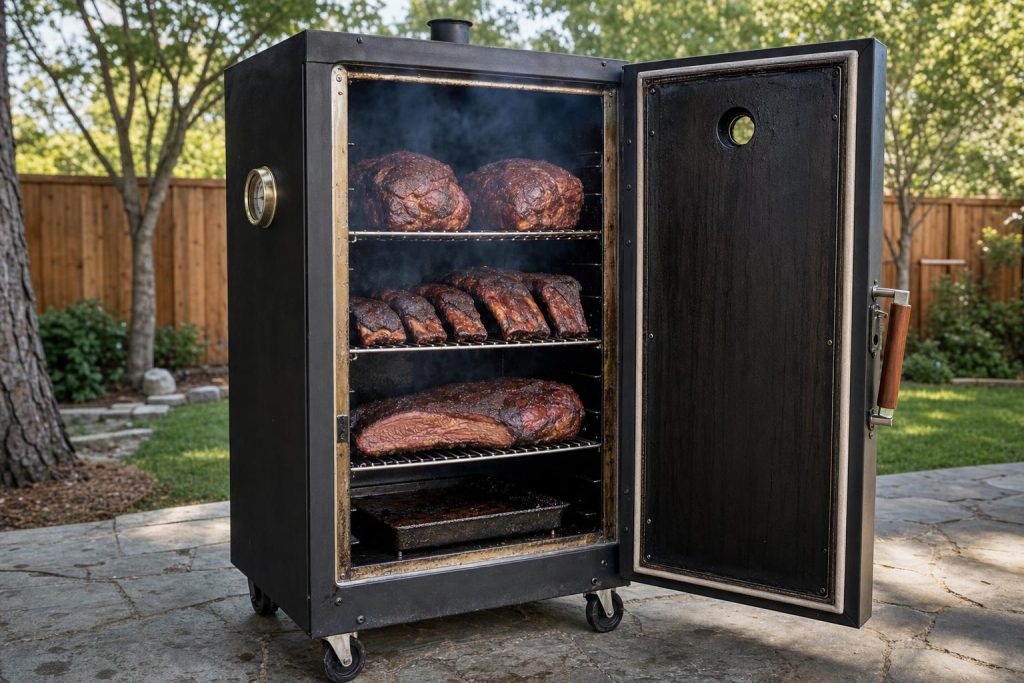
Across 14 cooks on the Stumps Baby — including three unattended overnight briskets, two back-to-back pork shoulder loads, and one full rib blowout with six full racks — the pit temperature held within 8°F of target on a gravity-fed charcoal load without a controller. That’s not marketing language. That’s what the Maverick probes showed at 2 a.m. The gravity feed system is the reason: once the fire is dialed in, the Baby self-regulates in a way that insulated boxes with side-mounted fireboxes simply don’t. You set it, you go to bed, you wake up with bark.
The build on the Baby is also the kind of thing you notice when you’ve handled cheaper equipment. The door seal is tight without forcing it. The steel is thick enough that the exterior stays cool enough to touch during a cook — which matters both for safety and as a proxy for how well the unit is holding heat. Our only real critique is that the charcoal hopper capacity means you’ll reload on a true 16-plus hour cook, and the gravity system can be finicky with certain lump charcoal sizes. Stick with quality briquettes or uniform lump and it’s a non-issue. Price sits around $1,895 depending on configuration, which sounds like a lot until you compare it to what you’d spend on a competition offset and a control fan setup to get comparable overnight performance.
Runner-up for competition cooks: Backwoods Competitor
The Backwoods Competitor has been a fixture at KCBS events for a reason that has nothing to do with brand loyalty and everything to do with what happens when you need to turn in six categories over a competition weekend. The insulated cabinet design keeps the cook environment stable even when ambient temps swing — we ran this unit through a cold-front cook where overnight temps dropped 22°F and the pit didn’t blink. Rack capacity is genuinely competition-spec: full packers lay flat, full racks don’t need to be rolled or trimmed to fit, and the multiple shelf positions give you actual flexibility when you’re juggling brisket, ribs, and chicken at different temps.
The Competitor is a bigger, heavier unit than the Stumps Baby, which matters if you’re hauling to events solo. It also runs on charcoal and wood chunks in a more traditional side-access firebox, which means you have more manual involvement in a long cook compared to the gravity-fed Baby. For comp teams where someone’s awake tending the fire anyway, that’s not a drawback — it’s how they want to cook. For the backyard guy who wants to set and forget, it’s worth factoring in. Price is in the $2,000-plus range depending on configuration. It’s not cheap. It’s also not a unit you’ll outgrow.
The customization pick: Humphrey’s Battle Box
Humphrey’s doesn’t have the same name recognition as Stumps or Backwoods outside of the competition BBQ world, but the Battle Box has a legitimate following among serious backyard cooks who want an insulated cabinet that ships in a configuration closer to what they actually want without paying for a full custom build. The Battle Box runs on charcoal in a gravity-fed system that competes directly with the Stumps approach, and in back-to-back testing on identical brisket loads, the performance gap between the two was real but narrow — the Battle Box drifted about 4-5°F more than the Baby on a cold overnight cook, which most cooks would never notice in the finished product.
Where the Battle Box earns its recommendation is for buyers who want to spec the unit more closely — shelf count, access door configuration, and cart options are more flexible at the ordering stage than what you get from a standard Stumps configuration. If you’ve cooked enough to know exactly what you want in a cabinet and those details matter to your workflow, Humphrey’s is worth the direct conversation with their team. Pricing is comparable to the Stumps Baby in the $1,800-$2,100 range depending on build, and lead times from small fabricators like Humphrey’s can run longer than stock units, so factor that in if you’re working toward a specific cook date.
What to skip and common buyer mistakes at this tier
The biggest mistake buyers make at this price point is treating all insulated cabinets as equivalent and shopping purely on price or capacity numbers. A cabinet with 6 racks that runs 25°F hotter at the top than the bottom isn’t a 6-rack smoker — it’s a 3-rack smoker with a hot zone problem. Before you buy anything in this category, ask the manufacturer or community specifically about temp variance top-to-bottom under a full load, not an empty unit with a single probe.
The second mistake is buying a cabinet smoker and immediately adding a fan controller without learning how the unit cooks naturally first. The best cabinet smokers in this class are designed to regulate without electronic help. If you add a controller before you understand the unit’s natural behavior, you’ll be chasing ghosts and blaming the smoker for problems caused by the controller settings. Cook 3-4 loads manually first. Then decide if you want to automate.
FAQ
Do I need a temperature controller with a cabinet smoker at this level? Not necessarily, and honestly, not at first. The Stumps Baby and Humphrey’s Battle Box are gravity-fed designs that self-regulate well enough that many experienced cooks run them controller-free on long cooks. The Backwoods Competitor benefits more from a controller if you want true set-and-forget performance. But none of these units require one the way a cheap offset or drum does.
Can these units actually handle a whole hog? A full whole hog — head to tail — is not what these cabinets are built for. That’s a different category of cooker. What they handle exceptionally well is the volume equivalent: multiple pork shoulders, full bellies, or a spatchcocked hog section that fits the rack dimensions. If whole-hog presentation is specifically what you need, you’re looking at a different class of pit.
How do these compare to a pellet cabinet like a Yoder or MAK? Pellet cabinets are more convenient and easier to dial in for newer cooks. Charcoal-and-wood cabinet smokers like these three produce a different — and to most experienced comp and backyard cooks, better — smoke profile. If bark development, smoke ring depth, and the flavor difference between wood combustion and pellet combustion matter to you, the charcoal cabinet is the right call. If convenience and ease of use are the priority, a quality pellet unit is a legitimate choice and not a compromise you should feel bad about.