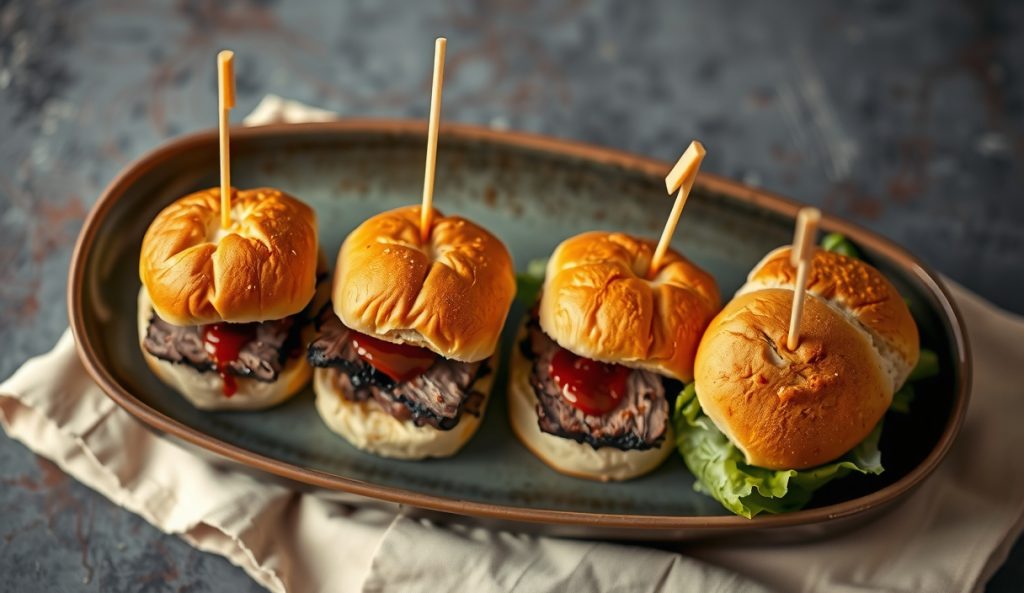
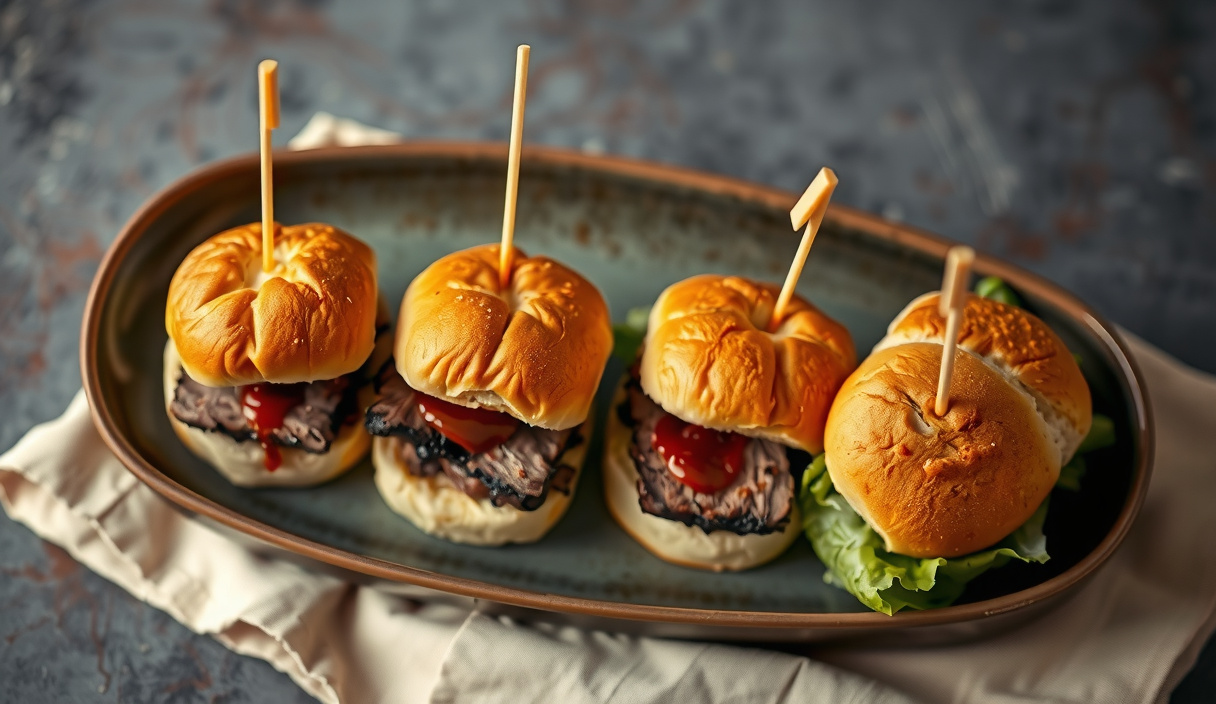
Keto Smoked Brisket Sliders — Cauliflower Buns
Equipment
- 1 Offset smoker, pellet grill, or kettle with slow-and-sear insert Needs to hold 225–250°F for 10–14 hours with indirect heat
- 1 Instant-read thermometer A probe thermometer with a leave-in cable is ideal for monitoring without lifting the lid
- 2 sheets Unwaxed butcher paper For wrapping brisket at the stall and during the rest
- 1 Insulated cooler For resting the wrapped brisket — holds temp without an oven
- 1 Food processor or box grater For ricing the cauliflower
- 2 Clean kitchen towel or cheesecloth For wringing moisture from riced cauliflower — critical step
- 1 Rimmed baking sheet
- 1 sheet Parchment paper
- 1 Cast-iron skillet or flat-top griddle For finishing the bun exterior with Maillard browning
- 1 Sharp slicing knife or electric carving knife
Ingredients
Brisket
- 1 whole packer brisket (10–14 lb) USDA Choice or Prime; both flat and point intact
- 3 tbsp coarse kosher salt
- 3 tbsp coarse black pepper Freshly cracked, 16-mesh grind
- 1 tbsp garlic powder
- 4 oz post oak or white oak wood chunks or chips Soaked chips if using a kettle; unsoaked chunks for an offset
Cauliflower Buns
- 200 g fresh cauliflower florets Riced then aggressively squeezed dry — yields about 120g after moisture removal
- 60 g low-moisture part-skim mozzarella, shredded
- 30 g sharp cheddar, finely shredded Optional — replaces 30g of mozzarella for the chipotle-cheddar variant; use all mozzarella for the standard version
- 1 large egg
- 5 g psyllium husk (whole husk, not powder) Approximately 1.5 tsp; do not substitute psyllium husk powder
- ½ tsp fine sea salt
- ¼ tsp garlic powder
- 1 spray avocado oil cooking spray For flat-top finishing
Assembly & Condiments (keto-compliant)
- 2 tbsp yellow mustard
- 24 chips dill pickle chips About 2 chips per slider
- 1 tsp flake finishing salt Maldon or similar — electrolyte maintenance on keto
- 2 tbsp keto-compliant mayonnaise or avocado-based aioli Optional; zero net carbs — check label for sugar-free status

Instructions
Prepare and Smoke the Brisket
- Trim the brisket to a 1/4-inch fat cap on all sides. Remove any hard fat nodes (kidney fat deposits) and the thin, papery silverskin membrane on the underside of the flat. Pat dry with paper towels.
- Mix salt, black pepper, and garlic powder in a small bowl. Apply the rub evenly across all surfaces of the brisket, pressing firmly to adhere. For optimal bark development, refrigerate the rubbed brisket uncovered on a wire rack for 4–12 hours before smoking. Alternatively, rest at room temperature for 30 minutes and proceed directly to the smoker.3 tbsp coarse kosher salt, 3 tbsp coarse black pepper, 1 tbsp garlic powder
- Fire your smoker and establish a stable cooking temperature of 225–250°F with indirect heat. Add wood — post oak or white oak chunks are the Texas standard. Wait until the smoke runs thin and bluish-grey (not thick and white) before placing the brisket. Thick white smoke carries acrid, creosote-laden compounds that impart bitterness.4 oz post oak or white oak wood chunks or chips
- Place the brisket fat-cap up (or fat-cap down if your heat source is below, as in most offsets — the fat cap insulates the leaner flat from direct radiant heat). Insert a leave-in probe thermometer into the thickest section of the flat, not the point. Close the lid. Do not open unnecessarily for at least 4 hours.
- Navigating the stall: Expect the internal temperature to plateau at 155–170°F for 2–5 hours. This is evaporative cooling — it is physics, not a problem. When the stall begins, you have two options: wait it out (produces the best bark) or wrap the brisket tightly in two sheets of unwaxed butcher paper and return to the smoker (speeds through the stall while preserving bark texture better than foil). Either way, continue cooking until the internal temperature reaches 200–205°F in the flat.
- Once the brisket probes tender at 200–205°F — the thermometer should slide in with almost no resistance, like pushing into room-temperature butter — remove from the smoker. If already in butcher paper, leave it wrapped. If not, wrap now. Place wrapped brisket into a dry cooler and allow to rest for a minimum of 60 minutes, ideally 90 minutes. The internal temperature will hold safely during this time as the gelatin reabsorbs into the muscle fibers.
Make the Cauliflower Buns
- Preheat your oven to 375°F. Line a rimmed baking sheet with parchment paper.
- Rice the cauliflower florets using a food processor (pulse 10–12 times) or a box grater. Spread in an even layer on a microwave-safe plate and microwave on high for 4 minutes. This collapses the cell walls, releasing bound water.200 g fresh cauliflower florets
- Transfer the hot riced cauliflower to the center of a clean kitchen towel. Gather the corners, twist to form a bundle, and wring aggressively over the sink. Squeeze until no more liquid drips — this takes real force. Open the towel, re-gather, and wring a second time. The cauliflower should look and feel like a dry, crumbly powder after both wrings. You are targeting at least 60–70g of liquid expelled from the 200g starting weight. This step determines your bun’s structural integrity. Residual free water prevents Maillard browning and causes the bun to collapse.200 g fresh cauliflower florets
- In a mixing bowl, combine the squeezed cauliflower, shredded mozzarella, egg, psyllium husk, fine sea salt, and garlic powder. Mix thoroughly until a cohesive dough forms. Allow the mixture to rest for 10 minutes at room temperature. During this rest, the psyllium mucilage hydrates fully, building the viscoelastic gel network that holds the bun together under compression. After resting, the dough should feel slightly tacky but hold a dome shape without spreading. If it feels too wet, the cauliflower was insufficiently dried — add an additional 2g of psyllium husk and rest another 5 minutes.200 g fresh cauliflower florets, 60 g low-moisture part-skim mozzarella, shredded, 30 g sharp cheddar, finely shredded, 1 large egg, 5 g psyllium husk (whole husk, not powder), 1/2 tsp fine sea salt, 1/4 tsp garlic powder
- Divide the dough into 12 equal portions (approximately 20–22g each). Roll each into a ball and place on the parchment-lined baking sheet, spacing at least 2 inches apart. Flatten gently into a disc roughly 2.5 inches in diameter and 3/4 inch tall — slightly thinner than you think, as the egg and cheese will puff slightly in the oven.200 g fresh cauliflower florets, 60 g low-moisture part-skim mozzarella, shredded, 30 g sharp cheddar, finely shredded, 1 large egg, 5 g psyllium husk (whole husk, not powder)
- Bake at 375°F for 18–22 minutes, until the tops are set, dry to the touch, and lightly golden at the edges. Remove from the oven and allow to cool on the pan for 5 minutes. The buns will be firm but not hard at this stage — the flat-top step adds the final crust.200 g fresh cauliflower florets, 60 g low-moisture part-skim mozzarella, shredded, 30 g sharp cheddar, finely shredded, 1 large egg, 5 g psyllium husk (whole husk, not powder)
- Heat a cast-iron skillet or flat-top griddle over medium-high heat. Spray lightly with avocado oil. Working in batches, place the baked buns flat-side down on the hot surface. Sear for 2–3 minutes until a deep golden-brown Maillard crust forms. Flip and sear the top for an additional 90 seconds. Remove to a wire rack. The finished bun should feel firm and dry-crusted on the outside, with a slightly yielding interior.1 spray avocado oil cooking spray
Slice and Assemble
- Unwrap the rested brisket on a large cutting board. Separate the point from the flat along the visible fat seam if desired (the point makes particularly rich sliders). Using a sharp slicing knife, cut across the grain of the flat at 1/4-inch thickness. The muscle fibers of the flat run lengthwise — your slices should be perpendicular to those fibers to minimize chew resistance. For each slider, you need roughly 1.5–2 oz of brisket, folded once.
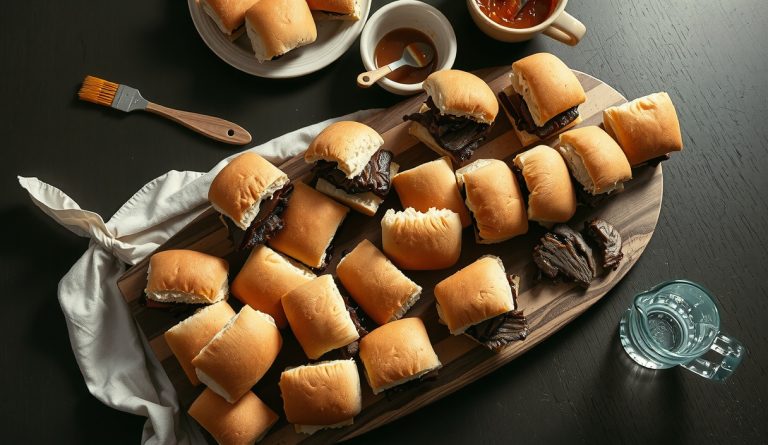
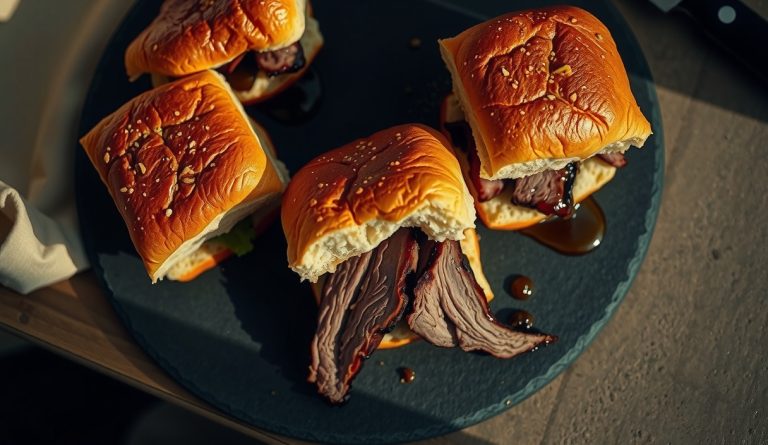
- Halve each cauliflower bun horizontally using a serrated knife. Spread the cut face of the bottom bun with a thin smear of yellow mustard or keto mayonnaise. Layer 1.5–2 oz of sliced brisket (folded to fit), 2 dill pickle chips, and a pinch of flake finishing salt directly on the meat. Cap with the top bun. Serve immediately while the brisket is still warm.2 tbsp yellow mustard, 24 chips dill pickle chips, 1 tsp flake finishing salt, 2 tbsp keto-compliant mayonnaise or avocado-based aioli
Notes
Nutrition
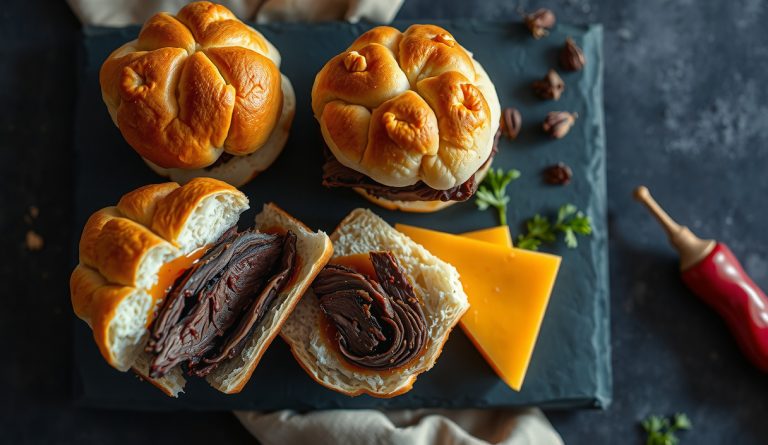
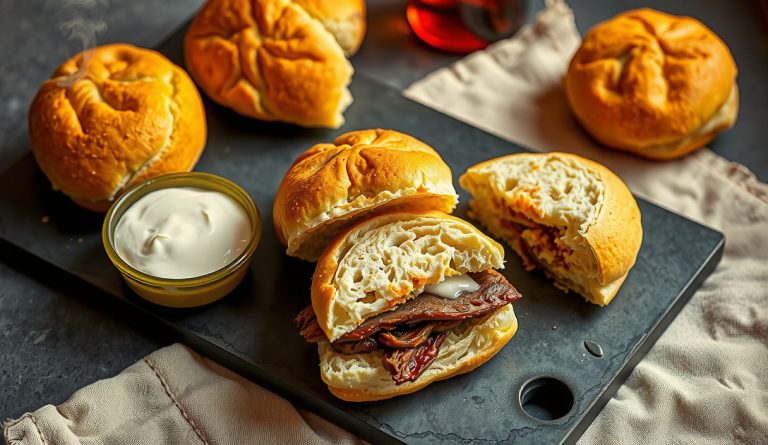
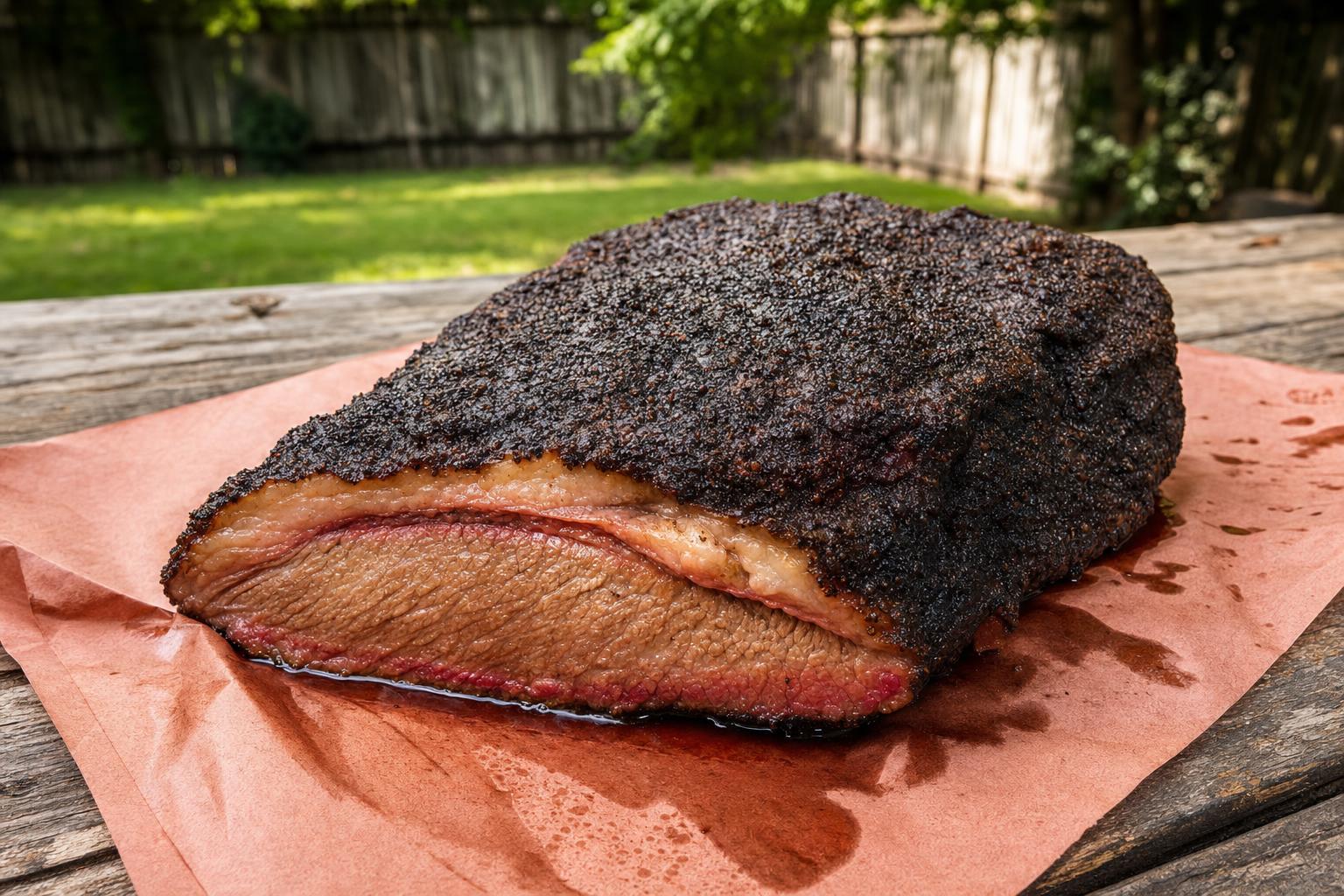
There is a specific kind of frustration that hits at the intersection of keto and BBQ: you pull a twelve-pound brisket off the smoker at 203°F, the flat glistening, the point yielding like butter under a thumbnail, and then you slice it for sliders and the only vessel you have is a limp lettuce leaf. I have been there. The lettuce wrap is not a bun — it is surrender. This recipe is the non-surrender version.
What we have engineered here is a cauliflower-mozzarella-psyllium bun that holds up to smoked brisket without dissolving, browns on a flat-top griddle into a genuinely satisfying crust, and clocks in under 4 grams of net carbohydrates per assembled slider. The brisket is a full Texas-style smoke — oak, low and slow, chasing an internal target of 200–205°F for collagen hydrolysis. Everything here is built on mechanism, not magic.
Why does smoked brisket work? The science of collagen and the cauliflower bun matrix
Great brisket is the result of collagen kinetics, not cooking intuition. Beef brisket is loaded with type I collagen in its connective tissue sheath — the flat’s intermuscular septa and the point’s fat cap underlayer. Collagen begins to thermally shrink around 160–165°F, which is also why the stall happens: evaporative cooling at the surface absorbs energy as fast as the smoker delivers it, parking the internal temperature in that band for anywhere from two to six hours. Pushing through the stall to 200–205°F is non-negotiable. At sustained temperatures above 180°F, first-order hydrolysis kinetics convert triple-helix collagen into soluble gelatin, and that gelatin is what coats every slice in the glossy, lip-smacking richness that defines great brisket.
Actin denaturation — the other major structural event in brisket — locks in around 167–170°F, which is why prolonged cooking below 200°F produces brisket that is technically food-safe but still mealy and dry: collagen conversion is incomplete. Temperature, not time, is the controlling variable.
The cauliflower bun is a phase-state engineering problem. Raw cauliflower is roughly 92% water by mass, held inside intact cellulosic cell walls. Ricing and then aggressively squeezing the cauliflower through cheesecloth drops the free water fraction dramatically, lowering water activity (a_w) and concentrating plant solids. Shredded mozzarella contributes a casein-fat network that heat-sets into a cohesive film; the egg white provides thermally irreversible ovalbumin coagulation above 145°F, locking the matrix rigid. The critical structural primitive is psyllium husk at approximately 2.5% by weight of the dry mixture. Psyllium’s hemicellulose backbone hydrates at a 1:10 to 1:15 seed-to-water ratio, forming a viscoelastic gel that provides the strain-hardening absent in nut-flour-only systems — it is the functional analog to gluten’s extensibility in this bun. Without it, the bun crumbles under compressive shear from the brisket slice.
The Maillard reaction on the bun surface requires surface a_w below 0.70 and sufficient reducing sugars and amino acids from the mozzarella proteins. That is why the flat-top sear at medium-high heat produces a genuine golden crust rather than steaming. Moisture control before baking is not optional — it is the prerequisite for crust formation.
From a ketogenic constraint standpoint, the bun’s net carbohydrate load is total carbohydrates minus dietary fiber. Cauliflower contributes roughly 2g total carbs per 50g serving, of which 1g is fiber. Psyllium is nearly 100% soluble fiber by mass — its contribution to net carbs is negligible. Mozzarella and egg add protein and fat with trivial carbohydrate content. The resulting bun sits at approximately 1.5–2g net carbs per piece. The brisket itself is zero-carbohydrate. Total slider net carbs land under 4g when assembled with compliant condiments — mustard (zero carbs), pickle chips (trace), and a smear of avocado-based aioli if desired.
Electrolyte discipline matters on a keto plate: smoked brisket is high in potassium and the keto-adapted kidney excretes sodium aggressively, so a finishing pinch of flake salt on each slider is not optional seasoning — it is physiological maintenance.
What equipment and ingredients do you actually need?
- Smoker or kettle grill: You need indirect heat and the ability to hold 225–250°F for 10–14 hours. A pellet grill, offset stick-burner, or 22-inch kettle with a slow-and-sear insert all work. The wood matters: post oak or white oak is the Texas standard; it delivers a clean, medium-density smoke that does not overpower the beef. Mesquite burns hot and acrid over long cooks — avoid it here.
- Instant-read thermometer: Non-negotiable. The stall can trick you into pulling early. Do not chase time, chase temperature. Target 200–205°F internal in the thickest part of the flat.
- Cauliflower moisture removal: The single most common bun failure is insufficient water extraction. After ricing, microwave the cauliflower for 4 minutes, spread on a clean kitchen towel, and wring aggressively. You are targeting a dry crumble, not a wet paste. If the riced cauliflower still feels damp, wring again. Residual free water prevents the Maillard crust from forming and causes the bun to steam-collapse under the brisket.
- Psyllium husk vs. psyllium husk powder: Use whole husk, not the ultra-fine powder. The powder hydrates so rapidly it can create a gummy, grey interior. Whole husk hydrates at a controlled rate during the 10-minute rest, giving you workable dough rather than a seized gel.
- Mozzarella type: Low-moisture part-skim shredded mozzarella, not fresh buffalo. Fresh mozzarella is approximately 60% water and will prevent proper bun cohesion. Pre-shredded low-moisture mozzarella is the correct functional choice — the anti-caking starch coating is a trivial net-carb addition (under 0.5g per 60g used).
- Flat-top or cast iron for bun finishing: The buns need direct dry-heat contact to develop the Maillard crust. A non-stick skillet will work but a cast-iron pan or flat-top griddle at medium-high gives more even browning. A light spray of avocado oil prevents sticking without adding significant carbohydrate or polyunsaturated fat load.
Keto Smoked Brisket Sliders — Cauliflower Buns
Equipment
- 1 Offset smoker, pellet grill, or kettle with slow-and-sear insert Needs to hold 225–250°F for 10–14 hours with indirect heat
- 1 Instant-read thermometer A probe thermometer with a leave-in cable is ideal for monitoring without lifting the lid
- 2 sheets Unwaxed butcher paper For wrapping brisket at the stall and during the rest
- 1 Insulated cooler For resting the wrapped brisket — holds temp without an oven
- 1 Food processor or box grater For ricing the cauliflower
- 2 Clean kitchen towel or cheesecloth For wringing moisture from riced cauliflower — critical step
- 1 Rimmed baking sheet
- 1 sheet Parchment paper
- 1 Cast-iron skillet or flat-top griddle For finishing the bun exterior with Maillard browning
- 1 Sharp slicing knife or electric carving knife
Ingredients
Brisket
- 1 whole packer brisket (10–14 lb) USDA Choice or Prime; both flat and point intact
- 3 tbsp coarse kosher salt
- 3 tbsp coarse black pepper Freshly cracked, 16-mesh grind
- 1 tbsp garlic powder
- 4 oz post oak or white oak wood chunks or chips Soaked chips if using a kettle; unsoaked chunks for an offset
Cauliflower Buns
- 200 g fresh cauliflower florets Riced then aggressively squeezed dry — yields about 120g after moisture removal
- 60 g low-moisture part-skim mozzarella, shredded
- 30 g sharp cheddar, finely shredded Optional — replaces 30g of mozzarella for the chipotle-cheddar variant; use all mozzarella for the standard version
- 1 large egg
- 5 g psyllium husk (whole husk, not powder) Approximately 1.5 tsp; do not substitute psyllium husk powder
- ½ tsp fine sea salt
- ¼ tsp garlic powder
- 1 spray avocado oil cooking spray For flat-top finishing
Assembly & Condiments (keto-compliant)
- 2 tbsp yellow mustard
- 24 chips dill pickle chips About 2 chips per slider
- 1 tsp flake finishing salt Maldon or similar — electrolyte maintenance on keto
- 2 tbsp keto-compliant mayonnaise or avocado-based aioli Optional; zero net carbs — check label for sugar-free status
Instructions
Prepare and Smoke the Brisket
- Trim the brisket to a 1/4-inch fat cap on all sides. Remove any hard fat nodes (kidney fat deposits) and the thin, papery silverskin membrane on the underside of the flat. Pat dry with paper towels.
- Mix salt, black pepper, and garlic powder in a small bowl. Apply the rub evenly across all surfaces of the brisket, pressing firmly to adhere. For optimal bark development, refrigerate the rubbed brisket uncovered on a wire rack for 4–12 hours before smoking. Alternatively, rest at room temperature for 30 minutes and proceed directly to the smoker.3 tbsp coarse kosher salt, 3 tbsp coarse black pepper, 1 tbsp garlic powder
- Fire your smoker and establish a stable cooking temperature of 225–250°F with indirect heat. Add wood — post oak or white oak chunks are the Texas standard. Wait until the smoke runs thin and bluish-grey (not thick and white) before placing the brisket. Thick white smoke carries acrid, creosote-laden compounds that impart bitterness.4 oz post oak or white oak wood chunks or chips
- Place the brisket fat-cap up (or fat-cap down if your heat source is below, as in most offsets — the fat cap insulates the leaner flat from direct radiant heat). Insert a leave-in probe thermometer into the thickest section of the flat, not the point. Close the lid. Do not open unnecessarily for at least 4 hours.
- Navigating the stall: Expect the internal temperature to plateau at 155–170°F for 2–5 hours. This is evaporative cooling — it is physics, not a problem. When the stall begins, you have two options: wait it out (produces the best bark) or wrap the brisket tightly in two sheets of unwaxed butcher paper and return to the smoker (speeds through the stall while preserving bark texture better than foil). Either way, continue cooking until the internal temperature reaches 200–205°F in the flat.
- Once the brisket probes tender at 200–205°F — the thermometer should slide in with almost no resistance, like pushing into room-temperature butter — remove from the smoker. If already in butcher paper, leave it wrapped. If not, wrap now. Place wrapped brisket into a dry cooler and allow to rest for a minimum of 60 minutes, ideally 90 minutes. The internal temperature will hold safely during this time as the gelatin reabsorbs into the muscle fibers.
Make the Cauliflower Buns
- Preheat your oven to 375°F. Line a rimmed baking sheet with parchment paper.
- Rice the cauliflower florets using a food processor (pulse 10–12 times) or a box grater. Spread in an even layer on a microwave-safe plate and microwave on high for 4 minutes. This collapses the cell walls, releasing bound water.200 g fresh cauliflower florets
- Transfer the hot riced cauliflower to the center of a clean kitchen towel. Gather the corners, twist to form a bundle, and wring aggressively over the sink. Squeeze until no more liquid drips — this takes real force. Open the towel, re-gather, and wring a second time. The cauliflower should look and feel like a dry, crumbly powder after both wrings. You are targeting at least 60–70g of liquid expelled from the 200g starting weight. This step determines your bun’s structural integrity. Residual free water prevents Maillard browning and causes the bun to collapse.200 g fresh cauliflower florets
- In a mixing bowl, combine the squeezed cauliflower, shredded mozzarella, egg, psyllium husk, fine sea salt, and garlic powder. Mix thoroughly until a cohesive dough forms. Allow the mixture to rest for 10 minutes at room temperature. During this rest, the psyllium mucilage hydrates fully, building the viscoelastic gel network that holds the bun together under compression. After resting, the dough should feel slightly tacky but hold a dome shape without spreading. If it feels too wet, the cauliflower was insufficiently dried — add an additional 2g of psyllium husk and rest another 5 minutes.200 g fresh cauliflower florets, 60 g low-moisture part-skim mozzarella, shredded, 30 g sharp cheddar, finely shredded, 1 large egg, 5 g psyllium husk (whole husk, not powder), 1/2 tsp fine sea salt, 1/4 tsp garlic powder
- Divide the dough into 12 equal portions (approximately 20–22g each). Roll each into a ball and place on the parchment-lined baking sheet, spacing at least 2 inches apart. Flatten gently into a disc roughly 2.5 inches in diameter and 3/4 inch tall — slightly thinner than you think, as the egg and cheese will puff slightly in the oven.200 g fresh cauliflower florets, 60 g low-moisture part-skim mozzarella, shredded, 30 g sharp cheddar, finely shredded, 1 large egg, 5 g psyllium husk (whole husk, not powder)
- Bake at 375°F for 18–22 minutes, until the tops are set, dry to the touch, and lightly golden at the edges. Remove from the oven and allow to cool on the pan for 5 minutes. The buns will be firm but not hard at this stage — the flat-top step adds the final crust.200 g fresh cauliflower florets, 60 g low-moisture part-skim mozzarella, shredded, 30 g sharp cheddar, finely shredded, 1 large egg, 5 g psyllium husk (whole husk, not powder)
- Heat a cast-iron skillet or flat-top griddle over medium-high heat. Spray lightly with avocado oil. Working in batches, place the baked buns flat-side down on the hot surface. Sear for 2–3 minutes until a deep golden-brown Maillard crust forms. Flip and sear the top for an additional 90 seconds. Remove to a wire rack. The finished bun should feel firm and dry-crusted on the outside, with a slightly yielding interior.1 spray avocado oil cooking spray
Slice and Assemble
- Unwrap the rested brisket on a large cutting board. Separate the point from the flat along the visible fat seam if desired (the point makes particularly rich sliders). Using a sharp slicing knife, cut across the grain of the flat at 1/4-inch thickness. The muscle fibers of the flat run lengthwise — your slices should be perpendicular to those fibers to minimize chew resistance. For each slider, you need roughly 1.5–2 oz of brisket, folded once.
- Halve each cauliflower bun horizontally using a serrated knife. Spread the cut face of the bottom bun with a thin smear of yellow mustard or keto mayonnaise. Layer 1.5–2 oz of sliced brisket (folded to fit), 2 dill pickle chips, and a pinch of flake finishing salt directly on the meat. Cap with the top bun. Serve immediately while the brisket is still warm.2 tbsp yellow mustard, 24 chips dill pickle chips, 1 tsp flake finishing salt, 2 tbsp keto-compliant mayonnaise or avocado-based aioli
Notes
Nutrition
How do I nail this recipe every time?
- Do not skip the brisket rest. After pulling at 200–205°F, the brisket must rest a minimum of 60 minutes, ideally 90 minutes, wrapped in unwaxed butcher paper inside a cooler. The thermal gradient between the hot center and cooler exterior equalizes, and the gelatin solubilized from collagen reabsorbs into the muscle fibers. Slicing too early causes that gelatin to run off the cutting board rather than stay in the meat.
- Wring the cauliflower twice. After the first wring, touch the dough — if it feels wet, the moisture content is too high. Wring again. Under-dried cauliflower is the number-one cause of buns that collapse or steam instead of sear.
- Let the psyllium gel fully before forming. After mixing bun ingredients, the dough needs a 10-minute rest at room temperature. During this window, the psyllium mucilage hydrates and the viscoelastic network forms. If you form the buns immediately, they will crack during baking. After the rest, the dough should feel slightly tacky but hold a dome shape without spreading.
- Bake buns before flat-top finishing. The oven bake at 375°F for 18–22 minutes sets the egg and mozzarella matrix into a firm puck. The flat-top step is purely for Maillard browning and textural contrast — a crisp exterior against the soft interior. Reversing the order produces a rubbery shell that will not crisp.
- Slice brisket thin and against the grain. The flat’s muscle fibers run longitudinally; slicing perpendicular to them shortens the fiber length, dropping chew resistance dramatically. Target 1/4-inch slices — thin enough to fold slightly into the bun without tearing it.
- Control condiment carbs. Yellow mustard is zero net carbs. Dill pickle chips run about 0.5g per three chips. Keto-compliant mayonnaise or avocado-based aioli adds fat without carbohydrate load. Avoid barbecue sauce unless it is specifically formulated with erythritol or allulose — standard BBQ sauce delivers 10–15g sugar per two tablespoons and will blow the macro target on a single slider.
What variations can I run on these sliders?
Point vs. flat: This recipe calls for a whole packer brisket, but if you are cooking for a smaller crowd, the point (deckle) alone makes extraordinary sliders. The point has significantly more intramuscular fat — marbling that renders during the long smoke into pockets of gelatin-rich richness. Point sliders are more forgiving on the smoker because the fat buffers against moisture loss, and the higher fat content aligns even more aggressively with ketogenic macro targets. Ask your butcher for a whole point, or separate it yourself along the fat seam that runs between point and flat.
Dairy-free bun matrix: If you need to eliminate mozzarella, replace it with 60g of finely shredded firm vegan mozzarella (coconut-oil-based) or increase the egg to 2 whole eggs and add 1 tablespoon of coconut flour. The coconut flour acts as a high-absorptive particulate that replaces some of the casein-fat network’s structural contribution. Expect a slightly more crumbly interior and a lighter exterior color — coconut flour’s reducing sugars participate in Maillard browning at a lower temperature, so reduce oven temperature to 350°F and watch the color closely.
Scaling for a party: The bun recipe scales linearly — double or triple without changes to technique. Baked buns can be made up to 48 hours ahead, cooled completely, wrapped individually, and refrigerated. The retrogradation of any residual starch in the cauliflower actually firms the bun texture slightly, which is a structural benefit. Re-crisp on the flat-top for 90 seconds per side directly from refrigerator temperature before assembling. The brisket holds refrigerated for 5 days and reheats beautifully wrapped in foil at 275°F until the internal temperature reaches 165°F.
Chipotle-cheddar bun variant: Add 1/4 teaspoon chipotle powder and 30g sharp cheddar (replacing 30g of the mozzarella) to the bun dough for a smoky, spicy shell that echoes the brisket’s smoke profile. Cheddar’s lower moisture content compared to mozzarella firms the bun matrix further — you may need to add 1 teaspoon of water if the dough feels too dry to form. The cheddar’s calcium content also slightly accelerates the Maillard reaction, yielding a deeper amber crust at the same baking temperature.
Frequently asked questions
My brisket stalled at 165°F for three hours and I’m panicking — what do I do? Nothing. The stall is evaporative cooling driven by surface moisture vaporizing and absorbing latent heat — a thermodynamic certainty on any large, moist protein cut. The stall resolves when surface moisture is depleted and the evaporative cooling rate drops below the smoker’s heat input rate. If you are truly time-constrained, wrap the brisket in unwaxed butcher paper (the Texas Crutch) once it stalls — the paper traps some vapor, reducing evaporative loss, and the internal temperature will climb again. Wrapping in foil works faster but steams the bark soft. Butcher paper is the pitmaster compromise: it speeds the stall exit while preserving a workable bark texture.
Can I make the cauliflower buns ahead and freeze them? Yes, with one important caveat. Bake the buns fully, cool completely on a wire rack, then freeze in a single layer on a parchment-lined sheet pan before transferring to a zip-lock bag. The freeze-thaw cycle disrupts some of the psyllium gel network, making the buns slightly more fragile after thawing. Compensate by increasing the flat-top finishing time to 2–3 minutes per side directly from frozen — the extended dry heat re-firms the mozzarella-egg matrix and restores most of the structural integrity. Do not thaw at room temperature before flat-top finishing; the condensation will prevent Maillard browning.
What is the actual net carb count and how does it stay so low? Each assembled slider is approximately 3.5–4g net carbs. One cauliflower-mozzarella bun contributes roughly 1.5g net carbs (cauliflower approximately 1g, mozzarella approximately 0.3g, egg approximately 0.2g, psyllium fiber is subtracted entirely). The brisket slice is zero carbohydrates — beef has no carbohydrate content. Yellow mustard is zero net carbs per teaspoon. Dill pickle chips contribute approximately 0.3g per slider. The remaining margin gets you to the 4g ceiling with room for a smear of keto-compliant mayo. The chipotle-cheddar bun variant does not meaningfully change the net carb count — substituted cheddar has slightly lower carbohydrate content than mozzarella on a per-gram basis.