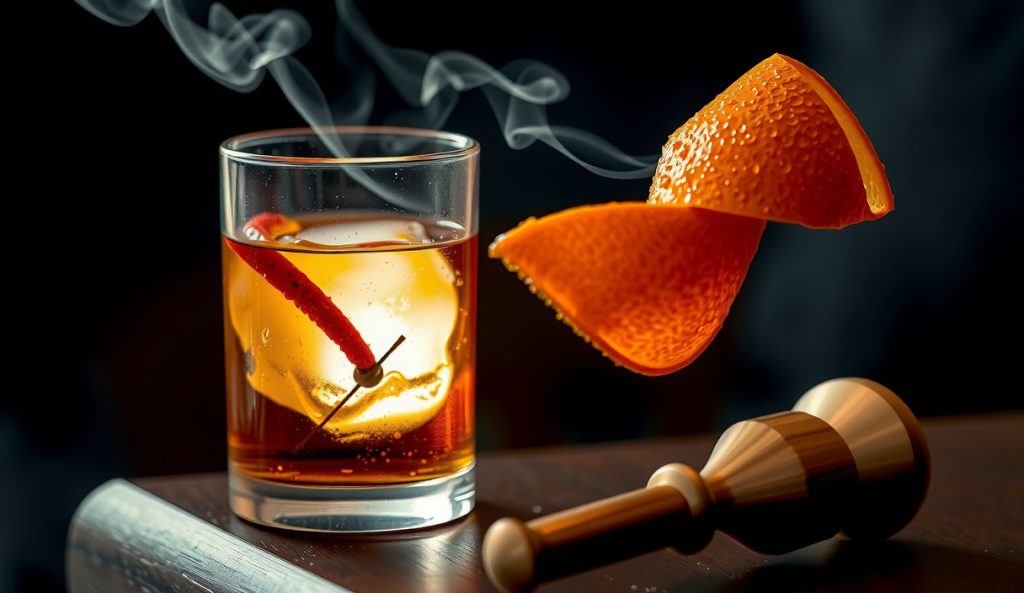
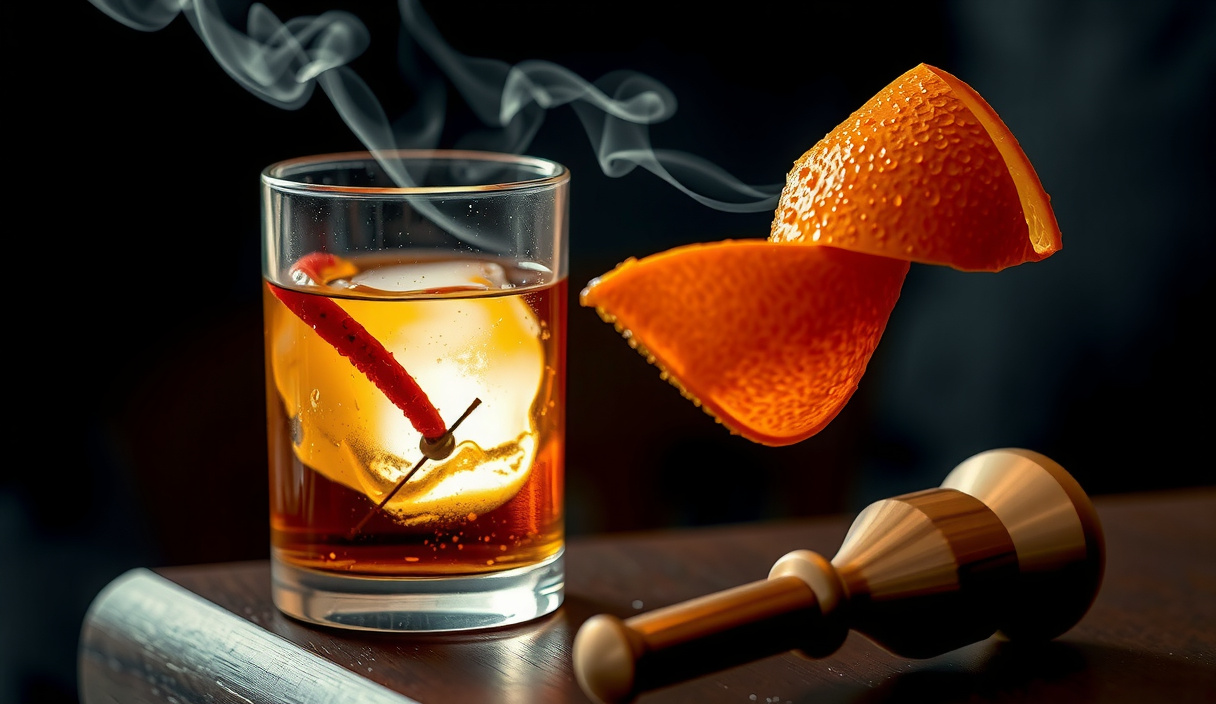
Smoked Old-Fashioned with Hickory-Cold-Smoked Bourbon
Equipment
- 1 Handheld cold smoke generator (Smoking Gun or equivalent) With flexible silicone tube attachment; do not use a torch-based hot smoker
- 1 Rocks glass (double old-fashioned, 10–12 oz) Heavy-bottomed crystal preferred for thermal stability
- 1 Small plate or coaster (for sealing the glass during smoking)
- 1 Instant-read thermometer To monitor bourbon temperature during smoke infusion; target 85–90°F
- 1 Mixing glass 16 oz minimum volume for stirring
- 1 Bar spoon
- 1 Julep strainer or Hawthorne strainer
- 1 Y-peeler or channel knife For producing a wide orange peel with maximum flavedo surface area
- 1 2-inch ice sphere or large format ice cube mold
- 1 Muddler
Ingredients
The Cocktail
- 2 oz bourbon whiskey 90–100 proof, rye-forward mash bill preferred (e.g., Four Roses Single Barrel, Knob Creek); wheated bourbon works with cherry wood smoke instead
- 1 white sugar cube Standard Demerara cube also works and adds a slight molasses note
- 2 dashes Angostura aromatic bitters Apply both dashes directly onto the sugar cube before muddling
- 1 wide strip fresh orange peel From a navel or Valencia orange; approximately 3 inches long, cut with a Y-peeler to include the flavedo (the colored outer layer) and minimal white pith
- 1 2-inch ice sphere or large-format ice cube Crystal-clear ice preferred; cloudy ice contains trapped air and mineral deposits that accelerate off-flavor development
For Smoking
- 1 small pinch hickory wood smoking chips Fine-cut chips designed for handheld smokers; do not use large BBQ chunks — they smolder incompletely in small-capacity devices. Cherry wood is the softer alternative for wheated bourbon.

Instructions
Cold-Smoke the Bourbon
- Pour 2 oz of bourbon into your rocks glass. Clip an instant-read thermometer to the rim or hold it submerged briefly to establish the starting liquid temperature.
- Load a small pinch of hickory chips into the combustion chamber of your cold smoke generator. Insert the flexible tube tip so it points down into the bourbon (approximately 1 inch below the liquid surface). Light the chips and activate the fan.1 small pinch hickory wood smoking chips
- Allow smoke to fill the glass and submerge into the bourbon for 20 minutes. Monitor the liquid temperature every 5 minutes — keep it between 85°F and 90°F. If it climbs above 95°F, pause the smoke feed and let the glass cool for 2 minutes before resuming. Immediately seal the glass with a coaster or small plate after the 20-minute infusion is complete.1 small pinch hickory wood smoking chips
Build the Base
- Place the sugar cube in the bottom of the mixing glass. Apply both dashes of Angostura bitters directly onto the cube, saturating it completely. Allow the cube to absorb the bitters for 30 seconds.1 white sugar cube, 2 dashes Angostura aromatic bitters
- Muddle the saturated sugar cube firmly until it is fully dissolved into the bitters — approximately 10 to 12 firm presses with the muddler. There should be no visible undissolved sugar granules remaining. This produces a dense, bitters-saturated paste rather than a loose slurry.1 white sugar cube, 2 dashes Angostura aromatic bitters
- Remove the coaster from the rocks glass and pour the smoked bourbon into the mixing glass over the bitters paste. Add standard ice to the mixing glass to fill it approximately two-thirds full.1 white sugar cube, 2 dashes Angostura aromatic bitters
- Stir with a bar spoon using long, even circular rotations for 40 to 45 revolutions over approximately 30 seconds. The goal is to chill and dilute without aerating. The finished cocktail should exit the mixing glass at approximately 18–22°F.1 white sugar cube, 2 dashes Angostura aromatic bitters
Assemble and Finish
- Place the 2-inch ice sphere or large-format ice cube into the rocks glass (the same glass used for smoking — residual phenolic condensation on the glass walls continues to contribute aroma during service).1 2-inch ice sphere or large-format ice cube
- Strain the stirred cocktail over the ice into the glass using a julep or Hawthorne strainer.1 white sugar cube, 2 dashes Angostura aromatic bitters, 1 2-inch ice sphere or large-format ice cube
- Hold the orange peel strip (flavedo side down) approximately 6 inches above the surface of the drink. Fold it sharply and quickly toward yourself so that the essential oil glands in the flavedo compress and release a fine mist of citrus oil directly over the liquid surface — not the rim. You should see a faint mist and may detect a brief flash of citrus aroma. This is the limonene and linalool partitioning into the ethanol phase.1 wide strip fresh orange peel
- Run the outside of the peel around the rim of the glass once, then drape the peel over the edge of the ice sphere as garnish. Serve immediately — the smoke phenols and expressed citrus oils are most vibrant in the first 10 minutes of service.1 wide strip fresh orange peel
Notes
Nutrition
The Old-Fashioned is the oldest cocktail still standing upright at the bar, and it has survived two centuries of revision attempts precisely because its structure is almost perfect: spirit, sweetener, bitters, expressed citrus oil. The only thing the original recipe never accounted for was smoke — not campfire smoke dumped carelessly from a burning plank, but cold smoke. Cold smoke is controlled, temperature-managed, phenol-selective vapor that layers into the bourbon’s existing chemistry rather than bulldozing it. That distinction is everything.
At American Meathead, we cold-smoke the bourbon directly in the serving glass at 90°F for twenty minutes using a hickory chip bed. That temperature matters: you want smoke volatiles dissolving into the liquid without thermally accelerating oxidation or volatilizing off the whiskey’s lighter esters. The result is a drink that opens with campfire depth, resolves through vanilla and caramel, and finishes with the clean bitter resonance of Angostura and orange peel. This is not a gimmick. It is a deliberate manipulation of phenolic chemistry, and every step below explains exactly why it works.
Why does the smoked Old-Fashioned work? The science
The smoked Old-Fashioned works because hickory smoke phenols and bourbon’s barrel-derived phenols belong to the same molecular family, so they synergize on the nose rather than competing. Hickory smoke contains a suite of volatile phenolic compounds — most critically guaiacol, 4-methylguaiacol, and syringol — generated by the incomplete combustion of lignin in the wood. These molecules are moderately lipophilic, meaning they partition preferentially into the ethanol-water solution of bourbon rather than evaporating back into the headspace. At 90°F, vapor pressure is high enough to produce a dense smoke stream, but the liquid temperature remains well below the threshold where whiskey’s light esters (ethyl acetate, isoamyl acetate) begin to volatilize at meaningful rates. The bourbon captures the phenols without losing the aromatics already present.
Bourbon’s characteristic vanillin, 4-ethylguaiacol, and oak lactones arrive via the wood-aging process: lignin in the charred American oak barrel pyrolyzes to release guaiacol and syringol derivatives during maturation — the same molecular family as hickory smoke phenols. This is not coincidence; it is convergent chemistry. When fresh hickory guaiacol is introduced into a bourbon that already carries barrel-derived guaiacol, the two pools of the same compound synergize on the nose in a psychophysical phenomenon called odor enhancement. The smoke does not smell foreign because it shares the same receptor targets as the whiskey’s existing oak character. They amplify each other. This is the mechanistic difference between a good smoked cocktail and one that just smells like a campfire got into the bar cart.
The sugar cube and Angostura perform their own separate physics. Angostura’s gentian, clove, and cinnamon volatiles — eugenol, cinnamaldehyde, beta-caryophyllene — are highly lipophilic aromatic compounds that partition strongly into the fat-adjacent ethanol phase. The sugar cube provides sucrose (a non-reducing disaccharide, so no Maillard reaction at room temperature), which acts as a solute to depress water activity slightly and increase the apparent viscosity of the mix, giving the drink that characteristic syrup-weight mouthfeel. Expressed orange peel introduces limonene and linalool from the flavedo’s essential oil glands; these citrus monoterpenes are highly volatile and thermodynamically unstable, meaning they must be added at the absolute final moment — heat or prolonged air exposure collapses their sensory contribution almost immediately. This makes the large-format ice sphere critical: it holds the bulk liquid temperature at or below 32°F during service without the dilution penalty of crushed ice.
What equipment and ingredients do I need?
Cold smoke generator: A handheld Smoking Gun or equivalent cold-smoke infuser with a flexible tube is essential. These devices combust a small quantity of chips and push smoke via a fan rather than a torch flame, keeping the smoke temperature manageable. Do not attempt this with a hot-smoke setup — hot smoking toasts the bourbon and flattens the esters.
Hickory chips: Hickory is preferred for its high guaiacol-to-syringol ratio, which produces a dry, assertive smoke note that complements rather than overwhelms rye-forward bourbon. Cherry wood is a softer alternative that skews sweeter and works well with a wheated bourbon. Apple wood is the mildest option. Do not use mesquite — its phenolic profile is dominated by catechol derivatives that read as acrid and medicinal in spirits.
Bourbon selection: Choose a bourbon bottled at 90–100 proof (45–50% ABV). Higher-proof whiskeys carry more ethanol, which acts as a more effective lipophilic solvent for smoke phenols — producing more smoke incorporation per minute of exposure. Rye-forward, high-rye mash bills (e.g., Four Roses Single Barrel, Knob Creek) have a spicy grain backbone that bridges beautifully to hickory’s assertive char. Wheated bourbons (e.g., Maker’s Mark, Weller) produce a softer, sweeter smoke profile that pairs better with cherry wood.
Large-format ice: A 2-inch ice sphere or cube is mandatory, not decorative. Surface-area-to-volume ratio determines dilution rate; a sphere minimizes that ratio by approximately 40% compared to an equivalent mass of standard cubes. This keeps the drink cold for 15 to 20 minutes of sipping without watering it down before the glass is finished.
Orange: Use a navel or Valencia orange — thick-skinned fruit with a rich flavedo layer. Avoid blood oranges for this preparation: their anthocyanin pigment reads visually, but their limonene concentration is lower, producing a less impactful peel expression.
Smoked Old-Fashioned with Hickory-Cold-Smoked Bourbon
Equipment
- 1 Handheld cold smoke generator (Smoking Gun or equivalent) With flexible silicone tube attachment; do not use a torch-based hot smoker
- 1 Rocks glass (double old-fashioned, 10–12 oz) Heavy-bottomed crystal preferred for thermal stability
- 1 Small plate or coaster (for sealing the glass during smoking)
- 1 Instant-read thermometer To monitor bourbon temperature during smoke infusion; target 85–90°F
- 1 Mixing glass 16 oz minimum volume for stirring
- 1 Bar spoon
- 1 Julep strainer or Hawthorne strainer
- 1 Y-peeler or channel knife For producing a wide orange peel with maximum flavedo surface area
- 1 2-inch ice sphere or large format ice cube mold
- 1 Muddler
Ingredients
The Cocktail
- 2 oz bourbon whiskey 90–100 proof, rye-forward mash bill preferred (e.g., Four Roses Single Barrel, Knob Creek); wheated bourbon works with cherry wood smoke instead
- 1 white sugar cube Standard Demerara cube also works and adds a slight molasses note
- 2 dashes Angostura aromatic bitters Apply both dashes directly onto the sugar cube before muddling
- 1 wide strip fresh orange peel From a navel or Valencia orange; approximately 3 inches long, cut with a Y-peeler to include the flavedo (the colored outer layer) and minimal white pith
- 1 2-inch ice sphere or large-format ice cube Crystal-clear ice preferred; cloudy ice contains trapped air and mineral deposits that accelerate off-flavor development
For Smoking
- 1 small pinch hickory wood smoking chips Fine-cut chips designed for handheld smokers; do not use large BBQ chunks — they smolder incompletely in small-capacity devices. Cherry wood is the softer alternative for wheated bourbon.
Instructions
Cold-Smoke the Bourbon
- Pour 2 oz of bourbon into your rocks glass. Clip an instant-read thermometer to the rim or hold it submerged briefly to establish the starting liquid temperature.
- Load a small pinch of hickory chips into the combustion chamber of your cold smoke generator. Insert the flexible tube tip so it points down into the bourbon (approximately 1 inch below the liquid surface). Light the chips and activate the fan.1 small pinch hickory wood smoking chips
- Allow smoke to fill the glass and submerge into the bourbon for 20 minutes. Monitor the liquid temperature every 5 minutes — keep it between 85°F and 90°F. If it climbs above 95°F, pause the smoke feed and let the glass cool for 2 minutes before resuming. Immediately seal the glass with a coaster or small plate after the 20-minute infusion is complete.1 small pinch hickory wood smoking chips
Build the Base
- Place the sugar cube in the bottom of the mixing glass. Apply both dashes of Angostura bitters directly onto the cube, saturating it completely. Allow the cube to absorb the bitters for 30 seconds.1 white sugar cube, 2 dashes Angostura aromatic bitters
- Muddle the saturated sugar cube firmly until it is fully dissolved into the bitters — approximately 10 to 12 firm presses with the muddler. There should be no visible undissolved sugar granules remaining. This produces a dense, bitters-saturated paste rather than a loose slurry.1 white sugar cube, 2 dashes Angostura aromatic bitters
- Remove the coaster from the rocks glass and pour the smoked bourbon into the mixing glass over the bitters paste. Add standard ice to the mixing glass to fill it approximately two-thirds full.1 white sugar cube, 2 dashes Angostura aromatic bitters
- Stir with a bar spoon using long, even circular rotations for 40 to 45 revolutions over approximately 30 seconds. The goal is to chill and dilute without aerating. The finished cocktail should exit the mixing glass at approximately 18–22°F.1 white sugar cube, 2 dashes Angostura aromatic bitters
Assemble and Finish
- Place the 2-inch ice sphere or large-format ice cube into the rocks glass (the same glass used for smoking — residual phenolic condensation on the glass walls continues to contribute aroma during service).1 2-inch ice sphere or large-format ice cube
- Strain the stirred cocktail over the ice into the glass using a julep or Hawthorne strainer.1 white sugar cube, 2 dashes Angostura aromatic bitters, 1 2-inch ice sphere or large-format ice cube
- Hold the orange peel strip (flavedo side down) approximately 6 inches above the surface of the drink. Fold it sharply and quickly toward yourself so that the essential oil glands in the flavedo compress and release a fine mist of citrus oil directly over the liquid surface — not the rim. You should see a faint mist and may detect a brief flash of citrus aroma. This is the limonene and linalool partitioning into the ethanol phase.1 wide strip fresh orange peel
- Run the outside of the peel around the rim of the glass once, then drape the peel over the edge of the ice sphere as garnish. Serve immediately — the smoke phenols and expressed citrus oils are most vibrant in the first 10 minutes of service.1 wide strip fresh orange peel
Notes
Nutrition
How do I nail it every time? Tips for the smoked Old-Fashioned
- Temperature-lock the smoke step. Use an instant-read thermometer clipped to the glass during smoke infusion. If the bourbon climbs above 95°F, remove the smoke source and wait. Above that threshold, ethyl acetate and lighter esters begin volatilizing faster than phenols accumulate — the whiskey loses its bright top notes while depth is being added. Hold 85–90°F for the full 20 minutes.
- Do not skip the sugar cube ritual. Saturating the cube with Angostura before muddling is not theater — it ensures the bitters-soaked sucrose is fully dissolved in the expressed oils before dilution from ice begins. Adding bitters directly into the spirit and then adding ice creates uneven bitters distribution during the early dilution phase. The cube method is slower but structurally superior.
- Express the peel toward the drink surface, not the rim. The essential oil spray from a properly expressed orange peel travels at a 90-degree angle to the flexion point. Hold the peel about 6 inches above the glass, fold it quickly away from you directly over the drink surface, and the limonene mist lands on the liquid where it can partition into the ethanol. Rubbing the peel on the rim afterward is a secondary step, not the primary one.
- Stir, do not shake. The smoked Old-Fashioned is a stirred drink. Shaking introduces air, creates a cloudy aerated appearance, and accelerates oxidation of smoke phenols. Stir 40–45 revolutions over a 30-second window over a large ice block or in a mixing glass with standard ice. The target exit temperature is 18–22°F at the finish.
- Seal the smoke immediately. After pumping smoke into the glass, cover it with a coaster or small plate and let it sit sealed for 20 minutes before proceeding. Phenolic absorption into ethanol follows a first-order kinetic curve: the first 10 minutes deliver most of the uptake, and the second 10 minutes equilibrate the flavor. Every minute the seal is broken early, smoke concentration is lost.
- Match wood to bourbon style. High-rye bourbon plus hickory. Wheated bourbon plus cherry. Corn-heavy distillate plus apple. Mismatching — such as wheated bourbon with heavy hickory — creates a phenolic imbalance where the smoke’s dryness fights the whiskey’s softness instead of integrating with it.
What variations can I make on the smoked Old-Fashioned?
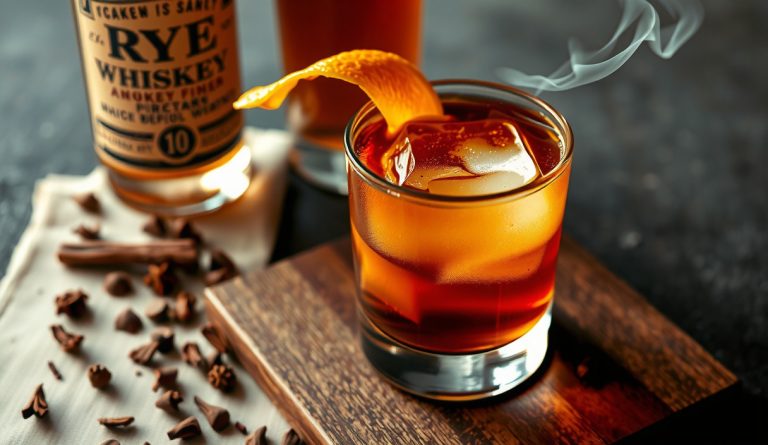
Rye whiskey build: Swap bourbon for a 100-proof rye (Rittenhouse, Sazerac 6-year) and shift to cherry wood smoke. Rye’s spicy grain character — driven by beta-myrcene and caryophyllene — bridges well to cherry wood’s softer guaiacol profile. Reduce the simple syrup or sugar to 0.25 oz (roughly half a small cube) because rye’s assertive palate needs less sweetness counterweight than bourbon. The result is drier, spicier, and more aromatic.
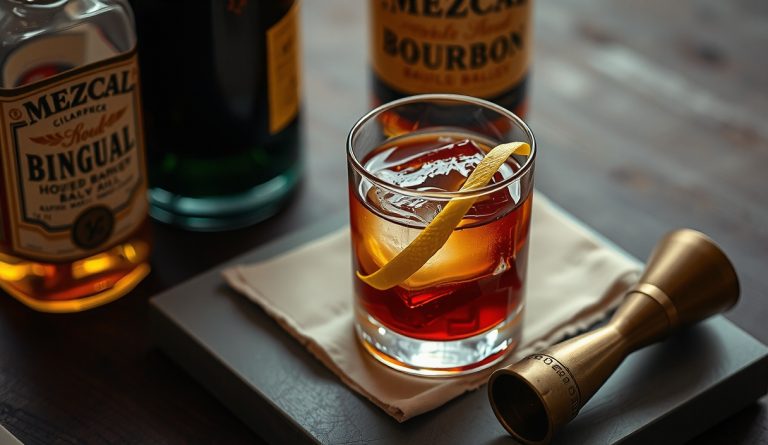
Mezcal split: Replace 1 oz of the bourbon with a joven mezcal (Del Maguey Vida or Banhez Espadin). Mezcal already carries an enormous native phenolic load from the pit-roasting of agave, so reduce the smoke infusion time to 10 minutes and use apple wood only — the goal is adding a complementary smoke signature, not doubling phenols. This version benefits from a lemon peel expression instead of orange: citral and limonene from lemon’s flavedo cut through the heavier mezcal density and brighten the mid-palate.
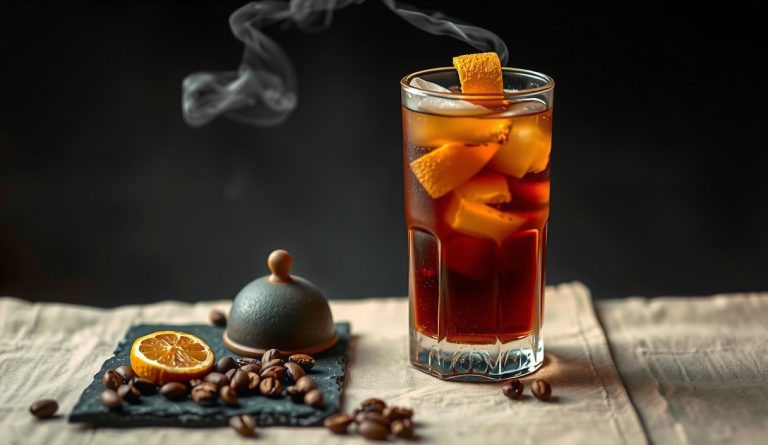
Non-alcoholic version: Cold-brew black tea concentrate (Ethiopian Yirgacheffe, brewed at 200 mL water to 20 g tea, 12 hours, refrigerator) stands in for the bourbon. The tea’s tannins provide astringency backbone and its natural aldehyde-ketone aromatic profile has structural parallels to whiskey. Smoke the tea concentrate for 8 minutes only — water is a far less efficient solvent for phenols than ethanol, and over-smoking causes phenols to adsorb onto tannin particles and produce a medicinal, harsh note. Add 0.5 oz of a non-alcoholic whiskey spirit (Lyre’s American Malt) for body, and use peach bitters in place of Angostura for a higher-note aromatic counterpoint.
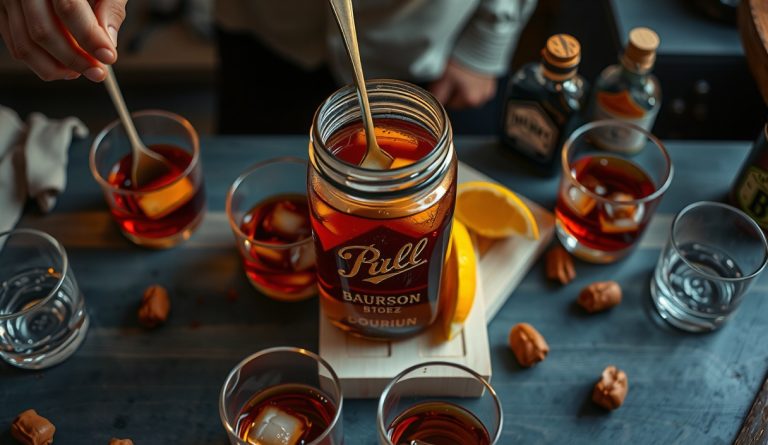
Scaling for batch service: For eight servings, cold-smoke 12 oz of bourbon in a sealed Mason jar for 25 minutes, shaking the jar gently every 5 minutes to increase liquid-vapor interface contact. Combine a pre-mixed bitters-and-syrup solution (8 sugar cubes dissolved in 4 oz hot water, cooled, plus 2 oz Angostura) with the smoked bourbon and refrigerate. For service, pour 2.5 oz per cocktail over ice and stir to order. The smoked bourbon holds in the sealed jar for up to 72 hours refrigerated before phenolic oxidation begins to shift the aromatic profile toward stale wood.
Frequently asked questions about the smoked Old-Fashioned
Why cold-smoke the bourbon at 90°F instead of just smoking the empty glass before adding spirit? Smoking an empty glass and then pouring spirit into it deposits phenolic compounds on the glass walls via condensation, not dissolution into the liquid. The majority of those compounds stay adsorbed to the glass surface and never transfer meaningfully into the drink. Cold-smoking the bourbon directly at 90°F ensures phenols dissolve into the ethanol matrix where they are bioavailable and organoleptically active. Glass-smoking is theater; liquid-smoking is chemistry.
Can I use simple syrup instead of a sugar cube? Yes, but one layer of control is sacrificed. A 1:1 simple syrup (0.25 oz) dissolved directly into the spirit means the sucrose is already in solution before bitters are added, so the bitters integrate into a more dilute liquid rather than being absorbed into a dense sugar crystal first. The experiential difference is subtle — the cube version tends to produce a slightly more integrated bitters presence — but if you are building cocktails quickly or scaling up a batch, simple syrup is a structurally sound shortcut.
How long does smoked bourbon keep before the smoke character degrades? Sealed and refrigerated, smoked bourbon retains its distinctive phenolic character for 48 to 72 hours. After that, the guaiacol and syringol compounds begin oxidizing, producing aldehydic degradation products that smell sour or papery rather than smoky. The ethanol matrix does provide some antioxidant protection, but it is not indefinite. If batch-smoking, label the container with the smoke date and treat the smoked bourbon like a fresh ingredient, not a pantry staple.