Smoked Bourbon-Pecan Pie
Equipment
- 1 Smoker or kettle grill with indirect setup Stable 325°F indirect heat required. Hickory or pecan wood chunk.
- 1 9-inch pie dish Standard deep-dish or regular depth both work.
- 1 cup Pie weights or dried beans For blind-baking the crust.
- 1 Rimmed baking sheet Catches any filling overflow and diffuses bottom heat on the smoker grate.
- 1 Instant-read thermometer Critical for hitting the 200°F pull point.
- 1 Medium saucepan For warming the corn syrup and butter mixture.
- 1 Whisk
Ingredients
Crust
- 1.25 cups all-purpose flour plus more for dusting
- 0.5 tsp kosher salt
- 1 tsp granulated sugar
- 8 tbsp unsalted butter cold, cut into 1/2-inch cubes
- 3 tbsp ice water add one tablespoon at a time until dough just comes together
Filling
- 1 cup dark corn syrup
- 0.75 cup packed dark brown sugar
- 4 tbsp unsalted butter
- 3 large eggs room temperature
- 3 tbsp wheated bourbon such as Maker’s Mark or Larceny
- 2 tsp pure vanilla extract
- 0.5 tsp kosher salt
- 2 cups pecan halves whole or half, not pieces
For the Smoker
- 1 large hickory wood chunk or 2 oz hickory chips, soaked 20 minutes if using chips

Instructions
Make the Crust
- Combine flour, salt, and granulated sugar in a large bowl. Add the cold butter cubes and work them in with your fingertips or a pastry cutter until the mixture resembles coarse, pea-sized crumbs. Drizzle in ice water one tablespoon at a time, tossing with a fork after each addition, until the dough just holds together when pressed. Do not overwork — you want visible butter streaks, which create flaky layers via steam expansion during baking.0.5 tsp kosher salt, 1 tsp granulated sugar, 8 tbsp unsalted butter, 3 tbsp ice water
- Shape the dough into a disc, wrap in plastic, and refrigerate for at least 30 minutes. On a lightly floured surface, roll to a 12-inch circle, about 1/8-inch thick. Transfer to the 9-inch pie dish, trim to a 1-inch overhang, fold under, and crimp. Freeze the shell for 15 minutes — this relaxes the gluten and prevents significant shrinkage during blind baking.
- Preheat your oven to 375°F. Line the chilled shell with parchment paper and fill with pie weights or dried beans. Blind bake for 20 minutes. Remove the weights and parchment, then bake uncovered for an additional 5 minutes until the bottom appears dry and just lightly golden. Remove and let cool while you build the filling. Do not skip this step — a par-baked crust is the only structural defense against a soggy bottom once the high-moisture filling is added.
Make the Filling
- In a medium saucepan over medium-low heat, combine dark corn syrup, dark brown sugar, and butter. Stir until the butter is fully melted and the sugar is dissolved, about 3–4 minutes. Remove from heat and let cool to room temperature — approximately 75–80°F. This is critical: adding eggs to a hot sugar mixture causes immediate, uncontrolled coagulation of the albumen, producing scrambled curds rather than a smooth custard matrix.1 cup dark corn syrup, 0.75 cup packed dark brown sugar, 4 tbsp unsalted butter
- Once the sugar mixture has cooled, whisk in the eggs one at a time, fully incorporating each before adding the next. Whisk in the bourbon, vanilla extract, and salt. The filling should be smooth, glossy, and uniform. Do not aerate excessively — vigorous whisking introduces bubbles that can cause surface cratering during the bake.3 large eggs, 3 tbsp wheated bourbon, 2 tsp pure vanilla extract, 0.5 tsp kosher salt
- Scatter the pecan halves evenly across the bottom of the par-baked crust. Pour the filling slowly over the pecans. The pecans will float to the surface as you pour — this is correct. They will form the exposed top layer that directly contacts the smoke environment. Pour filling to within 1/4 inch of the crust rim.2 cups pecan halves
Smoke-Bake the Pie
- Set up your smoker or kettle grill for indirect heat at 325°F. For a kettle grill: bank lit charcoal to one side, place a drip pan on the opposite side, and set the pie over the drip pan side. Add a hickory wood chunk directly to the coals. For a pellet smoker: set to 325°F and use hickory pellets. Allow the smoke to establish — the chamber should be running clear to light blue smoke (thin blue), not thick white smoke, before the pie goes in. Thick white smoke deposits acrid, bitter creosote, not clean phenolic campfire notes.1 large hickory wood chunk
- Place the filled pie on the rimmed baking sheet and set it in the indirect zone of the smoker. Close the lid. Smoke-bake at a steady 325°F for 45–55 minutes with minimal lid lifting. The pie is done when the edges are fully set and the center has a 2-inch wobble radius when the sheet is gently nudged. Confirm doneness with an instant-read thermometer inserted into the center: target is 200°F. Below 195°F the sugar matrix has not set sufficiently and the center will weep when sliced.
- Transfer the pie to a wire rack. Rest at room temperature, undisturbed, for a minimum of 2 hours before cutting. The custard egg matrix continues to firm as the temperature drops through the gelation curve. Cutting early — above 120°F internal — releases liquid filling that has not yet achieved its final semi-solid phase state. After 2 hours at room temperature, refrigerate for storage. Bring back to room temperature 30–40 minutes before serving for full fat-melt mouthfeel and peak aroma release.
Notes
Nutrition
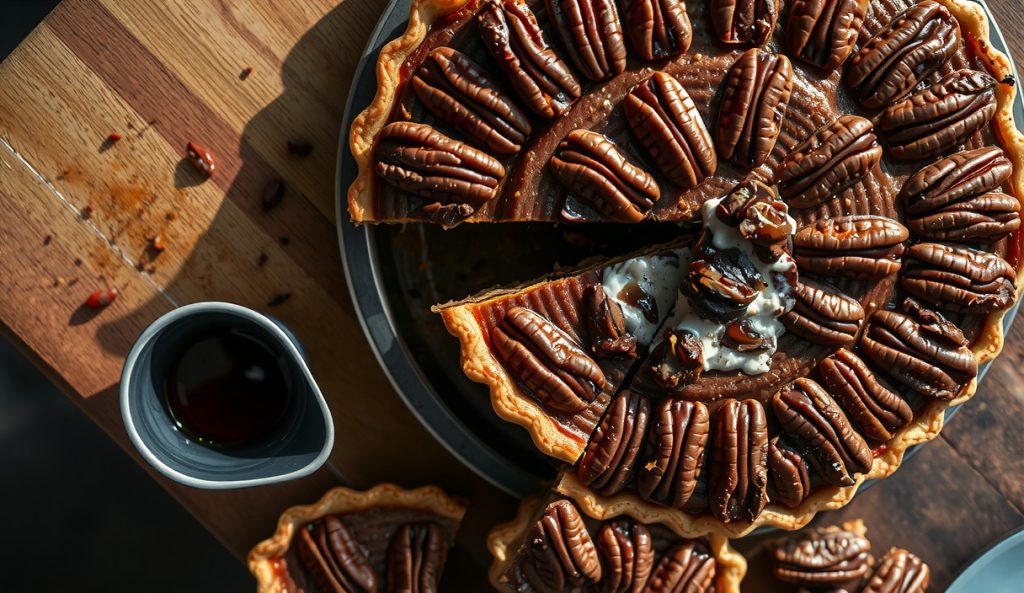
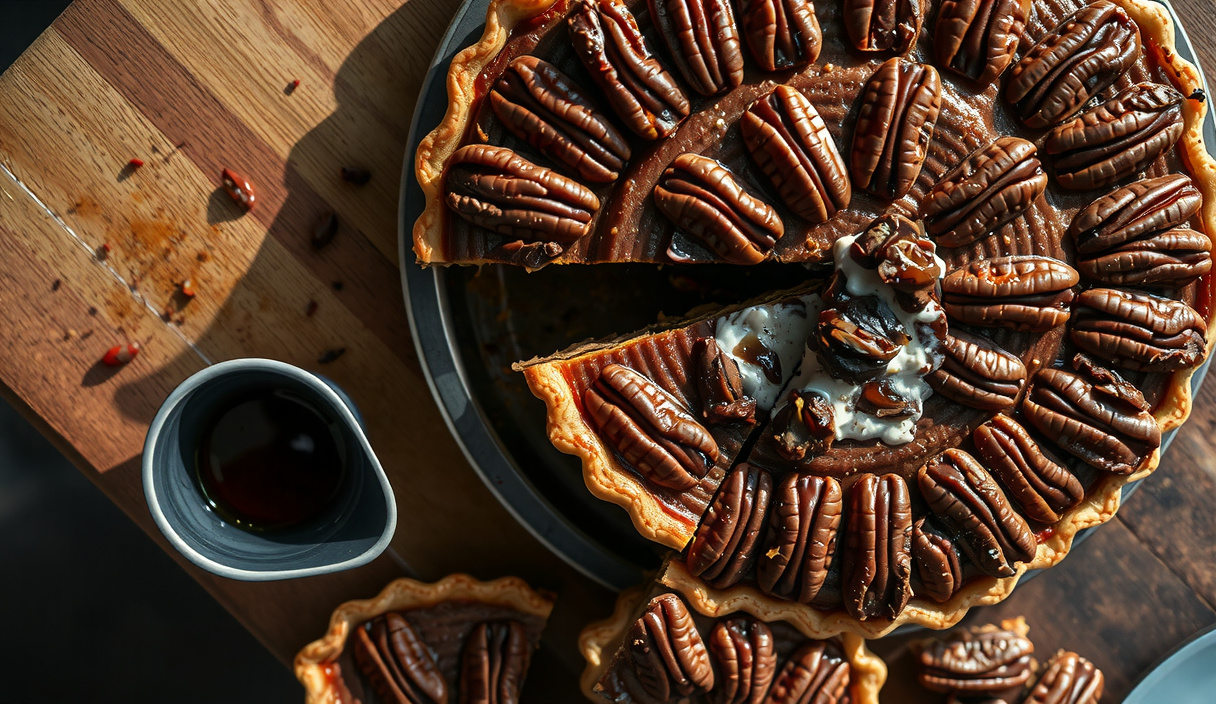
The first time I pulled this pie off the smoker, the backyard went quiet. That glossy, mahogany-lacquered surface — cracked at the edges, pecans toasted deep gold — carried something the oven version never could: a whisper of campfire that cut right through the sweetness. This is not a gimmick. The smoked bourbon-pecan pie is the predictable, reproducible result of forcing wood-smoke phenols into contact with a high-fat, high-sugar filling at a controlled 325°F — and the flavor physics behind it are worth understanding before you fire up the cooker.
Pecan pie sits at the intersection of two powerful reaction cascades: caramelization of sucrose and the Maillard browning of the egg–corn syrup matrix. Adding a live-fire smoke environment layers a third dimension — volatile guaiacol and syringol phenols from hickory combustion absorbing into the rendered pecan oil phase. The result is what serious tasters call a campfire pie note: smoky, slightly resinous, with a toasted nut depth that a convection oven simply cannot generate. This recipe is the engineered version of that experience.
Why does smoked bourbon-pecan pie work? The science
The smoked bourbon-pecan pie works because three distinct flavor-building reactions — sugar caramelization, Maillard browning, and smoke-phenol absorption — operate simultaneously at 325°F, each reinforcing the others. The pecan-pie filling is fundamentally a sugar glass suspended in a protein-egg matrix. Corn syrup — predominantly glucose oligomers — dominates the structure. Unlike sucrose, these oligomers resist crystallization, keeping the cooled filling in a soft, amorphous gel rather than a gritty crystalline mass.
Brown sugar contributes free glucose and fructose (from partial inversion), which are highly reactive in Maillard condensation above 280°F surface temperature, producing melanoidin pigments responsible for the filling’s mahogany color and toffee aroma. The eggs provide the protein network: ovalbumin begins denaturing around 142°F, ovotransferrin at 134°F, and the entire albumen fraction coagulates firmly by 160°F — locking the filling into a sliceable, custardy gel without crossing the 180°F threshold where sulfurous off-notes emerge from overcooking.
Bourbon contributes ethanol (boiling point 173°F), which volatilizes during baking, driving off harsh higher alcohols while depositing non-volatile congeners — vanillin, lactones, and furfural derivatives — directly into the fat phase of the filling. These congeners are lipophilic and bond preferentially to the rendered pecan oil, creating a time-delayed aromatic release as the fat melts on the palate.
The smoke mechanism is the most thermodynamically interesting layer. Wood combustion at the firebox produces volatile phenolic compounds — primarily guaiacol (2-methoxyphenol) and syringol (2,6-dimethoxyphenol) — with boiling points between 374°F and 428°F. In the cool-smoke environment of a 325°F smoker, these compounds exist in vapor phase and partition aggressively into the lipid-continuous surface layer of the filling and the rendered pecan fat. The partition coefficient strongly favors the fat phase (log P for guaiacol ≈ 1.34), meaning smoke phenols are literally absorbed and sequestered in the pecans’ own oil. This is why a smoked pecan pie carries flavor depth that a liquid-smoke-dosed oven pie cannot replicate: the phenols are delivered in a vapor matrix that contacts the entire exposed surface continuously during the 50-minute cook window, not in a single aqueous dose.
The par-baked crust enters the smoker already set, preventing the bottom from absorbing moisture from the filling and becoming gummy — a direct application of controlling the gelatinization window of the flour starch before the high-sugar, high-moisture filling is introduced. Water activity management is equally critical. The corn syrup and brown sugar together depress the water activity (aw) of the filling to approximately 0.80–0.85, which sits at the lower end of the optimal Maillard browning window (aw 0.50–0.70 for maximum rate, but the sugar load compensates by massively increasing the reactant concentration). This depressed aw also suppresses microbial activity and limits evaporative surface cooling that would otherwise delay browning — explaining why the top of the filling develops its lacquered crust during the smoke-bake without the surface temperature stalling at 212°F the way a high-moisture batter would.
What equipment and ingredients do I need?
- Smoker or kettle grill with indirect setup: You need a stable 325°F indirect environment. A kettle grill with two-zone charcoal and a chunk of hickory wood works perfectly. An offset or pellet smoker set to 325°F is equally valid. Avoid applewood or fruitwoods here — their lower phenol output produces a lighter smoke character that gets lost in the bold filling. Hickory or pecan wood (if you can find it) is the pairing choice.
- Blind-bake weights or dried beans: The crust must be par-baked blind to prevent the bottom from becoming a soggy, undercooked layer. Use pie weights, dried chickpeas, or aluminum foil pressed tight into the shell.
- Dark corn syrup, not light: Dark corn syrup contains refiner’s molasses, which adds bitterness, mineral depth, and additional Maillard precursors. Light corn syrup produces a sweeter, one-dimensional filling. Either works structurally, but dark is the correct choice for a smoked application where you want tonal depth.
- Bourbon quality: Use a wheated bourbon (e.g., Maker’s Mark, Larceny) for its softer, vanilla-forward congener profile. High-rye bourbons bring spice that can clash with the smoke phenols. The spirit should add sweetness and fat-soluble aromatics, not compete with the hickory.
- Pecan halves, not pieces: Whole or half pecans create a structural surface layer that absorbs smoke directly. Pieces sink into the filling and lose surface contact with the smoke environment.
- Instant-read thermometer: Pull the pie when the center registers 200°F. This is the critical control point — above 160°F the egg matrix is fully set, but you need to hold to 200°F to ensure the sugar solution has sufficiently firmed. Below 195°F, the center will weep.
Smoked Bourbon-Pecan Pie
Equipment
- 1 Smoker or kettle grill with indirect setup Stable 325°F indirect heat required. Hickory or pecan wood chunk.
- 1 9-inch pie dish Standard deep-dish or regular depth both work.
- 1 cup Pie weights or dried beans For blind-baking the crust.
- 1 Rimmed baking sheet Catches any filling overflow and diffuses bottom heat on the smoker grate.
- 1 Instant-read thermometer Critical for hitting the 200°F pull point.
- 1 Medium saucepan For warming the corn syrup and butter mixture.
- 1 Whisk
Ingredients
Crust
- 1.25 cups all-purpose flour plus more for dusting
- 0.5 tsp kosher salt
- 1 tsp granulated sugar
- 8 tbsp unsalted butter cold, cut into 1/2-inch cubes
- 3 tbsp ice water add one tablespoon at a time until dough just comes together
Filling
- 1 cup dark corn syrup
- 0.75 cup packed dark brown sugar
- 4 tbsp unsalted butter
- 3 large eggs room temperature
- 3 tbsp wheated bourbon such as Maker’s Mark or Larceny
- 2 tsp pure vanilla extract
- 0.5 tsp kosher salt
- 2 cups pecan halves whole or half, not pieces
For the Smoker
- 1 large hickory wood chunk or 2 oz hickory chips, soaked 20 minutes if using chips
Instructions
Make the Crust
- Combine flour, salt, and granulated sugar in a large bowl. Add the cold butter cubes and work them in with your fingertips or a pastry cutter until the mixture resembles coarse, pea-sized crumbs. Drizzle in ice water one tablespoon at a time, tossing with a fork after each addition, until the dough just holds together when pressed. Do not overwork — you want visible butter streaks, which create flaky layers via steam expansion during baking.0.5 tsp kosher salt, 1 tsp granulated sugar, 8 tbsp unsalted butter, 3 tbsp ice water
- Shape the dough into a disc, wrap in plastic, and refrigerate for at least 30 minutes. On a lightly floured surface, roll to a 12-inch circle, about 1/8-inch thick. Transfer to the 9-inch pie dish, trim to a 1-inch overhang, fold under, and crimp. Freeze the shell for 15 minutes — this relaxes the gluten and prevents significant shrinkage during blind baking.
- Preheat your oven to 375°F. Line the chilled shell with parchment paper and fill with pie weights or dried beans. Blind bake for 20 minutes. Remove the weights and parchment, then bake uncovered for an additional 5 minutes until the bottom appears dry and just lightly golden. Remove and let cool while you build the filling. Do not skip this step — a par-baked crust is the only structural defense against a soggy bottom once the high-moisture filling is added.
Make the Filling
- In a medium saucepan over medium-low heat, combine dark corn syrup, dark brown sugar, and butter. Stir until the butter is fully melted and the sugar is dissolved, about 3–4 minutes. Remove from heat and let cool to room temperature — approximately 75–80°F. This is critical: adding eggs to a hot sugar mixture causes immediate, uncontrolled coagulation of the albumen, producing scrambled curds rather than a smooth custard matrix.1 cup dark corn syrup, 0.75 cup packed dark brown sugar, 4 tbsp unsalted butter
- Once the sugar mixture has cooled, whisk in the eggs one at a time, fully incorporating each before adding the next. Whisk in the bourbon, vanilla extract, and salt. The filling should be smooth, glossy, and uniform. Do not aerate excessively — vigorous whisking introduces bubbles that can cause surface cratering during the bake.3 large eggs, 3 tbsp wheated bourbon, 2 tsp pure vanilla extract, 0.5 tsp kosher salt
- Scatter the pecan halves evenly across the bottom of the par-baked crust. Pour the filling slowly over the pecans. The pecans will float to the surface as you pour — this is correct. They will form the exposed top layer that directly contacts the smoke environment. Pour filling to within 1/4 inch of the crust rim.2 cups pecan halves
Smoke-Bake the Pie
- Set up your smoker or kettle grill for indirect heat at 325°F. For a kettle grill: bank lit charcoal to one side, place a drip pan on the opposite side, and set the pie over the drip pan side. Add a hickory wood chunk directly to the coals. For a pellet smoker: set to 325°F and use hickory pellets. Allow the smoke to establish — the chamber should be running clear to light blue smoke (thin blue), not thick white smoke, before the pie goes in. Thick white smoke deposits acrid, bitter creosote, not clean phenolic campfire notes.1 large hickory wood chunk
- Place the filled pie on the rimmed baking sheet and set it in the indirect zone of the smoker. Close the lid. Smoke-bake at a steady 325°F for 45–55 minutes with minimal lid lifting. The pie is done when the edges are fully set and the center has a 2-inch wobble radius when the sheet is gently nudged. Confirm doneness with an instant-read thermometer inserted into the center: target is 200°F. Below 195°F the sugar matrix has not set sufficiently and the center will weep when sliced.
- Transfer the pie to a wire rack. Rest at room temperature, undisturbed, for a minimum of 2 hours before cutting. The custard egg matrix continues to firm as the temperature drops through the gelation curve. Cutting early — above 120°F internal — releases liquid filling that has not yet achieved its final semi-solid phase state. After 2 hours at room temperature, refrigerate for storage. Bring back to room temperature 30–40 minutes before serving for full fat-melt mouthfeel and peak aroma release.
Notes
Nutrition
How do I nail it every time? Tips for the perfect smoked pecan pie
- Par-bake aggressively, not timidly. Most home bakers under-par-bake their crust, pulling it at pale gold. The bottom should be fully set and lightly golden — about 20 minutes at 375°F with weights, then 5 more minutes uncovered. A pale, underbaked bottom crust will become a gummy, undercooked disaster once the filling’s moisture migrates into it during the 50-minute smoke-bake.
- Let the filling cool to room temperature before pouring. A hot filling hits a warm crust and can cause the crust edge to over-brown before the center sets. Room-temperature filling ensures a more even thermal gradient during the bake.
- Place the pie on a rimmed baking sheet going into the smoker. Filling can bubble over, and the sheet acts as a heat diffuser — protecting the bottom of the crust from direct radiant heat off the grate and reducing the risk of a burnt bottom while the center climbs to temperature.
- Do not open the smoker lid repeatedly. Every lid-lift drops the chamber temperature 25–40°F and vents accumulated phenol-laden smoke. Smoke the pie with minimal interference. One check at 35 minutes to assess color is sufficient.
- The filling will jiggle at 200°F internal — that is correct. A 2-inch radius of the center will still wobble when you pull the pie. This is the correct carryover behavior for a custard-style pie. The filling firms fully as it cools to room temperature over 2 hours. Cutting a hot pie is the number-one cause of runny slices.
- Rest at room temperature, then refrigerate after 2 hours. The filling sets as it cools. Refrigerating too quickly causes condensation to form on the surface and dissolve the lacquered top layer. Two hours at room temperature, then wrap and refrigerate for clean slices.
What variations can I make on this recipe?
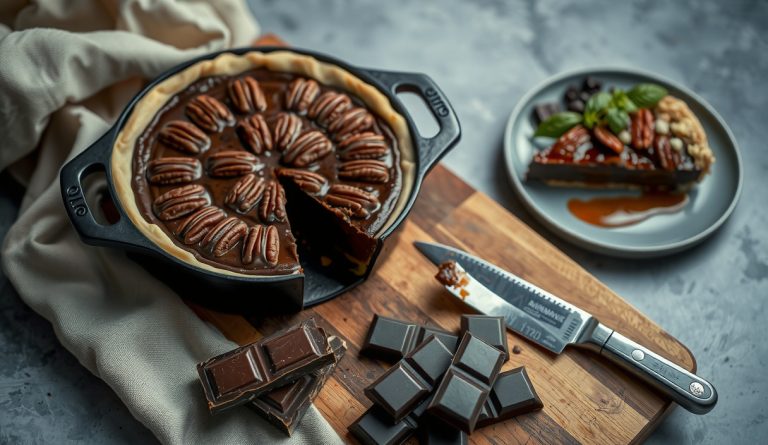
Chocolate-smoked pecan pie: Whisk 2 oz of finely chopped dark chocolate (70% cacao) into the warm corn syrup mixture before adding the eggs. The cocoa butter integrates into the fat phase and picks up smoke phenols alongside the pecan oil, creating a deeper, more resonant finish. Reduce the brown sugar by 2 tablespoons to compensate for the bitterness of the chocolate. This variant pairs exceptionally well with pecan wood smoke rather than hickory.
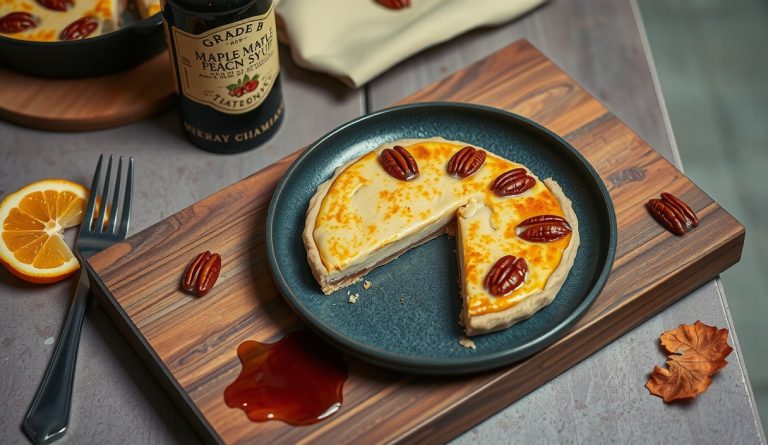
Maple-smoked pecan pie (no corn syrup): Replace the dark corn syrup entirely with Grade B (dark robust) maple syrup. The higher mineral and organic acid content of Grade B maple brings a more complex, less sweet profile that stands up to heavy smoke application. Note that maple syrup has a slightly higher water activity than corn syrup, so extend the smoke-bake time by 5–8 minutes and pull at 203°F internal. The maple-smoke combination with hickory wood is a particularly northeastern flavor pairing that works beautifully.
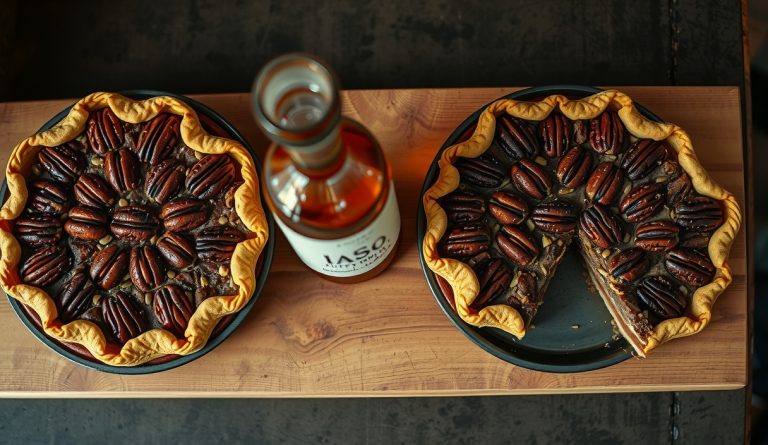
Scaling up for a crowd: This recipe fills one standard 9-inch pie. To make two pies simultaneously, double all filling ingredients and use two blind-baked shells. Both pies can sit side-by-side on the smoker grate without affecting each other’s cook time. The phenol absorption rate is surface-area-dependent, not volume-dependent, so two pies smoke identically to one.
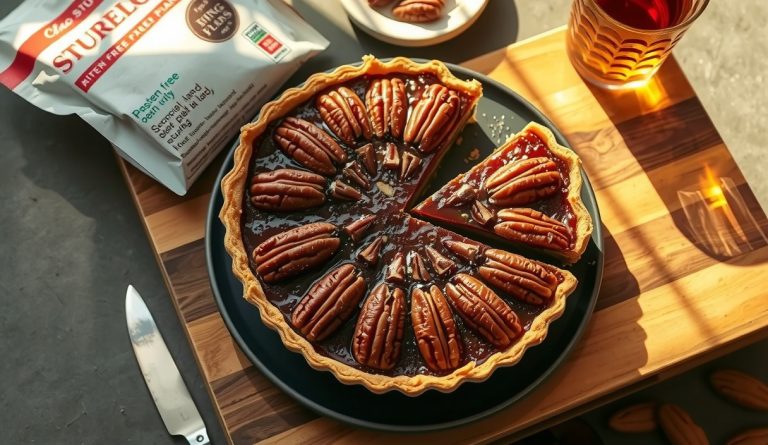
Gluten-free crust adaptation: A 1:1 gluten-free flour blend (rice flour dominant, with tapioca starch) works well for the crust if needed. Add 1/4 teaspoon xanthan gum per cup of GF flour to provide the viscoelastic network that gluten would normally supply. The blind-bake behavior is nearly identical, though GF crusts brown slightly faster — check at the 15-minute mark.
Frequently asked questions about smoked bourbon-pecan pie
Can I make this in a standard oven if I don’t have a smoker? Yes, with a meaningful flavor trade-off. Bake the smoked bourbon-pecan pie at 325°F in a conventional oven for 50–55 minutes. The result is a beautifully set, delicious pecan pie — but the smoke phenol layer that creates the campfire note will be absent. Adding 1/2 teaspoon of liquid smoke to the filling approximates the guaiacol profile chemically, though the delivery mechanism is aqueous rather than vapor-phase, meaning the flavor is sharper and less integrated than the genuine smoked version.
Why does my filling crack on top after cooling? Surface cracking in pecan pie is caused by the egg matrix setting at a faster rate than the sugar solution cools and contracts. Two common causes: the smoker ran too hot (above 340°F), or the pie cooled too rapidly in a cold draft. Pull the smoked bourbon-pecan pie right at 200°F internal and let it cool in a draft-free area. A small crack is cosmetic and does not affect texture or flavor.
How far in advance can I make this pie? The smoked bourbon-pecan pie holds very well refrigerated. Bake and cool fully, then wrap tightly and refrigerate for up to 4 days. The smoke phenols actually integrate more deeply into the fat phase over 24 hours of refrigeration, making a day-old slice more complex than a freshly baked one. Bring the pie to room temperature for 30–45 minutes before serving for the best fat-melt mouthfeel and aroma release.