Spatchcocked Smoked Whole Turkey
Equipment
- 1 Heavy-duty kitchen shears or poultry shears Must be rated for bone work. Standard scissors will fail on the spine and rib joints.
- 1 Smoker or charcoal grill with indirect heat setup Pellet grill, offset smoker, or kettle grill configured for indirect heat. Must hold 325°F stably.
- 1 Instant-read digital thermometer Mandatory. You will be probing breast and thigh independently. A leave-in probe for the breast and a spot-check thermometer for the thigh is ideal.
- 1 Large rimmed sheet pan or wire rack For dry brining in the refrigerator uncovered. Wire rack elevates the bird so air circulates beneath the skin.
- 3 to 4 chunks Apple wood chunks Dry, not soaked. 2 to 3 inch chunks. Not chips.
- 2 to 3 chunks Cherry wood chunks Dry, not soaked. Used alongside apple for color depth and mild tartness.
- 1 Disposable aluminum drip pan Placed under the bird to catch drippings and prevent flare-ups. Can be filled with 1 cup water to moderate temperature.
Ingredients
Turkey and Dry Brine
- 1 whole turkey, 12 to 14 pounds, spine removed (spatchcocked) Spine removal can be done by your butcher or at home with heavy shears. Fresh or fully thawed. Giblets and neck removed.
- 3 tablespoons kosher salt (Diamond Crystal) If using Morton kosher salt, reduce to 2 tablespoons plus 1 teaspoon. If using table salt, use 1 tablespoon plus 1 teaspoon.
- 1 tablespoon coarsely ground black pepper
- 1 teaspoon garlic powder
- 1 teaspoon onion powder
- 1 teaspoon smoked paprika Optional but contributes additional Maillard browning precursors and color.
Compound Butter (for under-skin application)
- 4 tablespoons unsalted butter, softened to room temperature
- 1 teaspoon fresh thyme leaves, roughly chopped
- 1 teaspoon fresh rosemary, minced
- 1 teaspoon lemon zest
- 1 pinch kosher salt

Instructions
Day 1 — Spatchcock and Dry Brine (48 Hours Before Cook)
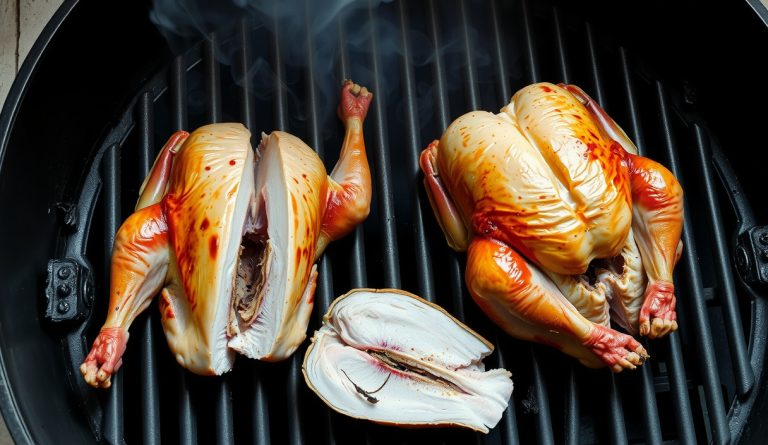
- Place the turkey breast-side down on a stable cutting board. Using heavy poultry shears, cut along one side of the spine from the tail cavity to the neck, staying as close to the spine as possible. Repeat on the other side of the spine and remove it entirely. Reserve the spine for stock if desired.
- Flip the turkey breast-side up. Use both palms to press down firmly on the center of the breastbone until you feel and hear a crack. The bird should now lay completely flat. If it still rocks, locate the high point and press again until it stays flat on the board.
- In a small bowl, combine the kosher salt, black pepper, garlic powder, onion powder, and smoked paprika. Mix thoroughly.3 tablespoons kosher salt (Diamond Crystal), 1 tablespoon coarsely ground black pepper, 1 teaspoon garlic powder, 1 teaspoon onion powder, 1 teaspoon smoked paprika
- Loosen the skin over the breast by gently running your fingers between the skin and the meat, working carefully to avoid tearing. Apply approximately half of the dry brine mixture directly onto the breast meat under the skin. Apply the remaining brine evenly over the entire exterior of the turkey — back, thighs, drumsticks, and wings — and inside the cavity.3 tablespoons kosher salt (Diamond Crystal), 1 tablespoon coarsely ground black pepper, 1 teaspoon garlic powder, 1 teaspoon onion powder, 1 teaspoon smoked paprika
- Place the seasoned turkey skin-side up on a wire rack set over a rimmed sheet pan. Refrigerate uncovered for 48 hours. Do not cover. The uncovered refrigerator environment is intentional — it desiccates the skin surface, which is critical for Maillard browning during smoking.
Day 3 — Smoke
- Remove the turkey from the refrigerator 45 to 60 minutes before cooking. Pat every surface thoroughly dry with paper towels — especially the skin folds, the inner cavity, and beneath the breast skin flap. Any pooled surface moisture will steam in the smoker and prevent crisping.
- Prepare the compound butter: in a small bowl, combine the softened butter, thyme, rosemary, lemon zest, and a pinch of kosher salt. Mix until uniform. Work the compound butter under the loosened breast skin and spread it evenly over the breast meat in a thin layer. Rub any remaining butter over the exterior skin of the thighs.4 tablespoons unsalted butter, softened to room temperature, 1 teaspoon fresh thyme leaves, roughly chopped, 1 teaspoon fresh rosemary, minced, 1 teaspoon lemon zest, 1 pinch kosher salt
- Prepare your smoker or grill for indirect cooking at 325°F. For a charcoal kettle, arrange coals to one side or use the snake method, placing a drip pan filled with 1 cup of water directly beneath where the bird will sit. Add 3 to 4 apple wood chunks and 2 to 3 cherry wood chunks directly on or beside the hot coals. Allow the smoker to reach and stabilize at 325°F before adding the turkey.
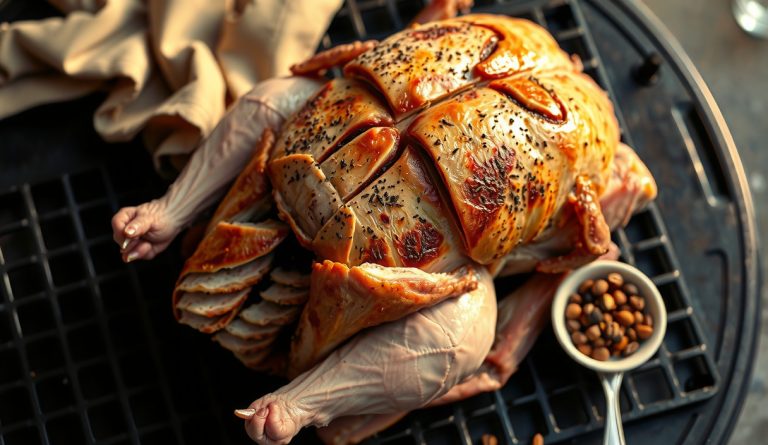
- Place the spatchcocked turkey skin-side up on the smoker grate over the drip pan, away from direct heat. Insert a leave-in probe thermometer horizontally into the thickest part of the breast, entering from the neck end and avoiding bone contact. Close the lid.
- Smoke at 325°F, maintaining thin blue smoke. Do not open the lid for the first 60 minutes. Check wood chunk combustion if the smoke goes white or heavy — adjust intake vents to increase airflow and thin out the smoke to a clean, pale blue.
- Beginning at 90 minutes, use a spot-check instant-read thermometer to probe the thigh at the thickest point, inserting from the inner thigh side toward the joint. Check both the breast and thigh temperature every 20 to 25 minutes from this point onward. The breast and thigh will not finish simultaneously — monitor both independently.
- Remove the turkey from the smoker when the breast registers 157°F and the thighs register 175°F. A 12 to 14 pound spatchcocked turkey at 325°F typically reaches these temperatures in 2 hours to 2 hours 30 minutes, but use temperature, not time, as your pull trigger. If the breast hits 157°F before the thighs reach 175°F, tent the breast loosely with foil and continue cooking until the thighs catch up.
- Transfer the turkey to a large cutting board. Tent loosely with foil — do not wrap tightly, as steam will soften the skin. Rest for 20 to 30 minutes. Carryover cooking will bring the breast to approximately 160 to 162°F and the thigh to approximately 178 to 180°F during this window.
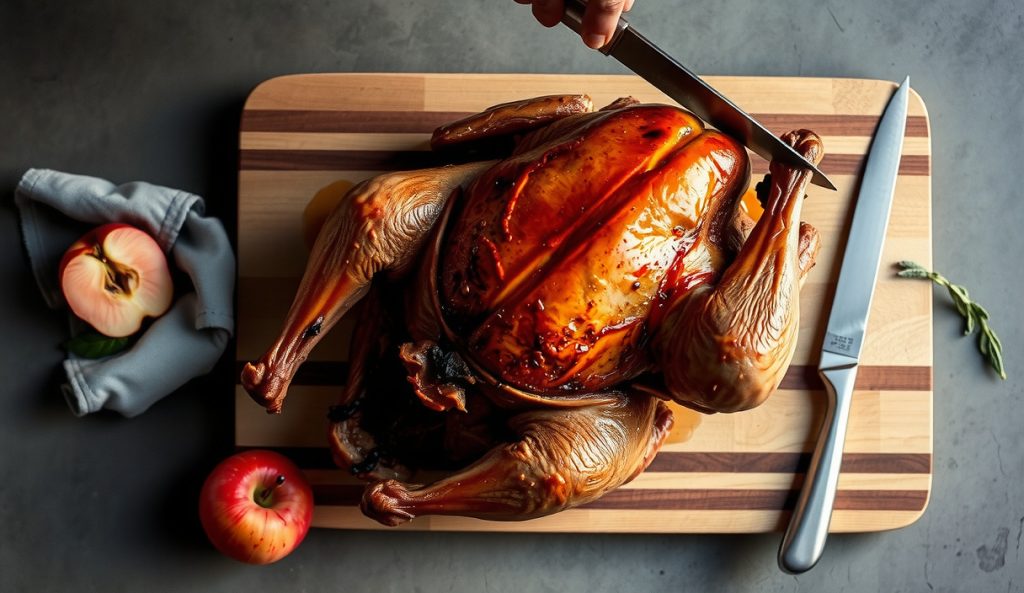
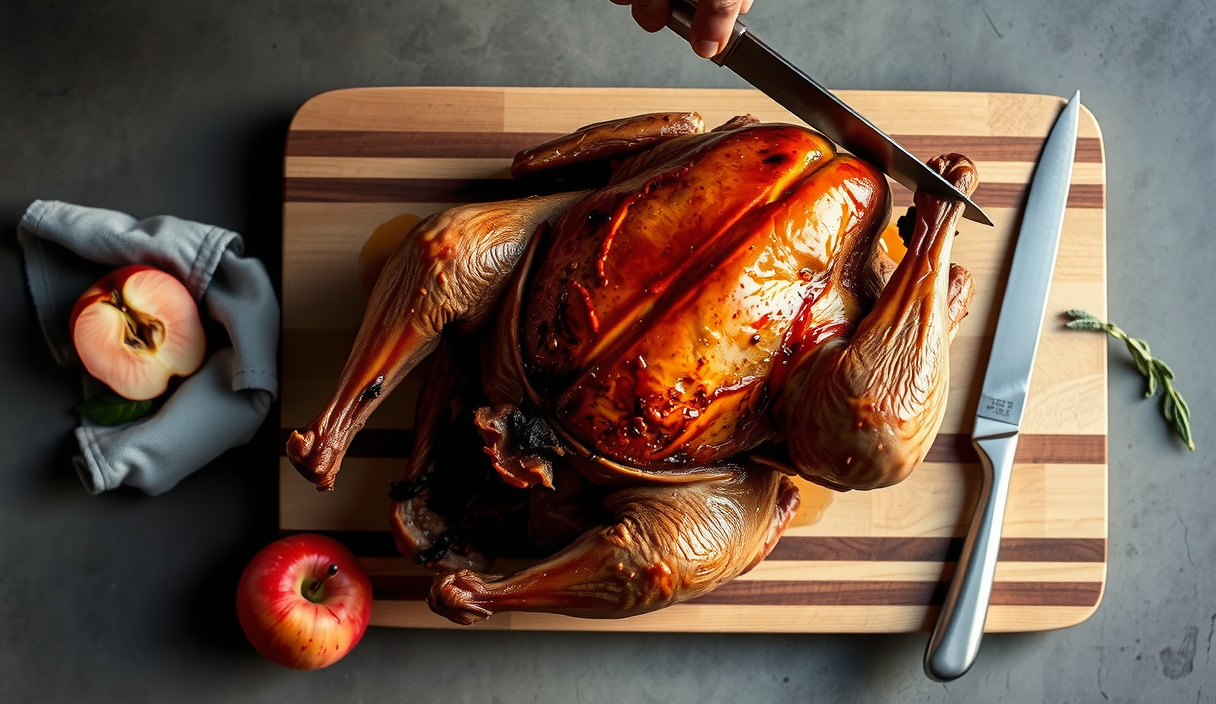
- Carve and serve. Separate the legs and thighs first by cutting through the hip joint, then remove the drumstick from the thigh at the knee joint. Slice the breast by running the knife along the breastbone and slicing crosswise against the grain at a slight angle.
Notes
Nutrition
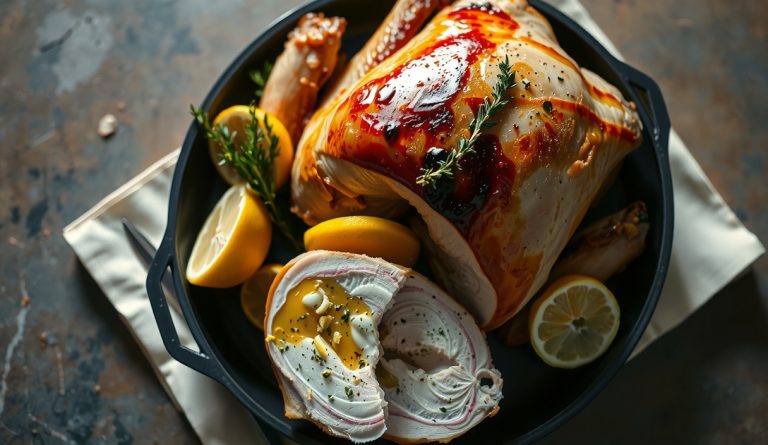
Most Thanksgiving turkeys are a compromise. The breast hits 165°F and dries out while you wait for the thighs to catch up. The skin steams instead of crisps. The bird sits upright in a roasting pan, shielded from the smoke that is supposed to be doing the work. Spatchcocking — removing the spine and pressing the bird flat — is the structural fix that changes every one of those failure modes simultaneously. Add a 48-hour dry brine and a smoker dialed to 325°F, and you are not just making turkey. You are engineering it.
At American Meathead, this technique has produced consistent results year after year: faster cook times, even color across the entire bird, and skin texture that bears no resemblance to the pale, rubbery results most smoked turkeys deliver. This is not low-and-slow mysticism. This is heat transfer physics applied to poultry.
Why does spatchcocked smoked turkey work? The science
Spatchcocking solves a geometry problem that makes whole roasted turkey so difficult to cook evenly. A whole turkey roasted upright positions the breast — the leanest, most moisture-sensitive muscle — directly above the heat source, where it cooks fastest. The thighs, rich in collagen and requiring slow hydrolysis, are tucked underneath, insulated by the carcass. Removing the spine and pressing the bird flat collapses this height differential, placing the breast and thigh on the same horizontal plane. Radiant and convective heat strikes both zones simultaneously, compressing the temperature gap from as much as 25°F to under 10°F. That single structural change drives every downstream improvement.
The 48-hour dry brine operates on two simultaneous pathways. In the first 12 hours, kosher salt draws moisture out of the surface tissue via osmosis, dissolving into a concentrated brine on the skin. Over the following 36 hours, that brine is reabsorbed by diffusion deep into the muscle fibers. Salt disrupts the myosin network at a molecular level — myosin denaturation onset begins around 104°F — causing protein strands to partially unfold and restructure in a looser geometry that holds significantly more water during cooking. The second effect is surface desiccation: leaving the bird uncovered in the refrigerator dries the skin, reducing its water activity and priming it for rapid Maillard browning the moment it hits the smoker. Maillard onset requires surface temperatures well above 250°F; at 325°F pit temperature, the skin’s boundary layer desiccates and reaches Maillard range within the first 30 minutes of cooking.
The pull targets — 157°F for the breast, 175°F for the thigh — are grounded in protein kinetics, not guesswork. Salmonella achieves a 7-log reduction at 157°F given adequate hold time; the breast is effectively pasteurized before carryover pushes it another 3 to 5 degrees during the rest. The thigh carries dense collagen networks that require sustained temperatures above 160°F to hydrolyze into gelatin. At 175°F, the collagen converts sufficiently to coat the thigh meat in a self-basting gelatin matrix — which is precisely why dark meat thighs feel juicier than breast meat even though their moisture content is actually lower. Apple wood contributes fruity esters and gentle phenolic smoke compounds; cherry wood adds anthocyanin-derived color depth and a mild tartness in the aromatic layer, staining the skin a deep mahogany without the resinous astringency of stronger woods like hickory.
What equipment and ingredients do I need?
Heavy kitchen shears or poultry shears rated for bone work are required — standard scissors will fail on the spine. If the shears hesitate on the rib joints, flip the bird breast-side up and apply direct downward palm pressure to crack the sternum flat. The breastbone breaking is correct and intentional; it is what allows the bird to lie perfectly flat.
Kosher salt is non-negotiable for the dry brine. Table salt is roughly twice as dense by volume, so if only iodized table salt is available, cut the quantity by half. Diamond Crystal and Morton kosher salt have different crystal sizes — this recipe was developed with Diamond Crystal. Morton users should reduce the salt quantity by about 25%.
The smoker must hold 325°F with confidence. Kettle grills work well using the snake or minion method with a drip pan directly under the bird. Offset smokers and pellet grills are fully compatible. The key is indirect heat: the bird must never sit directly over live coals or a flame burner. A digital instant-read thermometer is mandatory — the breast and thigh will reach their target temperatures at different times, and both zones need independent checks every 20 to 25 minutes in the final hour.
Apple and cherry wood chunks — not chips — provide sustained smoke without the sharp combustion notes that chips can deliver. Soaking wood is unnecessary and counterproductive: wet wood delays ignition and lowers chamber temperature before producing any meaningful smoke. Use dry chunks placed on or beside the coals at the start of the cook.
Spatchcocked Smoked Whole Turkey
Equipment
- 1 Heavy-duty kitchen shears or poultry shears Must be rated for bone work. Standard scissors will fail on the spine and rib joints.
- 1 Smoker or charcoal grill with indirect heat setup Pellet grill, offset smoker, or kettle grill configured for indirect heat. Must hold 325°F stably.
- 1 Instant-read digital thermometer Mandatory. You will be probing breast and thigh independently. A leave-in probe for the breast and a spot-check thermometer for the thigh is ideal.
- 1 Large rimmed sheet pan or wire rack For dry brining in the refrigerator uncovered. Wire rack elevates the bird so air circulates beneath the skin.
- 3 to 4 chunks Apple wood chunks Dry, not soaked. 2 to 3 inch chunks. Not chips.
- 2 to 3 chunks Cherry wood chunks Dry, not soaked. Used alongside apple for color depth and mild tartness.
- 1 Disposable aluminum drip pan Placed under the bird to catch drippings and prevent flare-ups. Can be filled with 1 cup water to moderate temperature.
Ingredients
Turkey and Dry Brine
- 1 whole turkey, 12 to 14 pounds, spine removed (spatchcocked) Spine removal can be done by your butcher or at home with heavy shears. Fresh or fully thawed. Giblets and neck removed.
- 3 tablespoons kosher salt (Diamond Crystal) If using Morton kosher salt, reduce to 2 tablespoons plus 1 teaspoon. If using table salt, use 1 tablespoon plus 1 teaspoon.
- 1 tablespoon coarsely ground black pepper
- 1 teaspoon garlic powder
- 1 teaspoon onion powder
- 1 teaspoon smoked paprika Optional but contributes additional Maillard browning precursors and color.
Compound Butter (for under-skin application)
- 4 tablespoons unsalted butter, softened to room temperature
- 1 teaspoon fresh thyme leaves, roughly chopped
- 1 teaspoon fresh rosemary, minced
- 1 teaspoon lemon zest
- 1 pinch kosher salt
Instructions
Day 1 — Spatchcock and Dry Brine (48 Hours Before Cook)
- Place the turkey breast-side down on a stable cutting board. Using heavy poultry shears, cut along one side of the spine from the tail cavity to the neck, staying as close to the spine as possible. Repeat on the other side of the spine and remove it entirely. Reserve the spine for stock if desired.
- Flip the turkey breast-side up. Use both palms to press down firmly on the center of the breastbone until you feel and hear a crack. The bird should now lay completely flat. If it still rocks, locate the high point and press again until it stays flat on the board.
- In a small bowl, combine the kosher salt, black pepper, garlic powder, onion powder, and smoked paprika. Mix thoroughly.3 tablespoons kosher salt (Diamond Crystal), 1 tablespoon coarsely ground black pepper, 1 teaspoon garlic powder, 1 teaspoon onion powder, 1 teaspoon smoked paprika
- Loosen the skin over the breast by gently running your fingers between the skin and the meat, working carefully to avoid tearing. Apply approximately half of the dry brine mixture directly onto the breast meat under the skin. Apply the remaining brine evenly over the entire exterior of the turkey — back, thighs, drumsticks, and wings — and inside the cavity.3 tablespoons kosher salt (Diamond Crystal), 1 tablespoon coarsely ground black pepper, 1 teaspoon garlic powder, 1 teaspoon onion powder, 1 teaspoon smoked paprika
- Place the seasoned turkey skin-side up on a wire rack set over a rimmed sheet pan. Refrigerate uncovered for 48 hours. Do not cover. The uncovered refrigerator environment is intentional — it desiccates the skin surface, which is critical for Maillard browning during smoking.
Day 3 — Smoke
- Remove the turkey from the refrigerator 45 to 60 minutes before cooking. Pat every surface thoroughly dry with paper towels — especially the skin folds, the inner cavity, and beneath the breast skin flap. Any pooled surface moisture will steam in the smoker and prevent crisping.
- Prepare the compound butter: in a small bowl, combine the softened butter, thyme, rosemary, lemon zest, and a pinch of kosher salt. Mix until uniform. Work the compound butter under the loosened breast skin and spread it evenly over the breast meat in a thin layer. Rub any remaining butter over the exterior skin of the thighs.4 tablespoons unsalted butter, softened to room temperature, 1 teaspoon fresh thyme leaves, roughly chopped, 1 teaspoon fresh rosemary, minced, 1 teaspoon lemon zest, 1 pinch kosher salt
- Prepare your smoker or grill for indirect cooking at 325°F. For a charcoal kettle, arrange coals to one side or use the snake method, placing a drip pan filled with 1 cup of water directly beneath where the bird will sit. Add 3 to 4 apple wood chunks and 2 to 3 cherry wood chunks directly on or beside the hot coals. Allow the smoker to reach and stabilize at 325°F before adding the turkey.
- Place the spatchcocked turkey skin-side up on the smoker grate over the drip pan, away from direct heat. Insert a leave-in probe thermometer horizontally into the thickest part of the breast, entering from the neck end and avoiding bone contact. Close the lid.
- Smoke at 325°F, maintaining thin blue smoke. Do not open the lid for the first 60 minutes. Check wood chunk combustion if the smoke goes white or heavy — adjust intake vents to increase airflow and thin out the smoke to a clean, pale blue.
- Beginning at 90 minutes, use a spot-check instant-read thermometer to probe the thigh at the thickest point, inserting from the inner thigh side toward the joint. Check both the breast and thigh temperature every 20 to 25 minutes from this point onward. The breast and thigh will not finish simultaneously — monitor both independently.
- Remove the turkey from the smoker when the breast registers 157°F and the thighs register 175°F. A 12 to 14 pound spatchcocked turkey at 325°F typically reaches these temperatures in 2 hours to 2 hours 30 minutes, but use temperature, not time, as your pull trigger. If the breast hits 157°F before the thighs reach 175°F, tent the breast loosely with foil and continue cooking until the thighs catch up.
- Transfer the turkey to a large cutting board. Tent loosely with foil — do not wrap tightly, as steam will soften the skin. Rest for 20 to 30 minutes. Carryover cooking will bring the breast to approximately 160 to 162°F and the thigh to approximately 178 to 180°F during this window.
- Carve and serve. Separate the legs and thighs first by cutting through the hip joint, then remove the drumstick from the thigh at the knee joint. Slice the breast by running the knife along the breastbone and slicing crosswise against the grain at a slight angle.
Notes
Nutrition
How do I nail it every time?
- Dry skin is the non-negotiable prerequisite for crispy skin. After the 48-hour dry brine, pat every surface aggressively with paper towels — especially under the breast skin flap — before applying butter or placing the bird in the smoker. Any pooled surface moisture will steam, not sear, and the skin will be leather rather than lacquered mahogany.
- Do not skip the sternum crack. If the bird rocks and will not lie flat, the sternum is not fully cracked. Press down hard with both palms until the cartilage gives audibly. A flat bird cooks in a flat, predictable way; a bird that leans will develop hot and cool spots across the breast and thigh.
- Thermometer placement matters more than you think. In the breast, insert the probe horizontally from the neck end toward the center of the thickest point and avoid bone contact. In the thigh, probe from the inner thigh side, angling toward the joint. If the femur is contacted, pull back slightly and re-angle before reading.
- 325°F is the target temperature, and it is not negotiable downward. Lower temperatures — the classic 225°F to 250°F range — prevent the skin from rendering its fat and achieving Maillard browning before the interior is cooked through. The result is rubbery, pale skin. Holding 325°F is what produces the mahogany crust this recipe is built around.
- Rest the bird tented, not wrapped. Tight foil wrapping traps steam and softens the skin that was just worked to crisp. Tent the bird loosely with foil for 20 to 30 minutes. Internal carryover will add 3 to 5 degrees to both the breast and thigh during this window.
- Monitor wood smoke output throughout the cook. Thin blue smoke is the target — that is efficient combustion producing desirable flavor compounds. Thick white or grey smoke indicates incomplete combustion and will deposit harsh, acrid notes on the skin. Adjust intake vents to thin the smoke output before it contacts the bird.
What variations can I try?
For a citrus and herb profile, work a compound butter made from softened unsalted butter, lemon zest, fresh thyme, and minced rosemary directly under the breast skin before smoking. The fat acts as a lipophilic solvent for the volatile aromatic compounds, extending their release throughout the cook and into the final bite. The compound butter should not be applied until after the dry brine period is complete and the skin is fully dry.
For a deeper, more savory bark, replace half the kosher salt in the dry brine with a mixture of kosher salt, black pepper, garlic powder, and smoked paprika in equal parts. The paprika contributes additional Maillard precursors and a red color layer beneath the smoke ring. This variation leans toward a Texas-style seasoning profile and pairs well with mesquite cut with cherry rather than the apple-forward blend in the base recipe.
For smaller birds in the 10 to 12 pound range, the cook time compresses by roughly 25 to 35 minutes. Pull temperatures remain identical at 157°F breast and 175°F thigh. Check thermometer readings earlier; a smaller bird at 325°F can hit 157°F breast temperature in as little as 90 minutes total. For birds above 16 pounds, consider splitting the bird completely into two halves after spatchcocking to further equalize cooking geometry across the larger mass.
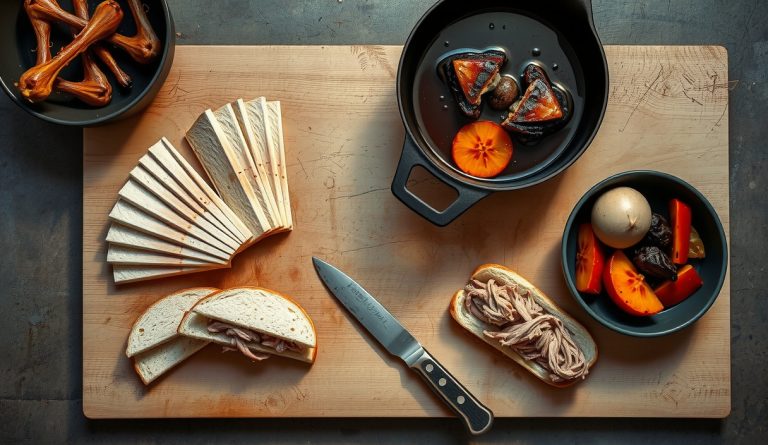
Leftover smoked turkey benefits from the residual smoke and salt concentration in ways that roasted turkey does not. Pulled thigh meat works exceptionally well in smoked turkey stock — the collagen content remains substantial even after smoking. Slice breast meat thin for sandwiches where the smoke character carries without additional seasoning. The carcass makes an exceptional smoked turkey stock; roast the bones at 400°F for 20 minutes first to develop additional Maillard depth before simmering.
Frequently asked questions
Can I brine for less than 48 hours? A 24-hour dry brine still produces meaningful improvement over an unbrined bird. Below 24 hours, the salt has not had time to fully diffuse and re-absorb, so interior benefit is minimal — mostly surface seasoning. 48 hours is the sweet spot for a 12 to 14 pound bird, allowing salt penetration to reach the deep breast muscle. If time is the constraint, prioritize drying the skin over interior salt penetration, and extend to the full 48 hours on the next cook.
Why pull the breast at 157°F instead of the USDA-recommended 165°F? The USDA’s 165°F recommendation is an instantaneous kill temperature requiring zero hold time. At 157°F with a 30-second hold — which carryover rest provides — Salmonella achieves an equivalent 7-log reduction. Pulling the breast at 157°F and resting the bird delivers a microbiologically equivalent result to 165°F while preserving measurably more moisture. The actin protein network, which begins collapsing catastrophically above 160°F and destroys water-holding capacity, is largely spared. The resulting breast is noticeably juicier with no reduction in food safety when proper resting is observed.
Do I need to baste this turkey? No, and basting actively works against the goals of this recipe. Every time the smoker lid is opened to baste, 10 to 15 minutes of heat recovery time is lost and steam is introduced that softens the skin being worked to crisp. The 48-hour dry brine has already restructured the protein network to retain interior moisture, and rendered fat from the skin will self-baste the exposed meat as the cook progresses. Keep the lid down and trust the thermometer.