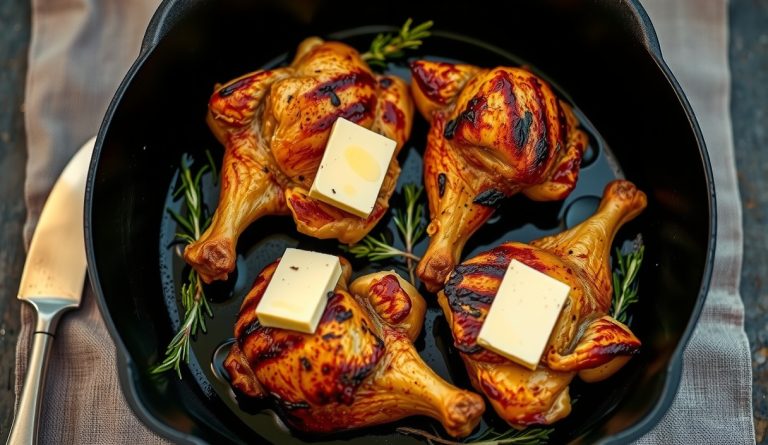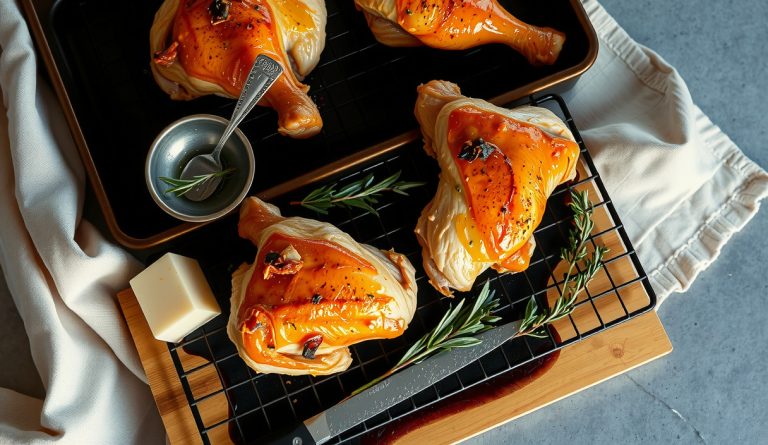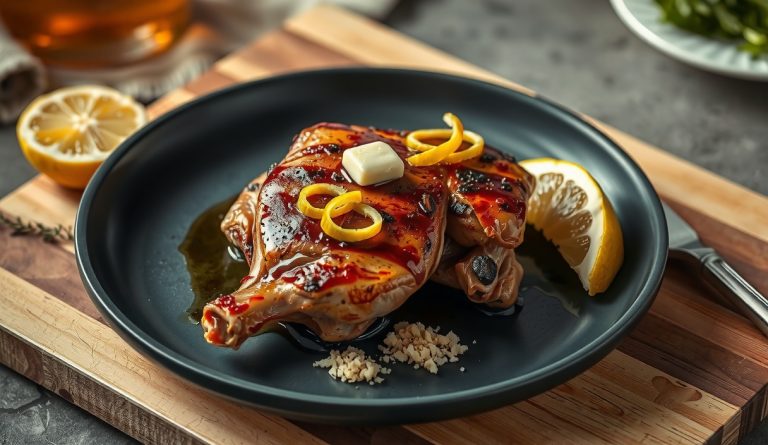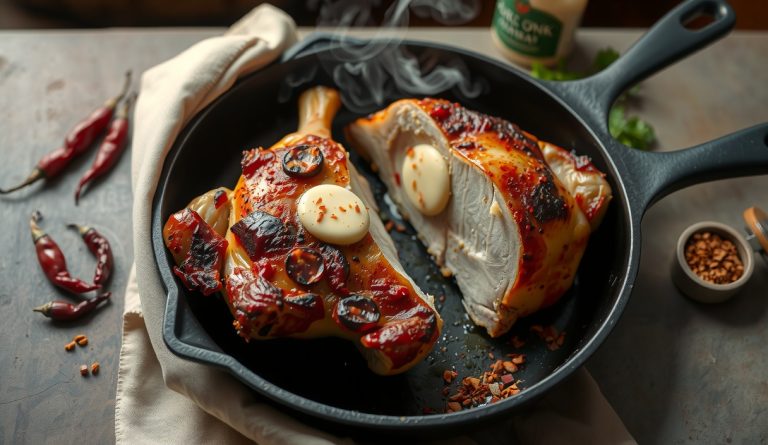
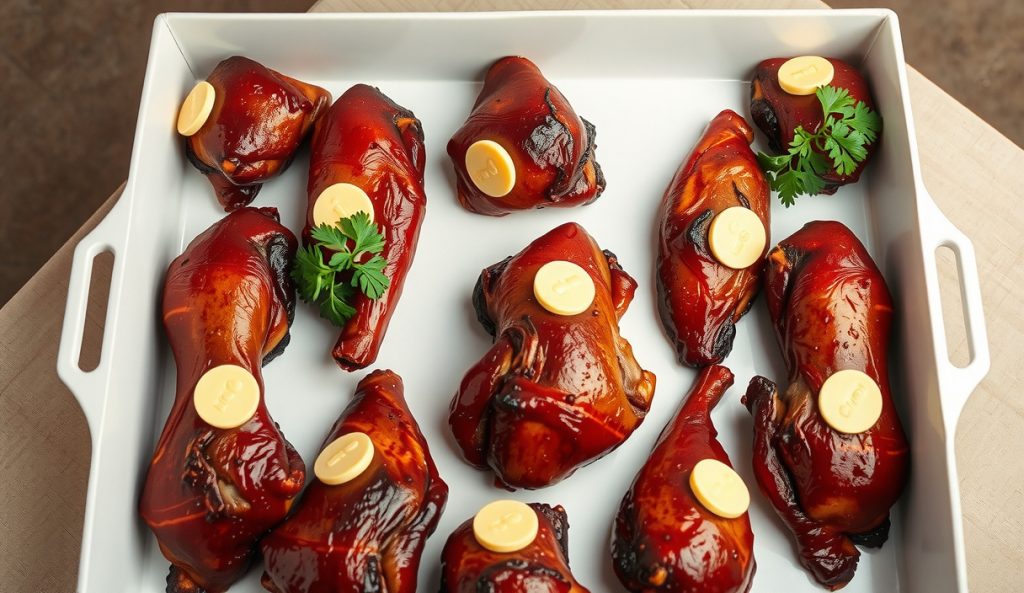
The canonical keto smoked chicken thighs recipe is written for a home cook producing four to six pieces. When you scale to competition volume — twenty, thirty, or more thighs — the core recipe math stays simple, but physical execution demands different handling. Two friction points emerge at scale: maintaining even convective smoke flow across a crowded rack, and applying compound butter efficiently under the skin of dozens of thighs without losing precision or patience.
What changes when you scale smoked chicken thighs to competition volume?
The recipe scales linearly — every thigh receives its own proportional share of rub and compound butter, with the butter scaling at exactly 1:1 by weight of butter per thigh, precisely as written in the original recipe. The critical physical constraint at competition volume is rack spacing: maintain a minimum of 1 inch of airspace between pieces on every side. Smoke is delivered by convection, and crowding creates stagnant pockets where airflow stalls, leading to uneven bark development and inconsistent internal temperature progression across the entire batch.
If your smoker uses a single large rack, arrange thighs in staggered rows rather than tight grids to preserve airflow channels between every piece. This single spacing discipline is the difference between a uniform competition box and a batch with soft spots, pale patches, or a 10°F to 15°F temperature spread between pieces on the same rack.
For the compound butter, abandon the softened-butter application method once volume exceeds roughly eight thighs. Instead, form the compound butter into one or more logs using plastic wrap, refrigerate until firm — at least two hours, or overnight — then slice coins of approximately 0.5 oz each. A cold, firm coin slides cleanly under the skin and stays in place while you work through the rest of the batch. Softened butter at volume becomes a time-consuming and inconsistently portioned process; the log-and-coin method eliminates both problems. Label coins by weight if portioning consistency is being judged.
What stays exactly the same at any batch size?
Target smoker temperature, the internal doneness target of 175°F, rub composition, wood selection, and resting protocol are all unchanged regardless of how many thighs are on the rack. Scaling does not alter the thermodynamics of an individual thigh — each piece cooks on its own internal schedule once correct spacing is maintained. The physics of a single 4 oz thigh reaching 175°F is identical whether it shares a smoker with five other pieces or thirty-five.
When is the competition-scale approach the right choice?
Use this approach any time you are cooking for more than eight people, catering a private event, or entering a competition where chicken thigh boxes are judged. The coin-slice butter technique is also worth adopting at moderate scale — ten to twelve thighs — if kitchen ambient temperature is above 75°F, where softened compound butter becomes difficult to handle cleanly and portioning precision degrades.
- Batch size over 8 thighs: switch to log-and-coin butter method
- Kitchen temperature above 75°F: coin method regardless of batch size
- Competition judging context: label butter coins by weight for portioning consistency
- Single large rack: staggered rows, minimum 1 inch airspace on all sides
Use the full method, equipment, and rub measurements from the original Keto Smoked Chicken Thighs with Garlic-Herb Compound Butter.