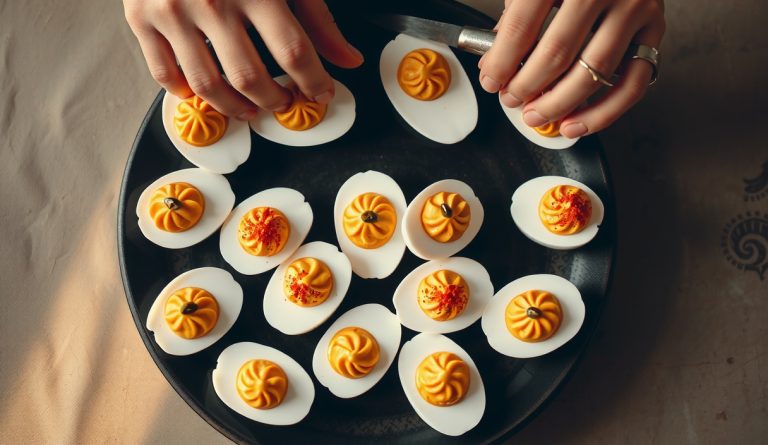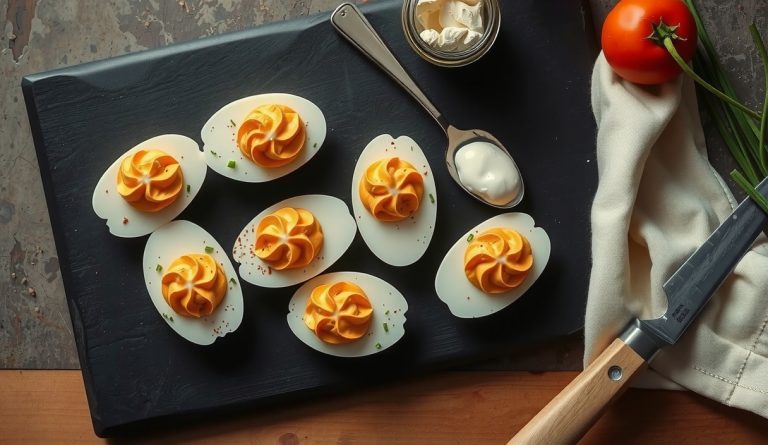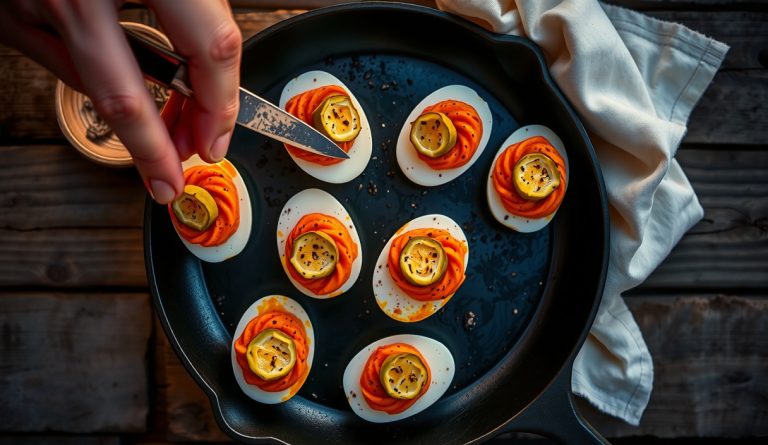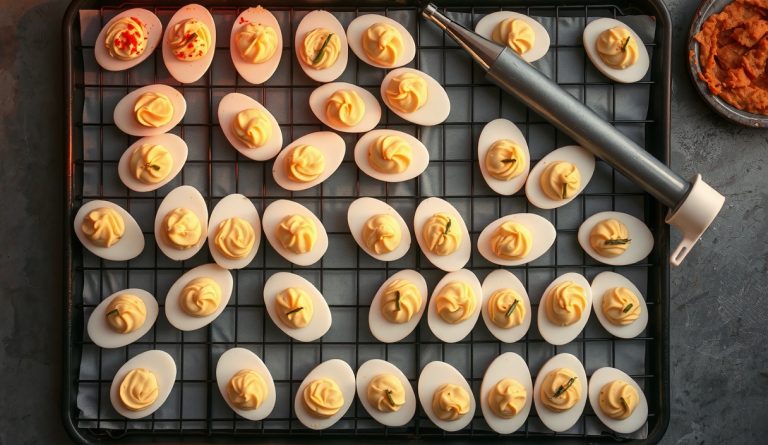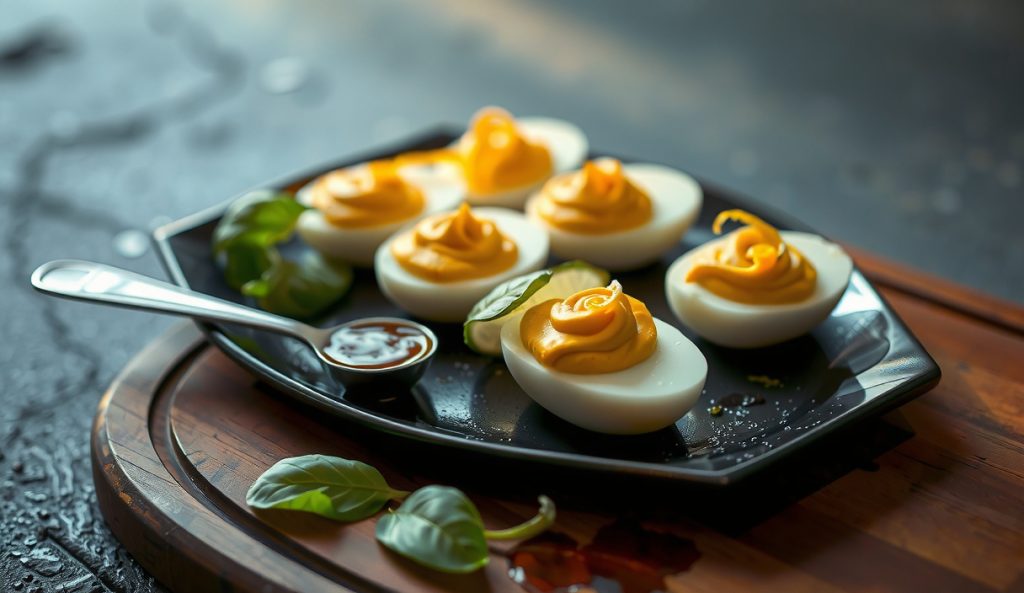
The canonical smoked deviled egg leans on Dijon mustard’s acidity and mild allyl isothiocyanate sharpness to lift the yolk filling. This Southeast Asian variation replaces that European backbone with fish sauce and Sriracha, pulling the flavor register toward the bright, fermented-savory profile of Thai and Vietnamese cooking. The result is a deviled egg that tastes simultaneously richer and lighter — more umami depth, less creamy weight.
The smoke note does not disappear in this Southeast Asian build; it shifts. Against the glutamate-forward fish sauce and the citrus brightness of lime zest, the cold smoke reads almost like a char note on grilled lemongrass — present, recognizable, but recontextualized entirely.
What changes in the Southeast Asian version?
Replace the Dijon with 1 teaspoon of fish sauce and 1 teaspoon of Sriracha. Fold 1 tablespoon of finely sliced scallion greens into the filling after mixing. Garnish each egg with a small leaf of Thai basil and a microplane pass of fresh lime zest directly over the piped filling.
Fish sauce carries a free glutamate concentration of roughly 1,400 mg per 100 g — among the highest of any condiment. Egg yolks contain endogenous ribonucleotides (IMP and GMP) that synergize with free glutamates multiplicatively rather than additively. This glutamate-ribonucleotide synergy explains why the flavor depth registers as far greater than the small quantity of fish sauce added would suggest; the yolk itself amplifies the effect.
Lime zest contributes volatile limonene and citral compounds that lift the top of the flavor profile, preventing the umami depth from reading as heavy or muddy.
What stays the same as the original smoked deviled eggs?
The cold-smoke process on the yolks is unchanged in every respect — wood species, smoking temperature, duration, and the resting period before mixing. Mayo remains the emulsifying base of the filling; only the acid and seasoning sources are swapped. Texture and pipe-ability are identical to the canonical version.
When is this Southeast Asian version the better choice?
This version outperforms the canonical smoked deviled egg when the serving context skews toward global or fusion menus, or when you want an appetizer that prompts genuine curiosity. The Southeast Asian build also pairs exceptionally well with grilled shrimp, larb, or any spread where bright, acid-forward flavors are already present.
Use the full cold-smoke method, equipment, and structural filling ratios from the original Smoked Deviled Eggs — The Cold-Smoke Yolk Method.