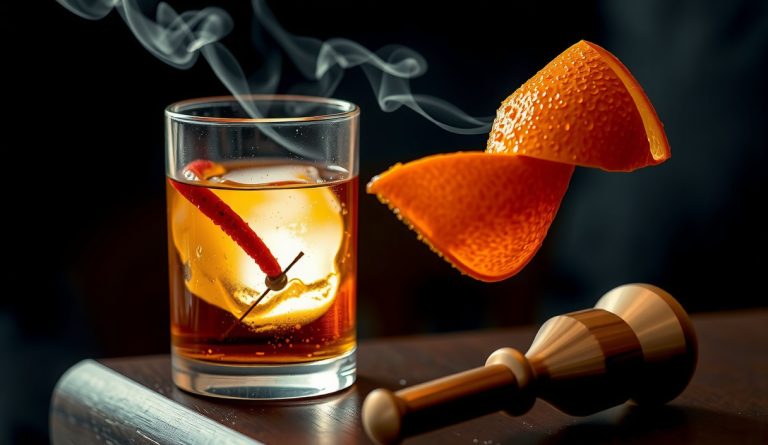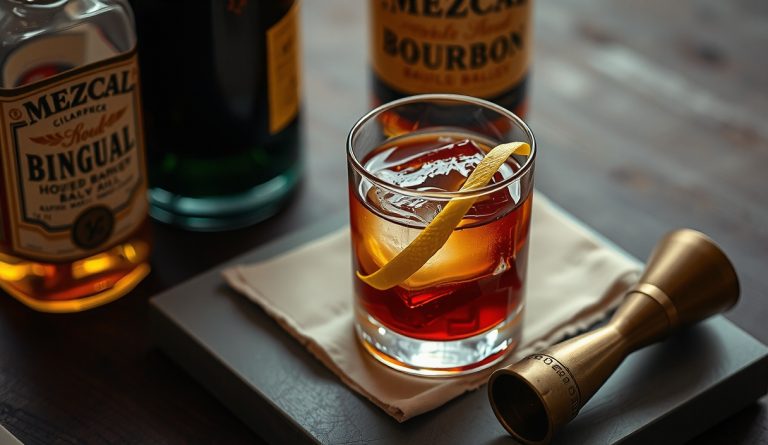
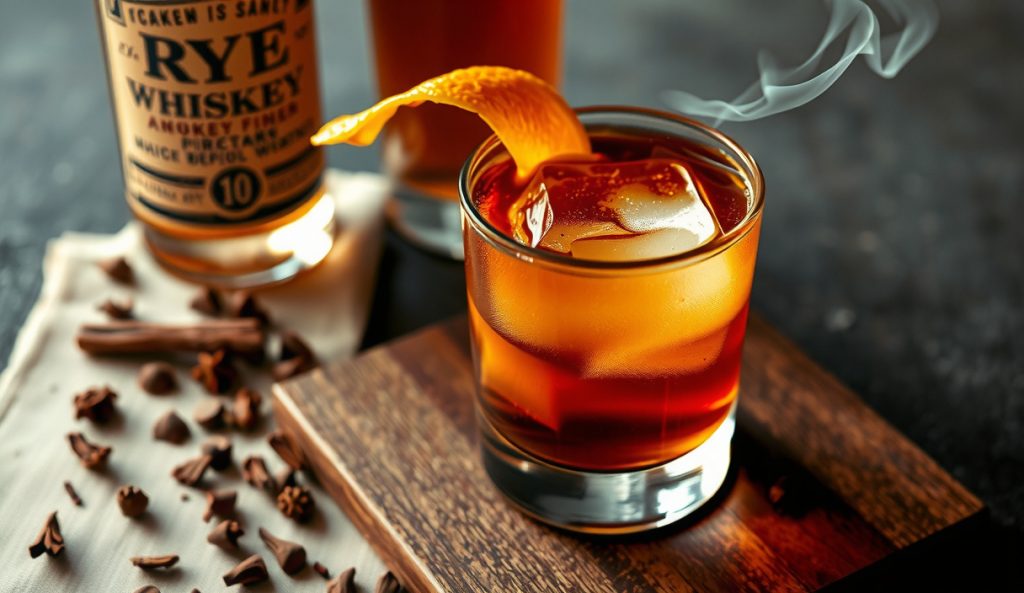
The rye-whiskey smoked Old-Fashioned diverges from the bourbon classic because rye occupies a fundamentally different aromatic register. At 100-proof — the level delivered by bottles like Rittenhouse or Sazerac 6-year — rye whiskey carries elevated concentrations of beta-myrcene and caryophyllene, terpenic compounds that express as herbal, piney, and faintly floral heat on the palate. That grain-driven profile demands a recalibrated smoke pairing and a reduced sweetness level to stay in balance.
This build is for drinkers who find the standard bourbon version too round and accommodating. Rye asserts itself. The finished cocktail is drier, sharper, and more aromatic — closer in spirit to a Sazerac than to a classic Old-Fashioned — while retaining the same cold-smoke phenolic backbone.
What changes when you switch to rye?
Replace the bourbon one-for-one with a 100-proof rye whiskey. The first critical change is the smoke source: move from hickory or oak to cherry wood. Cherry wood produces a softer guaiacol profile — lower char-derived phenol intensity — that bridges to rye’s spicy grain character without overwhelming it. The elevated beta-myrcene and caryophyllene in rye create a terpenic bridge to cherry’s gentler smoke compounds, so the two reinforce each other rather than compete.
The second change is sweetness. Reduce the simple syrup or sugar to 0.25 oz — roughly half a small cube, compared to the standard measure used in the bourbon build. Rye’s assertive, spice-forward palate requires less sweetness counterweight because rye mash contributes fewer residual natural sugars than bourbon’s corn-dominant mash and barrel-char caramelization. Adding the standard sweetener amount dulls rye’s defining characteristic rather than complementing it.
Smoke infusion time remains unchanged from the canonical method. Rye’s ethanol content is comparable to bourbon at the 100-proof mark, meaning the spirit absorbs phenolic smoke compounds at the same rate. No timing adjustment is needed.
What stays exactly the same in the rye build?
The cold-smoke technique, the sealed-vessel infusion, the orange peel expression, the Angostura bitters ratio, and the ice-and-stir finishing method all carry over from the original recipe without modification. The structural intent is identical: a spirit-forward cocktail where smoke adds a phenolic third dimension rather than dominating the glass.
When is the rye build the better choice?
Choose the rye build when your audience skews toward Manhattan or Sazerac drinkers. The drier, grain-spice profile pairs more naturally with charcuterie or cured fish than with smoked red meat, and it is the correct choice when serving someone who finds the bourbon version too sweet. The drier finish also functions as a stronger aperitif — it sharpens appetite rather than satisfying it, making it well-suited to the opening of a meal.
Use the full method, equipment, and smoke-infusion process from the original Smoked Old-Fashioned. Only the whiskey selection, smoke wood, and sweetener quantity change.