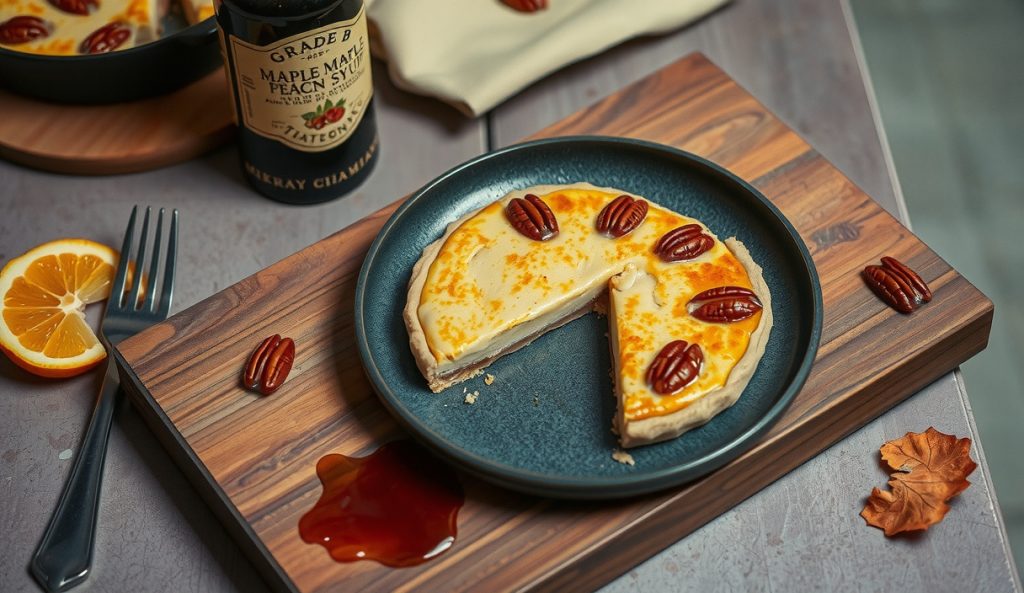
Corn syrup is the default binding agent in classic pecan pie because its glucose-dominated composition resists crystallization and sets cleanly. Grade B (dark robust) maple syrup replaces it entirely in this variant, and the swap is worth understanding before you bake. This is not simply a flavor substitution — it changes the water activity of the filling, the sweetness level, and the way smoke integrates into the finished slice.
What changes when you swap maple syrup for corn syrup?
Replace the full volume of dark corn syrup with an equal volume of Grade B (dark robust) maple syrup. Grade B maple carries a higher concentration of minerals, amino acids, and organic acids than Grade A — compounds produced during late-season sap collection and processing — and that complexity translates directly to the palate as a more savory, less linearly sweet base. The practical consequence is that the filling stands up to heavy smoke application without being overwhelmed, since the sweetness threshold is lower and the competing flavor compounds are more robust.
Maple syrup has a higher water activity (aw ≈ 0.85–0.87) than corn syrup (aw ≈ 0.75–0.78), which means more free moisture must drive off during baking for the filling to set correctly. Extend the smoke-bake time by 5–8 minutes beyond the canonical timing and pull the pie at an internal temperature of 203°F rather than 200°F. Those three degrees represent additional moisture evaporation and egg protein cross-linking that the extra water content requires. Use hickory wood — the pairing of maple syrup with hickory smoke is a classically northeastern flavor profile, and the two reinforce each other without either becoming dominant.
What stays the same in the maple syrup variant?
The crust, blind-bake protocol, egg quantity, bourbon measurement, and smoker temperature are all unchanged from the base recipe. The ratio of liquid sweetener to eggs remains constant, so the structural logic of the filling — a custard set reinforced by high sugar concentration — is fully preserved. Only the syrup source and the final pull temperature differ between the maple variant and the original.
When is the maple syrup variant the better choice?
This variant is ideal for guests who find corn-syrup-based pecan pie too sweet, or for fall and winter occasions where a maple note reads as seasonally appropriate. It also suits pairing with rye whiskey rather than sweeter wheated bourbons, since the mineral backbone of the maple syrup can match rye’s spice without being lost. The lower perceived sweetness and higher flavor complexity make the maple variant the more versatile table dessert of the two.
Use the full method, equipment, and rub measurements from the original Smoked Bourbon-Pecan Pie.