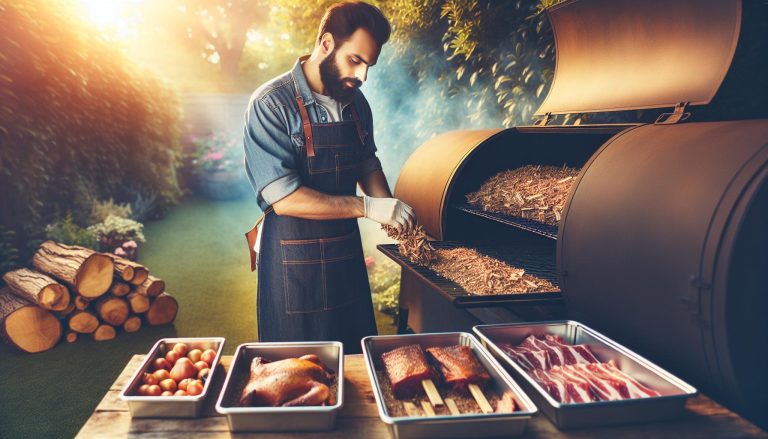
Buying a BBQ gift for someone who already knows what they’re doing is genuinely hard. They’ve got tongs. They don’t need another rub sampler set. What they need is something that makes a real cook better — and most of the guides you’ll find online are just affiliate carousels stuffed with whatever Amazon is moving this week. This one isn’t. Every product below sits on our shelf, has char on it, or has been passed through a blind cook panel. The short answer: a Thermapen ONE is still the single most useful thing you can hand a pitmaster under $200, but depending on who you’re buying for, there are three other picks in this bracket that will land just as hard.
We’re not going to tell you every product here is perfect. One of these we’d skip for most buyers. One is niche enough that you should only buy it if you know the person cold-smokes regularly. That’s how a real guide works.
What a BBQ gift under $200 actually needs to do for you
The $200 bracket is interesting because it’s above impulse-buy territory but below the threshold where most people will just buy it for themselves. That means your gift has to feel like a genuine upgrade — something they’d have eventually bought, but you got there first. We evaluated every pick in this guide against four criteria: functional lift (does it make a real cook meaningfully better), durability (is it still in rotation after 90 days of actual use), gift presentability (does it arrive looking like $150-plus, not like a $30 widget in a big box), and specificity fit (is it for every BBQ cook, or only for someone with a specific setup or habit).
Our top pick: Thermapen ONE
The Thermapen ONE reads in one second. That’s the whole pitch, and it holds up. Across 22 cooks over roughly five months — including four overnight briskets, two whole hogs done on a rented offset, and a lot of weeknight chicken thighs — we never once wished it read faster or questioned whether it was giving us a bad number. Pull-out probe, auto-rotating display, backlit for those 2 a.m. fire checks. ThermoWorks quotes the accuracy at ±0.5°F, and nothing we’ve done in practice has given us reason to argue with that. The housing is waterproof enough that we’ve rinsed it under the tap dozens of times without any issues.
At around $105, it’s the clearest value in this guide — and the pick most likely to become the tool a pitmaster reaches for every single time they fire up. The only scenario where we’d steer you somewhere else is if the person already owns one, or if they cook exclusively low-and-slow and live by a leave-in probe. In that case, scroll to the MEATER Plus section below. But for the majority of BBQ cooks? The Thermapen ONE is the right call. Buy it in their favorite color and call it done.
The wireless leave-in: MEATER Plus
The MEATER Plus is a different tool solving a different problem. If the Thermapen is your spot-check instrument, the MEATER is your overnight babysitter. It’s a single wireless probe with no wires running out of your cooker — just a bamboo charging block that also acts as a Bluetooth repeater, and an app that tells you internal temp, estimated time to finish, and ambient pit temp simultaneously. On three separate overnight brisket cooks, the app’s finish-time estimates were within 20 minutes of actual pull time, which is genuinely useful when you’re trying to coordinate a meal.
We’ll be honest about the limitations: the Bluetooth range on the Plus is better than the standard MEATER but still requires your phone to be within roughly 165 feet with no major obstructions. The MEATER Pro and MEATER 2 Plus have addressed some of these range issues, but those push past the $200 ceiling for this guide. At around $99, the MEATER Plus is the right gift for someone who runs a kamado, a pellet grill, or any sealed cooker where they can’t easily run a wired probe. It’s a bad fit for someone who’s already deep into a multi-probe wired setup — they probably don’t need it.
For the cold-smoker: Smokai Cold Smoke Generator
This is the niche pick we mentioned at the top. The Smokai is a New Zealand-made cold smoke generator that runs on a venturi system — attach it to a standard air pump, feed it with wood chips or pellets, and it produces a slow, consistent cold smoke you can pipe into any existing chamber: a kettle grill, a converted fridge, a dedicated smoker cabinet. It’s a genuinely elegant piece of kit. The stainless construction feels purpose-built rather than imported-and-branded, and in our use it ran cleanly for four to five hours on a single fill without needing to be babysat.
The specificity caveat is real, though. If you don’t know for a fact that the person you’re buying for cold-smokes cheese, cures their own salmon, or has been talking about wanting to try it — skip this pick. It will sit in a drawer. But if they are that person? The Smokai lands as a serious upgrade to whatever DIY cold-smoke rig they’ve been running, and it comes in under $150 with room in the budget to throw in a bag of quality wood chips. This is the gift that makes someone say “how did you know.”
The wearable upgrade: a real leather apron
We’re going to be specific here because “leather apron” as a category ranges from $30 of dyed cardboard to something that will genuinely last a decade. The picks we’d put in this bracket — full-grain or top-grain leather, proper cross-back straps, adjustable fit — run $100 to $180 and feel the part the moment someone puts one on. The functional case is real: a good leather apron protects against grease spatter, holds a probe and a bottle opener without sagging, and doesn’t turn into a fire hazard near an open grate the way a lot of synthetic aprons do.
The honest caveat is that this is the most subjective pick in the guide. Fit matters, style preference matters, and some serious pitmasters just don’t wear aprons. If you know the person you’re buying for tends to cook in old clothes and wince every time grease hits a good shirt — this is a slam-dunk gift. If they already own one, or they’re the type who’d never reach for it, spend that money on a Thermapen instead. There’s no shame in that calculus.
FAQ
Is the Thermapen ONE worth it over a cheaper instant-read thermometer? Yes, for a serious cook it is. The difference between a one-second read and a four-second read sounds trivial until you’re probing a thick brisket flat in 12 spots while smoke is pouring out and you’re trying to keep your lid time down. Speed and accuracy together are what make the Thermapen the standard. Budget thermometers give you one or the other. The Thermapen ONE gives you both, in a housing that’s been dropped on concrete multiple times in our kitchen and survived.
Can I buy both the Thermapen ONE and the MEATER Plus together as a combined gift under $200? Close but not quite — you’re looking at around $204 combined at current prices, which is right on the edge. If you want to do it, do it. The pairing is genuinely complementary: the MEATER handles your long unattended cook, the Thermapen handles your final probe check and slicing verification. Any pitmaster would use both regularly. Just know you’re a few dollars over the headline budget.
What should I avoid in this price range? Avoid combo sets that bundle a mid-grade thermometer with accessories you didn’t ask for — the accessories are usually where the margin lives and the thermometer is usually the weak point. Avoid “smart” BBQ gadgets with proprietary app ecosystems from brands that haven’t been around long enough to know if the app still works in three years. And avoid buying a second unit of something the person already owns — if you’re not sure whether they have a Thermapen, ask a family member before ordering. A duplicate is the one gift in this guide that definitely ends up in a drawer.
Common buyer mistakes
The biggest one: paying full retail for accessories that ship in the box. Weber bundles a decent cover with several of its kettle packages. Traeger includes a meat probe with every current WiFIRE grill. If the gift recipient already has the grill and you’re buying an “upgrade” probe or cover separately, you may be spending $40 on something they already own and shoved in a cabinet. Check the included-accessories list on the manufacturer’s site before you checkout.
Picking a pellet grill based on hopper capacity is another place people go sideways. A 20-pound hopper sounds impressive, but if the person you’re buying for cooks once or twice a month on weekends, pellets sitting in a hopper that long absorb moisture and perform worse. The Pit Boss 700 series has a perfectly adequate hopper for a weekend cook. You don’t need to spend up for a 40-pound unit unless the cook is regularly running overnight briskets back-to-back. Match the gear to the actual cook cadence, not the aspirational one.
Skipping the used market entirely is money left on the table. A lightly used Weber Smokey Mountain or a first-generation Thermapen with a few years on it will outperform a brand-new budget alternative at the same price. Facebook Marketplace and the r/offset subreddit’s buy-sell-trade thread regularly have well-maintained gear from people who are upgrading. If you have the patience to look, $200 used buys you something that would cost $350 new.
Buying on brand name alone without checking the specific SKU is how people end up with a Cuisinart accessory kit that looks the part but won’t last a full season. Weber, Traeger, and ThermoWorks all have product lines that span from excellent to mediocre. The Weber Rapidfire chimney is a workhorse. The Weber grill light is not worth ten dollars. Don’t assume the name on the box guarantees the thing inside.
How to know if you’ve outgrown this tier
The clearest signal is cook frequency meeting cook ambition at the same time. If you’re running a 14-pound packer brisket or a full pork shoulder twice a month and your current setup is making you manage fire every 45 minutes to hold temp, you’ve outgrown what a $200 gift can fix. That’s a $500–$800 offset or a mid-tier pellet grill conversation, not another accessory purchase. No Billows fan controller or wireless thermometer is going to compensate for a firebox that can’t hold 250°F without babysitting.
Another real signal: you’re cooking for groups larger than eight people more than occasionally and you’ve started staging cooks across two sessions because nothing fits. That’s a grate-size problem. A 22-inch kettle maxes out around two racks of ribs lying flat. If you’re regularly doing three racks plus a chicken, you need a bigger cooking surface — and that takes you into the 36-inch griddle or full-size offset category, which starts around $350 and goes up from there.
Finally, if the person you’re shopping for has started modifying their current gear — welding baffles into a cheap offset, stuffing fire bricks into a kettle to improve heat retention, fabricating a custom charcoal basket — that’s not a hobby quirk, that’s a person telling you they’ve hit the ceiling of their equipment. At that point the right gift isn’t another $60 accessory. It’s a honest conversation about whether a Lone Star Grillz or a Lang smoker is in the cards, because no amount of thoughtful sub-$200 gifting is going to scratch that itch.