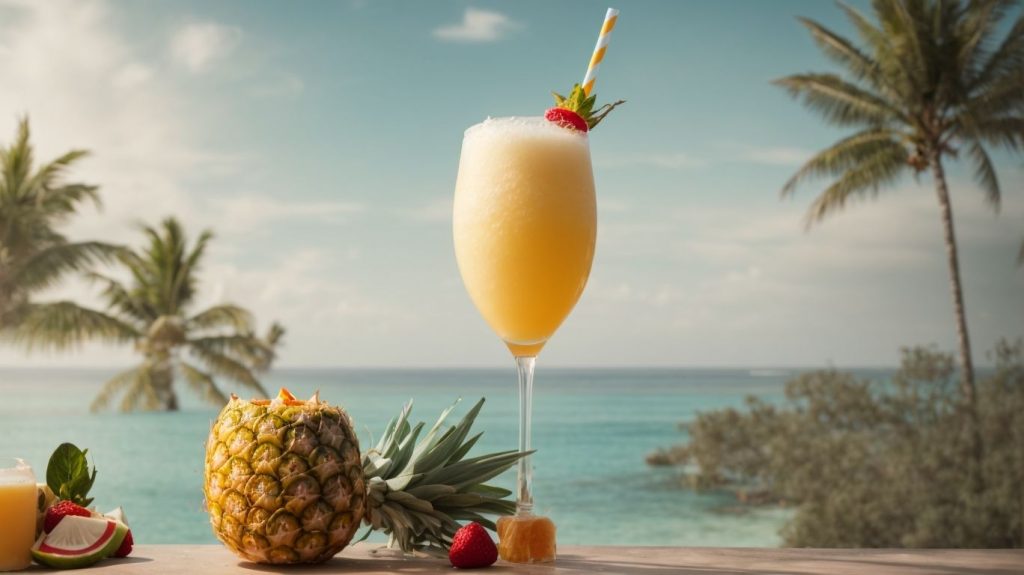

Pineapple Coconut Rum Slush

Equipment
- 1 Blender
Ingredients
- 2 oz Coconut Rum
- 1 cup Pineapple Chunks
- ½ cup Coconut Cream
- 2 cups Crushed Ice
- 1 Lime juiced
- 1 oz Simple Syrup
- ¼ tsp Ground Cinnamon
- 1 oz Champagne optional

Instructions
- Prepare Pineapple: If using fresh pineapple, peel, core, and cut into chunks. Optionally, grill the pineapple chunks for a caramelized flavor before freezing them.
- Blend: In a blender, combine the coconut rum, pineapple chunks, coconut cream, lime juice, simple syrup, and crushed ice. Blend until smooth.2 oz Coconut Rum, 1 cup Pineapple Chunks, 1/2 cup Coconut Cream, 1 Lime, 1 oz Simple Syrup, 2 cups Crushed Ice
- Consistency: Check for a smooth, slushy consistency, adding more ice if necessary.
- Serve: Pour the mixture into glasses, leaving room if you wish to top with champagne.1 oz Champagne
- Garnish: Garnish with fresh pineapple wedges, a sprinkle of ground cinnamon, or a splash of coconut water for an extra tropical flair.1/4 tsp Ground Cinnamon
Notes
Nutrition
There is a narrow window every summer — somewhere between the third hour of a backyard smoke session and the moment the sun drops below the fence line — when what you want is not another beer and not another whiskey. You want something cold enough to drop your core temperature, sweet enough to feel like a reward, and complex enough to hold your attention past the first sip. The Pineapple Coconut Rum Slush was engineered for exactly that window. Coconut rum, fresh pineapple, coconut cream, a hit of champagne for lift, and a whisper of cinnamon that ties the whole tropical stack together in a way that will make you question every frozen drink you accepted at a swim-up bar.
The optional grill step on the pineapple is not a suggestion — it is the difference between a good slush and a great one. Two minutes on a screaming-hot grate converts surface sugars into a caramelized crust carrying compounds that frozen blending simply cannot replicate. If you have a grill running, use it. Your blender will do the rest of the heavy lifting in under sixty seconds.
Why does the Pineapple Coconut Rum Slush work? The science
The Pineapple Coconut Rum Slush works because each ingredient solves a specific physical problem — fat carries aroma, acid sharpens sweetness, CO2 breaks texture, and cinnamon grounds the tropical volatiles in warm spice. Start with what happens when pineapple hits a hot grate. The surface of a pineapple chunk contains roughly 10–13 Brix of free sugars — primarily sucrose, glucose, and fructose. At grate temperatures above 350°F (177°C), those sugars undergo Maillard browning and caramelization in parallel. Maillard chemistry between reducing sugars and the fruit’s free amino acids produces furanic aldehydes and pyrazines — the same aromatic class responsible for toasted-bread and roasted-nut character. Caramelization of fructose, which initiates around 220°F (104°C), generates hydroxymethylfurfural and diacetyl, adding butterscotch depth. Both reaction families contribute fat-soluble volatiles that partition efficiently into the coconut cream’s lipid phase during blending, locking flavor into the finished drink rather than letting it flash off into the air.
Coconut cream is doing serious structural work in the Pineapple Coconut Rum Slush beyond flavor. Its emulsified fat content — typically 20–24% by weight — functions as a lipophilic solvent for aromatic esters and terpenes. Pineapple’s dominant ester, ethyl butanoate, and its secondary volatile, allyl hexanoate, both carry log P (octanol-water partition coefficient) values above 1.5, meaning they strongly prefer a lipid environment over a water environment. The coconut cream traps those esters and prevents them from volatilizing during high-shear blending. The result: a drink that smells as tropical in the glass as it does the moment you open a fresh pineapple. Meanwhile, the 2 oz of coconut rum — typically bottled at 21% ABV — contributes its own ester load along with a modest ethanol matrix that assists in solubilizing cinnamon’s primary volatile, cinnamaldehyde, which is only sparingly water-soluble but readily ethanol-soluble.
The champagne addition at the end is pH and effervescence management in one move. Champagne’s dissolved CO2 — at service pressure carrying roughly 5–6 volumes of gas — disrupts the slush’s dense texture at the surface, providing a textural contrast and delivering a volatile aromatic burst on the nose as bubbles break. Champagne’s titratable acidity (primarily tartaric acid, pH typically 3.0–3.4) reinforces the lime’s citric acid charge, dropping the finished drink’s pH low enough to brighten sweetness perception and suppress any cloying quality from the coconut cream fat and simple syrup. Acidity does not just add sourness — at pH below 3.5, sweet threshold perception shifts downward, meaning you taste the sugar as brighter and cleaner rather than heavy. That is the balancing act this drink is running: fat carries aroma, acid sharpens sweetness, CO2 breaks texture, cinnamon grounds the tropical volatiles in warm spice.
What equipment and ingredients do you need for the Pineapple Coconut Rum Slush?
A high-torque blender — anything with a blade assembly rated above 1,000 watts — will process 2 cups of crushed ice into a homogenous slush in 30–45 seconds without leaving ice shards. A standard household blender will work but may require two short pulse cycles to fully incorporate the ice without stalling. Do not over-blend: sustained high-speed blending past 60 seconds generates frictional heat that begins melting ice and thinning the slush before it ever reaches the glass.
- Pineapple: Fresh is strongly preferred over canned. Canned pineapple has been heat-processed, which degrades ethyl butanoate concentration and eliminates any possibility of productive Maillard reaction on the grill. If grilling, slice chunks to roughly 1-inch thickness for maximum surface-to-mass ratio.
- Coconut Cream vs. Coconut Milk: Coconut cream runs 20–24% fat; coconut milk runs 10–15%. Substituting coconut milk will thin the texture and reduce aromatic trapping. Canned coconut cream (not cream of coconut, which is sweetened) is the correct product here.
- Coconut Rum: Most commercial coconut rums clock in at 21% ABV. That lower proof is intentional in this build — it keeps the drink’s finished ABV balanced without overwhelming the fruit. A higher-proof white rum with a barspoon of coconut extract can substitute but will read drier.
- Champagne: Any dry sparkling wine works — Cava, Prosecco, Crémant. Brut or Extra Brut is preferred; demi-sec residual sugar will push the sweetness past the acid’s ability to keep it in check.
- Cinnamon: Ground cinnamon at 1/4 tsp per serving is the ceiling, not the floor. Cinnamaldehyde is potent — at concentrations above roughly 50 ppm in a water matrix, it reads as medicinal rather than warm. Start with 1/8 tsp if you are sensitive to spice.
Pineapple Coconut Rum Slush
Equipment
- 1 Blender
Ingredients
- 2 oz Coconut Rum
- 1 cup Pineapple Chunks
- ½ cup Coconut Cream
- 2 cups Crushed Ice
- 1 Lime juiced
- 1 oz Simple Syrup
- ¼ tsp Ground Cinnamon
- 1 oz Champagne optional
Instructions
- Prepare Pineapple: If using fresh pineapple, peel, core, and cut into chunks. Optionally, grill the pineapple chunks for a caramelized flavor before freezing them.
- Blend: In a blender, combine the coconut rum, pineapple chunks, coconut cream, lime juice, simple syrup, and crushed ice. Blend until smooth.2 oz Coconut Rum, 1 cup Pineapple Chunks, 1/2 cup Coconut Cream, 1 Lime, 1 oz Simple Syrup, 2 cups Crushed Ice
- Consistency: Check for a smooth, slushy consistency, adding more ice if necessary.
- Serve: Pour the mixture into glasses, leaving room if you wish to top with champagne.1 oz Champagne
- Garnish: Garnish with fresh pineapple wedges, a sprinkle of ground cinnamon, or a splash of coconut water for an extra tropical flair.1/4 tsp Ground Cinnamon
Notes
Nutrition
How do I nail the Pineapple Coconut Rum Slush every time?
- Grilled pineapple or nothing: If you skip the grill, chill the fresh pineapple chunks in the freezer for 20 minutes before blending. It will not replicate caramelization, but it reduces ice dilution and concentrates the raw fruit aroma at cold temperature.
- Add champagne last, off the blade: Blending champagne destroys its carbonation entirely. Pour it over the finished slush in the glass — do not return the blender lid and pulse “just to mix.” The CO2 is the point.
- Taste before the champagne: The blended base should read slightly sweeter and more acidic than you want the finished drink to be. The champagne dilutes and brightens simultaneously — calibrate the base with that in mind.
- Ice density matters: Crushed ice incorporates faster and produces a finer slush texture than cubed ice. If you only have cubed, pulse the ice alone for 10 seconds before adding liquids.
- Batch scaling: This recipe scales linearly to 4–6 servings in a single blender cycle. Hold the champagne in a chilled bottle and pour to order — do not add it to the blended batch.
- Prevent texture collapse: Serve immediately or transfer to a pre-chilled metal vessel. The coconut fat fraction begins to separate and the slush texture degrades within 8–10 minutes at room temperature.
What variations can you make on the Pineapple Coconut Rum Slush?
Smoked Pineapple Build: If the grill is already running with wood chunks, place pineapple slices on the cool side of a two-zone fire and let them absorb 10–12 minutes of indirect smoke before finishing over direct heat. Guava wood and fruitwood chips deliver a soft, stone-fruit-adjacent phenol load — primarily syringol and methyl syringol — that pairs exceptionally well with coconut cream’s neutral fat profile. The smoke phenols adsorb onto the fruit’s surface pectin matrix and survive the blending process intact, producing a slush with a faint campfire finish underneath the tropical fruit stack.
Spiced Rum Swap: Replace the coconut rum with a quality aged spiced rum — something carrying genuine vanilla and allspice notes from barrel contact and botanicals rather than artificial flavoring. The higher typical ABV (35% and up) of most spiced rums will produce a drier, more spirit-forward drink. Compensate by increasing simple syrup by a half ounce and pulling the cinnamon back to 1/8 tsp to avoid spice overlap.
No-Alcohol Version: Replace coconut rum with 2 oz of full-fat coconut milk plus 1/2 tsp of pure coconut extract, and replace the champagne with chilled sparkling water or a dry ginger beer. The Pineapple Coconut Rum Slush loses the ethanol matrix that carries cinnamaldehyde and some fruit esters in the non-alcoholic build, so lean into the grilled pineapple hard — the caramelized crust aroma will compensate significantly. Reduce simple syrup by half since the alcohol’s slight bitterness is no longer present to offset sweetness.
Frozen Batch for a Crowd: Scale to 8 servings, blend in two cycles without champagne, and transfer the base to a zip-seal bag laid flat in the freezer. The base will hold semi-frozen texture for up to 4 hours. At service, break up the frozen mass with a spoon directly in the bag, scoop into glasses, and top each with 1 oz sparkling wine to order. This is the move for a summer cookout where the pitmaster cannot also be the bartender.
Frequently asked questions about the Pineapple Coconut Rum Slush
Can I use frozen pineapple instead of fresh? Frozen pineapple works and will reduce the amount of ice needed — reduce crushed ice to 1.5 cups and adjust from there, since frozen chunks carry enough thermal mass to do some of the chilling work themselves. Frozen pineapple is typically processed at peak ripeness and retains good ester concentration, but it will not take a grill char, so you lose the Maillard complexity entirely. If frozen is your only option, add a small pinch of flaky sea salt to the blend — sodium ions at low concentration enhance sweet and fruit flavor perception by suppressing bitter receptor sensitivity.
Why does the Pineapple Coconut Rum Slush turn watery within a few minutes of serving? Two likely causes account for texture collapse. First, insufficient ice volume relative to liquid — the fat content of coconut cream lowers the freezing-point depression slightly, meaning the slush needs a higher ice ratio than a standard frozen margarita to maintain structure. Second, over-blending: frictional heat from a blender running longer than 60 seconds at high speed begins melting the outermost ice crystals before the drink leaves the jar. Blend fast, serve immediately, and use a pre-chilled glass.
Does the champagne actually make a detectable difference, or is it just for show? The champagne makes a detectable difference on two axes: texture and acidity. The CO2 breaks up the dense, uniform slush surface and delivers a sharp aromatic burst on the first nosing — volatile esters trapped in the blended base are released by the mechanical action of bubble collapse. On the palate, champagne’s tartaric acid charge sharpens the lime’s citric foundation and prevents the coconut cream’s richness from reading as flat or cloying. A Pineapple Coconut Rum Slush without champagne is a perfectly fine drink. A slush with it is the drink you will be asked to make again before you finish your first glass.