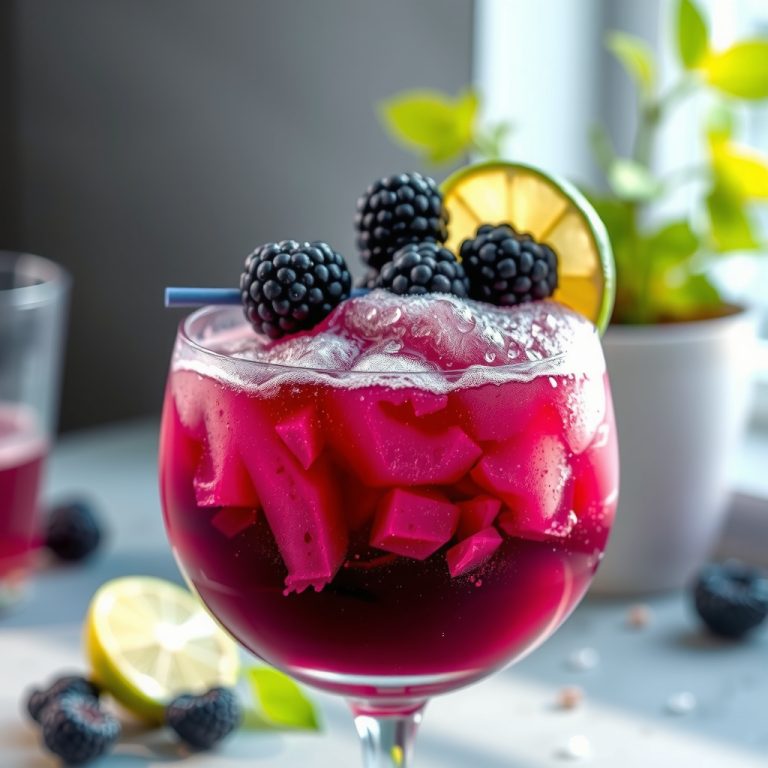
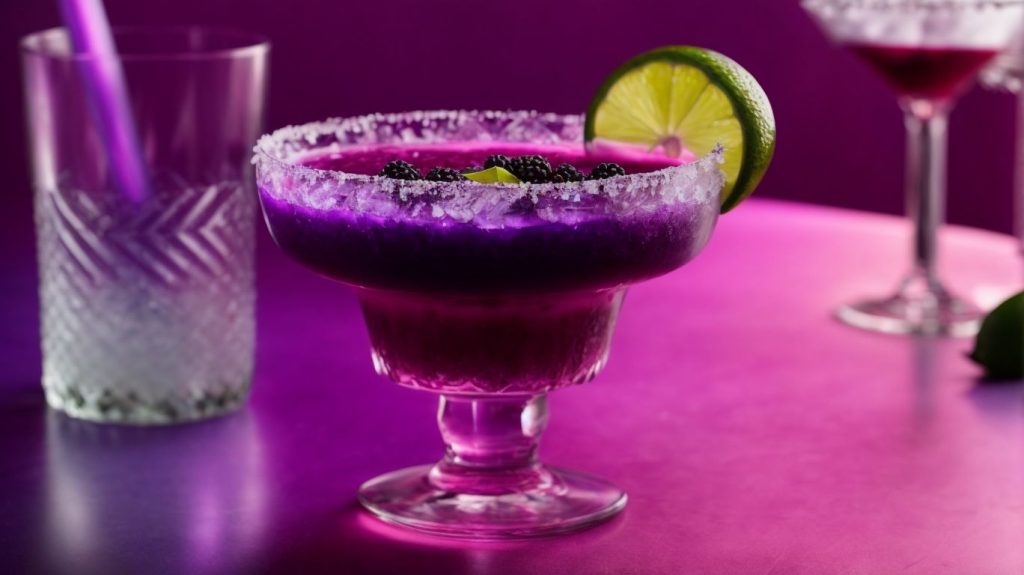

Frozen Blackberry Lime Margarita
Equipment
- Blender
- Measuring cups
- Measuring spoons
- Serving glasses
- Lime squeezer (optional)
Ingredients
- 2 cups frozen blackberries
- ½ cup lime juice fresh is best
- ¼ cup tequila
- ¼ cup orange liqueur like Triple Sec
- 2 tablespoons simple syrup adjust to taste
- 2 cups ice

Instructions
- To prepare the Frozen Blackberry Lime Margarita, start by adding the frozen blackberries, lime juice, tequila, orange liqueur, simple syrup, and ice into a blender.
- Blend on high speed until the mixture reaches a smooth and creamy consistency.
- If necessary, pause to scrape down the sides of the blender to confirm that all ingredients are well combined.
- Once blended, taste the mixture and adjust the flavors as needed before pouring the margarita into serving glasses.
Notes
Nutrition
A margarita is, at its core, a balance equation: acid cuts fat and sugar, alcohol carries volatile aromatics, and cold suppresses bitterness while amplifying sweetness. Swap in frozen blackberries and suddenly you have a second acid vector — citric plus malic — layered on top of lime’s dominant citric punch, and a payload of anthocyanin pigments that turn the whole glass a deep, electric violet. This is not a novelty cocktail. It is a precisely constructed frozen drink that happens to look extraordinary.
The frozen format does real work here. Blending whole frozen blackberries rather than fresh ones means the cell walls rupture under blade shear at sub-zero temperatures, releasing juice without thermal degradation of the volatile esters responsible for that floral, jammy top note. You get maximum flavor extraction with zero heat damage. The result is a 12-ounce pour that drinks clean, tart, and just sweet enough — the kind of drink that disappears faster than you planned for it to.
Why does a frozen blackberry lime margarita work? The science
The frozen blackberry lime margarita works because blackberry acids, tequila ethanol, and orange liqueur esters interact in ways that amplify flavor rather than simply add to it. Blackberries carry two primary organic acids — citric (roughly 1.5–2.0% by weight) and malic (0.5–1.0%) — alongside a suite of anthocyanin polyphenols, chiefly cyanidin-3-glucoside. These pigments are pH-sensitive chromophores: below pH 3.5 they express vivid red-violet; above pH 5 they shift toward purple-blue and eventually colorless. The finished margarita, sitting around pH 2.8–3.2 due to combined fruit and lime juice acidity, locks those anthocyanins in their brightest, most saturated state. That is not accidental color — it is acid chemistry doing visible work.
Ethanol acts as a co-solvent, pulling lipophilic aromatic compounds out of the blackberry matrix that water alone cannot carry. The tequila — ideally a blanco at 40% ABV — contributes its own volatile profile: isoamyl alcohol, ethyl acetate, and agave-derived furfural compounds that interact with the fruit esters at the partition boundary of the ice-water-ethanol mixture. Orange liqueur (typically 40% ABV, 200–280 g/L residual sugar, roughly 25–28 Brix) introduces d-limonene from the orange peel maceration, which reinforces the citrus top note from the lime juice without duplicating it. The result is a layered aromatic profile rather than a flat citrus wall.
Dilution is the final variable, and in a frozen cocktail it is managed by the ice-to-liquid ratio. The 2 cups of ice in this recipe melt partially during blending — a high-speed blender adds 8–12°F of frictional heat to the mixture — contributing approximately 60–80 mL of dilution water into the final 12–14 oz batch. This is intentional: it drops the effective ABV of the finished drink to roughly 8–10%, a range where the ethanol enhances aroma perception rather than overpowering it, and where the texture transitions from granita-coarse to genuinely smooth and creamy.
What equipment and ingredients do you actually need?
A high-powered blender — 1,200 watts or above — is not a suggestion. Underpowered units will leave blackberry seed fragments and ice shards in the pour. If your blender struggles, add a 30-second rest between pulses to protect the motor and prevent excess heat input. The tamper that comes with professional blenders is worth using here: frozen blackberries pack densely and can air-pocket above the blade, stalling the blend.
Tequila selection matters more than it gets credit for in frozen drinks. A highland blanco (Los Altos region, typically higher in citrus and floral esters) marries more cohesively with blackberry than a lowland expression (earthier, more vegetal). Avoid aged expressions — reposado or añejo barrel notes compete with the fruit rather than supporting it. For the orange liqueur, a triple sec at 40% ABV keeps the sugar contribution in check; a lower-ABV, higher-sugar cordial will tip the drink sweet and muddy the acid balance. Simple syrup at 1:1 (equal parts sugar and water, approximately 50 Brix) is the calibration tool — start at 2 tablespoons and adjust after the first taste pass. Lime juice should be fresh-squeezed; bottled juice at pH 2.0–2.2 reads sharper and more one-dimensional than fresh at pH 2.3–2.5 and will fight the blackberry rather than complement it.
Frozen Blackberry Lime Margarita
Equipment
- Blender
- Measuring cups
- Measuring spoons
- Serving glasses
- Lime squeezer (optional)
Ingredients
- 2 cups frozen blackberries
- ½ cup lime juice fresh is best
- ¼ cup tequila
- ¼ cup orange liqueur like Triple Sec
- 2 tablespoons simple syrup adjust to taste
- 2 cups ice
Instructions
- To prepare the Frozen Blackberry Lime Margarita, start by adding the frozen blackberries, lime juice, tequila, orange liqueur, simple syrup, and ice into a blender.
- Blend on high speed until the mixture reaches a smooth and creamy consistency.
- If necessary, pause to scrape down the sides of the blender to confirm that all ingredients are well combined.
- Once blended, taste the mixture and adjust the flavors as needed before pouring the margarita into serving glasses.
Notes
Nutrition
How do I nail it every time? Tips for a perfect blend
- Do not thaw the blackberries. Frozen fruit provides both chilling mass and structural integrity during the blend. Thawed berries turn the mixture watery and reduce texture from smooth to slushy-thin.
- Taste before you pour. Blackberry sweetness varies significantly by brand and harvest. After blending, dip a spoon and assess: if it reads flat, add simple syrup in half-tablespoon increments; if it reads sweet, squeeze in an additional wedge of lime.
- Ice order matters. Add the ice last, on top of the liquids and fruit. This creates a more efficient vortex pull toward the blade and reduces the risk of air-pocketing that stalls the blend.
- Serve immediately. A frozen margarita begins phase-separating within 5–7 minutes at room temperature. If you are batching for a group, blend in rounds and keep the blender jar in the freezer between pours.
- Watch your glass temperature. A warm glass will melt the outer layer of the drink on contact. Pre-chill glasses in the freezer for 10 minutes or fill them with ice water while you blend, then dump and pour.
- Salt rim is optional but use the right salt. Coarse kosher or Maldon sea salt — not fine table salt — provides intermittent salinity bursts that reset the palate between sips and sharpen the fruit perception. A tajin rim is a defensible variation if you want heat.
What variations can I make with this recipe?
Smoked salt and mezcal. Substitute half the tequila (2 tablespoons) with a joven mezcal — one that carries guaiacol and 4-methylguaiacol smoke phenols in the 5–15 ppm range. Those phenols bind to the fat-soluble aromatic matrix of the blackberry and create a smoke-fruit contrast that reads less like a modification and more like a different drink entirely. Rim the glass with smoked Maldon rather than standard salt to reinforce the signal.
Spiced blackberry. Add 2–3 slices of fresh jalapeño to the blender before the blend cycle. Capsaicin (8-methyl-N-vanillyl-6-nonenamide) is soluble in ethanol, which means the tequila and liqueur act as efficient extraction solvents. Even a brief 45-second blend cycle will produce meaningful heat. Start conservative — you can always add heat, you cannot remove it. A pinch of cayenne in the glass as a garnish signals the variation visually.
Non-alcoholic build. Replace the tequila with 3 tablespoons of white grape juice and a teaspoon of white wine vinegar (for ethanol-adjacent acidity and ester contribution), and swap the orange liqueur for 3 tablespoons of fresh-squeezed orange juice plus a drop of orange blossom water. The result loses the ethanol co-solvent aromatic lift but retains the acid-sugar-fruit architecture. Adjust simple syrup upward by 1 tablespoon to compensate for the reduced perceived sweetness without ethanol amplification.
Batch format for parties. This recipe scales to a 6-serving batch cleanly: multiply all quantities by three and run two full blender cycles rather than one overloaded cycle. Pre-batch the alcohol components (tequila + orange liqueur + simple syrup) in a measuring cup the night before and refrigerate. Day-of, you are simply adding frozen fruit and ice — a 90-second operation per round. Keep blended portions in a pre-frozen pitcher and stir before each pour to re-homogenize any separation.
Frequently asked questions
Can I use fresh blackberries instead of frozen? Yes, but the trade-offs are real. Fresh blackberries will not provide the chilling mass that frozen ones do, so increase the ice by approximately half a cup to compensate. More critically, fresh berries blend at a higher temperature, which accelerates oxidation of the anthocyanin pigments and can mute both the color and the floral ester volatiles. The drink will still taste good — it will just be slightly less vivid in both appearance and aroma.
What is the best way to strain out the blackberry seeds? Blend on high for a full 60 seconds to pulverize the seeds as finely as possible, then pour the mixture through a fine-mesh strainer while pressing with the back of a spoon. Expect to lose about 10–15% of the volume and a portion of the fiber. The strained version will have a cleaner mouthfeel and a slightly more translucent appearance — closer to a sorbet than a smoothie-style frozen drink.
How do I keep leftovers without losing texture? Transfer any unserved portion to a freezer-safe container and freeze flat. Within 2 hours it will solidify completely. To serve again, let it sit at room temperature for 8–10 minutes until partially thawed, then break it into chunks and re-blend on high for 20–30 seconds with a splash of lime juice to re-emulsify and restore the smooth texture. The flavor will be fully intact; expect minimal quality degradation within a 48-hour freeze window.