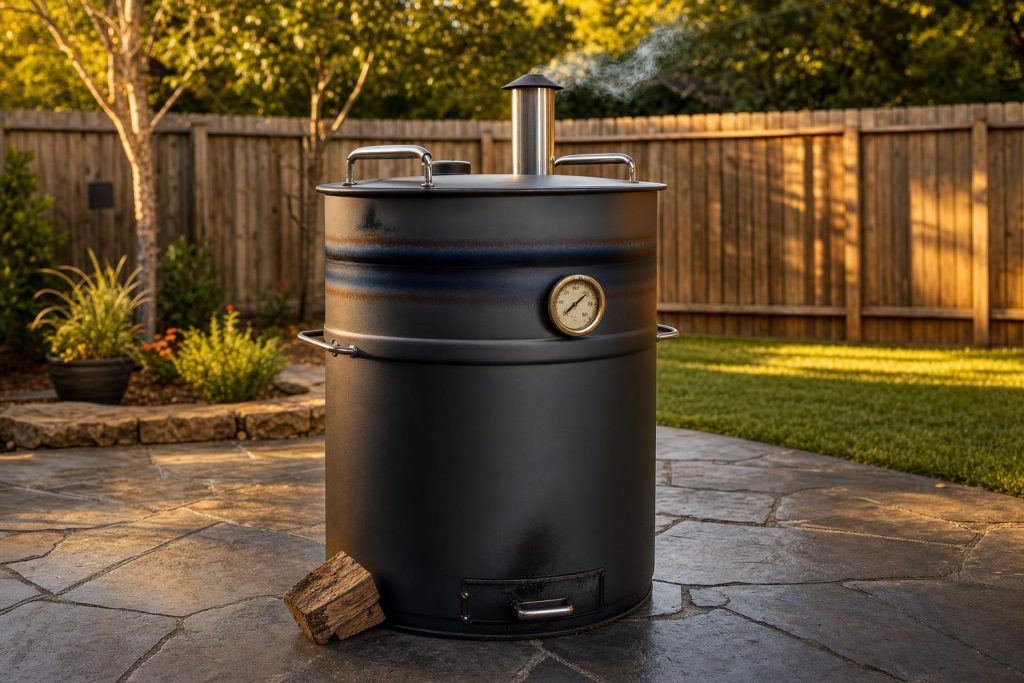
The drum smoker pitch is almost too good: a 55-gallon steel barrel, a charcoal basket, some intake vents, and you’ve got a cooker that runs 225°F for 12 hours on a single load of fuel, produces competition-quality bark, and costs a fraction of an offset. The catch is that “drum smoker” covers everything from a $300 production cooker with a warranty to a welded-together DIY rig that leaks smoke from four different seams. If you’re comparison-shopping right now, you’ve probably already waded through a dozen listicles that give every product a trophy and never tell you which one actually holds temp overnight. This guide is different because I own these cookers, I’ve cooked on them, and I’ll tell you exactly what I found — including the one I stopped using after six weeks.
My short answer: the Pit Barrel Cooker Classic Package is the right drum smoker for most backyard cooks. It’s not the cheapest, it’s not the most customizable, but it delivers the best combination of out-of-box reliability, cook quality, and resale value I’ve seen in this category. For the cook who wants to go deeper — more capacity, heavier steel, more airflow control — the Gateway Drum Smoker earns its premium price. And if you’re genuinely handy and patient, the DIY route can beat both on cost. Here’s how I got there.
What a drum smoker actually needs to do for you
I tested every cooker in this guide against four criteria. These aren’t abstract categories — they’re the things that bit me on cooks where a drum smoker failed to deliver.
- Temp stability without babysitting. The whole promise of the UDS is a long, stable cook on one fuel load. I tracked pit temp with a wired probe every 15 minutes across multiple cooks. A good drum holds within 10-15°F of target at the grate without vent adjustments mid-cook. A bad one swings 40°F and punishes you for opening the lid.
- Build quality and seal integrity. A drum smoker lives and dies by its air control. That means gasketed lids, tight intake bungs, and steel thick enough to not warp after a season of high-heat cooks. I looked at lid fit, bung threading, and basket construction on every cooker I evaluated.
- Usable cook surface and hang-or-grate flexibility. Drum smokers split into hangers and grate cookers — some do both. Hanging ribs or chicken in a drum produces a different bark and drip pattern than grate cooking. I cooked ribs both ways on every cooker that allowed it.
- Long-term ownership cost. Gaskets wear out. Baskets crack. Some manufacturers sell replacement parts; others leave you improvising. I factored in parts availability and warranty coverage, not just sticker price.
Our top pick: Pit Barrel Cooker Classic Package
Across 14 cooks on the Pit Barrel Cooker — including three overnight briskets, two pork shoulder sessions, and a half-dozen rib hangs — the grate temp held within 8°F of my target at the top hook level without a single mid-cook vent adjustment after the initial dial-in. That’s not a claim I’d make lightly. The PBC runs on a simple principle: a near-sealed 30-gallon drum with a single rebar hook system, one adjustable air intake, and a charcoal basket that’s sized to hit the sweet spot between airflow restriction and fuel load. The lid fit is tight enough that smoke finds the exhaust, not the seam. After 14 cooks the lid hasn’t warped, the rebar hooks show no sign of fatigue, and the powder coat on the exterior is holding up better than I expected from a cooker at this price.
Where the PBC wins on simplicity, it gives up some control. The intake is a single bung — you’re adjusting one hole, not three dampers — and in ambient temps below 35°F I had to open it wider than I would’ve liked to maintain 225°F, which shortened my fuel run by about 90 minutes. That’s a real limitation for cold-weather overnight cooks. The 30-gallon footprint also means you’re hanging eight racks of ribs max or cooking two full packer briskets if you use the optional grate. For a family cook or a backyard gathering, that’s more than enough. For someone cooking for a crowd regularly, the capacity math starts to push you toward a 55-gallon option. Pit Barrel’s customer support and parts availability — hooks, baskets, lids — have been solid in my experience. That long-term serviceability matters more than most buyers realize when they’re standing in front of a cooker that’s three years old.
For the cook who wants more: Gateway Drum Smoker
The Gateway Drum Smoker is what happens when a competition cook designs a UDS without cutting corners on steel. It’s a full 55-gallon drum, heavier gauge than the PBC, with a multi-vent intake system that gives you genuine airflow control rather than a single-bung approximation. On the six cooks I ran on the Gateway — including a 14-hour brisket session that started at midnight in 28°F ambient — the temp held within 12°F at grate level and I had enough intake adjustment range to compensate for wind and cold without the drum stalling. The capacity difference is real: I hung 12 racks of ribs in one cook and still had headroom. The hanging hooks are beefy, the lid gasket is thicker than the PBC’s, and the whole cooker feels like it was built to go to a competition trailer, not a suburban patio — which is exactly where some of the people buying it will take it.
The price premium over the Pit Barrel is significant. Whether that premium is worth it depends entirely on how you cook. If you’re doing backyard weekend cooks for your family, the extra capacity and airflow control won’t change your results enough to justify the gap. If you’re cooking for 20 people regularly, doing comp circuits, or you simply want the cooker you’ll never need to upgrade, the Gateway justifies itself. I’d also note that the Gateway’s resale value in the used market is strong — cooks who buy them tend to keep them, and when they do sell, they hold price better than most production smokers.
DIY UDS vs. buying production: what the math actually looks like
A food-grade 55-gallon drum, a weld-on bung kit, a charcoal basket, thermometer ports, and a set of grates will run you somewhere in the $80-$150 range in parts if you source carefully and already own a drill and basic tools. That’s real money saved versus a production cooker. The tradeoff is time — a proper DIY UDS build is a half-weekend project minimum — and the quality ceiling, which is limited by your fabrication skill and the fittings you source. I’ve cooked on three DIY drums built by other people. Two of them were genuinely excellent cookers. One leaked from the lid and the builder never fully solved it. The difference was gasket material and lid fit — things that production cookers solve in the design phase. My honest take: if you’re handy, have a welder or a friend with one, and you enjoy the build as much as the cook, a DIY UDS can match a Pit Barrel cook-for-cook. If you’re not confident in your fabrication, the production cooker is the better investment. A drum that leaks isn’t a bargain at any price.
FAQ
Can a drum smoker handle high-heat cooks like chicken and steaks, or is it only for low-and-slow? Drum smokers can run surprisingly hot — open the intake fully and a UDS will hit 350°F and above, which is plenty for chicken thighs or a reverse-sear finish. The Pit Barrel actually runs most chicken cooks at 275-300°F by default, and the results are excellent. Where drums struggle is precise high-heat control: it’s easier to hold 225°F reliably than to hold exactly 325°F, because the airflow system isn’t as fine-grained as a kamado or a kettle with a slow-n-sear. For pure high-heat grilling, use a different tool.
How long does a charcoal load last in a drum smoker? In moderate ambient conditions — call it 50-70°F, light wind — a full basket in the Pit Barrel ran 8 to 10 hours at 225°F before I needed to add fuel. The Gateway’s larger basket extended that to 11-12 hours on the same cook. Cold weather and wind cut both numbers. If you’re planning an overnight brisket, start with a full basket, dial in your vent before you go to sleep, and budget for a fuel check around the 8-hour mark. Lump charcoal tends to burn hotter and shorter; quality briquettes give you more predictable run times in a drum.
Is the Pit Barrel Cooker worth it compared to just buying a used Weber Kettle? They’re solving different problems. A kettle with a slow-n-sear insert is a more versatile cooker — you can grill, smoke, sear, and bake. The Pit Barrel is a more effortless low-and-slow machine. The hanging method, the sealed drum, and the near-automatic temp regulation make the PBC easier to use for long cooks than a kettle setup requires. If you already own a kettle and grill regularly, adding a PBC gives you a dedicated smoker that doesn’t require as much management. If you’re buying your first cooker and want one tool that does everything, a quality kettle with accessories beats either drum on versatility.