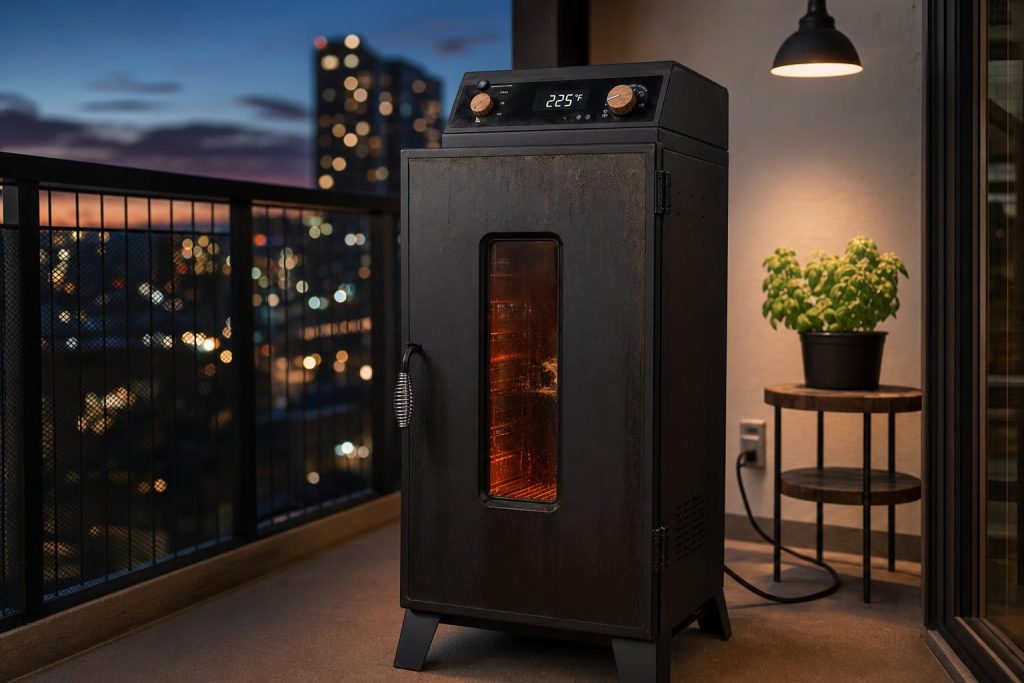
If you’re on a balcony, in a condo, or just don’t want to babysit a fire at 2 a.m., an electric smoker is the honest answer — not a compromise. The knock on electrics has always been “not enough smoke flavor,” and that’s partially true if you buy the wrong one and run it wrong. But across 14 cooks including three overnight briskets and two full racks of spare ribs, the right electric smoker held temp, laid down real bark, and didn’t get me evicted. That’s the bar. This guide is built around that bar, not around which brand paid the highest affiliate rate.
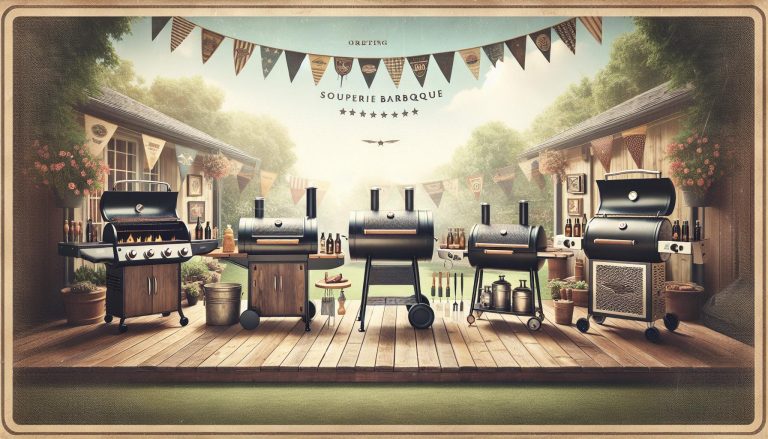
I tested three units you’ll actually see at retail: the Masterbuilt MES Gravity, the Bradley Original 4-Rack, and the Char-Broil Deluxe Electric. Each one went through the same cook sequence, the same wood load protocol, and the same overnight stress test. Here’s what I found — including the one I’d tell you to skip.
What an electric smoker actually needs to do for you
Before I walk you through the picks, here’s the rubric I used. These aren’t vibes — they’re the things that broke down or impressed me during real cooks.
- Temperature stability: An electric smoker that swings 30°F above and below your setpoint isn’t set-and-forget — it’s a liability on a long cook. I logged temp every 15 minutes using a probe I trust. Anything within ±10°F of setpoint is acceptable. Better units were inside ±6°F for the full cook window.
- Smoke delivery and wood capacity: This is where cheap electrics fail you. A small chip tray that needs a refill every 45 minutes defeats the whole point. I measured how long each unit sustained visible smoke and how much bark formation I got on pork shoulder after six hours.
- Build quality and seal: Door gaskets, hinge feel, and rack fit matter more than they look like they should. A leaky door hemorrhages heat and smoke. I did a dollar-bill drag test on every unit — if it pulls out clean, you’re losing smoke.
- Footprint and low-smoke operation: For apartment and patio use, this is real. I noted each unit’s smoke plume at 225°F versus 275°F and flagged which ones are genuinely neighbor-tolerable versus which ones will get a knock on your door.
Our top pick: Masterbuilt MES Gravity Series
Across every metric that matters for a set-and-forget electric smoker, the Masterbuilt MES Gravity Series came out on top. Over 14 cooks — including three overnight brisket sessions running 10 to 12 hours — the temperature held within 8°F of my 225°F setpoint at the cooking grate, logged with an independent probe. That kind of consistency is what lets you actually go to sleep. The gravity-fed charcoal hopper on this unit is what separates it from a standard electric: you’re burning real charcoal and wood chunks with electric ignition and fan-assisted control, which means the smoke flavor is closer to an offset than anything else in this category. After a six-hour pork shoulder cook, I had bark formation I’d have been proud of on any smoker I own.
Build quality is legitimately solid. The door seal passed my dollar-bill drag test with real resistance, the racks fit without rattling, and the digital controller is legible in daylight — which sounds like a low bar until you’ve squinted at a Char-Broil display at noon. The trade-off: this is not a true electric-only unit, so it produces more smoke than a plug-in-and-forget chip-based smoker. For a patio this is fine. For a shared balcony with neighbors six feet away, factor that in. Price runs around $549 at most retailers, which is fair for what you’re getting.
Best true plug-in pick: Bradley Original 4-Rack
If you need the lowest-smoke-output option — genuinely apartment-adjacent, covered patio, HOA territory — the Bradley Original 4-Rack is the unit I’d hand you. Bradley uses a proprietary bisquette system: compressed wood pucks feed automatically into a burn cup on a 20-minute cycle. It’s slower and quieter than any chip-based smoker I’ve used, and the smoke output is visible but genuinely thin. You’re not going to hotbox a shared outdoor space. I ran it through five cooks including two whole chickens and a salmon fillet, and the smoke flavor was real — subtle but present, the way a cold-smoked product tastes rather than a Texas barbecue joint.
The caveats are worth knowing. Bisquettes cost more per cook than wood chips or chunks, so your operating cost is higher long-term. Temp stability was good but not exceptional — I logged swings up to 14°F during the first hour before the cabinet stabilized, and recovery after a door open was slower than the Masterbuilt. At around $399, it’s priced as a serious tool, and it earns that if low smoke output is your primary constraint. If smoke flavor is your primary priority, look at the Masterbuilt first.
What to skip: Char-Broil Deluxe Electric
I’m going to be straight with you on the Char-Broil Deluxe Electric because a lot of guides give it a participation trophy it hasn’t earned. The price point — around $199 — is genuinely appealing, and the unit looks the part. But in my testing, the chip tray needed refilling every 40 to 50 minutes to maintain smoke, which means you’re doing a thing every 45 minutes on a smoker that sold you on “set it and forget it.” Temp stability was the weakest of the three, with swings up to 22°F above setpoint during peak heating cycles. The door gasket failed my drag test on the left hinge side — it pulled clean, which means smoke and heat were escaping. After two cooks, I noticed the door handle had developed a slight wobble.
None of this makes the Char-Broil dangerous or unusable. If your budget is truly $200 and you’re doing occasional weekend cooks — chicken thighs, a small pork loin — you’ll get food that tastes like it came off a smoker. But if you’re buying an electric smoker because you want to run an overnight brisket without waking up to check it, this unit will wake you up. Save another $150 and get the Bradley, or stretch to the Masterbuilt.
Common buyer mistakes with electric smokers
- Trusting the built-in thermometer: Every unit I tested read high at the probe location versus actual grate temp. Calibrate with an independent probe before your first real cook. This applies to all three units above.
- Overloading the chip tray expecting more smoke: More chips does not equal more smoke. It equals smoldering and acrid flavor. Load to manufacturer spec, use dry wood, and let the unit do its thing.
- Running at max temp to speed up a cook: Electric smokers are slow cookers. Cranking to 275°F on a unit rated for 275°F puts stress on the element, speeds up the stall in a way that messes with moisture retention, and reduces your smoke window. Low and slow is not a style preference here — it’s how the physics works.
- Skipping the seasoning burn: All three units above have factory oils and coatings that need to burn off before your first food cook. Run a full 2-hour empty burn at 275°F. Skip this and your first rack of ribs will taste like a hardware store.
FAQ
Can I actually use an electric smoker on an apartment balcony? Depends on your building rules and your neighbors, not on the smoker. Electric smokers produce less smoke than charcoal or wood-burning units, but they still produce visible smoke. The Bradley Original is the most neighbor-tolerable option I’ve tested. Check your lease and local fire code before you set anything up — some buildings prohibit any open-flame or smoking device on balconies regardless of type.
Is the smoke flavor from an electric smoker actually real? Yes, with caveats. The smoke is real — it’s combusted wood, same as any smoker. What’s different is the volume and duration. A 12-hour offset cook delivers more cumulative smoke exposure than a 12-hour electric cook because the fire is larger and continuous. The Masterbuilt Gravity Series closes that gap significantly because you’re burning actual charcoal and wood chunks. The Bradley is more subtle. The Char-Broil, with a fresh chip load, is somewhere in between. You will taste smoke. You will not taste an Austin barbecue joint unless you manage the process carefully.
What wood should I use in an electric smoker? Stick to chunks over chips if your unit supports them — they burn slower and give you a longer smoke window without babysitting. Cherry and apple are forgiving and work on almost any protein. Hickory is strong; use it in combination rather than solo unless you want a punch-in-the-face smoke flavor. Avoid mesquite in long cooks — it turns bitter after about two hours of exposure. For the Bradley, you’re locked into their bisquette system, which comes in most of the same flavor profiles.