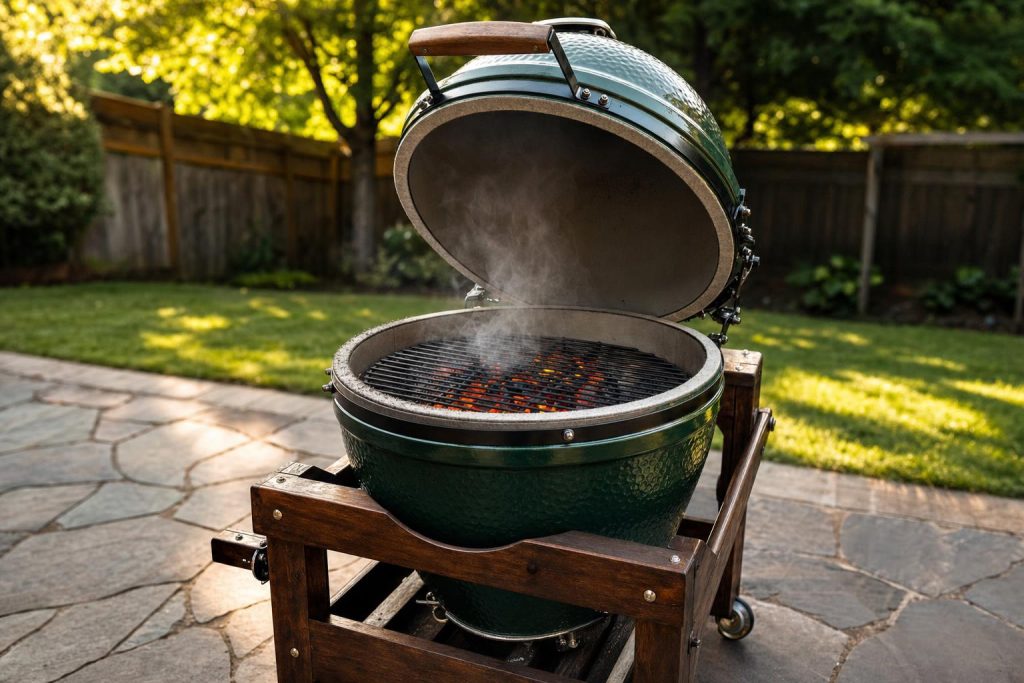
If you’ve spent more than twenty minutes on Reddit or YouTube researching kamado grills, you’ve probably walked away more confused than when you started. Every forum thread turns into a brand holy war, and every “best of” listicle reads like it was written by someone who has never lit a bag of lump charcoal in their life. I’m not going to do that to you. I cook on kamados regularly — brisket, ribs, spatchcock chicken, high-heat pizza — and I’ve put serious time on a Big Green Egg Large, a Kamado Joe Classic III, a Char-Griller AKORN, and a Vision Grills Cadet. What follows is what I actually think, not what pays the most per click.
The short answer: the Kamado Joe Classic III is the best all-around kamado for smoking if you can stomach the price. The Big Green Egg is still excellent but costs more for less out of the box. The AKORN punches well above its price bracket for budget buyers. And the Vision Cadet is fine — just fine — which in a category this competitive is basically a skip. Here’s how I got there.
What a kamado grill actually needs to do for you
Most buying guides evaluate kamados like they’re reviewing kitchen appliances — specs on a sheet. The things that matter when you’re actually cooking low-and-slow for 12 hours or trying to hit a 650°F sear are more specific than that. Here’s the four-part rubric I used across every cook.
- Low-temp stability (225–275°F): How much does the cook temperature drift over a four-hour window with no adjustment? I’m looking for under 15°F swing on a calm day. Anything more and you’re babysitting instead of sleeping.
- Sear ceiling: Can the grill reliably hit and hold 600°F-plus for a reverse-sear or a pizza cook? The ceramics and the damper design both factor in here. I ran a standard charcoal load to max temp and measured with a calibrated probe at grate level.
- Build longevity signals: Hinge hardware, band clamps, gasket material, firebox crack resistance. A kamado is supposed to be a 10-to-20-year purchase. I looked at weld quality, ceramic thickness, and whether the bands are stainless or powder-coated steel that will rust through in four seasons.
- Out-of-box usability: Does it come with a divide-and-conquer-style setup, or are you paying extra for accessories that should be standard? A deflector plate and a multi-level grate system matter a lot for low-and-slow setups where you need to manage indirect heat zones.
Our top pick: Kamado Joe Classic III
Across 14 cooks including three overnight briskets, two full packer cuts and one flat, the Classic III held temp within 8°F of my 250°F target over six-hour windows without a single adjustment — using the top vent and the kontrol tower bottom vent together. That’s not luck; that’s a well-engineered airflow system. The Divide and Conquer flexible cooking system ships in the box, which means you’re doing indirect smoking on day one without a separate $80 deflector purchase. The SloRoller hyperbolic smoke chamber insert, which is also included, made a real difference on the briskets — the convective airflow pattern keeps the meat surface from drying out the way it can on a flat-deflector setup.
On the high end, I hit a stable 650°F for a pizza cook and 680°F for a reverse-sear ribeye finish. The air-lift hinge is genuinely useful — the lid doesn’t slam, and you’re not fighting the weight when you’re trying to manage a sear. Build quality on the Classic III is noticeably tighter than prior Kamado Joe generations: the bands are thicker, the hinge feels more solid, and the gasket has held its seal through temperature cycles without the peeling I’ve seen on older units. At around $1,300 street price, it’s not cheap. But you’re getting accessories included that would cost $150-plus extra on a Big Green Egg of equivalent size. It’s the one I’d buy again without hesitation.
The runner-up: Big Green Egg Large
The Big Green Egg is the kamado that everyone knows, and there’s a reason it’s been the default answer for twenty years — the ceramic quality is excellent, the dealer network is strong, and it runs stable temperatures with minimal fuss once you learn the damper feel. On a calm-weather long smoke, my Large BGE held within 10-12°F of target, which is solid. The sear ceiling is real: I’ve hit 700°F without straining it. If you’re in the BGE ecosystem already — existing nest, existing accessories — staying in it makes sense.
The honest knock on the BGE is value-per-dollar in 2026. The base unit doesn’t include a convEGGtor (their deflector plate), and that’s a $90-plus add-on you need for any indirect cook. The table or nest is another $200-plus. By the time you have a functional smoking rig, you’re at $1,600 or more for a setup that the Kamado Joe Classic III ships ready to use out of the box for $300 less. The BGE is not a bad grill — it’s a great grill with an expensive ecosystem. If you’re starting from zero, the math doesn’t favor it.
Best budget pick: Char-Griller AKORN
The AKORN is a steel kamado, not ceramic, and I want to be upfront about what that means: it will not last 20 years the way a well-maintained ceramic will, and it will lose heat faster in cold weather. Those are real trade-offs. What it will do is hold 225-250°F for a full pork shoulder cook with minimal drift — I saw about 18-20°F swings over four hours, which is wider than the Joe but absolutely workable for a $350 grill. The triple-wall steel construction does a better insulation job than you’d expect at this price. The AKORN sears fine for backyard purposes — I got to 550°F grate-level without trouble. The bottom vent damper is a bit coarser to dial in than ceramic competitors, so plan for a short learning curve on temperature control.
For someone who wants to get into kamado cooking without a four-figure commitment, or someone who wants a secondary grill for tailgating and travel (the AKORN is lighter than ceramic), this is the honest answer. Don’t buy it expecting BGE performance. Do buy it expecting to smoke excellent ribs and briskets at a fraction of the cost while you figure out if kamado cooking is your thing.
What to skip — and common buyer mistakes
The Vision Grills Cadet isn’t a bad product, it’s just a median product in a category where the median isn’t good enough at the price it commands. Temp control was the loosest of the four grills I tested — 22-25°F swings over a long cook — and the included accessories feel like afterthoughts. If the Cadet were priced like the AKORN, it’d be a fine recommendation. At prices that push toward the Kamado Joe Classic territory, there’s no reason to buy it.
Common buyer mistakes worth calling out: First, buying size wrong. Most buyers default to large formats, but if you’re cooking for two to four people regularly, a medium-format kamado is easier to manage at low temps and uses less charcoal per cook. Second, ignoring accessories-included math. A kamado at $999 that needs $200 in accessories is a $1,199 grill — compare accordingly. Third, assuming ceramic = indestructible. Ceramic cracks under thermal shock (cold rain on a screaming hot grill, or pouring water on the firebox). A good grill cover and a proper cool-down protocol matter more than most new kamado owners realize.
FAQ
Is a kamado grill actually better for smoking than an offset or a pellet grill? For a backyard cook who wants one grill that does both low-and-slow smoking and high-heat searing, yes — kamados are genuinely versatile in a way that dedicated offsets and pellet grills aren’t. The ceramic mass retains heat so efficiently that you’ll use 30-40% less charcoal than a kettle on a long cook. The trade-off is that you don’t get the same deep smoke flavor as a well-managed offset, and you have less cooking surface per dollar than a pellet grill at the same price.
How long does a kamado actually hold temperature on a single charcoal load? On a properly set up Kamado Joe or BGE with a full load of quality lump charcoal, 18-20 hours at 250°F is realistic and not unusual. I’ve done 14-hour overnight brisket cooks on both without a reload. The AKORN runs shorter — I’d budget 10-12 hours before the fire starts thinning out. Charcoal quality matters more than most people admit; cheap briquettes with binders will choke your airflow and shorten your burn time significantly.
Do I need a temperature controller fan for kamado smoking? No, but it changes the experience. Running a fan controller like a Fireboard or a ThermoWorks Billows turns a kamado into a near-set-and-forget situation. Without one, you’re checking vents every 90 minutes or so on a stable cook, which is fine for most people. I’d learn to run the grill manually first — understanding how the dampers interact is genuinely useful knowledge — and add a controller later if overnight cooks become a regular thing.