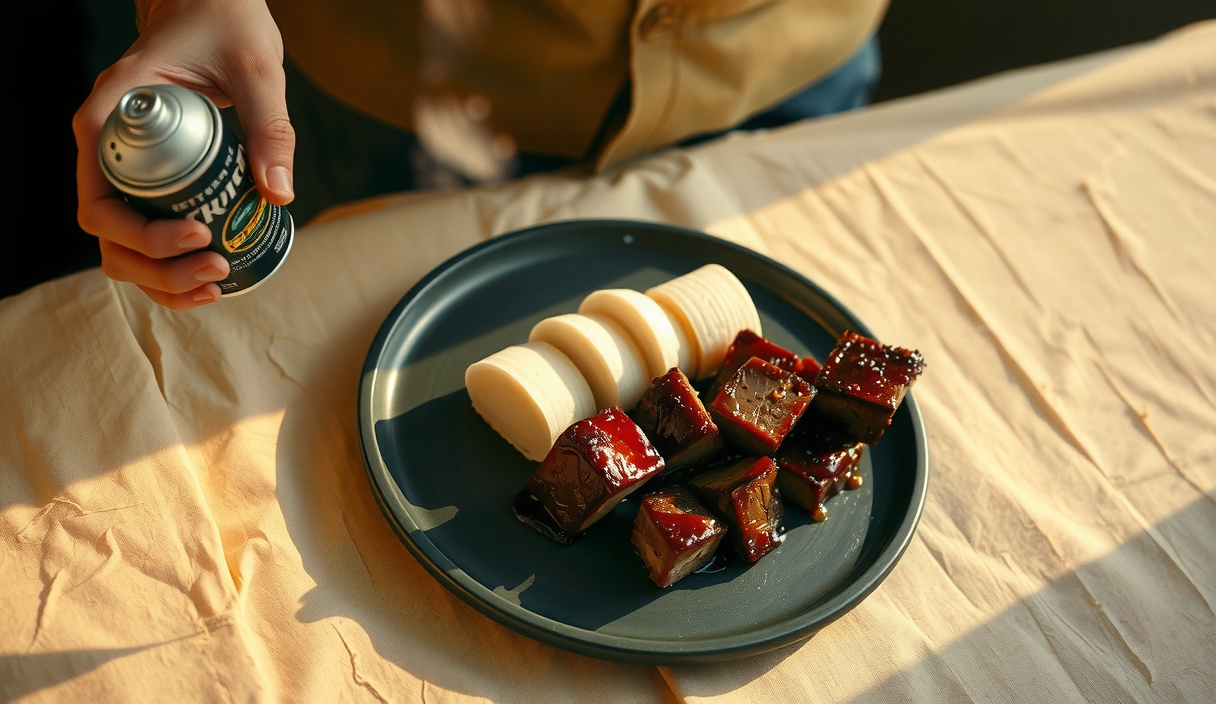
Burnt Ends with Cherry-Bourbon Foam
Point-cut brisket cubes smoked to 203°F internal for complete collagen hydrolysis, lacquered in a cherry-bourbon glaze and returned to the fire for a double bark, then crowned at service with a shear-thinning N2O foam built on 0.2% xanthan and 0.5% sunflower lecithin. The foam collapses in seconds on the palate, releasing cherry benzaldehyde and bourbon oak phenolics directly into the retronasal passage — flavor the sauce alone cannot deliver.
Equipment
- 1 Offset smoker or kettle grill Set up for indirect heat with a water pan; capable of holding 250-300°F
- 6-8 Post oak or cherry wood chunks Chunks, not chips — chips burn too fast for a 6-8 hour smoke
- 1 Probe thermometer Leave-in probe for tracking internal temperature through the stall
- 1 Instant-read thermometer Confirm pull temp at 203°F in multiple spots
- 1 iSi Gourmet Whip or equivalent N2O siphon 500 mL minimum; must be food-grade N2O rated
- 2 N2O charger cartridges One per 500 mL of foam base; do not substitute CO2
- 1 Immersion blender or high-speed blender Essential for hydrating xanthan under high shear before foam charging
- 1 Fine-mesh strainer For straining cherry reduction before adding hydrocolloids
- 2 Aluminum half pan One for resting the cubed ends, one for the second smoke pass
- 1 large sheet Butcher paper For wrapping through the stall — foil will soften bark
Ingredients
Brisket & Rub
- 4 lb brisket point (deckle), fat cap trimmed to 1/4 inch Also called the second cut; do not substitute brisket flat
- 2 tbsp kosher salt
- 2 tbsp coarse black pepper 16-mesh preferred for bark texture
- 1 tsp garlic powder
- 1 tsp smoked paprika
Cherry-Bourbon Glaze
- 1 cup tart cherry juice (100%, unsweetened) Not cherry cocktail; the sugar content of cocktail juice will burn before the glaze sets
- 3 tbsp high-rye bourbon Bulleit, Knob Creek, or Old Grand-Dad recommended
- 3 tbsp dark brown sugar, packed Provides the reducing sugars for Maillard browning on the second smoke pass
- 2 tbsp Worcestershire sauce
- 1 tbsp apple cider vinegar Brightens the glaze and mildly depresses pH toward optimal Maillard range
- 1 tsp black pepper
- ½ tsp cayenne Optional; omit for reflux-sensitive guests
Cherry-Bourbon N2O Foam Base
- 200 mL tart cherry juice (100%, unsweetened), reduced by half Start with 400 mL and reduce over medium heat to 200 mL; cool completely before proceeding
- 60 mL high-rye bourbon Do not cook off the alcohol before adding to foam base — ethanol is a co-solvent that keeps volatile aromatics in solution
- 15 mL kirsch (cherry eau-de-vie) Amplifies benzaldehyde concentration in the aqueous phase; substitute additional bourbon if unavailable
- 1 tbsp honey For light sweetness and minor foam stabilization via fructose-water hydrogen bonding
- 0.56 g xanthan gum (food-grade) Precisely 0.2% w/w of the 280 mL total liquid base; weigh on a digital scale — do not estimate
- 1.4 g sunflower lecithin (liquid or reconstituted powder) Precisely 0.5% w/w of the 280 mL total liquid base; soy lecithin works as a 1:1 substitute
- 1 pinch fine sea salt Ionic strength adjustment; enhances flavor perception and mildly accelerates xanthan hydration

Instructions
Day Before: Dry Brine
- Combine the kosher salt, black pepper, garlic powder, and smoked paprika in a small bowl. Apply the rub evenly across all surfaces of the brisket point, pressing gently to adhere. Place uncovered on a wire rack set in a sheet pan. Refrigerate for 12-16 hours. Why: Dry brining depresses surface water activity and allows the salt to migrate inward via osmosis, improving moisture retention during the long cook.2 tbsp kosher salt, 2 tbsp coarse black pepper, 1 tsp garlic powder, 1 tsp smoked paprika
First Smoke: Full Point
- Set up your smoker for indirect heat at 250°F. Add 3-4 wood chunks to the fire box. Place the brisket point fat-side up on the grate, insert the probe thermometer into the thickest part, and close the lid.
- Smoke at 250°F until the internal temperature reaches 165-170°F — this is the stall onset and typically takes 4-5 hours. Do not rush or raise the pit temperature. The stall is evaporative cooling; it is doing work on the surface bark.
- When the probe reads 165-170°F, wrap the point tightly in a single layer of butcher paper (not foil). Return to the smoker and continue cooking until the internal temperature reaches 203°F — expect 2-3 additional hours. Verify with an instant-read in at least three spots across the point.
- Remove the wrapped point from the smoker. Keep it wrapped and rest at room temperature for 30 minutes minimum. Do not skip the rest — internal gelatin re-sets and moisture redistributes during this window.
Make the Cherry-Bourbon Glaze
- While the point rests, combine the tart cherry juice, bourbon, dark brown sugar, Worcestershire, apple cider vinegar, black pepper, and cayenne in a small saucepan over medium heat. Stir to dissolve the sugar.1 cup tart cherry juice (100%, unsweetened), 3 tbsp high-rye bourbon, 3 tbsp dark brown sugar, packed, 2 tbsp Worcestershire sauce, 1 tbsp apple cider vinegar, 1 tsp black pepper, 1/2 tsp cayenne
- Bring to a simmer and reduce until the sauce coats the back of a spoon thickly and falls in slow ribbons — approximately 12-15 minutes of active reduction. The sauce will tighten further as it cools. Remove from heat and set aside.1 cup tart cherry juice (100%, unsweetened), 3 tbsp high-rye bourbon, 3 tbsp dark brown sugar, packed, 2 tbsp Worcestershire sauce, 1 tbsp apple cider vinegar, 1 tsp black pepper, 1/2 tsp cayenne
Cube, Sauce, and Second Smoke
- Raise the smoker temperature to 275-300°F. Unwrap the rested point and cut into 1.5-inch cubes using a sharp boning or chef's knife. The interior should be deeply mahogany, yielding under gentle pressure, and visibly moist from rendered gelatin.
- Transfer the cubed burnt ends to an aluminum half pan. Pour the cherry-bourbon glaze over the cubes and toss gently to coat all surfaces. The glaze should just barely pool at the bottom of the pan — not submerge the cubes.1 cup tart cherry juice (100%, unsweetened), 3 tbsp high-rye bourbon, 3 tbsp dark brown sugar, packed, 2 tbsp Worcestershire sauce, 1 tbsp apple cider vinegar, 1 tsp black pepper, 1/2 tsp cayenne
- Place the uncovered pan back on the smoker at 275-300°F for 60-90 minutes. Toss the cubes at the 45-minute mark. The glaze should caramelize onto all six faces of each cube, forming a second bark layer. The pan bottom should be nearly dry with thick, lacquered residue — not a pool of liquid. Remove from the smoker.1 cup tart cherry juice (100%, unsweetened), 3 tbsp high-rye bourbon, 3 tbsp dark brown sugar, packed, 2 tbsp Worcestershire sauce, 1 tbsp apple cider vinegar, 1 tsp black pepper, 1/2 tsp cayenne
Make the Cherry-Bourbon N2O Foam
- Start the foam base at least 2 hours before service. In a small saucepan, combine 400 mL of tart cherry juice and reduce over medium heat to 200 mL (a 2:1 reduction). Cool completely to room temperature, then refrigerate until cold (38-42°F).200 mL tart cherry juice (100%, unsweetened), reduced by half
- In a small pitcher or tall jar, combine the cold reduced cherry juice (200 mL), bourbon (60 mL), kirsch (15 mL), honey, and fine sea salt. Stir to dissolve the honey. This is your 280 mL base. Weigh the xanthan and lecithin precisely on a digital scale before proceeding.200 mL tart cherry juice (100%, unsweetened), reduced by half, 60 mL high-rye bourbon, 15 mL kirsch (cherry eau-de-vie), 1 tbsp honey, 1 pinch fine sea salt
- Add the xanthan gum (0.56 g) to the cold liquid base. Blend immediately with an immersion blender at high speed for 60-90 seconds until fully hydrated with no visible gum particles. Do not add the lecithin yet. Xanthan must fully hydrate before the lecithin is introduced or the gum will clump.0.56 g xanthan gum (food-grade)
- Add the sunflower lecithin (1.4 g) to the xanthan-thickened base. Blend again at high speed for 30-45 seconds until the lecithin is fully emulsified and the base appears slightly hazy and uniform. Strain through a fine-mesh strainer to remove any remaining particulates.1.4 g sunflower lecithin (liquid or reconstituted powder)
- Pour the strained foam base into the iSi siphon. Seal the siphon head. Charge with one N2O cartridge, shake vigorously 5 times, and refrigerate the charged siphon upright at 38-42°F until service. Do not use CO2 cartridges. The siphon is now charged and ready to dispense for up to 4 hours under refrigeration.200 mL tart cherry juice (100%, unsweetened), reduced by half, 60 mL high-rye bourbon, 15 mL kirsch (cherry eau-de-vie), 1 tbsp honey, 0.56 g xanthan gum (food-grade), 1.4 g sunflower lecithin (liquid or reconstituted powder), 1 pinch fine sea salt
Plate and Serve
- Allow the finished burnt ends to cool slightly off the smoker for 3-5 minutes — surface temperature should drop below 150°F before foam application. Arrange 4-5 cubes per serving on a warm plate or cast iron vessel. Do not plate onto cold surfaces; thermal shock will collapse the foam faster.
- Immediately before serving, remove the charged iSi siphon from the refrigerator. Shake twice, invert completely, and dispense the cherry-bourbon foam over the burnt ends in a loose, airy crown — not a dense pipe. Service window is 8-12 minutes on a warm surface. Deliver to the table immediately.200 mL tart cherry juice (100%, unsweetened), reduced by half, 60 mL high-rye bourbon, 15 mL kirsch (cherry eau-de-vie), 1 tbsp honey, 0.56 g xanthan gum (food-grade), 1.4 g sunflower lecithin (liquid or reconstituted powder), 1 pinch fine sea salt
Notes
Why 203°F and not 190°F? Collagen hydrolysis follows first-order kinetics. The rate constant increases exponentially with temperature above 160°F. At 190°F, conversion is substantial but cross-links remain. At 203°F held for 2 hours post-stall, you achieve near-complete hydrolysis of intermolecular collagen bonds into free gelatin — the structural signature of great burnt ends. Rushing to 190°F and pulling saves 30-45 minutes and costs you the difference between firm and gelatinous.
Xanthan at 0.2% w/w: the pseudoplasticity window. Below 0.1%, the foam drains too fast — insufficient continuous-phase viscosity to arrest bubble migration. Above 0.4%, the dispense texture becomes ropy and gummy, the foam feels heavy on the tongue, and the shear-thinning release during mastication is delayed. The 0.2% band delivers n ≈ 0.20-0.30 (power-law flow behavior), which means the foam appears to hold its structure at rest but collapses nearly instantaneously under the 50-100 Pa shear forces of chewing — releasing the cherry volatiles in a single retronasal pulse.
Lecithin at 0.5% w/w: the interface budget. Lecithin (phosphatidylcholine dominant in sunflower-sourced) is an amphiphile with HLB ≈ 7-8. At the N2O bubble interface in this aqueous system, it orients its hydrophilic phosphate head toward the water phase and its fatty acid tails toward the gas phase, forming a packed monolayer that reduces interfacial tension from ~72 mN/m (clean water-gas) to approximately 40-45 mN/m. Below 0.3%, interface coverage is sparse and bubbles coalesce rapidly. Above 1.0%, excess lecithin forms lamellar aggregates that compete with xanthan for water, destabilizing the continuous phase viscosity. 0.5% is the empirical optimum for this specific liquid base composition.
Why N2O and not CO2? N2O is approximately 60x more soluble in aqueous systems than CO2 at equivalent pressures. More critically, CO2 forms carbonic acid upon dissolution, dropping the pH of the cherry reduction to below 3.5. At pH 3.5, the pectin fractions from the cherry juice begin to degrade, and the lecithin headgroup ionization shifts in a way that reduces interfacial activity. N2O is chemically inert in this system — it does not alter pH, does not react with the aromatics, and releases cleanly from solution upon dispense.
The fat-partition problem and why the foam solves it. Cherry benzaldehyde (log P = 1.48) and ethyl hexanoate (log P = 2.83) are moderately to strongly lipophilic. In a fat-rich sauce or glaze coating, these compounds partition strongly into the lipid phase, suppressing their vapor pressure and delaying their release into the headspace. The foam base is nearly fat-free (the lecithin represents less than 0.5% lipid by mass). In this aqueous matrix, the partition coefficient shifts toward the vapor phase — the aromatics are delivered directly into the retronasal passage when the foam collapses on the tongue, providing a burst of cherry and bourbon aromatics that the glaze-coated burnt end surface, alone, cannot achieve.
Nutrition
Calories: 520kcalCarbohydrates: 18gProtein: 38gFat: 28gSaturated Fat: 11gCholesterol: 135mgSodium: 980mgFiber: 1gSugar: 14g
Tried this recipe?Let us know how it was!