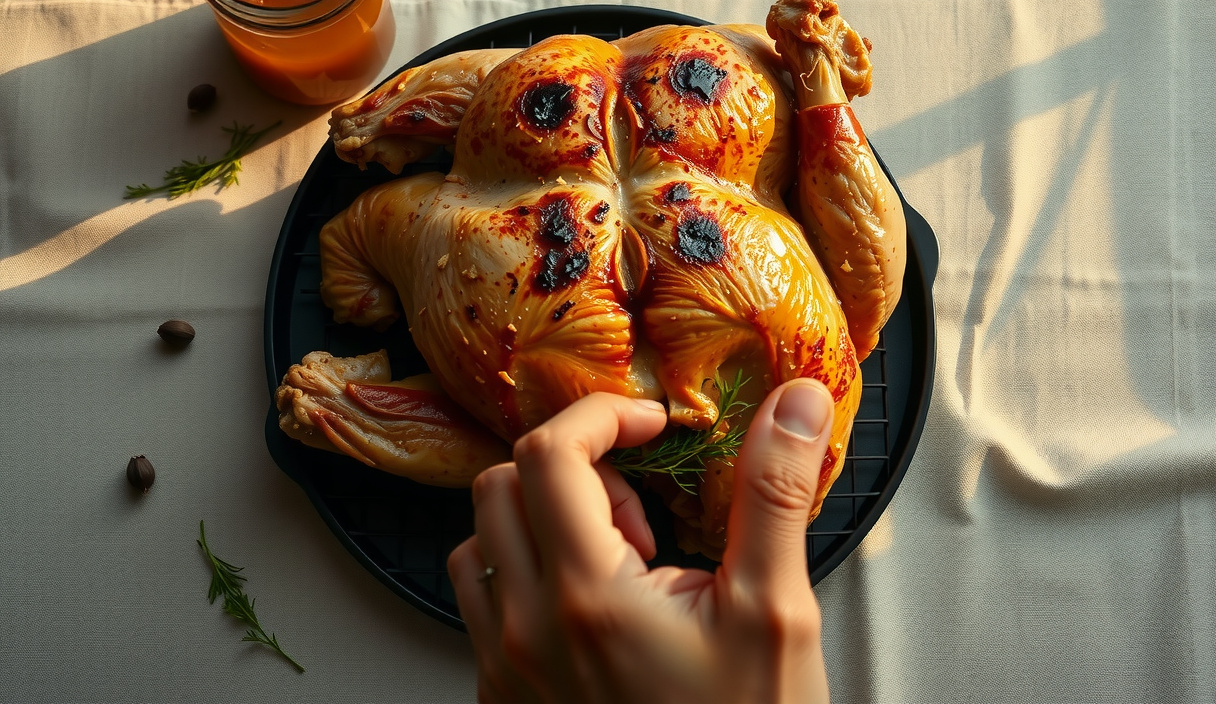
Fermented Pickle Brine Smoked Chicken

A whole spatchcocked chicken brined for 12 hours in six-week lacto-fermented pickle brine, then slow-smoked over cherry wood to an internal temperature of 157°F. The lactic acid in the brine — reaching pH 3.8 to 4.2 — partially denatures collagen cross-links before the cook begins, producing exceptionally juicy meat with a tangy, dill-and-garlic-infused bark that rivals any buttermilk-fried bird for depth of flavor.
Equipment
- 1 Offset smoker or kettle grill set up for indirect smoking Maintain 250–275°F throughout the cook; temperature swings beyond 25°F in either direction will compromise bark development and moisture retention.
- 2 Half-gallon wide-mouth mason jar For the lacto-ferment. Must be scrupulously clean but not sterile — residual chlorine from dishwasher rinsing will inhibit Lactobacillus colonization.
- 1 Dual-probe wireless thermometer One probe monitors smoker ambient temperature at grate level; the second monitors thigh internal temperature. Do not rely on lid thermometers — they typically read 25–50°F higher than actual grate temperature.
- 1 Wire rack set inside a rimmed sheet pan Used for drying the brined chicken uncovered in the refrigerator before smoking. Airflow under the bird is critical for pellicle formation.
- 1 Kitchen shears or boning knife For spatchcocking — removing the backbone requires firm, confident cuts through the rib cage on either side of the spine.
Ingredients
Lacto-Fermented Pickle Brine (make 6 weeks ahead)
- 1 quart filtered or well water (not chlorinated tap water) Chlorine kills Lactobacillus. If tap water is your only option, let it sit uncovered 30 minutes to off-gas chlorine, or use a Brita-filtered source.
- 20 grams non-iodized kosher salt Exactly 2% w/v salt — this is the critical threshold that selects for Lactobacillus and suppresses pathogenic bacteria. Do not eyeball it; weigh it.
- 4 small Kirby cucumbers, halved lengthwise Kirby cucumbers have thinner skins and firmer flesh than standard slicing cucumbers, maintaining texture over the 6-week ferment.
- 6 garlic cloves, smashed Smashing (not mincing) releases allicin while keeping the pieces large enough to fish out after fermentation.
- 2 teaspoons whole black peppercorns
- 1 teaspoon whole coriander seeds
- 1 teaspoon whole mustard seeds
- 4 fresh dill heads, or 2 tablespoons dried dill weed
- 1 dried bay leaf
- 1 small grape leaf or horseradish leaf (optional) Contains tannins that inhibit pectin methylesterase, helping the cucumbers stay firm. Omit if unavailable — it affects texture, not fermentation safety.
Chicken and Dry Rub
- 1 whole chicken, 3.5 to 4.5 pounds, spatchcocked (backbone removed) Pat completely dry before spatchcocking. Ask your butcher to remove the backbone if kitchen shears are unavailable.
- 1 quart finished lacto-fermented pickle brine (strained, cold) Brine should taste aggressively sour — pH 3.8 to 4.2. Dilute 50/50 with cold water if pH reads below 3.5 on a meter.
- 1 tablespoon coarse kosher salt
- 2 teaspoons coarsely ground black pepper
- 1 teaspoon smoked paprika
- 0.5 teaspoon garlic powder
- 2 cherry wood chunks, fist-sized Soak-free. Modern consensus supports dry wood chunks for more controlled, less steamy combustion. Fruit woods (apple, peach) work equally well.

Instructions
Make the Lacto-Fermented Brine (6 weeks ahead)
- Dissolve the kosher salt completely in the filtered water, stirring until no granules remain. This is your 2% w/v brine solution.20 grams non-iodized kosher salt
- Pack the halved cucumbers, smashed garlic, peppercorns, coriander seeds, mustard seeds, dill, bay leaf, and the grape or horseradish leaf (if using) into two clean half-gallon mason jars. Divide evenly between the jars.4 small Kirby cucumbers, halved lengthwise, 6 garlic cloves, smashed, 2 teaspoons whole black peppercorns, 1 teaspoon whole coriander seeds, 1 teaspoon whole mustard seeds, 4 fresh dill heads, or 2 tablespoons dried dill weed, 1 dried bay leaf, 1 small grape leaf or horseradish leaf (optional)
- Pour the salt brine over the vegetables, ensuring all solids are fully submerged. Leave 1 inch of headspace. Weight the cucumbers below the brine line using a small zip-lock bag filled with brine, or a purpose-built fermentation weight. Exposure to air allows kahm yeast and mold to colonize the surface. Cover the jar loosely with a cloth secured with a rubber band, or use an airlock lid.
- Ferment at room temperature (68–75°F ideal) for 6 weeks. In the first 48 to 72 hours you will see active bubbling — carbon dioxide produced by Lactobacillus metabolism. The brine will turn progressively cloudier as lactic acid concentration increases. Taste weekly: at 2 weeks the brine is pleasantly tart; at 6 weeks it should be aggressively sour and tangy. Transfer to the refrigerator when the fermentation activity slows (minimal bubbling) or when the sour level satisfies you.
- Strain the finished brine through a fine-mesh sieve, discarding solids (or eat the pickled cucumbers — they are excellent). Refrigerate the strained brine until ready to use. Properly fermented brine keeps refrigerated for up to 3 months.
Spatchcock and Brine the Chicken
- Place the chicken breast-side down on a cutting board. Using sturdy kitchen shears, cut along both sides of the spine from the tail to the neck opening, removing the backbone entirely. Reserve the backbone for stock. Flip the bird breast-side up and press firmly on the breastbone with the heel of your hand until you hear and feel the cartilage crack — the bird should now lie flat.1 whole chicken, 3.5 to 4.5 pounds, spatchcocked (backbone removed)
- Place the spatchcocked chicken in a large zip-lock bag or a snug-fitting container. Pour the cold strained pickle brine over the chicken. The bird should be fully submerged; if needed, add a small amount of cold water to ensure coverage. Seal and refrigerate for exactly 12 hours — no longer. Set a timer.1 whole chicken, 3.5 to 4.5 pounds, spatchcocked (backbone removed), 1 quart finished lacto-fermented pickle brine (strained, cold)
- Remove the chicken from the brine and rinse briefly under cold running water. Pat aggressively dry on all surfaces — including the cavity side — using paper towels. Place breast-side up on a wire rack set inside a sheet pan. Return uncovered to the refrigerator for a minimum of 2 hours, or up to 12 hours overnight. The surface must be completely dry and slightly tacky (the pellicle) before it enters the smoker. A visibly wet surface will steam rather than absorb smoke in the critical early phase of the cook.
Apply the Rub and Smoke
- Mix the kosher salt, black pepper, smoked paprika, and garlic powder together in a small bowl. The rub is intentionally minimal — the brine has already seasoned the interior of the meat. Apply a thin, even coat to all external surfaces of the dried chicken, including under the loosened skin over the breast and thighs wherever possible.1 tablespoon coarse kosher salt, 2 teaspoons coarsely ground black pepper, 1 teaspoon smoked paprika, 0.5 teaspoon garlic powder
- Set up your smoker for indirect cooking. Establish a stable ambient temperature of 250–275°F at grate level before adding the chicken. Add the cherry wood chunks directly to the coals or wood supply. You want thin blue smoke — not thick white billowing smoke, which indicates incomplete combustion and will impart a bitter, acrid note to the bark.2 cherry wood chunks, fist-sized
- Place the chicken skin-side up on the smoker grate, thighs oriented toward the heat source (firebox side on an offset, or closer to the coals on a kettle). Insert one probe thermometer into the deepest part of the inner thigh without touching bone. Insert the second probe to monitor ambient smoker temperature at grate level. Close the lid.
- Smoke undisturbed at 250–275°F until the thigh registers 157°F internal temperature — approximately 2.5 to 3.5 hours depending on bird size and smoker efficiency. Resist opening the lid in the first 90 minutes; this is the critical smoke-deposition window where the phenolic bark is forming. After 90 minutes, you may open briefly to assess color and add additional wood if the smoker has gone clean.
- When the thigh reads 157°F, remove the chicken from the smoker. Tent loosely with aluminum foil and rest undisturbed on a cutting board for 15 minutes. Carryover heat will bring the internal temperature to 165°F during rest. Do not skip or shorten the rest — this is when the denatured protein matrix partially relaxes and reabsorbs expelled moisture.
- Carve by first separating the leg quarters at the hip joint, then slicing along the breastbone to remove each breast half. Serve immediately, skin-side up. The bark should be dry, mahogany-colored, and audibly crisp when tapped with a fingernail.
Notes
Why lactic acid tenderizes better than vinegar-based brines: Lactic acid (pKa 3.86) is a weaker acid than acetic acid (pKa 4.76 — counterintuitively, the lower the pKa the stronger the acid; acetic acid is actually stronger). However, at the same pH, lactic acid's smaller molecular weight and higher water-solubility allow it to penetrate deeper into muscle tissue by diffusion before its proton load is buffered by the bicarbonate and phosphate systems within the meat. The net result is more uniform collagen weakening throughout the muscle cross-section rather than a surface-only effect. Vinegar brines deliver tenderization at the surface but can create a noticeably mealy outer layer — particularly pronounced on chicken breast — because acetic acid attacks surface proteins aggressively before diffusing inward. Lactic acid's gentler diffusion gradient softens the whole muscle more uniformly.
The pellicle is a phenolic trap: Smoke-derived phenolics (guaiacol, syringol, cresol) are hydrophobic molecules with log P (octanol-water partition coefficient) values above 1.0. They partition strongly into lipid and protein films rather than bulk water. The partially dried, slightly sticky protein-and-fat layer on the surface of a properly pellicled chicken acts as a hydrophobic sink, accumulating phenolics during the first 60 to 90 minutes of smoking when the surface temperature is still low enough to prevent bark hardening. Once the bark seals (around 160°F surface temperature), phenolic uptake slows dramatically. Every minute of wet-surface smoking is a minute of lost bark complexity.
The 157°F pull temperature: USDA tables for poultry define safety by a combination of temperature and hold time — 165°F for instantaneous kill, or 157°F held for 10.4 seconds for an equivalent 7-log reduction in Salmonella. The 15-minute rest period vastly exceeds the required hold time, making a 157°F pull thermodynamically safe while meaningfully protecting the moisture content of the breast meat. Pulling at 165°F from the smoker routinely results in breast temperatures at 170–172°F by the time carving occurs — a zone where actin-network contraction is essentially complete and water-holding capacity has dropped to its minimum.
Salt concentration math for scaling the ferment: The 2% w/v target (20 grams per liter of water) is not arbitrary — it is the minimum ionic strength required to create an environment where Lactobacillus species outcompete pathogenic gram-negative bacteria in the first 24 to 48 hours. Below 1.5%, fermentation can still occur but the safety margin narrows. Above 3%, the salt begins to inhibit Lactobacillus itself, slowing acid production and extending the fermentation timeline unpredictably.
Nutrition
Calories: 410kcalCarbohydrates: 2gProtein: 52gFat: 20gSaturated Fat: 5gCholesterol: 185mgSodium: 890mg
Tried this recipe?Let us know how it was!