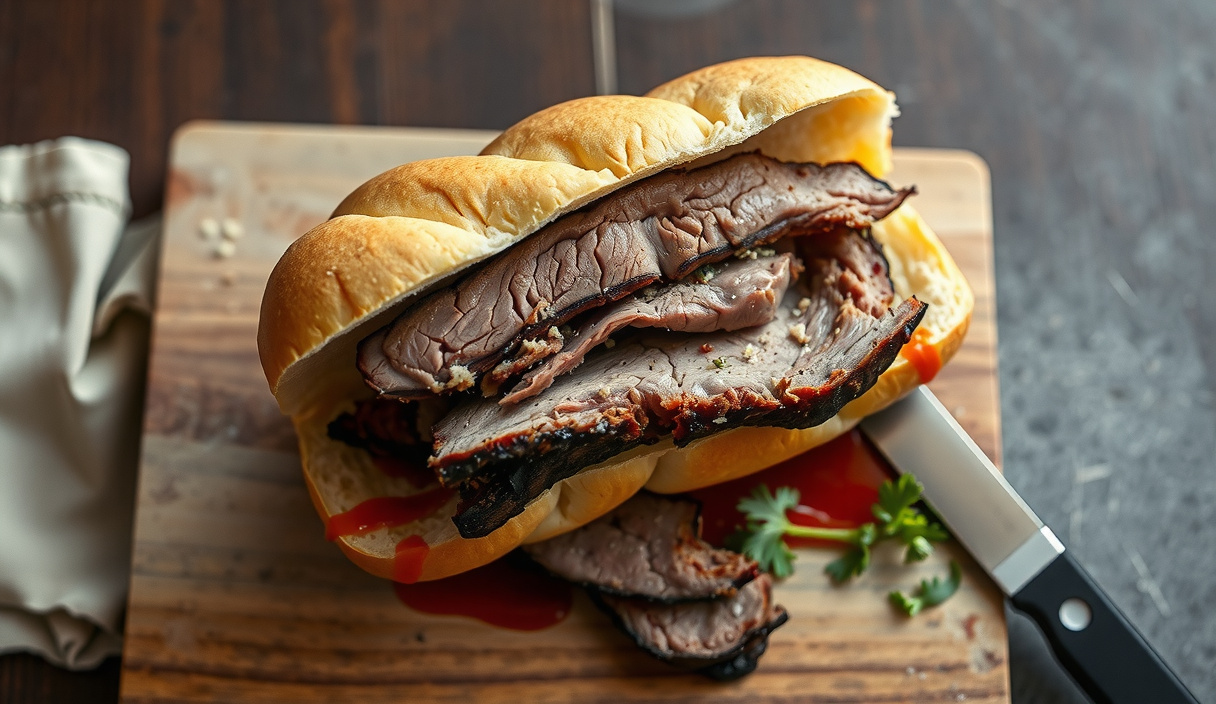
Gluten-Free Smoked Brisket Sandwich on GF Brioche
A full packer brisket smoked low-and-slow over post oak until collagen converts to gelatin at 203°F, sliced and loaded onto a rice-flour and tapioca-starch brioche bun engineered with 6% psyllium husk to replace gluten's viscoelastic gas-trapping network. The result is a sandwich that delivers bark, smoke ring, gelatinous juiciness, and a bun with genuine brioche stretch — all 100% gluten-free.
Equipment
- 1 Offset, drum, kamado, or pellet smoker Must hold 225°F–250°F steadily for 10–14 hours
- 1 Dual-probe digital thermometer One probe at grate level, one in the flat
- 1 Stand mixer with dough hook Or large bowl and wooden spoon for GF brioche
- 1 Kitchen scale Mandatory for psyllium and starch ratios
- 1 large sheet Butcher paper (unlined) For wrapping brisket during the stall — not aluminum foil
- 1 Large cooler For the 60–90 minute rest period
- 1 Baking sheet with parchment
- 1 Bench scraper For portioning and shaping GF brioche dough
- 1 Pastry brush For egg wash on buns
Ingredients
Brisket and Rub
- 12 –16 lb whole packer brisket (USDA Choice or Prime) Fat cap trimmed to 1/4 inch; both flat and point intact
- 3 tbsp coarse kosher salt
- 3 tbsp coarsely ground black pepper 16-mesh or similar coarse grind
- 1 tbsp garlic powder
- 1 tbsp smoked paprika
- 1 tsp cayenne pepper
- 1 tbsp certified GF tamari or coconut aminos Brushed lightly over brisket surface before rub application
- 4 oz post oak wood chunks or chips Soaked 30 min if chips; chunks used dry
GF Brioche Buns
- 280 g superfine white rice flour Not a pre-made GF blend containing xanthan
- 120 g tapioca starch
- 50 g potato starch
- 27 g whole-husk psyllium husk Exactly 6% of total dry flour mass (450g total); measure by weight
- 1.5 g xanthan gum 0.3% w/w of total liquid; do not increase
- 7 g instant dry yeast One standard packet
- 30 g granulated sugar
- 8 g fine sea salt
- 240 ml warm water 100°F–105°F; activates yeast and hydrates psyllium
- 120 ml warm whole milk or full-fat plant milk 105°F; adds richness and Maillard precursors
- 3 large eggs Room temperature; 2 for dough, 1 for egg wash
- 85 g unsalted butter Cold, cubed into 1/2-inch pieces; freeze 30 min before use
- 1 tsp apple cider vinegar Prevents psyllium gray discoloration by maintaining slight acidity
- 1 tbsp sesame seeds (certified GF, optional) For topping; skip if sesame is a concern
- 1 tbsp water Mixed with egg for egg wash
Assembly and Sauce
- 1 cup reserved brisket drippings Collected from the butcher paper wrap; skim excess fat
- 3 tbsp certified GF apple cider vinegar
- 2 tbsp certified GF tamari or coconut aminos
- 1 tbsp brown sugar or coconut sugar
- 1 tsp black pepper, coarsely ground
- 2 large yellow onions, thinly sliced For caramelizing
- 2 tbsp avocado oil or neutral high-heat oil
- 1 tbsp unsalted butter Added at the end of onion caramelization for gloss
- 8 leaves butter lettuce or iceberg lettuce
- 2 medium dill pickles, thinly sliced Certified GF brand; acid contrast cuts richness

Instructions
Day Before — Dry Brine and Rub
- Trim the fat cap of the packer brisket to a uniform 1/4 inch. Brush the entire surface lightly with GF tamari or coconut aminos. Combine coarse salt, coarsely ground black pepper, garlic powder, smoked paprika, and cayenne. Apply the rub liberally on all sides, pressing it firmly into the meat surface. Wrap loosely in butcher paper or plastic wrap and refrigerate uncovered for 8–12 hours (overnight). The salt draws surface moisture out, then the brine is reabsorbed, seasoning deeper layers and raising the surface water activity before the cook.3 tbsp coarse kosher salt, 3 tbsp coarsely ground black pepper, 1 tbsp garlic powder, 1 tbsp smoked paprika, 1 tsp cayenne pepper, 1 tbsp certified GF tamari or coconut aminos
Smoke the Brisket
- Remove the brisket from the refrigerator 45–60 minutes before smoking to temper the surface temperature. Meanwhile, establish your smoker at a steady 225°F–250°F with indirect heat. Place post oak wood chunks on the coals or in the wood box. The initial smoke exposure is most important — myoglobin forms a stable carboxy-myoglobin smoke ring only before the surface fully dries.4 oz post oak wood chunks or chips
- Place the brisket fat-cap-up on the grate, away from direct heat. Insert one probe into the thickest part of the flat (not the point, which cooks faster). Set a second probe at grate level 2–3 inches from the meat. Monitor both. Cook undisturbed for the first 4 hours — opening the lid drops chamber temp and stalls bark formation.
- After 4 hours, begin spot-checking the bark. You want a deep mahogany crust that does not smear when pressed with a finger. The flat internal temp will likely be in the 145°F–155°F range. Continue smoking. When the internal temp plateaus in the stall (typically 155°F–170°F for 1–3 hours), assess the bark: if it is set and deep, wrap the brisket fat-side-up in two layers of unlined butcher paper, returning it to the smoker. If you want more bark development, push through the stall unwrapped, accepting that the flat will be drier. Butcher paper is the correct call for this sandwich application — you need sliceable flat moisture.
- Continue cooking wrapped until the flat internal temperature reaches 195°F for sliceable brisket (or 203°F–205°F for pull-apart tenderness). Verify doneness by inserting the probe through the paper into the flat — it should slide in with almost no resistance, like warm butter. The point will be a few degrees warmer; that is expected. Total cook time is typically 10–14 hours depending on the size of the packer and smoker consistency.
- Remove the brisket from the smoker. Without unwrapping, place it in a dry cooler and close the lid. Rest for a minimum of 60 minutes, ideally 90 minutes. This rest allows the gelatin-water sol to partially re-gel around fiber bundles, reducing purge loss on the cutting board. Collect and reserve any drippings that accumulate in the butcher paper for the sauce.1 tsp black pepper, coarsely ground
GF Brioche Buns — Mix and First Proof
- Begin the brioche dough approximately 4–5 hours before you plan to serve (it can be baked while the brisket rests). In a large bowl or stand mixer bowl, whisk together the superfine white rice flour, tapioca starch, potato starch, whole-husk psyllium husk, xanthan gum, instant yeast, granulated sugar, and fine sea salt until evenly distributed.280 g superfine white rice flour, 120 g tapioca starch, 50 g potato starch, 27 g whole-husk psyllium husk, 1.5 g xanthan gum, 7 g instant dry yeast, 30 g granulated sugar, 8 g fine sea salt
- Combine the warm water (100°F–105°F), warm milk, 2 of the 3 eggs, and apple cider vinegar in a separate bowl. Whisk briefly. Pour the wet ingredients into the dry ingredients all at once. Mix on medium speed (or by hand with a stiff spatula) for 2 minutes until the dough comes together. The psyllium will begin absorbing liquid immediately — the dough will stiffen visibly within 60 seconds of mixing. Do not panic: this is the hydrocolloid network forming.240 ml warm water, 120 ml warm whole milk or full-fat plant milk, 3 large eggs, 1 tsp apple cider vinegar, 1 tbsp sesame seeds (certified GF, optional)
- With the mixer running on low, add the cold cubed butter piece by piece, waiting until each piece is incorporated before adding the next. The dough will look broken briefly — that is the fat disrupting the hydrocolloid surface — then come back together. Once all butter is incorporated, increase speed to medium and mix for 3 minutes. The final dough should be tacky but not wet, hold its shape when scooped, and not stick aggressively to the sides of the bowl. If it is too slack, add rice flour 1 tablespoon at a time. If it crumbles and does not hold, add warm water 1 tablespoon at a time.85 g unsalted butter
- Cover the bowl with plastic wrap or a damp towel. Proof at room temperature (70°F–75°F) for 60–75 minutes until the dough has increased noticeably in volume — GF dough will not double the way wheat dough does; a 50%–70% volume increase is correct. The psyllium network is trapping CO2 from the yeast, not gluten, so the rise will be denser and slower.
GF Brioche Buns — Shape, Second Proof, and Bake
- Preheat your oven to 375°F. Line a baking sheet with parchment paper. Lightly oil your hands and a bench scraper — do not flour the work surface; water or oil only, as rice flour makes a gummy paste on contact with wet dough. Divide the dough into 8 equal portions (approximately 120–130g each) using the bench scraper. Shape each into a smooth ball by tucking the edges underneath and rotating against the work surface. The dough is forgiving but moves fast — work with purpose.
- Place shaped buns on the prepared baking sheet, spacing them 3 inches apart. Press each gently to flatten to approximately 1 inch thick — this encourages lateral rather than vertical rise, giving a bun with better structural width for a loaded sandwich. Refrigerate the sheet for 15 minutes; cold butter resolidifies, which improves oven spring.
- Remove from refrigerator. Proof at room temperature for an additional 30–40 minutes while the oven preheats. The buns should look slightly puffed and feel light when picked up. Whisk the remaining egg with 1 tablespoon water to make egg wash. Brush generously over the top and sides of each bun. Sprinkle with certified GF sesame seeds if using.3 large eggs, 1 tbsp water, 1 cup reserved brisket drippings
- Bake at 375°F for 22–26 minutes until the tops are deep golden brown and the internal temperature of the center bun reads 190°F–195°F on an instant-read thermometer. A GF crumb that reads below 185°F will be gummy and wet; do not pull them early based on color alone. Transfer to a wire rack and cool for a minimum of 20 minutes before slicing. The crumb continues to set structurally during cooling as the starch network firms.
Pan Dripping Sauce and Caramelized Onions
- Heat avocado oil in a wide skillet over medium heat. Add sliced onions and 1/2 teaspoon of salt. Cook, stirring every 3–5 minutes, for 35–45 minutes until the onions are deeply caramelized — mahogany in color, jammy in texture. Maillard browning of the onion sugars accelerates after the first 20 minutes as moisture evaporates; resist the urge to rush with high heat, which causes burning, not browning. Add butter in the final 2 minutes for gloss. Hold warm.2 medium dill pickles, thinly sliced
- Skim the excess rendered fat from the reserved brisket drippings. In a small saucepan over medium heat, combine the skimmed drippings, GF apple cider vinegar, GF tamari, brown sugar, and coarsely ground black pepper. Simmer for 5–8 minutes, stirring occasionally, until the sauce reduces by one-third and coats a spoon. Taste and adjust salt. This sauce carries concentrated Maillard polymers and dissolved collagen from the cook — it does not need much else.1 tsp black pepper, coarsely ground, 2 large yellow onions, thinly sliced, 2 tbsp avocado oil or neutral high-heat oil, 1 tbsp unsalted butter, 8 leaves butter lettuce or iceberg lettuce
Slice the Brisket and Assemble
- Unwrap the rested brisket. Identify the seam of fat between the flat and the point. Separate them by running a long slicing knife along the fat layer. Set the point aside (or cube it for burnt ends). Identify the grain direction of the flat — the long muscle fibers run lengthwise. Rotate the flat 90 degrees and slice against the grain into 1/4-inch-thick slices. Slicing with the grain produces stringy, tough beef regardless of how well it was cooked. Slice the point separately, against its own grain direction.
- Split each GF brioche bun horizontally. Toast cut-side-down in a dry skillet over medium-high heat for 60–90 seconds until golden and slightly crisped — this seals the crumb and prevents sogginess under the juicy brisket. To assemble: spoon a tablespoon of pan dripping sauce onto the bottom bun. Layer butter lettuce, 3–4 slices of brisket (or a generous mound of point slices), a spoonful of caramelized onions, sliced pickles, and a final drizzle of sauce. Crown with the top bun and serve immediately.
Notes
Why psyllium works where xanthan alone fails: At 6% w/w of dry flour, psyllium husk forms a continuous, viscoelastic gel network with a storage modulus (G') that exceeds its loss modulus (G'') — meaning the network behaves more like a solid than a liquid at rest. This gel film coats CO2 bubbles produced by yeast fermentation, resisting coalescence and escape during proofing and the early bake phase. Xanthan gum at 0.3% w/w of total liquid lowers the flow behavior index (n) of the continuous phase, creating synergistic shear-thinning behavior that makes the dough shapeable without breaking the psyllium gas network. Above 140°F in the oven, rice and tapioca starch granules gelatinize and set permanently around the now-fixed bubble structure.
Why the smoke ring forms (and why it doesn't matter for flavor): Carbon monoxide from incomplete combustion penetrates 3–5mm into the meat surface and binds ferrous myoglobin before it can oxidize to metmyoglobin. The resulting carboxy-myoglobin complex is heat-stable and pink. The smoke ring is a reliable indicator of correct low-oxygen combustion and a well-managed fire, but contributes zero flavor compounds. Bark flavor is generated by the Maillard cascade operating between aw 0.50–0.70 on the bark surface, where reducing sugars from the rub react with amino acids to generate pyrazines, furanones, and thiazoles — the volatile organic compounds that define BBQ character.
The stall, explained precisely: Between 155°F and 170°F internal temperature, the evaporative cooling rate at the brisket surface equals the smoker's energy delivery rate. Surface water absorbs approximately 970 BTU per pound during vaporization — enough to hold the surface at 212°F indefinitely until the exterior bark dries out. Wrapping in butcher paper accelerates the stall exit by trapping vapor close to the surface, raising local humidity and reducing the evaporative cooling rate. This allows conductive heat transfer to resume driving the internal temperature upward.
Apple cider vinegar in the brioche dough: Psyllium husk contains mucilage polysaccharides that oxidize grayish-purple in alkaline or neutral environments after prolonged mixing. A slightly acidic continuous phase (target pH 5.5–6.0, achieved with 1 teaspoon of apple cider vinegar) slows this oxidation without affecting the hydrocolloid gel formation. The color effect is cosmetic and flavor-neutral, but visually alarming if unexpected.
GF certification vigilance: This recipe is formulated to be gluten-free, but cross-contact risk exists with several purchased ingredients. Verify that your tamari or coconut aminos, smoked paprika, apple cider vinegar, pickles, and BBQ dripping sauce components all carry certified GF labeling. Shared smoker grates that have cooked wheat-containing marinades should be cleaned and high-heat burned before this cook.
Nutrition
Calories: 720kcalCarbohydrates: 52gProtein: 54gFat: 30gSaturated Fat: 11gCholesterol: 195mgSodium: 980mgFiber: 8gSugar: 9g
Tried this recipe?Let us know how it was!