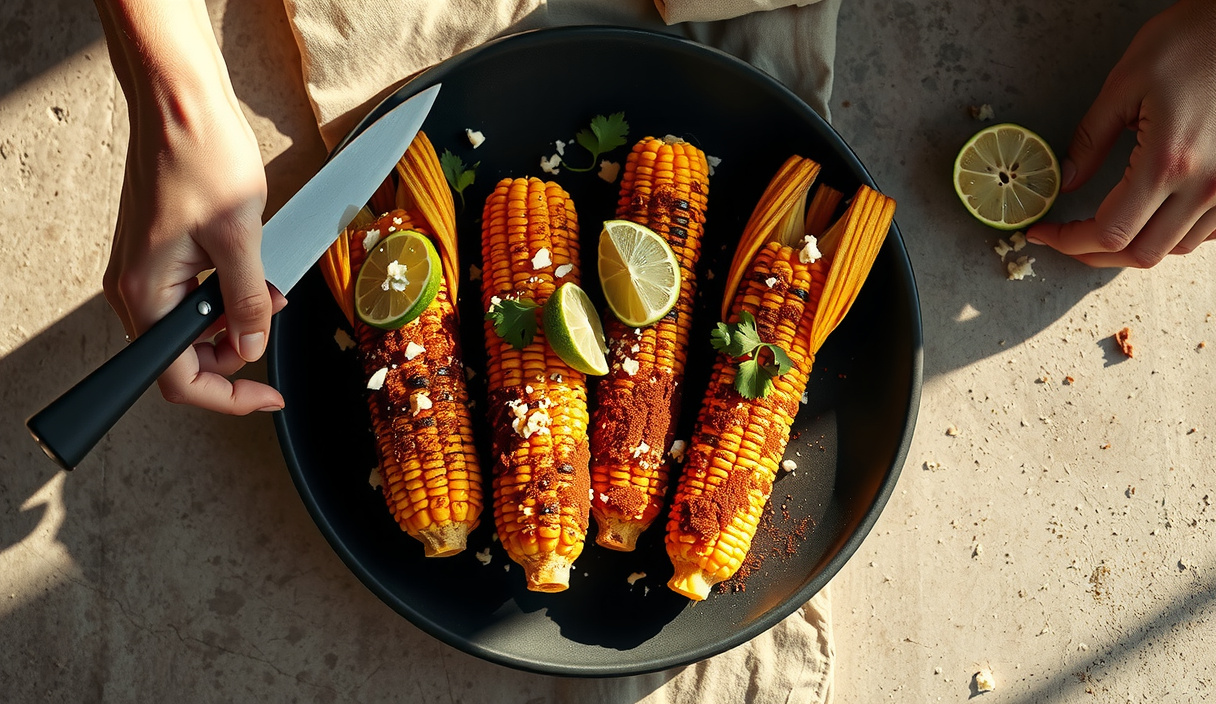
Grilled Corn on the Cob — Mexican Street-Style Elote

Naked ears of sweet corn grilled directly over high flame until the kernel surfaces hit the Maillard window and generate the pyrazine-rich char signature of authentic Mexican street elote. Finished with full-fat mayonnaise, Mexican crema, crumbled cotija, ancho-chili powder, and fresh lime — each component chosen for its specific role in aroma capture, salt delivery, acid balance, and trigeminal heat. This is street food built on fire physics.
Equipment
- 1 Charcoal or gas grill Must reach 500–550°F at the grate. Preheat a minimum of 15 minutes with the lid closed before cooking.
- 1 each Grill brush and tongs Clean and oil the grate immediately before the corn goes on.
- 1 Pastry brush or spoon For applying the mayo-crema coating while the cob is still hot.
- 1 Microplane or zester For lime zest; zest directly over the sauced cob while it is still warm.
- 1 Shallow dish or plate Wide enough to roll the cob through the cotija for full coating.
Ingredients
Corn
- 4 ears fresh sweet corn Husks and silk fully removed. Bicolor or yellow varieties preferred. Do not soak in water.
- 1 tablespoon neutral oil Canola or vegetable oil, for oiling the grate.
Elote Sauce
- ¼ cup full-fat mayonnaise Duke's or Hellmann's full-fat. Not light, not mayo-style dressing.
- 3 tablespoons Mexican crema Crema Mexicana (Cacique brand works well). Substitute: 2 tablespoons sour cream plus 1 tablespoon heavy cream plus a pinch of salt.
- ½ teaspoon fine sea salt Stir into the sauce base.
Finishing Toppings
- ¾ cup cotija cheese Aged, dry-style cotija, finely crumbled. Substitute: aged pecorino romano, finely grated. Do not use feta.
- 1 ½ teaspoons ancho chili powder Gebhardt's or a good ancho-forward blend. For more heat, blend 3 parts ancho to 1 part cayenne.
- 2 limes Zest of both limes, juice of both limes, applied separately — zest while cob is warm, juice immediately before eating.
- 2 tablespoons fresh cilantro leaves Optional. Torn, not chopped. Add just before serving.
- 1 teaspoon hot sauce Optional. Valentina or Tapatío. Drizzle over the finished cob.

Instructions
Prepare and Build the Sauce
- In a small bowl, whisk together the full-fat mayonnaise, Mexican crema, and fine sea salt until smooth and uniform. Set aside at room temperature — do not refrigerate. The sauce needs to be fluid enough to flow into the char crevices on a hot cob.3 tablespoons Mexican crema, 1/2 teaspoon fine sea salt, 3/4 cup cotija cheese
- Crumble the cotija cheese finely onto a wide, shallow plate or dish large enough to roll an ear of corn through. The crumble should be fine enough to adhere to the wet sauce surface — roughly the texture of coarse breadcrumbs. Set aside.1 1/2 teaspoons ancho chili powder
Preheat the Grill
- Preheat your charcoal or gas grill to high heat with the lid closed for a minimum of 15 minutes. You are targeting a grate temperature of 500–550°F. For charcoal, this means a full chimney of lit coals spread in an even layer. For gas, all burners on high. Do not rush this step — a fully preheated grate is the single most important variable for Maillard char formation on the kernel surface.
- Fold a paper towel over itself, dip it in the neutral oil, and use tongs to wipe the grate surface thoroughly. The oil creates a nonstick layer and helps conduct heat directly to the corn surface. Do this immediately before the corn goes on.1 tablespoon neutral oil
Grill the Corn
- Place the husked ears of corn directly on the hot grate. Leave the grill lid open — this allows surface moisture to escape rather than recirculating as steam, which would retard char formation. Do not crowd the cobs; leave at least one inch of space between each ear.
- Grill the corn, turning every 2–3 minutes, for a total of 12–15 minutes. You are targeting scattered, deep char marks across 30–40% of the total kernel surface area — not uniform golden toasting and not wholesale blackening. Some kernels should be deeply browned to near-black; others remain bright yellow. This variation in browning creates the full aromatic complexity: light Maillard notes from the partially browned kernels, and heavy pyrazine-furan roast notes from the deeply charred ones. If flare-ups occur from dripping moisture, close the lid briefly to extinguish, then reopen immediately.
- Pull the corn from the grill when the char distribution is right. Work quickly — the next steps must happen while the cob is still very hot.
Sauce, Coat, and Finish
- Using a pastry brush or spoon, immediately coat each hot ear of corn generously with the mayo-crema sauce. The heat of the cob will thin the sauce slightly, encouraging it to flow into the crevices between charred kernels. Turn the cob as you go to coat all sides. Do not be timid — a thick, even coating is the goal.3 tablespoons Mexican crema, 1/2 teaspoon fine sea salt, 3/4 cup cotija cheese
- Roll the sauced cob across the plate of crumbled cotija, pressing gently to pack the cheese into the wet sauce surface. Rotate the cob to cover all faces. The cheese layer should be thick and visually dramatic — this is structurally correct, not excessive.1 1/2 teaspoons ancho chili powder
- Dust each cob evenly with ancho chili powder. Zest both limes directly over the warm, sauced cobs — zest them now while the cob is warm so the citrus essential oils volatilize and integrate with the char aroma. Do not add the juice yet.2 limes, 2 tablespoons fresh cilantro leaves
- Immediately before serving, squeeze fresh lime juice generously over each cob. This is the final acid note — it should arrive sharp and bright on the palate. Add the optional torn cilantro leaves and a drizzle of hot sauce if using. Serve immediately.2 tablespoons fresh cilantro leaves, 1 teaspoon hot sauce
Notes
Why husks-off, not husks-on: Husks-on grilling is steaming, not grilling. The husk traps moisture and prevents the kernel surface from reaching the Maillard activation threshold (roughly 280°F at the surface). Husks-off direct flame desiccates the kernel pericarp rapidly, allowing surface temperature to climb past 300°F on each contact face and initiating the Schiff base formation cascade that produces pyrazines, furanones, and alkylphenols — the actual aroma signature of roasted corn.
Why apply mayo hot, not cold: The mayo-crema sauce has a viscosity of roughly 8,000–12,000 mPa·s at refrigerator temperature (5°C). Applied to a cob at 180°F+ surface temperature, it thins dramatically, flowing into the inter-kernel gaps and maximizing contact area. This matters because the dispersed fat phase of the mayo acts as a hydrophobic solvent for lipophilic char volatiles (pyrazines, alkylphenols): the fat captures and time-releases these aroma compounds during mastication rather than allowing them to volatilize instantly. A cold sauce applied to a cold cob produces a surface coating only — no aroma capture.
Why aged cotija over feta: Aged cotija has a water activity (Aw) of approximately 0.85–0.88 and an extremely low moisture content (~28–32%), producing hard, crystalline salt microparticles when crumbled. These dissolve progressively during mastication, creating a sustained salt burst that amplifies the sweet-char contrast. Feta (Aw ~0.96, moisture ~55%) smears rather than crumbles, provides insufficient salt concentration, and coats rather than contrasts. Crystalline salt geometry is load-bearing in this dish.
Grate temperature targeting: At 500–550°F grate temperature, the surface of the corn kernel reaches Maillard-active temperatures within 60–90 seconds of contact. Below 450°F, the evaporative cooling from kernel moisture keeps the surface temperature suppressed near 212°F for too long, delaying char formation significantly. If you do not have a grate thermometer, hold your palm 3 inches above the grate — you should be able to hold it there for no more than 1 second before the heat forces you to pull away. That is a 500°F+ grate.
Nutrition
Calories: 285kcalCarbohydrates: 28.5gProtein: 7.2gFat: 17.8gSaturated Fat: 5.4gCholesterol: 28mgSodium: 520mgFiber: 3.1gSugar: 6.8g
Tried this recipe?Let us know how it was!