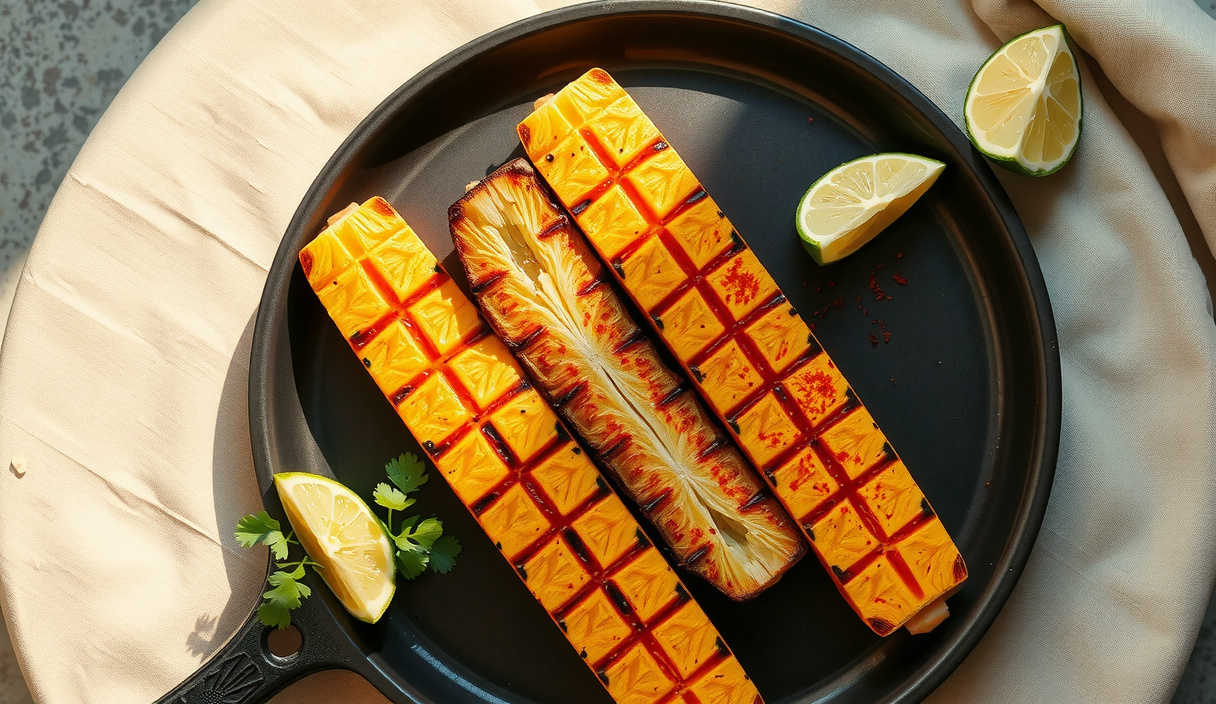
Grilled Pineapple with Tajín

Pineapple spears grilled at 450°F until the surface sugars caramelize past 320°F, then finished with Tajín chili-lime-salt for a three-way hit of sweet, sour, and spicy heat. Bromelain denatures during cooking, yielding a jammy interior under a crackable caramel crust. Ten minutes on the grate, zero fuss, maximum flavor.
Equipment
- 1 Gas or charcoal grill Must reach 450°F minimum surface temperature. Preheat 15 minutes with lid closed.
- 1 Infrared thermometer Optional but highly recommended for confirming grate temperature.
- 1 pair Long-handled tongs
- 1 Chef's knife Sharp knife essential for clean spear cuts without crushing the fruit.
- 1 Cutting board
- several Paper towels For drying cut faces before grilling.
- 1 Pastry brush For oiling the grate and fruit.
Ingredients
- 1 large ripe pineapple Golden-yellow exterior, fragrant at the base. Do not substitute pre-cut rings.
- 2 tablespoons avocado oil or refined coconut oil High smoke point required. Divided — half for grate, half for fruit.
- 1.5 tablespoons Tajín Clásico seasoning The standard salted version; do not substitute Tajín Sin Sal.
- 1 lime Cut into wedges for serving.

Instructions
Prep the pineapple
- Lay the pineapple on its side and slice off the top crown and the bottom base, removing about 1/2 inch on each end to expose fresh flesh. Stand the pineapple upright and cut straight down to remove the skin in strips, following the curve of the fruit and cutting just deep enough to remove the eyes. Aim to waste as little flesh as possible.1 large ripe pineapple
- Cut the peeled pineapple in half lengthwise through the core. Cut each half into 2 equal wedges lengthwise, giving you 4 long spears. For thicker pineapples, cut into thirds to produce 6 spears. Optional: trim the fibrous central core from each spear by running your knife along its edge — the core cooks unevenly and tends to be tough.1 large ripe pineapple
- Pat every cut face of each spear thoroughly dry with paper towels. This step removes surface moisture that would otherwise flash to steam on the grate and delay caramelization by 2 to 3 minutes. Dry surfaces brown faster and more evenly.1 large ripe pineapple
- Brush all cut faces of the spears lightly with oil. Use just enough to coat — a thin film prevents the caramelizing sugars from cementing to the grate prematurely.2 tablespoons avocado oil or refined coconut oil
Preheat and oil the grill
- Preheat your grill on high with the lid closed for at least 15 minutes. Verify the grate surface temperature has reached 450°F (232°C) using an infrared thermometer, or use the palm test: hold your hand 3 inches above the grate — if you cannot hold it there for more than 2 seconds, the grate is hot enough.
- Using a folded paper towel held with tongs, wipe the grate with a thin coat of avocado oil just before adding the pineapple. A well-oiled, properly preheated grate is critical for clean release.2 tablespoons avocado oil or refined coconut oil
Grill the pineapple
- Place the pineapple spears cut-face-down on the hot grate. Do not move them for the first 3 to 4 minutes. The caramelizing sugar crust needs to set and polymerize before the spear will release cleanly. Attempting to move the spear before it is ready will tear the caramel layer off and leave it on the grate.1 large ripe pineapple
- After 3 to 4 minutes, check one spear: slide tongs under it gently. If it resists, wait 30 to 60 more seconds and check again. When it releases cleanly, the cut face should show deep amber to dark-brown char with visible caramel color. Rotate each spear 90 degrees onto the second cut face and grill another 3 to 4 minutes for the second set of char marks.1 large ripe pineapple
- Optionally rotate to the skin side for 1 to 2 minutes to heat through completely, though this side does not caramelize. Total grill time per spear: 7 to 10 minutes. Target visual cue: both flat faces show uniform golden-amber caramelization with dark grill marks. Pale beige indicates insufficient temperature or early flipping.1 large ripe pineapple
Finish and serve
- Transfer spears to a serving platter or board. Let them rest uncovered for 2 minutes — the caramel surface, still molten from the grate, will firm into a crackable shell as it cools slightly. Do not cover; steam will dissolve the crust.
- Immediately before serving, dust each spear generously and evenly with Tajín Clásico. Apply it now — not before grilling — so the citric acid in the seasoning remains bright and sharp rather than burning to a bitter residue on the grate. The salt in Tajín will begin amplifying the sweetness of the caramel within seconds of contact.1.5 tablespoons Tajín Clásico seasoning
- Serve immediately with lime wedges on the side. A squeeze of fresh lime over the spear just before eating adds a final hit of volatile citrus terpenes that the dehydrated lime in the Tajín alone cannot fully replicate.1 lime
Notes
Why 450°F is the minimum: Surface caramelization of pineapple sugars begins at approximately 320°F (160°C), but at grate temperatures below 400°F, the rate of heat input barely outpaces the cooling effect of evaporating surface moisture. The result is steamed, pale fruit with soft texture and none of the Maillard or caramelization aromatic complexity. At 450°F, surface moisture clears in 60 to 90 seconds and browning begins immediately after — the system crosses into the reaction-limited regime rather than the evaporation-limited regime.
Bromelain kinetics: Bromelain is a cysteine protease with peak enzymatic activity between 50°C and 60°C (122–140°F). As the interior of the spear slowly climbs through this range during grilling, the enzyme hydrolyzes peptide bonds in the pineapple's cell-wall proteins, releasing free amino acids that serve as Maillard reactants at the hotter surface. Above approximately 70°C (158°F), bromelain undergoes irreversible thermal denaturation — this is why grilled pineapple does not produce the oral irritation associated with raw pineapple consumption. The protease that dissolves buccal and lingual mucosa in raw fruit is fully inactive by the time the spear reaches service temperature.
Tajín timing and citric acid pyrolysis: Tajín Clásico contains dehydrated lime juice (pH approximately 2.5–3.0 when reconstituted). Applied to a surface above 300°F (149°C), citric acid undergoes thermal decomposition, producing aconitic acid and ultimately itaconic acid — compounds with sharp, acrid, and bitter sensory profiles that overwhelm the caramel sweetness. Applied post-grill to a surface cooling toward 200°F, citric acid remains intact and performs its intended function: protonating and volatilizing terpene and ester aroma compounds from the caramelized pineapple surface, brightening the retronasal olfactory profile and extending the finish.
Salt cross-modality: Sodium chloride at low concentrations (well below detection threshold as a distinct salty taste) suppresses bitter taste receptor activation and simultaneously enhances the perceived intensity of sweetness through a mechanism involving competitive inhibition at gustatory receptor level. The salt in Tajín operates precisely in this range — it makes the caramelized pineapple taste measurably sweeter without any added sugar, a clean demonstration of cross-modal flavor engineering requiring zero extra ingredients.
Nutrition
Calories: 112kcalCarbohydrates: 28gProtein: 1.2gFat: 1.8gSaturated Fat: 0.3gSodium: 310mgFiber: 2.3gSugar: 21g
Tried this recipe?Let us know how it was!