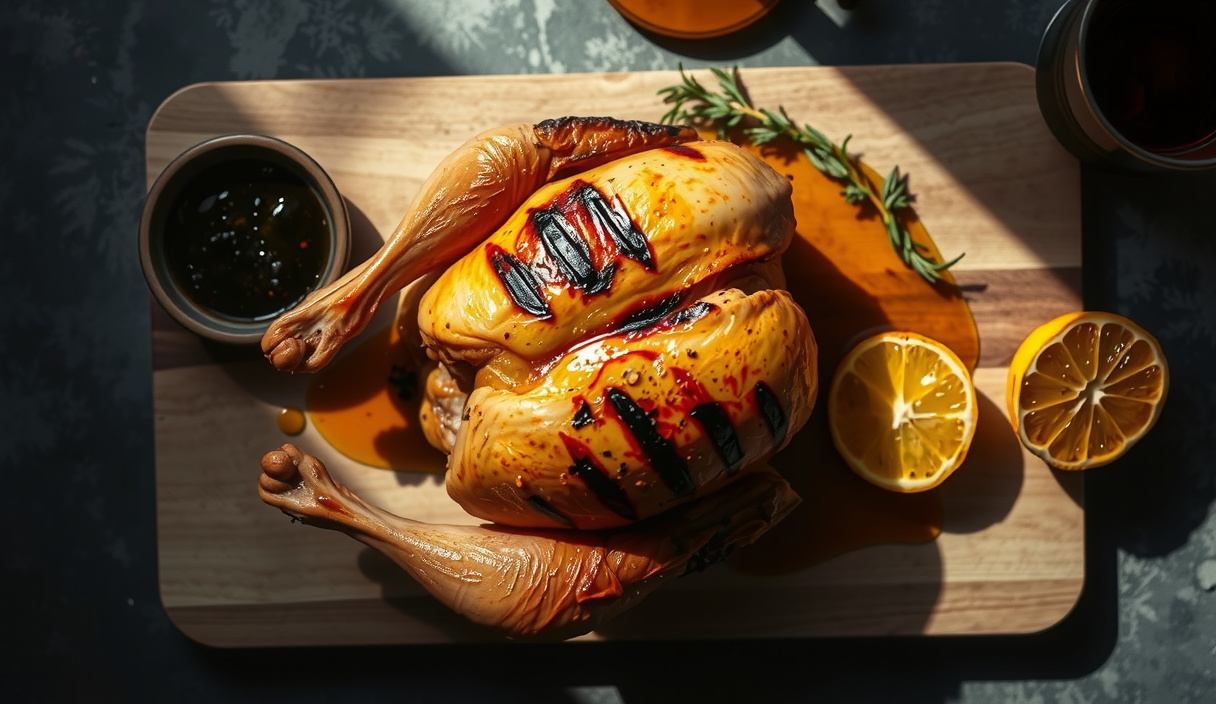
Grilled Spatchcock Chicken — Lemon-Garlic

A whole chicken flattened by removing the spine, marinated in a lemon-garlic-thyme mixture for 45 minutes, then grilled over indirect heat at 400°F skin-side up until the breast reaches 157°F internal. The technique controls myofibrillar protein denaturation for maximum juiciness and produces uniformly crisp skin across the entire bird.
Equipment
- 1 Gas or charcoal grill Needs a two-zone indirect setup — at least 450 sq in of grate space recommended
- 1 Kitchen shears or boning knife For removing the backbone
- 1 Instant-read thermometer Mandatory — insert horizontally into thickest part of breast, away from bone
- 1 Large zip-lock bag or baking dish For marinating
- Paper towels For patting the bird completely dry before marinating
- Aluminum foil For tenting during rest
Ingredients
The Chicken
- 1 whole chicken (3.5–4 lb), preferably air-chilled Backbone removed, bird flattened
Lemon-Garlic-Thyme Marinade
- 3 tablespoons extra-virgin olive oil Lipid carrier for volatile aromatic compounds
- 3 tablespoons fresh lemon juice (from about 1 large lemon) Use fresh only — bottled is heat-pasteurized and loses key aromatic esters
- 1 teaspoon lemon zest Concentrates limonene and linalool from the flavedo layer
- 5 cloves garlic, finely minced or pressed Mincing ruptures cell walls, maximizing allicin formation
- 1 tablespoon fresh thyme leaves Dried works in a pinch — use 1 teaspoon
- 1.5 teaspoons kosher salt Diamond Crystal; reduce by one-third if using Morton
- 0.5 teaspoon freshly ground black pepper
- 0.25 teaspoon red pepper flakes Optional — activates TRPV1 receptors and amplifies perceived heat from the char
For Serving
- 1 lemon, halved Char cut-side down on the grill for 2 minutes — caramelizes the sugars and concentrates aroma
- 2 tablespoons fresh flat-leaf parsley, roughly chopped Optional garnish

Instructions
Spatchcock the Chicken
- Place the chicken breast-side down on a sturdy cutting board. Using sharp kitchen shears, cut along both sides of the backbone from the tail to the neck, removing the spine entirely. Save the backbone for stock — freeze it in a zip-lock bag.
- Flip the bird breast-side up. Locate the sternum (keel bone) running down the center of the breast. Press firmly on the center of the breast with both palms until you hear and feel the cartilage crack. The bird should now lie completely flat with the legs splaying outward. This is the architecture that defeats the geometry problem.
- Pat the entire bird completely dry — top, bottom, under the wings, inside the cavity — with paper towels. Any residual moisture on the skin will inhibit Maillard browning later. This step is not optional.
Make the Marinade and Marinate
- Whisk together the olive oil, fresh lemon juice, lemon zest, minced garlic, thyme, kosher salt, black pepper, and red pepper flakes in a small bowl. The olive oil and lemon juice will not fully emulsify — that is fine. Give it a stir just before applying.3 tablespoons fresh lemon juice (from about 1 large lemon), 1 teaspoon lemon zest, 5 cloves garlic, finely minced or pressed, 1 tablespoon fresh thyme leaves, 1.5 teaspoons kosher salt, 0.5 teaspoon freshly ground black pepper, 0.25 teaspoon red pepper flakes, 1 lemon, halved
- Place the spatchcocked chicken in a large zip-lock bag or a baking dish. Pour the marinade over, ensuring it coats both sides. Work the marinade under the skin over the breast and thigh meat if you can do so without tearing the skin. Set a timer for 45 minutes. Do not exceed 60 minutes — the citric acid in the lemon juice at pH 2.0–2.5 will begin denaturing myofibrillar proteins beyond the surface layer, resulting in a mushy texture.3 tablespoons fresh lemon juice (from about 1 large lemon), 1 teaspoon lemon zest, 5 cloves garlic, finely minced or pressed, 1 tablespoon fresh thyme leaves, 1.5 teaspoons kosher salt, 0.5 teaspoon freshly ground black pepper, 0.25 teaspoon red pepper flakes, 1 lemon, halved
Set Up the Grill
- Gas grill: Light only one side of burners on high. Close the lid and preheat until the grill thermometer at grate level reads 400°F — this takes 10–15 minutes. The unlit side is your indirect cooking zone.Charcoal grill: Light two-thirds of a chimney of charcoal. When the coals are ashed over, bank them all to one side with a drip pan on the opposite side. Grill temperature at the grate level on the indirect side should read 390°F–410°F.
Grill the Chicken
- Remove the chicken from the marinade and shake off any excess. Pat the skin side lightly with a paper towel if the surface looks very wet — a thin coating of oil is fine; pooling liquid is not. Place the chicken skin-side up on the indirect (cool) side of the grill. Close the lid.
- Cook with the lid closed over indirect heat at 400°F for 40–50 minutes. Do not flip the chicken. Convective heat inside the closed grill drives the core temperature upward uniformly. Resist the urge to open the lid frequently — each opening drops the grill temperature by 50°F–75°F and extends cook time.
- Begin probing the breast at the 35-minute mark. Insert the thermometer horizontally into the thickest part of the breast, keeping the probe tip away from bone. Pull the chicken when the breast reads 157°F internal temperature. At this point, confirm the thigh reads at or above 165°F — it almost certainly will, often 175°F–180°F, which is ideal for dark meat collagen conversion.
- Optional skin crisping step: If the skin is not yet deeply golden (sometimes residual marinade moisture delays the color), move the chicken skin-side down over direct heat for 2–3 minutes only, watching carefully to prevent charring. Remove the moment you see aggressive browning and hear a pronounced sizzle. This is the Maillard cascade accelerating as surface moisture is eliminated.
- While the chicken rests, place the lemon halves cut-side down directly over the hot side of the grill for 2 minutes until caramelized. The heat drives Maillard browning of the lemon's natural sugars and concentrates the juice, eliminating harsh raw acidity.2 tablespoons fresh flat-leaf parsley, roughly chopped
Rest and Carve
- Transfer the chicken to a cutting board and tent loosely with aluminum foil. Rest for a minimum of 5 minutes. Carryover heat will carry the breast temperature from 157°F to approximately 160°F–163°F during this window, completing the pasteurization curve safely while the juices redistribute.
- Carve by first separating the leg quarters at the hip joint, then cutting through the thigh-drumstick joint. Remove the breasts by slicing along the keel bone and following the rib cage. Serve with the charred lemon halves for squeezing and scatter with fresh parsley if desired.
Notes
Why 157°F is safe: USDA's 165°F is an instantaneous kill target. Pasteurization is a time-temperature relationship. At 157°F (69°C) held for 42 seconds — which carryover heat during a 5-minute rest easily provides — you achieve the same 7-log10 Salmonella reduction. The breast arriving at the table at 160°F–163°F is both safe and fully within the moisture-preserving zone below actin's catastrophic denaturation threshold (74°C–78°C / 165°F–172°F).
The acid-marination window: Lemon juice operates at pH 2.0–2.5. In this range, citric acid denatures surface myofibrillar proteins — useful for flavor penetration, disastrous if overdone. The visible failure mode is a pale, mealy, softened surface on the raw chicken. This means the acid has compromised the water-holding capacity of the protein network before the grill even touches the bird. Keep marination to 30–45 minutes, 60 minutes absolute maximum.
Allicin and garlic VOC partitioning: Mincing garlic ruptures the cell wall, bringing the enzyme alliinase into contact with alliin. The reaction produces allicin and related thiosulfinate compounds within 60 seconds. These organosulfur VOCs are lipophilic — they partition strongly into the olive oil phase of the marinade, protecting them from rapid volatilization during grilling. This is why olive oil is the correct fat here, not water or broth.
Skin crisping physics: The skin stalls in color development when its surface water activity is high. Evaporative cooling pins the boundary-layer temperature near 100°C (212°F), preventing the Maillard onset temperature (~140°C / 284°F) from being reached. Patting dry before marinating, plus the indirect-heat render that drives moisture from the subcutaneous fat layer, sets up the rapid color shift in the optional direct-heat finish step.
Nutrition
Calories: 420kcalCarbohydrates: 2gProtein: 48gFat: 24gSaturated Fat: 6gCholesterol: 155mgSodium: 520mg
Tried this recipe?Let us know how it was!