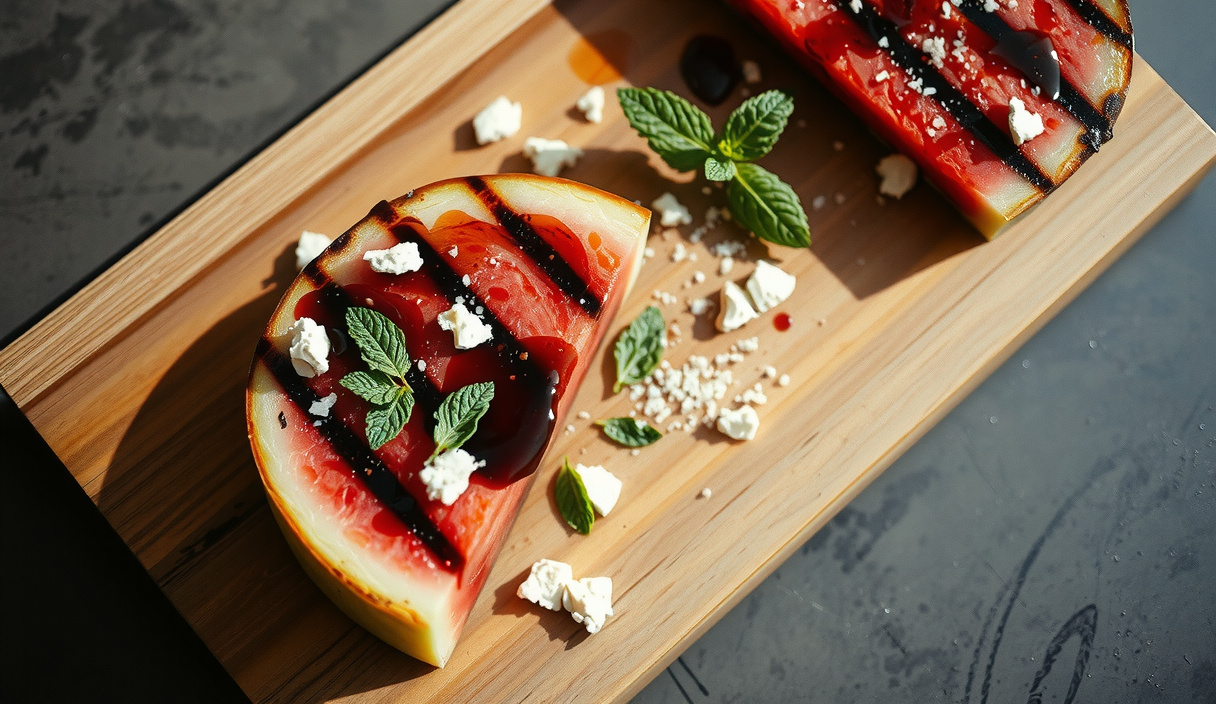
Grilled Watermelon Steak with Feta, Mint, and Balsamic

Thick watermelon slabs are salt-blotted to lower surface moisture, then hit a screaming-hot grill for deep Maillard char. Finished with crumbled brined feta, torn fresh mint, and a balsamic glaze, this dish is a study in contrast: smoky and sweet, salty and bright, warm and cool. Ready in under 20 minutes and guaranteed to be the most surprising thing on the table.
Equipment
- 1 Gas or charcoal grill Preheat to high — target grate temperature 550°F to 650°F (290°C to 345°C). Clean and oil the grates immediately before grilling.
- 1 Large cutting board
- 1 Sharp chef's knife A long blade makes it easier to cut clean, even 1-inch slabs through a large melon.
- Several sheets Paper towels For blotting the salt-drawn moisture off the watermelon surface before grilling.
- 1 pair Grill tongs
- 1 Small saucepan (optional) Only needed if making balsamic glaze from scratch.
Ingredients
Watermelon
- 1 small seedless watermelon (6 to 8 lb / 2.7 to 3.6 kg) Fully ripe — look for a yellow ground spot and a hollow sound when tapped.
- 1 teaspoon kosher salt For the surface draw. Do not substitute fine table salt.
- 1 tablespoon neutral oil (vegetable or canola) For oiling the grill grates, not the watermelon.
Finish
- 3 oz brined feta cheese Block-style packed in brine, hand-crumbled just before serving. About 85g.
- 2 tablespoons balsamic glaze (condimento) Store-bought balsamic glaze works well, or reduce 1 cup balsamic vinegar by half over medium-low heat.
- 15 leaves fresh spearmint Torn or roughly chopped immediately before serving. Do not pre-cut.
- 1 pinch flaky sea salt (such as Maldon) Optional finishing salt. The feta provides significant sodium — taste first.
- 1 tablespoon extra-virgin olive oil Optional drizzle for richness and sheen.

Instructions
Prep
- Slice the ends off the watermelon to create flat, stable surfaces. Stand it upright and slice down the sides to remove the rind, following the curve of the fruit. Cut the peeled melon into 1-inch-thick slabs — you should get 6 to 8 slabs depending on the melon's diameter. Reserve any irregular pieces for eating out of hand.
- Lay the watermelon slabs in a single layer on a sheet pan or cutting board. Sprinkle both cut faces lightly and evenly with kosher salt — about 1/8 teaspoon per face. You will see moisture begin to bead on the surface within 60 to 90 seconds. Let the slabs rest for 5 minutes.1 teaspoon kosher salt
- Using paper towels, firmly blot both faces of each slab to absorb the drawn surface moisture. Press down with conviction — you want the surface to look visually dry, not damp. This step is what enables Maillard browning; do not rush it.
Grill
- Preheat your grill on high for at least 10 to 15 minutes with the lid closed, targeting a grate temperature of 550°F to 650°F (290°C to 345°C). Fold a paper towel into a thick pad, grip it with tongs, dip it in neutral oil, and wipe the grates firmly in a single direction. Repeat 2 to 3 times until the grates are visibly glossy.1 tablespoon neutral oil (vegetable or canola)
- Place the blotted watermelon slabs directly on the hot grates in a single layer with at least 2 inches of space between them. Do not move them for 2 full minutes. You should hear an immediate sizzle and see grill marks developing. If the slab sticks when you attempt to lift a corner at 2 minutes, wait 20 to 30 seconds — it will release cleanly when the crust sets.
- Flip the slabs using tongs or a wide spatula. Grill the second side for 2 minutes without moving. The slabs should have deep amber-to-mahogany grill marks on both sides and smell faintly smoky and sweet. Transfer immediately to a serving platter.
Finish and Serve
- Working quickly while the slabs are still warm, crumble the feta generously over the top of each slab.3 oz brined feta cheese
- Drizzle the balsamic glaze in a thin stream across all the slabs. Use restraint — the glaze is intensely flavored and the watermelon is already sweet. You can always add more at the table.2 tablespoons balsamic glaze (condimento)
- Tear the mint leaves over the platter immediately before serving. Taste and decide if a pinch of flaky sea salt and a drizzle of olive oil are needed — both are optional but excellent. Serve within 5 minutes.15 leaves fresh spearmint, 1 pinch flaky sea salt (such as Maldon), 1 tablespoon extra-virgin olive oil
Notes
Why the salt-blot works: Watermelon's free water fraction ($a_w$) is approximately 0.99 — close to pure water. When that saturated surface contacts a hot grate, latent heat of vaporization (2,260 J/g) absorbs grill energy and locks the surface at 212°F (100°C), physically preventing the Maillard reaction, which requires surface temperatures above 140°C to 150°C. Kosher salt draws water out of the surface cells via osmotic pressure differential, lowering the local $a_w$ and allowing the grate to finally drive the surface past the browning threshold before the interior moisture replenishes it.
Why 1-inch thickness: At 1 inch, the thermal conduction time from grate to slab midpoint is approximately 90 to 120 seconds — precisely aligned with the 2-minute per-side cook time. The exterior achieves Maillard browning while the interior warms to roughly 50°C to 55°C, amplifying volatile aromatics and concentrating sweetness without collapsing cell structure. Thinner slabs (under 3/4 inch) collapse before the interior warms; thicker slabs need more time than the crust can tolerate without burning.
Feta as a fat-phase buffer: Feta's fat content (approximately 21% by weight) and its crumbled geometry create dozens of small lipid droplets on the warm fruit surface. These droplets act as hydrophobic reservoirs that sequester fat-soluble volatile aromatics, extending their release during mastication and prolonging the aromatic window of each bite. The high salt content of the brine (4% to 5% NaCl) also ionically contrasts the sweetness of the watermelon, a classic salt-fat-sweet sensory amplification effect.
Mint timing: Add mint at the absolute last second. l-Menthol, the primary trigeminal cooling agent in spearmint, volatilizes rapidly once the leaf structure is torn. Mint left to sit more than 3 to 4 minutes after tearing loses a measurable fraction of its TRPM8-activating potency and begins to oxidize and brown visually, undermining both flavor and plate presentation.
Nutrition
Calories: 148kcalCarbohydrates: 24gProtein: 5gFat: 5gSaturated Fat: 3gCholesterol: 19mgSodium: 390mgFiber: 1gSugar: 19g
Tried this recipe?Let us know how it was!