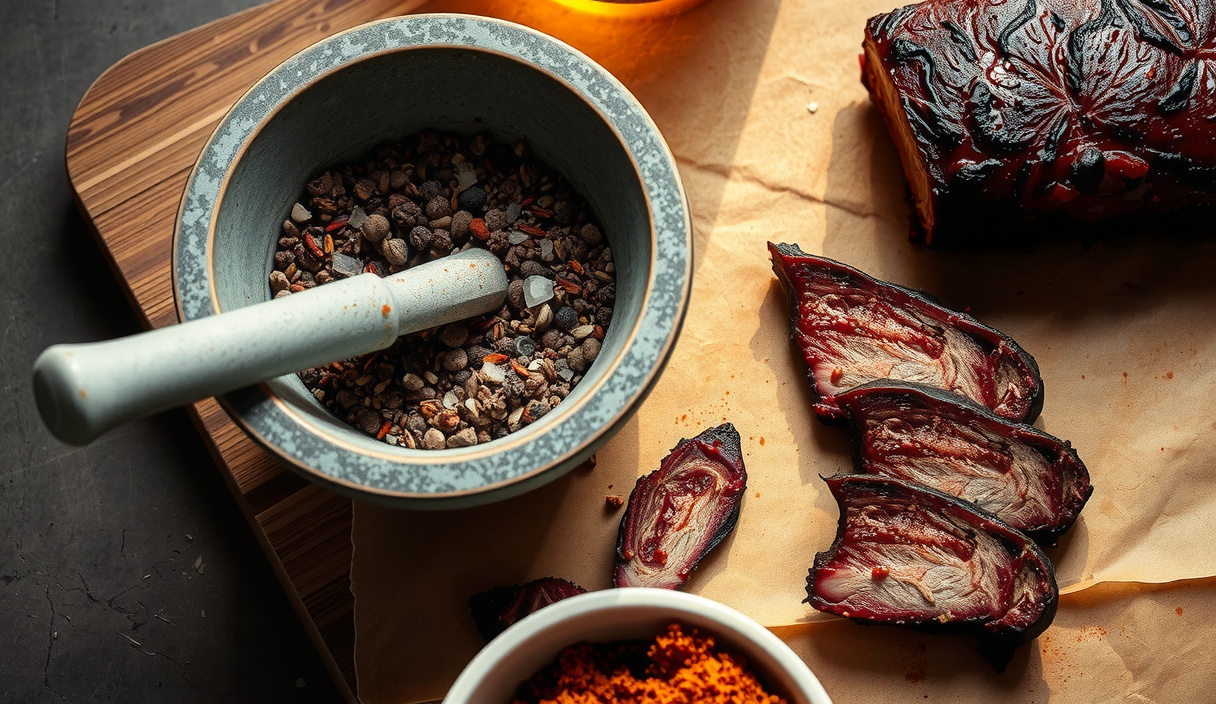
Keto Brisket Rub — No-Sugar Bark
A precisely formulated keto dry rub for whole packer brisket, built on the salt-pepper-smoked paprika foundation of Central Texas BBQ. Five percent allulose by weight supplies enough reducing monosaccharide to drive continuous Maillard browning across a 12–18 hour smoke without raising blood glucose. The result is a deep mahogany bark with legitimate crust and zero sugar compromise.
Equipment
- 1 Offset smoker or ceramic kamado Target 250–265°F at grate level. Verify with a calibrated probe — not the dome thermometer.
- 1 Digital kitchen scale Gram-precision required for the allulose 5% w/w calculation. Volume measures are insufficiently accurate.
- 1 Instant-read probe thermometer For tracking internal brisket temperature through the stall and into the 200–205°F probe-tender window.
- 1 Mixing bowl Medium, for combining the dry rub components.
- 2 sheets Unwaxed butcher paper For wrapping at 165°F internal if needed. Do not use foil — it traps steam and softens the bark.
Ingredients
Rub Base
- 36 g kosher salt (Diamond Crystal) Coarse. If using Morton kosher salt, reduce to 29 g — Morton crystals are denser. This is approximately 3 tablespoons Diamond Crystal.
- 30 g coarse-ground black pepper 16–18 mesh coarseness. Pre-ground coarse, not fine. The large fragments are structurally important for bark texture.
- 18 g sweet smoked paprika (pimentón de la Vera dulce) Specifically sweet smoked, not hot. Contributes guaiacol and syringol volatiles plus color precursors.
- 14 g ancho chile powder Pure ancho only — not a chili powder blend. Adds fruity, low-heat depth without front-loading capsaicin.
- 10 g garlic powder Standard granulated garlic powder. Contributes alliin-derived sulfur volatiles and free amine groups.
- 8 g onion powder Adds propanethial S-oxide volatiles and fructan-derived browning precursors.
- 4 g ground cayenne pepper Optional heat layer. Omit or halve for a mild profile.
- 4 g dry mustard powder Provides isothiocyanate volatiles and emulsification support for rub adhesion.
Browning Agent
- 17 g granular D-allulose Fine granular form, not syrup. This constitutes 5% w/w of the total rub batch. Measure by weight. Supplies reducing monosaccharide for Maillard bark at pit temperatures without glycemic impact.
The Brisket
- 1 whole packer brisket, 12–14 lb, USDA Choice or Prime Fat cap trimmed to 1/4 inch. Point and flat intact. Dry the surface with paper towels before applying the rub.

Instructions
Make the Rub
- Weigh each ingredient separately using a digital kitchen scale. Combine the kosher salt, black pepper, smoked paprika, ancho chile powder, garlic powder, onion powder, cayenne, and dry mustard in a mixing bowl.30 g coarse-ground black pepper, 18 g sweet smoked paprika (pimentón de la Vera dulce), 14 g ancho chile powder, 10 g garlic powder, 8 g onion powder, 4 g ground cayenne pepper, 4 g dry mustard powder
- Add the granular allulose. Whisk thoroughly until the rub is homogeneous — allulose is slightly more hygroscopic than the other components and will clump if not fully dispersed. The final rub should be visually uniform in color and texture.17 g granular D-allulose
- Transfer to an airtight jar. The rub keeps for up to 6 months at room temperature in a dark, dry location. Shake before each use as the allulose may settle.
Dry Brine the Brisket
- Pat the trimmed brisket completely dry on all surfaces with paper towels. Any surface moisture will dilute the rub and slow the osmotic draw.1 whole packer brisket, 12–14 lb, USDA Choice or Prime
- Apply the rub generously and evenly across all surfaces of the brisket — fat cap, flat, point, and all edges. Target 2–2.5 grams of rub per 100 grams of estimated brisket surface area. For a 13 lb brisket, you will use approximately 100–110 grams of the total rub batch. Press the rub firmly into the meat surface to ensure adhesion.30 g coarse-ground black pepper, 18 g sweet smoked paprika (pimentón de la Vera dulce), 14 g ancho chile powder, 10 g garlic powder, 8 g onion powder, 4 g ground cayenne pepper, 4 g dry mustard powder, 17 g granular D-allulose, 1 whole packer brisket, 12–14 lb, USDA Choice or Prime
- Place the rubbed brisket on a wire rack set over a sheet pan. Refrigerate uncovered for 12–24 hours. Do not cover — you want air circulation over the surface to facilitate the initial moisture draw and evaporation cycle that drops surface water activity into the Maillard-active range before the cook begins.
Smoke the Brisket
- Remove the brisket from the refrigerator 45–60 minutes before cooking. Do not rinse off the rub. The surface should look slightly tacky and moist where the salt has drawn and reabsorbed moisture — this is correct.
- Fire the smoker and stabilize at 250–265°F at grate level. Verify temperature with a calibrated probe thermometer placed at the cooking grate, not by the dome gauge. Add your chosen wood — post oak for Central Texas authenticity, hickory or pecan for a heavier smoke profile. Allow the smoker to reach steady temperature before loading the brisket.
- Place the brisket fat cap up on the grate. Insert a leave-in probe thermometer into the thickest part of the flat, away from the fat seam. Close the smoker and do not open it for the first 6 hours minimum.
- Monitor the internal temperature through the stall — the long plateau between 155°F and 170°F is normal and driven by evaporative cooling. Do not panic and crank the heat. The surface Maillard chemistry is active during the stall even though the internal temperature is static. Allow the stall to resolve naturally, or wrap in butcher paper at 165°F internal to push through it while preserving bark integrity. Do not spritz with any liquid during this phase.
- Continue cooking until the internal temperature reaches 200–205°F and a probe slides into the thickest part of the flat with zero resistance — it should feel like probing warm butter. Color, feel, and probe-tenderness together define doneness, not temperature alone.
Rest and Slice
- Remove the brisket from the smoker. Rest uncovered on a wire rack for 15 minutes — this allows the bark to firm before wrapping. Then wrap tightly in butcher paper (not foil) and place in a dry cooler or warming oven at 150–160°F for a minimum of 1 hour, ideally 2–3 hours. The rest is non-negotiable for moisture redistribution and collagen gelation in the flat.
- Unwrap and slice against the grain. Slice the flat at approximately 1/4 inch thickness. Separate the point from the flat at the fat seam and slice the point against its own grain direction, which runs perpendicular to the flat. Serve immediately.
Notes
Why allulose and not erythritol: Erythritol is a 4-carbon sugar alcohol — it has no free reducing carbonyl group and cannot participate in the Maillard condensation cascade. Allulose is a reducing monosaccharide (C-3 epimer of fructose) with a free aldehyde available for immediate Schiff base formation with surface protein amine groups. At 250°F pit temperatures, allulose participates in browning at a threshold of approximately 110°C vs. sucrose's 160°C threshold — meaning it is actively building bark chemistry across the entire cook, not just during high-heat finishing phases. At 5% w/w in the rub batch, the per-serving allulose load is under 1.5 grams — entirely negligible glycemically.
The stall is not a problem to eliminate: The evaporative cooling stall between 155°F and 170°F internal occurs because surface moisture vaporization absorbs energy as fast as the smoker delivers it, holding the surface near 212°F. Critically, the Maillard chemistry on the surface rub layer is still active during the stall — the surface temperature is above the allulose Maillard threshold of 110°C even while the internal temperature is plateaued. This extended surface thermal exposure is part of what builds deep bark on a long smoke. Do not rush through the stall with artificial heat spikes.
Collagen hydrolysis window: The brisket flat is collagen-dense connective tissue. Collagen hydrolysis into soluble gelatin follows first-order kinetics and proceeds meaningfully above 160°F (71°C) internal, accelerating significantly above 180°F. The target window of 200–205°F internal reached after 10–16 hours gives the collagen network sufficient time and temperature to fully convert, producing the characteristic moist, tender flat that defines a properly executed brisket. Pulling at 185°F internal produces a flat that is technically safe but will slice tough — the collagen has not fully hydrolyzed.
Bark color ladder: Reddish-brown at hour 6 = paprika and ancho pigments bonding to the surface. Mahogany at hour 10 = initial melanoidin formation from allulose-amino condensation. Near-black at hour 14–16 = advanced melanoidin accumulation and dehydration of the outer crust layer. Fully black and charred = you have pushed past the Maillard endpoint into pyrolysis — bitter, acrid bark that cannot be recovered. Monitor surface color every 2 hours after hour 8.
Nutrition
Calories: 420kcalCarbohydrates: 1.2gProtein: 52gFat: 21gSaturated Fat: 8gCholesterol: 155mgSodium: 780mgFiber: 0.3g
Tried this recipe?Let us know how it was!